
Key Takeaways
blueCheck icon

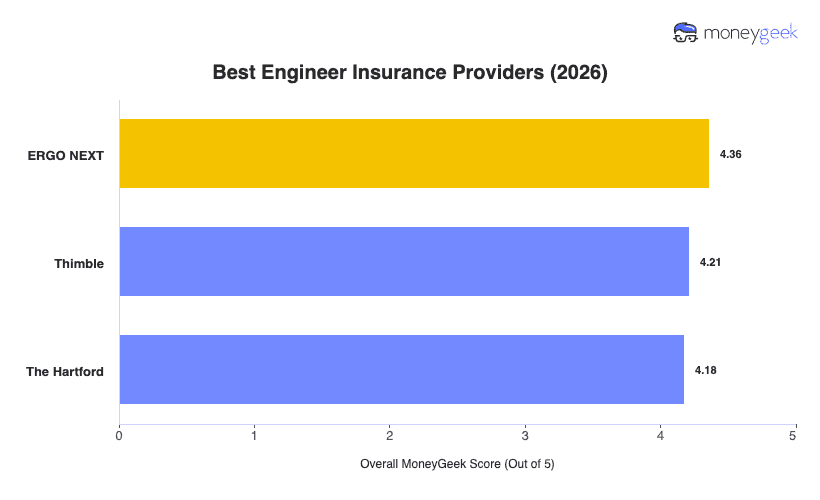
With the best balance of pricing, customer experience and coverage options, ERGO NEXT, Thimble and The Hartford lead our analysis of engineering business insurance companies. (Jump to Top Providers)

blueCheck icon

ERGO NEXT has the lowest average rate at $94 a month. It runs 11% below the industry average and saves engineering firms about $11 monthly. (Jump to Cheapest Providers)

blueCheck icon

Your biggest coverage needs includes professional liability for stamped-drawing claims and general liability for site visits and workers' comp once you hire, which reflect the dual exposure that comes with both design work and field presence. (Jump to Types You Need)

blueCheck icon

Engineering firm insurance costs range from $28 to $167 a month, though your total spend depends on which policies your contracts and operations require. (Jump to Costs)

blueCheck icon

Choosing the right coverage means matching policy types to your actual engineering risks, setting limits that reflect your project values and client contracts and confirming your provider can grow with your firm. (Jump to Choosing Process)

Best Engineering Business Insurance Companies

ERGO NEXT ranks first overall for engineering firms, leading on affordability and customer experience, which matters when your firm needs a COI in hand before a project can start. Thimble ranks second, with affordable rates and flexible, project-based coverage. Our analysis found that for small engineering firms, price and service responsiveness carry more weight than brand recognition when contract requirements leave little room to negotiate.

All seven providers we reviewed are rated across affordability, customer experience and coverage strength so you can see where each one holds up.

ERGO NEXT4.39113
Thimble4.23256
The Hartford4.13731
biBERK4.01475
Hiscox3.95327
Nationwide3.92562
Progressive Commercial3.88644

For our overall best engineering business insurance ratings, we analyzed pricing, coverage options, and customer experience across all 50 states and Washington, D.C. Our analysis focuses on 1-to-4-person engineering firms, while weighting results to ensure broader industry and location representation. To do this, we evaluated over six million business profiles, more than 100,000 customer experience data points and performed in-depth analysis of coverage contracts and endorsements to compare insurers consistently across industries and regions. We then rated each company across categories of affordability (50% of overall score), customer experience (30% of overall score) and coverage options and terms (20% of overall score) to form an overall rating.

See our full business insurance methodology.

The rankings are a useful starting point, but the right provider for your firm depends on how you operate. A solo PE doing structural subconsultant work under tight contract deadlines needs fast COI turnaround and responsive service above all else, which is where ERGO NEXT's customer experience lead translates into a real operational advantage. A small civil engineering firm managing project-based workflows and variable monthly overhead will find Thimble's flexible coverage structure a closer fit for how its contracts are actually structured.

Each provider profile below identifies the specific engineering firm types each one serves well and where it falls short.

ERGO NEXT

ERGO NEXT

Best Overall for Engineering Businesses
On ERGO NEXT's site

ERGO NEXT ranks first overall for engineering firms, which gives you coverage that holds up in the office and the field. Backed by Munich Re with an AM Best A+ (Superior) rating, it runs about 11% below the sub-industry pricing benchmark, which matters when professional liability limits are already pulling your premium higher. On complex claims like a disputed foundation report or a coordination failure between subconsultants, defense counsel quality and dispute handling score below average. That gap counts when a professional liability case runs two or three years.

Learn More: ERGO NEXT Business Insurance Review

Thimble

Thimble

Best for Flexible, Project-Based Coverage

For engineering firms that don't need a policy running year-round, Thimble's structure is genuinely different. GL and PL are available by the job, hour, month or year, so your coverage runs when your projects do, not when they don't. It ranks second overall and prices 11% below the sub-industry benchmark on average, with the strongest savings at larger firm sizes. If your firm is working through a contested professional liability dispute, look elsewhere. Claims route to Markel or Sedgwick, and Thimble is not involved after filing.

Learn More: Thimble Business Insurance Review

Cheapest Engineering Business Insurance

Finding affordable small engineering business insurance starts with knowing where your premium dollar goes furthest. At 11% below the industry average, ERGO NEXT saves you the most of any provider we analyzed, and gives you $11 back each month. Thimble is the next closest on savings, followed by The Hartford. That said, the cheapest policy isn't always the right one for engineering firms, as a coverage gap in professional liability can cost far more than the premium you saved.

The rates below cover all seven providers in our analysis so you can compare monthly and annual costs side by side.

biBERK$102$1,229
Hiscox$108$1,291
Progressive Commercial$111$1,335
Nationwide$112$1,349
ERGO NEXT$94$1,128
Thimble$94$1,131
The Hartford$100$1,196

What Types of Insurance Do Engineering Firms Need?

Engineering firms carry a coverage mix that most professional services businesses don't since your work produces two distinct liability streams at the same time. There's professional exposure from stamped drawings and signed reports and physical exposure from engineers working on active construction sites, drilling borings or inspecting structures. A single project can generate both a professional liability claim from a design error and a general liability claim from a site incident, which is why your coverage program needs to address both, not just one.

Your engineering business insurance needs to include the following policies:

  • Professional liability (since every engineer who stamps work accepts legal accountability for that document the moment it leaves the firm)
  • General liability (since most client contracts require it, and your engineers work on premises you don't control)
  • Workers' comp (if you have employees, legally required in most states, and field work elevates the risk classification)
  • Commercial auto (if your engineers drive to job sites, borings or inspections, since personal auto policies exclude regular business use)
  • Commercial property (if you have an office or store equipment at a fixed location)
  • Cyber insurance (if you manage BIM models, environmental site assessments or project files containing sensitive client data)

What we consistently see across engineering firms is that professional liability and general liability are the non-negotiable starting point for your coverage program. How far your coverage extends from there depends on your headcount and the nature of your work as client contracts often push the boundary further.

How Much Does Engineering Business Insurance Cost?

Engineering firm business insurance costs average $103 a month ($1,234 a year) across all coverage types, though what your firm actually pays depends on which policies you carry and how your operations are structured. General liability and professional liability are the two most expensive individual coverage types for engineering firms. GL responds to the physical exposure your engineers create on client sites, while professional liability covers the intellectual exposure embedded in every stamped drawing and signed report your firm produces.

Professional liability is where most engineering firms start because the PE stamp creates a liability the moment it's applied. A solo PE carrying professional liability and general liability pays around $304 a month. Add field staff and your total climbs: a small firm adding workers' comp and commercial auto pays closer to $466 a month. The added cost traces to field exposure and workers' comp obligations.

Your engineering firm's coverage costs by policy type:

How did we determine business insurance rates for engineering firms?

The averages above reflect a standard profile, but your firm's actual premium depends on variables specific to how you operate. Whether your engineers conduct field work or work exclusively in the office changes your workers' comp classification and GL exposure meaningfully. Your project scale and client mix matter too — a firm serving government agencies with $5 million contract minimums prices differently than one working with small private developers. An engineering firm business insurance calculator gives you a figure built around your firm's actual profile.

Estimate Your Monthly Engineering Insurance Cost

Enter your coverage type, state, number of employees and type of vehicle (if you need commercial auto coverage) to get a pricing estimate that fits your business.

We do not collect any personal information, and all rates are aggregated for all 50 states and Washington D.C. Workers' comp rate estimates are provided on a per employee basis and all coverage types assume standard industry limit recommendations for most businesses.

Select Coverage Type
Select State
Select Employee Cand
Select Vehicle Type
Average Monthly Cost—

How to Choose the Right Engineering Business Insurance

Getting business insurance right for an engineering firm takes more than picking a policy and moving on. We find that firms who skip steps on limits and compliance often discover the gap only when a client contract falls through or a claim surfaces. Here's how to approach it as the deliberate process it needs to be.

  1. 1
    Understand your risk profile and what coverage it requires

    Your firm carries two distinct liability streams at once. The first comes from the work you stamp and sign; the second from the sites your engineers work on. How much weight each carries depends on how your practice is structured. A design-only firm with no field staff looks very different from one running concurrent observation assignments. Before you shop, map what you stamp, where your engineers go and what your clients demand. Workers' comp kicks in the moment you hire, and professional liability starts with your first stamped drawing.

  2. 2
    Choose the right coverage limits

    Your contract minimums are a floor, not a ceiling, and building your coverage around them is one of the most common mistakes we see engineering firms make. The right limit for your firm reflects your worst realistic scenario. That might be a structural design claim on a completed building, a geotechnical error surfacing during foundation remediation or a professional liability aggregate consumed by smaller claims before a major project closes. A solo PE working with private developers needs different limits than a 15-person firm serving public infrastructure clients.

  3. 3
    Evaluate providers who understand engineering firms

    Not every insurer writes engineering business insurance, and the ones that do vary on claims handling, COI turnaround speed and whether their coverage terms hold up against real engineering contract requirements. When you evaluate providers, look for balanced performance across affordability, customer experience and coverage strength, since a gap in any one of those areas creates a real problem. Slow certificate turnaround costs you time at project start, and coverage terms that don't match your contracts send you back to shopping mid-engagement.

  4. 4
    Get compliance-ready

    Once you have a policy in place, your clients will ask for a certificate of insurance naming them as an additional insured before work begins. Confirm your policy includes a blanket additional insured endorsement so you're not generating a manual request for every new contract. If your firm stamps work in multiple states, verify that your professional liability coverage follows you into each state where you hold licensure. Some carriers default to your state of incorporation only.

  5. 5
    Revisit your coverage as your engineering firm grows

    The coverage that fit your firm last year may not fit it today. Hiring your first employee brings workers' comp obligations with it, and landing a government contract may require higher limits and a project-specific policy before you can execute it. In the same way, expanding into a new state raises PE licensure and insurance compliance questions in that jurisdiction. Review your coverage at every contract renewal and before any change in headcount, client type or project scale that shifts your actual exposure.

Get Engineering Business Insurance Quotes

Pricing for engineering firm insurance varies by insurer, and the right provider depends on how your firm operates. A solo PE doing residential structural reviews has a different risk profile and price point than a 12-person civil firm managing public infrastructure contracts across multiple states. Which carrier fits your firm best comes down to your coverage mix and claims history, plus what your clients contractually require. When you're ready to compare, request business insurance quotes and get matched with providers who write coverage for engineering firms.

About Connor Bolton


Connor Bolton, Senior SEO and Content Manager (Business & Pet), MoneyGeek

Connor Bolton is Senior SEO and Content Manager at MoneyGeek, where he leads the business and pet insurance editorial teams. He sets the research framework, data standards and content structure for his team. All content goes through his accuracy review before publication. Connor also writes in-depth guides and has spent more than four years covering insurance products across personal, commercial and specialty lines.

The research infrastructure Connor built covers auto, home, renters, life, health, business and pet insurance across pricing analysis, carrier research, customer experience and coverage evaluation. It includes over 6 million data points for business insurance across 408 industry areas, all 50 states and 16 vehicle types. The pet insurance side covers over 5 million profiles across 18 major providers, 100+ breeds and ages up to 20 years. Connor’s insurance research and his team's work has been cited by the U.S. Chamber of Commerce, Allstate, Liberty Mutual, CBS News, Forbes and LegalZoom.

Connor also talks with underwriters and carrier liaisons at Ethos, The Hartford, ERGO NEXT, Nationwide and State Farm, and monitors business and pet owner communities on Reddit. Those sources shape how his team evaluates carriers, structures rate analysis and writes for human buyers rather than search engines.

For questions about MoneyGeek's business and pet insurance content, contact him at connor@moneygeek.com or on LinkedIn.