




Choose where to jump to next based on your needs:
Average General Liability Insurance Cost in California (2026 Report)
For general liability insurance in California, costs range from $34 to $596 per month, depending on your industry’s risk profile and business size.
If you're ready for a quote, get connected to the right general liability carrier for your California business with our matching tool below.
Select state
Updated: September 11, 2026
Advertising & Editorial Disclosure
How Much Does General Liability Insurance Cost in California?
For most California small businesses, their general liability insurance rates will be the most expensive in the United States at an average of $190 monthly ($2,285 annually) sitting at 54% higher than the national benchmarks.
Keep in mind that our rates only represent small companies with one to four employees and should not be treated as a quote. Your actual pricing will mostly depend on your industry area and your business size, and you can check how rate vary in the dropdowns below.
MoneyGeek's California general liability cost estimates are built around a standardized small business, with the statewide average based on companies with one to four employees across all industries. Industry and employee-size averages are calculated separately so you can see how those factors shift pricing without treating them as personalized quotes.
The broader analysis uses more than 20,000 standardized pricing estimates from 10 major insurers across 25 general industries and businesses with zero to 49 employees. Each estimate assumes $1 million per occurrence and $2 million aggregate limits, with modeled revenue and payroll informed by government and private-market data.
Your actual California premium can still vary based on factors such as your claims history, location, selected coverage terms and the characteristics of your business.
What Factors Affect General Liability Insurance Costs in California?
General liability insurance costs in California are based primarily on the industry you are in and the amount of employees you have. All sub-factors such as claims frequency, annual revenue and type of work you do fall under these umbrellas.
In addition, your state has location specific considerations that make it the most unaffordable state for coverage. We break down the key factors that affect general liability insurance in California so you can better understand your quote.
California Agnostic General Liability Insurance Cost Factors
As a starting point, insurers price your policy mainly on two factors including your industry and employee count (size of your business).
 Business size
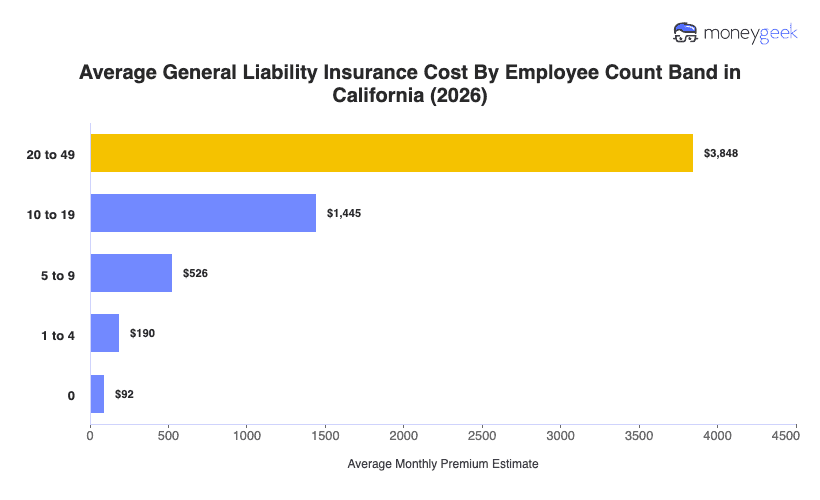
Business size is the most influential factor in general liability pricing. Insurers use it as a straightforward measure of risk: the more employees you have, the higher your premiums, because a larger workforce raises the likelihood of third-party claims like bodily injury, false advertising and subpar work complaints.
General liability insurance costs in California for 1 to 4 employee businesses are two times larger than for a sole proprietor at 107% higher. That gap widens sharply as headcount grows, reaching well over 4,000% once you reach 20 to 49 employees compared to an owner-only operation.
 Industry classification
Your industry in California is the second core factor that influences rates the most, as it determines the severity of risk associated with your work. For example, an office-based business will often not have many third-party liability risks like slip and falls compared to a cleaning company, so pricing will reflect this accordingly.
In our research, we found that rates can vary from 82% lower than the state average for tech/IT companies to 213% higher than California benchmarks for those in the construction and contracting industry.
California-Specific General Liability Insurance Cost Factors
Once you provide location-specific details, the following factors come into play and can raise general liability premiums in California.
 California's Legal and Regulatory Environment
California's Proposition 103 requires insurers to obtain Department of Insurance approval before implementing rate changes for commercial lines, including business owners' policies and other liability coverage, through a prior approval system. The law permits public intervenors to participate in rate filings and recover costs from insurers.
The result is stable but slower rate adjustments compared to other states, with regulatory constraints that have not kept pace with modern business practices.
 California's Litigation Environment and Social Inflation
Swiss Re Institute research found social inflation increased liability claims in the United States by 57% over the past decade and reached an annual peak of 7% in 2023. California does not cap liability damages, exposing the defendant to unlimited awards.
 California's Geographic Location and Urban Density
Location is a direct driver of general liability insurance costs. Urban areas with higher population density experience more frequent litigation and larger court awards, which pushes premiums upward.
In California, major metro regions tend to carry higher rates due to increased claims from heavy foot traffic, higher medical costs and property values, elevated labor markets and active plaintiff attorneys in cities such as Los Angeles and San Francisco.
 California's Industry-Specific Regulations and Mandates
California cannabis businesses cannot operate legally without general liability insurance: $2 million aggregate, $1 million per occurrence. Certain licensed trades have similar minimums. These industry-specific requirements push coverage higher than standard businesses require, resulting in higher premiums.
Taken together, these requirements add compliance costs and liability exposure on top of what standard general liability covers across California.
Get a CA General Liability Insurance Cost Estimate
Using your industry and employee count, you can estimate your costs through our general liability insurance calculator. You'll get a value that reflects a policy with limits of $1 million per occurrence and $2 million aggregate. If you want to get matched to an insurer that best fits your business details, click Get Quotes.
California General Liability Cost Estimate Calculator
Select General Industry
Select Employee Count
Monthly rate estimate—
Select General Industry
Monthly rate estimate—
Select Employee Count
How to Lower General Liability Insurance Costs Without Sacrificing Coverage
The following methods will help you find more affordable general liability rates in California, so you can avoid the highest costs for coverage nationwide.
Quick General Liability Cost Lowering Methods
If you want quicker fixes to apply during the buying process, renewal or while managing a current policy, these general liability cost saving tips will be the most effective.
- Provide clean, accurate underwriting information
The accuracy of the information you provide insurers matters not only for keeping compliance, but also to make sure you're not overpaying for general liability insurance. The more specific you can be, the more easily insurance companies can price your business correctly. For example, if you are a California tech company, accurately reporting all of the types of work you do, all locations and employees along with exact revenue and payroll projections will work in your favor.
 Compare multiple insurers
Different insurers have different business types they prefer to work with depending on their model and customer that is most profitable for them. So due to this, there is a large amount of variance in the pricing you'll receive for general liability insurance in California and all other commercial insurance policies. So we recommend whenever you're buying a new policy or comparing business insurance quotes to include three to five different providers in your search to get the best price.
 Bundle general liability into a business owner's policy (BOP)
The best way to buy general liability insurance, regardless of if you're in California or not, is to bundle as part of a business owners insurance policy (BOP). Costs for BOP insurance are lower due to insurers getting more value from your business if you buy more policies in one go. You can expect savings anywhere from 10% to 15% on average and you'll get the benefits of general liability, commercial property and business interruption insurance, all in one.
- Pay annually instead of monthly
If it makes sense for your businesses, you can save additionally by paying the full annual cost of a general liability policy upfront. Insurers offer these savings since it is less risky from a financial perspective and they get a larger cash infusion in a shorter amount of time.
 Increase your deductible (if you can afford it)
If you have the out of pocket means, lowering your deductible for general liability insurance will help you lower costs. Moving from a $250 to a $1,000 deductible for example would decrease the cost an insurance provider would have to pay out of pocket.
 Adjust your coverage limits
Adjusting your coverage limits to meet your general liability requirements will protect you from risk and prevent you from buying an excessive policy. If you can still maintain compliance and are in a low-risk industry, a $500,000 per occurrence and $1 million aggregate policy instead of a standard $1 million per occurrence and $2 million aggregate plan could save you up to 17% in California.
Read More: How Much General Liability Insurance Do You Need?
Long-Term General Liability Cost Lowering Methods
Quick fixes are often not enough when you're scaling a company up and insurers look for you to show more long term commitment to claims reduction. These methods will allow you to build relationships with any insurer and give you negotiating power as you become a more established customer.
General Liability Insurance Cost in California: Bottom Line
General liability insurance costs in California vary widely, and premiums shift based on business size, industry classification and location within the state. State-specific factors such as expanded damage caps, wildfire and seismic zone proximity and coastal winter slip-and-fall exposure also influence rates in ways outside the operation's control.
Apply this report by considering context, not a single price:
- How do you compare to California's distribution? (industry tier + Los Angeles metro vs. mountain town + employee count)
- What is affecting your cost? (baseline risk vs. California's comparative fault legal environment vs. wildfire/seismic exposure vs. coastal weather zone proximity)
- What would change your price? (limits, deductible, bundling with property coverage, accurate underwriting details and claims management)
Frame your premium this way to evaluate quotes and coverage options based on how well they reflect your true risk profile within California's market, rather than whether they fall above or below the state average.
About Angelique Palenzuela-Cruz

Angelique Palenzuela-Cruz is a Business Insurance Content Writer at MoneyGeek, where she specializes in general liability, workers’ compensation and professional liability insurance. Her work helps small business owners understand how these policies apply to coverage, including risks like customer injuries, employee injuries, professional mistakes, client contract terms and industry-specific coverage requirements.
She primarily covers service-based businesses where liability and employee coverage decisions are especially important, including cleaning, consulting, beauty and wellness, childcare, education, fitness, food service, pet care, repair and maintenance, and other professional services.
Before joining MoneyGeek, Angelique spent nearly 12 years at Guthrie-Jensen Consultants, one of Southeast Asia’s largest management training firms, where she advanced from Training Consultant to Managing Consultant. In that role, she worked with business clients to assess operational needs, develop training programs and present performance analyses to executive decision-makers. She also helped establish Gladwin Training Consultancy, where she served in learning solutions and client service roles.
Her background gives her practical context for writing about how businesses operate, manage client expectations, structure teams and make risk decisions. At MoneyGeek, she applies that experience to business insurance content, connecting coverage to actual business needs.
LinkedIn: linkedin.com/in/ma-angela-cruz
Email Contact: angelique.palenzuela@moneygeek.com
Sources
- California Department of Insurance. "Prop 103 Consumer Intervenor Process." Accessed September 25, 2026.
- Swiss Re Institute. "Social inflation: litigation costs drive claims inflation." Accessed September 25, 2026.
- California Department of Cannabis Control. "DCC Regulations." Accessed September 25, 2026.
- IBISWorld. "California - State Economic Profile." Accessed September 25, 2026.