
How Much Does Commercial Auto Insurance Cost in California?

The average commercial auto insurance cost for California businesses is $209 per month ($2,503 per year) for minimum coverage, based on MoneyGeek's analysis of eight vehicle types across 25 general industry categories. That puts California 28% above the average commercial auto insurance cost of $163 per month nationally, ranking 44th out of 51 states for affordability.

California's rates run higher than every neighboring state. Oregon comes closest at $158 per month, followed by Washington at $157, Nevada at $167 and Arizona at $149. None of the states bordering California come close to its $209 monthly average.

Three factors push California above the national benchmark: an active litigation climate with higher attorney involvement and larger jury awards than most markets, dense urban centers like Los Angeles and San Francisco with higher claim frequency and repair costs, and the January 2025 minimum liability increase to 30/60/15. Your rate will differ from that benchmark depending on your vehicle, your drivers and what your business does.


Commercial Auto Insurance in California Calculator

The commercial auto insurance calculator below gives you an estimate based on your specific profile. It covers personal vehicles used for business but excludes commercial trucks like semis, buses and tankers. For those vehicle types, use the commercial truck insurance calculator.

To estimate average commercial auto insurance costs, MoneyGeek analyzed pricing estimates from five major commercial auto providers and modeled standardized premium estimates across common business vehicle profiles. These modeled results give a consistent national benchmark and show how premiums shift by vehicle type, industry and location.

Dataset Scope and Assumptions

Our cost modeling uses standardized inputs for comparable results across businesses.

  • Providers analyzed: five major commercial auto providers
  • Vehicle types covered: eight (Sedan, SUV, Pickup Truck, Van, Food Truck, Farm Tractor, Taxi, Limousine). Vehicles were only analyzed where they would realistically be used widely for commercial purposes within industry areas for accuracy.
  • Industries covered: 25 general industry categories
  • Location: California
  • Coverage baseline: minimum coverage commercial auto policy (the market standard for benchmark comparisons)

How We Calculated Average Commercial Auto Insurance Costs

MoneyGeek's published averages represent modeled premiums for standardized business profiles, aggregated two ways. Each figure isolates one variable at a time so you can see where your costs land relative to the national benchmark of $163 per month.

  • National Benchmark Average: The national average reflects the modeled premium for a minimum coverage policy across all vehicle types, industries and states in the dataset. This single figure covers all 51 states and territories, and gives you a starting reference point before accounting for your specific business profile.
  • Segment Averages: To show how costs shift, MoneyGeek calculated average modeled premiums isolated by one variable at a time, covering vehicle type, general industry category and state. Segment averages aggregate modeled pricing trends across the full dataset so you can compare how premiums change across business types and regions. A sedan operator in Pennsylvania will see a very different number than a limousine service in Michigan.

What Factors Affect Commercial Auto Insurance Costs in California?

Four factors drive commercial auto insurance pricing in California: vehicle type, general industry classification, geographic location and coverage level. Each one shapes how insurers estimate claim frequency, severity and total exposure.

    car2 icon
    Vehicle Type

    Vehicle type is the heaviest weight factor, determining physical damage exposure, bodily injury liability and replacement cost. In California, sedans sit 33% below the state average at $139 per month, while limousines run 608% above it at $1,477 per month.

    building icon
    General Industry Category

    General industry classification is the second biggest factor, reflecting how much driving your vehicles do, what they carry and what environments they operate in. California rates range from 46% below the state average for Marketing and Communications businesses to 140% above it for Transportation and Logistics.

    pin icon
    Geographic Location

    Geographic location also affects your rate. Los Angeles and San Francisco carry higher premiums than smaller California cities not just because of traffic volume but because of claim litigation risk. Los Angeles is ranked the most plaintiff-favorable court jurisdiction in the country, with third-party litigation financing and aggressive attorney tactics routinely driving commercial auto claim costs well above what the same accident would cost to resolve in a smaller market.

    shield icon
    Coverage Level

    Coverage level is the single largest controllable factor. It sets the maximum the insurer pays per occurrence, and higher limits mean more risk per claim. Your premium reflects that directly.

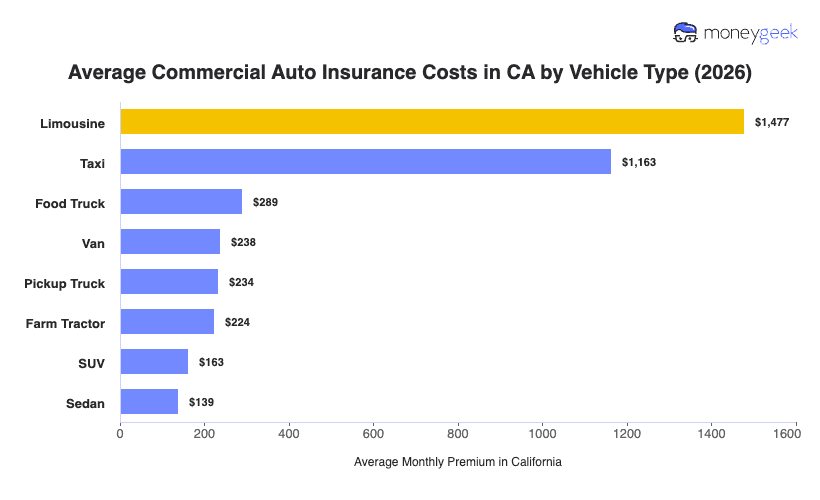
Average Commercial Auto Insurance Costs in CA by Vehicle Type

California commercial auto insurance rates start at $139 per month for a sedan and reach $1,477 per month for a limousine. The vehicle types most California businesses rely on, like sedans, SUVs and pickup trucks, cluster between $139 and $234 per month.

Passenger-carrying vehicles sit in a category of their own. Taxis average $1,163 per month and limousines average $1,477 per month, coming in 457% and 607% above the state average respectively. That premium reflects greater liability exposure, stricter minimum coverage requirements under California law and higher daily driving frequency than any other vehicle type.

Sedan$139$1,6671
SUV$163$1,9572
Farm Tractor$224$2,6863
Pickup Truck$234$2,8034
Van$238$2,8585
Food Truck$289$3,4706
Taxi$1,163$13,9627
Limousine$1,477$17,7308

If you're looking for coverage details on specific vehicle types, use our guides below.

Average California Commercial Auto Insurance Costs by Industry

General industry classification is one of the biggest pricing factors for commercial auto insurance in California. Rates run from $112 per month for Marketing and Communications to $500 per month for Transportation and Logistics across 25 general industry categories, a $388 per month gap driven by how much driving a business does and the liability that comes with it.

Here's how California's 25 general industry categories break down by cost tier:

  • Lower-Cost Industries (20%+ Below California Average): Marketing and Communications, Financial Services, Beauty Body and Wellness Services, Fitness Services, Consulting Services, Tech/IT, Education, Arts Media and Entertainment, Real Estate and Property Services
  • Mid-Cost Industries (Within 20% of California Average): Healthcare and Medical, Pet Care Services, Childcare Services, Nonprofit and Associations, Agriculture and Natural Resources, Recreation and Sports, Retail and Product Rental, Repair and Maintenance, Wholesale and Distribution, Food and Beverage, Cleaning Services, Manufacturing, Hospitality Travel and Tourism, Construction and Contracting
  • Higher-Cost Industries (More Than 20% Above California Average): Other Professional Services, Transportation and Logistics

Sixty-four percent of all general industry categories in California fall at or below the state average of $209 per month. Transportation and Logistics is the most expensive by a wide margin, coming in $193 per month above the next most expensive category, Other Professional Services.

Data filtered by:
Agriculture & Natural Resources
Agriculture & Natural Resources$200$2,39914

Use our guides below to see commercial auto insurance cost details on specific general industry categories in California.

How to Lower Commercial Auto Insurance Costs in California Without Sacrificing Coverage

California ranks among the most expensive states for commercial auto insurance. The good news is that most of what drives your rate is adjustable. Some changes take effect immediately, while others build over time and compound at each renewal.

Quick Commercial Auto Cost-Lowering Methods

These actions impact your rates immediately and are ranked from lowest financial risk to highest effectiveness.

    insurance2 icon
    Get Your Underwriting Details Right From the Start

    Annual mileage, vehicle use and driver job descriptions all feed directly into your rate. Vague answers push underwriters toward worst-case assumptions, and you pay for that conservatism. Specificity costs nothing and can move your premium meaningfully before you ever file a claim.

    shoppingCart icon
    Compare Quotes on Identical Coverage Terms

    A lower quote doesn't mean better value if it's missing hired and non-owned auto coverage or carries a higher deductible. Confirm every quote reflects the same liability limits, deductibles and endorsements, then get at least three before deciding.

    building icon
    Bundle Commercial Auto With Your GL or BOP Policy

    Ask for multi-policy discounts because they rarely show up on a standalone quote. California's rate approval process means insurers sometimes absorb cost pressure across bundled policies rather than spiking any single line. In a state where commercial auto already runs 28% above the national average, stacking available discounts matters more than it would in a cheaper market.

    coins2 icon
    Pay Annually Instead of Monthly

    Monthly billing plans carry installment fees that add up. Annual payment typically saves 5% to 10% and eliminates those fees. It requires paying the full premium upfront, but the math usually favors it.

    money2 icon
    Raise Deductibles if Your Fleet Has a Clean History

    Moving from $500 to $1,000 on comprehensive and collision deductibles can cut physical damage premiums by 15% to 25%. However, this is not recommended if you expect to file claims frequently, since your out-of-pocket payments may exceed whatever you'd save on premiums.

Long-Term Commercial Auto Cost-Lowering Methods

The real savings come from shifting how insurers view your fleet's risk profile at renewal. These strategies take time to gain traction, but their impact builds steadily as your claims history and driver data strengthen.

Commercial Auto Insurance Cost in California: Bottom Line

California's commercial auto market is among the most expensive in the country, but what you actually pay depends almost entirely on your specific fleet. Two businesses operating in the same city, in the same general industry category, can have very different starting rates based on vehicle type and coverage choices alone. Before comparing quotes, it helps to get clear on three things.

  1. What does your fleet actually look like? Vehicle type is the heaviest pricing factor in California, and how your drivers use those vehicles and what general industry category your business operates in shape the baseline from there. Get those details right before you start comparing numbers.
  2. How much risk are you willing to carry? Coverage level is the biggest controllable variable in your premium. Higher limits protect your business when a claim exceeds your policy, but they cost more at every renewal. The right balance depends on your cash reserves, your contract requirements and how much out-of-pocket exposure your business can absorb.
  3. What's your timeline? Cost levers like accurate underwriting details, bundling and annual payment immediately impact your rates. Others, like building a clean loss history or strengthening your driver safety controls, take one to three renewal cycles to show up in your rate. Knowing which category each strategy falls into helps you prioritize.

Getting commercial auto insurance right in California is less about finding the lowest number and more about matching your coverage to your actual risk profile.

Commercial Auto Insurance Cost in CA: Next Steps

For most California businesses, the right next move is comparing providers directly. California's rate spread is wide enough that the right carrier for your fleet type and industry can make a meaningful difference in what you pay.

Recommended: If You're Ready to Compare Providers

Start with our guides to the cheapest and best providers in California to build a shortlist. Cost and quality don't always move in the same direction, and reviewing both gives you a complete picture before committing.

If You Want to Learn About Costs From Other Coverage Types

If You Want to Learn More About Commercial Auto Insurance Coverage

About Connor Bolton


Connor Bolton headshot

Connor Bolton is Senior SEO and Content Manager at MoneyGeek, where he leads the business and pet insurance editorial teams. As editorial lead for both verticals, Connor sets the research framework, data standards, and content structure that his writers execute, directly authoring in-depth guides himself and reviewing all team content for accuracy and practical value before it goes live. With over four years evaluating insurance products across personal, commercial, and specialty lines, he brings cross-vertical knowledge to every guide the team produces.

Connor architected MoneyGeek's insurance research infrastructure across all major verticals including auto, home, renters, life, health, business, and pet, building systems for pricing analysis, provider-level research, customer experience evaluation, and coverage analysis with AI support. The infrastructure includes over 6 million data points for business insurance across 408 industry areas, all 50 states, and 16 vehicle types, and over 5 million pet insurance profiles across 18 major providers and hundreds of breed and age combinations. Connor's insurance cost research and his team's work has been cited by the U.S. Chamber of Commerce, Allstate, Liberty Mutual, CBS News, Forbes and LegalZoom.

Beyond the data, Connor stays connected to how the market actually operates, drawing on direct conversations with underwriters and carrier liaisons at Ethos, The Hartford, NEXT Insurance, Nationwide, and State Farm, and monitoring business and pet owner communities including Reddit, to inform how he interprets findings and frames guidance for real buyers.

He is the direct editorial contact for methodology questions at connor@moneygeek.com and can be found on LinkedIn.