
How Much Does Food Truck Business Insurance Cost?

Food truck insurance costs about $443 per month for a recommended startup package with commercial auto, general liability and commercial property insurance. A minimum requirements package with only commercial auto and general liability costs about $406 per month, while a broader package with cyber insurance added costs about $520 per month. If you're adding employees, factor in $34/mo per employee and $259/mo per food truck you add to your fleet.

Keep in mind these are modeled benchmark averages (not quotes) for a 1–4-employee operation across all 50 states, and the bundle costs presented are before discounts are applied. Your actual premium will vary based on factors such as your state, employee count, and claims history, but these figures provide a realistic range to evaluate quotes against.

Below, you can compare insurance bundle costs and the coverages they include for food trucks.

Minimum Bundle
Commercial auto, general liability
$406
$4,862
Recommended Bundle
Commercial auto, general liability, commercial property
$443
$5,301
Comprehensive Bundle
Commercial auto, general liability, commercial property, cyber insurance
$520
$6,230

Average Food Truck Business Insurance Cost Overview By Coverage Type

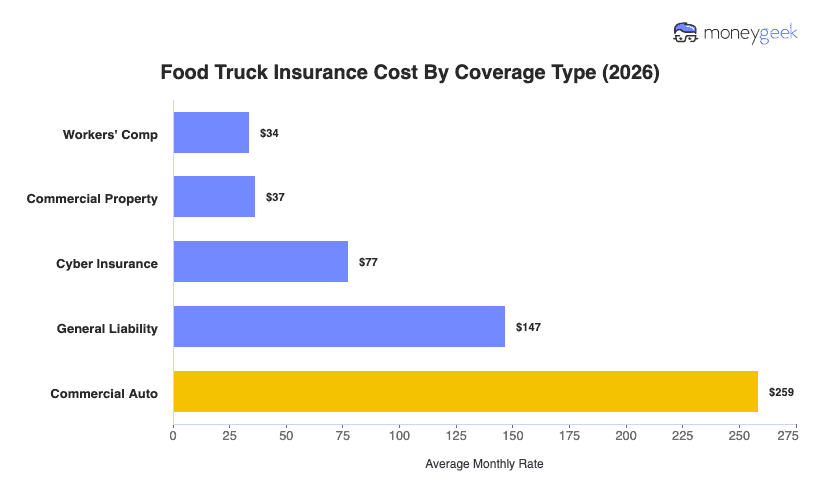
At the national level, average food truck insurance costs vary by coverage type, from $34/mo per employee for workers’ comp to $259/mo per truck for commercial auto. The spread reflects how differently each policy prices food truck risks, from customer illness and vehicle accidents to broken equipment or employee burns.

You can compare costs for policy types you may need for your food truck below:

Workers' Comp
$34 per employee
$408 per employee
Commercial Property
$37
$439
Equipment Breakdown
$38
$450
Inland Marine
$39
$462
Food Spoilage
$63
$750
Cyber Insurance
$77
$929
Liquor Liability
$80
$960
General Liability
$147
$1,759
Commercial Auto
$259 per truck
$3,103 per truck

How Much Does General Liability Insurance Cost for Food Truck Businesses?

The national average general liability cost for food trucks is $147/mo, but it ranges from $95/mo in West Virginia to $243/mo in Washington, D.C., a 155% gap. Premiums vary by state primarily because insurers price legal defense and settlement costs, which differ significantly across litigation environments. States with higher jury awards, more active plaintiff bars, and denser urban markets consistently produce higher premiums than rural, lower-litigation states.

If your route runs through high-cost states like California or New York, build that variance into your budget before you book the season.

Alabama$109$1,314
Alaska$177$2,134
Arizona$149$1,784
Arkansas$103$1,234
California$241$2,893
Colorado$185$2,211
Connecticut$201$2,411
Delaware$157$1,884
District of Columbia$243$2,918
Florida$172$2,060
Georgia$138$1,654
Hawaii$196$2,344
Idaho$107$1,286
Illinois$179$2,150
Indiana$124$1,485
Iowa$110$1,324
Kansas$116$1,388
Kentucky$116$1,391
Louisiana$113$1,361
Maine$127$1,522
Maryland$196$2,354
Massachusetts$218$2,616
Michigan$133$1,600
New Mexico$109$1,311
Minnesota$160$1,918
Mississippi$97$1,165
Missouri$122$1,461
Montana$111$1,335
Nebraska$116$1,394
Nevada$154$1,852
New Hampshire$160$1,921
New Jersey$205$2,457
New York$229$2,751
North Carolina$133$1,592
North Dakota$114$1,373
Ohio$130$1,557
Oklahoma$111$1,332
Oregon$170$2,043
Pennsylvania$156$1,875
Rhode Island$157$1,887
South Carolina$107$1,282
South Dakota$103$1,237
Tennessee$127$1,522
Texas$144$1,726
Utah$132$1,586
Vermont$148$1,775
Virginia$169$2,035
Washington$200$2,394
West Virginia$95$1,144
Wisconsin$128$1,538
Wyoming$109$1,306

How Much Does Commercial Auto Insurance Cost for Food Truck Businesses?

The national average is $259/mo, but costs range from $115/mo in Pennsylvania to $439/mo in Michigan, a nearly fourfold gap. Commercial auto premiums vary by state primarily because insurers price road liability based on the legal and regulatory framework governing auto claims in each state. States with no-fault insurance systems, higher injury benefit requirements, or more plaintiff-friendly auto litigation environments produce structurally higher premiums regardless of how safely you operate.

Food trucks also pay more than standard commercial vehicles because stopping to serve customers in high-traffic locations creates greater road exposure per mile than a vehicle that simply drives between destinations.

Alabama
$195
$2,335
Alaska
$381
$4,578
Arizona
$210
$2,519
Arkansas
$210
$2,516
California
$289
$3,470
Colorado
$232
$2,779
Connecticut
$269
$3,228
Delaware
$190
$2,283
Florida
$327
$3,925
Georgia
$222
$2,663
Hawaii
$123
$1,471
Idaho
$146
$1,750
Illinois
$256
$3,070
Indiana
$217
$2,600
Iowa
$135
$1,620
Kansas
$202
$2,426
Kentucky
$221
$2,648
Louisiana
$254
$3,045
Maine
$258
$3,098
Maryland
$280
$3,366
Massachusetts
$280
$3,357
Michigan
$439
$5,271
Minnesota
$229
$2,745
Mississippi
$214
$2,566
Missouri
$264
$3,170
Montana
$185
$2,223
Nebraska
$190
$2,285
Nevada
$230
$2,763
New Hampshire
$164
$1,964
New Jersey
$288
$3,461
New Mexico
$180
$2,163
New York
$302
$3,621
North Carolina
$228
$2,732
North Dakota
$177
$2,124
Ohio
$222
$2,661
Oklahoma
$205
$2,457
Oregon
$222
$2,658
Pennsylvania
$115
$1,378
Rhode Island
$286
$3,432
South Carolina
$229
$2,744
South Dakota
$255
$3,062
Tennessee
$205
$2,457
Texas
$312
$3,738
Utah
$206
$2,478
Vermont
$126
$1,517
Virginia
$244
$2,926
Washington
$217
$2,607
Washington D.C.
$313
$3,756
West Virginia
$219
$2,625
Wisconsin
$168
$2,014
Wyoming
$197
$2,366

How Much Does Business Owners Policy (BOP) Insurance Cost for Food Truck Businesses?

The national average runs $165/mo, but costs range from $115/mo in West Virginia to $256/mo in Washington, D.C., a 122% gap driven almost entirely by the general liability component, since commercial property costs are relatively uniform across states. High-litigation markets push the BOP cost up for the same reason they push standalone general liability up: insurers are pricing legal defense and settlement exposure, not just equipment value.

A business owner's policy (BOP) bundles general liability and commercial property into a single policy, typically at a lower combined rate than buying each separately. For food trucks, I recommend buying a BOP to save money on both coverages. Most insurers apply a 10% discount, which has been applied to our averages for accuracy.

Alabama
$129
$1,548
Alaska
$196
$2,352
Arizona
$167
$2,004
Arkansas
$122
$1,464
California
$255
$3,060
Colorado
$201
$2,412
Connecticut
$218
$2,616
Delaware
$176
$2,112
District of Columbia
$256
$3,072
Florida
$192
$2,304
Georgia
$157
$1,884
Hawaii
$217
$2,604
Idaho
$128
$1,536
Illinois
$195
$2,340
Indiana
$142
$1,704
Iowa
$129
$1,548
Kansas
$134
$1,608
Kentucky
$135
$1,620
Louisiana
$136
$1,632
Maine
$146
$1,752
Maryland
$212
$2,544
Massachusetts
$233
$2,796
Michigan
$151
$1,812
Minnesota
$176
$2,112
Mississippi
$117
$1,404
Missouri
$140
$1,680
Montana
$130
$1,560
Nebraska
$133
$1,596
Nevada
$172
$2,064
New Hampshire
$176
$2,112
New Jersey
$222
$2,664
New Mexico
$129
$1,548
New York
$246
$2,952
North Carolina
$153
$1,836
North Dakota
$131
$1,572
Ohio
$148
$1,776
Oklahoma
$130
$1,560
Oregon
$187
$2,244
Pennsylvania
$176
$2,112
Rhode Island
$177
$2,124
South Carolina
$129
$1,548
South Dakota
$122
$1,464
Tennessee
$146
$1,752
Texas
$165
$1,980
Utah
$151
$1,812
Vermont
$165
$1,980
Virginia
$185
$2,220
Washington
$215
$2,580
West Virginia
$115
$1,380
Wisconsin
$146
$1,752
Wyoming
$128
$1,536

How Much Does Commercial Property Insurance Cost for Food Truck Businesses?

Commercial property costs are the second cheapest food truck insurance line at $37/mo, and it's also the most stable. The national range runs from $32/mo in North Dakota to $44/mo in New York, a 36% gap which is narrower than any other coverage type we studied.

This is due to business property insurance pricing being based on a defined and bounded asset at a declared value. There's no litigation, variable like customer volume, and no regulatory framework that differs dramatically from state to state. What moves the price is property crime rates and local repair and replacement costs, both of which shift modestly from state to state.

That said, your equipment value matters more than your state. A custom-built kitchen with commercial fryers, a generator, and refrigeration units warrants a higher coverage limit and premium than a basic cold-prep setup. If your onboard equipment is worth more than a standard build, the state average is less relevant than the declared value on your policy.

Alabama$34$410
Alaska$41$486
Arizona$37$439
Arkansas$33$397
California$42$508
Colorado$38$456
Connecticut$41$488
Delaware$38$458
District of Columbia$42$509
Florida$41$495
Georgia$36$436
Hawaii$43$516
Idaho$35$417
Illinois$38$453
Indiana$34$405
Iowa$33$392
Kansas$33$392
Kentucky$34$405
Louisiana$38$456
Maine$35$416
Maryland$39$471
Massachusetts$41$496
Michigan$35$419
Minnesota$36$431
Mississippi$33$401
Missouri$33$401
Montana$34$406
Nebraska$32$389
Nevada$37$448
New Hampshire$36$432
New Jersey$42$507
New Mexico$34$409
New York$44$522
North Carolina$37$439
North Dakota$32$385
Ohio$35$418
Oklahoma$34$403
Oregon$38$460
Pennsylvania$39$462
Rhode Island$40$475
South Carolina$36$431
South Dakota$32$388
Tennessee$35$418
Texas$39$465
Utah$36$430
Vermont$35$419
Virginia$37$447
Washington$39$474
West Virginia$33$398
Wisconsin$34$414
Wyoming$33$397

How Much Does Workers’ Comp Insurance Cost for Food Truck Businesses?

At $34/mo per employee, workers' comp is the most affordable coverage type, but that average masks a range from $19/mo in Indiana to $79/mo in California. That's a $60-per-employee gap that has almost nothing to do with how food trucks operate and everything to do with how each state structures its workers' comp system.

Unlike commercial auto or general liability, where litigation environment and claim frequency drive variance, workers' comp rates are set by state regulatory bodies and reflect each state's benefit levels, maximum weekly payments, and injury definitions. A part-time weekend worker costs four times more to insure in California than in Indiana, not because California kitchens are more dangerous, but because the state mandates higher payouts when injuries occur.

Alabama$22$268
Alaska$55$659
Arizona$27$325
Arkansas$19$234
California$79$950
Colorado$34$413
Connecticut$62$743
Delaware$42$500
District of Columbia$72$866
Florida$31$375
Georgia$30$359
Hawaii$42$507
Idaho$21$251
Illinois$44$531
Indiana$19$226
Iowa$20$243
Kansas$22$268
Kentucky$24$285
Louisiana$32$380
Maine$30$360
Maryland$36$435
Massachusetts$57$679
Michigan$35$423
Minnesota$35$414
Mississippi$21$257
Missouri$28$334
Montana$28$337
Nebraska$22$263
Nevada$30$354
New Hampshire$36$433
New Jersey$59$705
New Mexico$25$299
New York$62$743
North Carolina$27$320
Oklahoma$28$338
Oregon$32$380
Pennsylvania$44$522
Rhode Island$37$443
South Carolina$31$371
South Dakota$20$235
Tennessee$24$293
Texas$23$280
Utah$22$261
Vermont$32$381
Virginia$25$304
West Virginia$29$353
Wisconsin$29$346

How Much Does Cyber Insurance Cost for Food Truck Businesses?

Cyber sits in the middle of the food truck insurance cost range at $77/mo nationally and has a narrow state spread, similar to commercial property insurance. Cyber insurance costs vary from $65/mo in Alaska to $96/mo in Washington, D.C, and this tight range reflects the fact that payment processing risk is fairly uniform and standard across locations. So that means a food truck running Square in Montana faces essentially the same breach exposure as one running Toast in New Jersey.

What creates price differences by location is breach notification laws. States set their own disclosure deadlines, definitions of what constitutes personal data, and regulatory penalties for non-compliance. Compliance costs get baked into the premium, which is why high-regulation markets sit at the top of the range.

Alabama$75$895
Alaska$65$790
Arizona$78$944
Arkansas$71$854
California$91$1,094
Colorado$84$1,006
Connecticut$88$1,061
Delaware$86$1,033
District of Columbia$96$1,147
Florida$83$1,003
Missouri$77$923
Georgia$82$987
Hawaii$70$836
Idaho$67$806
Illinois$88$1,059
Indiana$77$926
Iowa$69$833
Kansas$73$878
Kentucky$75$895
Louisiana$75$895
Maine$70$834
Maryland$88$1,057
Massachusetts$88$1,061
Michigan$78$941
Minnesota$78$942
Mississippi$71$851
Montana$65$789
Nebraska$69$833
Nevada$86$1,033
New Hampshire$70$834
New Jersey$90$1,075
New Mexico$71$854
New York$94$1,122
North Carolina$81$967
North Dakota$65$790
Ohio$78$944
Oklahoma$73$878
Oregon$81$970
Pennsylvania$81$967
Rhode Island$70$834
South Carolina$75$895
South Dakota$67$806
Tennessee$77$926
Texas$84$1,005
Utah$73$880
Vermont$70$834
Virginia$86$1,030
Washington$86$1,032
West Virginia$67$806
Wisconsin$77$923
Wyoming$65$790

How Much Do Specialized Insurance Policies Cost For Food Trucks?

Depending on your setup's details, like whether you serve alcohol, operate across multiple locations, or run a full hot kitchen, these additional coverages are worth considering as an additional expense. Unlike the most common five, these are typically add-ons or endorsements rather than standalone policies, which keeps costs manageable.

Costs provided are not based on our direct study, but are based on the minimums and maximums I discovered in external research for food trucks.

Food spoilage
Covers costs of replacing perishable inventory lost to power outages, refrigeration failure, or equipment contamination
$40 to $85
Any truck carrying significant perishable inventory, especially those running refrigeration units or operating in extreme heat
Equipment breakdown
Reimburses you for repairs or replacements of cooking equipment that fails from internal mechanical failure, power surges, or electrical shorts that commercial property doesn't cover
$25 to $50
Trucks running full hot kitchens with fryers, grills, or generators where a breakdown stops revenue entirely
Equipment, supplies, and inventory damaged while in transit between locations or stored outside of the food truck overnight are paid for by this policy
$29 to $48
Food trucks operating across multiple daily locations, leaving equipment at event sites overnight, or transporting high-value supplies between commissary and truck
Provides financial protection for legal defense costs, settlements, and regulatory penalties if a customer you served causes injury or property damage
$45 to $115
Required in most states to obtain a liquor license and it is essential for any truck serving alcohol at events or markets

Factors Affecting Food Truck Business Insurance Costs

Unlike most small businesses, a food truck functions as a commercial vehicle, a licensed food service operation, and a customer-facing retail environment simultaneously. Which of those dimensions drives your food truck business insurance costs depends on your specific setup. The standard factors that affect any small business premium also apply, including your annual revenue, employee count, claims history, and location, all of which affect what you pay.

I go into the details of what affects rates specific to your food truck business and what can apply to any company below

Food Truck Specific Insurance Cost Factors

These are the variables that underwriters look at differently for food trucks than for other small businesses. They reflect the unique combination of road risk, cooking exposure, and operational complexity that makes food truck insurance its own category.

    fryingPan icon
    Cooking equipment and heat sources

    If your truck runs propane systems, deep fryers or commercial grills, those heat sources affect how insurers price your policy. Operating that equipment inside a moving vehicle adds fire exposure a fixed kitchen doesn't carry. A cold-prep or pre-packaged menu places your truck in a lower fire-risk tier.

    rideshare icon
    Operating model and territory

    A food truck parked at the same office pitch every weekday carries more predictable exposure than one covering farmers markets, food festivals and private catering across multiple locations. Running a multi-county circuit, adding alcohol service or stacking event weekends each shifts your risk profile in ways a fixed pitch doesn't.

    money2 icon
    Annual revenue

    Food trucks can swing between a quiet Tuesday lunch doing a few hundred dollars and a festival weekend clearing several thousand. Underwriters use annual revenue to assess how much liability exposure your customer volume creates: more service means more food handling and more potential claims from a foodborne illness or customer injury.

    pickupTruck icon
    Truck age and build

    Many food trucks are converted vehicles, and your build's age and condition affect how underwriters approach replacement value and mechanical risk. A 20-year-old converted step van sits in a different risk tier than a purpose-built commercial unit. Generator mounts, cold-side additions and service window extensions can each shift your classification.

    smallBusiness icon
    Off-truck operations

    If you prep at a commissary kitchen, serve at client sites or run indoor pop-ups, your liability exposure extends beyond the truck. A slip-and-fall at the commissary or property damage at a catered event may fall outside your standard policy unless those locations are specifically addressed in your coverage.

General Factors That Affect Any Business Premium

These factors apply to all types of small business insurance and aren't specific to food trucks.

How to Lower Food Truck Business Insurance Costs

Getting cheap food truck business insurance starts with knowing which levers actually move the needle for your operation. Some, like comparing quotes across the smaller pool of insurers that understand mobile food operations, can immediately lower your renewal rate. Others, like adjusting your route or investing in safety practices, reduce your risk profile over time and strengthen your position at renewal.

Below, I go over the most common methods that can help you save the most.

    vsDocuments icon
    Compare quotes using the same coverage limits

    The pool of insurers specializing in mobile food operations is smaller than the general small-business market, and pricing varies significantly across them. Before comparing prices, make sure each quote covers an identical coverage structure, including the same limits, deductibles and coverage scope for each coverage type. This allows you to properly compare side by side and find the actual cheapest option versus one with lower rates due to less protection.

    uninsured icon
    Right-size your coverage

    If your truck is an older converted vehicle, insuring at actual cash value rather than replacement cost will save you more in the long run. If you work primarily in low-volume markets rather than high-traffic festivals, your general liability limits may be set higher than your contracts and your actual claim risk requires. Review both your limits and your vehicle valuation at each renewal to ensure you're properly calibrating your policy and saving as much as possible.

    shoppingBag icon
    Bundle policies with the same provider

    When your commercial auto and general liability sit with different insurers, a single incident involving the truck can become a dispute over which policy responds first. Specialty insurers focused on mobile food businesses often package general liability, commercial auto, workers' comp and commercial property together at a lower combined rate. Bundling also eliminates the hassle of working with multiple providers at once when an incident applies to both insurers' policies.

    insurance2 icon
    Lower your risk profile

    Underwriters re-assess your operation at every renewal, which means changes you make during the policy period show up in next year's quote. Moving from propane to electric cooking equipment, shifting from a high-volume festival circuit to a more consistent fixed pitch, completing a food safety certification, or adding a fire suppression system to your cooking area each signals lower risk at renewal.

    stackOfBooks icon
    Invest in risk management practices

    For food trucks, the claims that tend to trigger renewal scrutiny are kitchen fires, foodborne illness reports, customer injuries at the service window and road incidents in the truck. Addressing the most common ones systematically is what builds a claim-free history that lowers your renewal rate and saves you the trouble of dealing with a financial issue.

    • Install a fire suppression system in your cooking area, especially if you run open-flame equipment, to reduce fire-related claim exposure.
    • Make sure anyone handling food on your truck holds a current food handler certification, which documents your safety practices and limits foodborne illness claims.
    • Fit a dashcam on the truck and maintain a vehicle service log so you have documentation if a road incident becomes a commercial auto dispute.
    • Keep records of commissary kitchen inspections and off-truck prep procedures so claims arising at those locations have the compliance documentation to support a defense.

Food Truck Business Insurance Cost: Bottom Line

The benchmarks on this page are intended as a measuring stick. Your actual premium depends on a combination of factors that no average can capture, including your cooking setup, route, truck's age and build, and the state you operate in. What the data gives you is a framework for evaluating where you stand:

  1. Where do you fall in the distribution: Use your coverage types, state, and employee count as coordinates. A solo cold-prep operator in a lower-cost state sits well below the benchmarks here. A staffed festival truck with a full propane kitchen in California sits well above them. If your quote does not match your profile, that gap is worth investigating before you accept it.
  2. Is your quote consistent with your risk profile: Food truck quotes above the benchmark almost always trace back to commercial auto costs, cooking equipment complexity, or operating territory. If your setup is straightforward but your quote is high, compare across at least two other providers that specialize in mobile food operations before deciding. Generalist small business insurers often price food trucks conservatively because they don't write enough of them to underwrite the risk accurately.
  3. Which cost drivers apply to your business: A cold-prep truck at a fixed pitch and a propane-kitchen truck on a festival circuit share a business category but almost nothing else from an underwriting perspective. Go through the factors section and identify which ones describe your actual operation. Those are the drivers most likely to explain where your quote landed, and the ones most worth addressing if you want to move it.
Food Truck Business Insurance Cost Chart

How We Determined Food Truck Insurance Costs

We analyzed quote data from 10 major U.S. commercial insurance providers, modeled standardized premium estimates for food truck business profiles across all states (including D.C.), and employee counts from sole proprietorships to 49-employee operations.

Our published averages represent modeled premiums for standardized business profiles and were aggregated in three ways.

  • National benchmark average: The national average cost reflects the modeled premium for a standardized one to four employee food truck business and all 50 states (and D.C.) standard industry-recommended policy limits.
  • State averages: To show how costs vary, we calculated average modeled premiums for our national base profile and isolated them for each state and D.C.
  • Bundle averages: We added single policy type premiums individually together without applying discounts to get a total package cost.

Other coverage costs, including food spoilage, equipment breakdown, inland marine, and liquor liability insurance, were gathered externally, and minimum, maximum, and national average rates for most small food truck companies were presented.

See our full business insurance methodology.

Food Truck Business Insurance Cost: Next Steps

If you're still working out which coverage types apply to your truck, start with what your state requires and what your event or commissary contracts specify. Those two sources usually define the minimum you need to carry.

If you're ready to find a better rate, compare quotes from providers that specialize in mobile food businesses rather than general small business insurers. Ask each one to quote the same coverage structure so the price difference reflects the provider, not the policy. I've also provided a guide for the best providers below to give you starting point:

If your quote came back higher than the benchmarks

If you're just starting out as a food truck operator

If you're adding a second truck to your fleet

If your truck only operates part of the year

Get Food Truck Insurance Estimates and Quotes

The food truck business insurance cost calculator below lets you get more personalized estimates to compare rates. Once you get a baseline, you're able to get a quote from your top business insurance provider based on the company details you enter.

Calculate Food Truck Insurance Costs

Plug in your coverage type, state, employee count and vehicle type (if you need commercial auto coverage) to get a cost estimate built around your operation. No personal information is required, and workers' comp estimates are calculated per employee. Once you have a good basis, click Get Quotes to be directed to your top food truck business insurer for pricing.

Select Coverage Type
Select State
Select Employee Count
Select vehicle_type
Monthly Rate Estimate—

About Angelique Palenzuela-Cruz


Angelique Palenzuela-Cruz, Business Insurance Writer, MoneyGeek

Angelique Palenzuela-Cruz is a Business Insurance Content Writer at MoneyGeek, where she specializes in general liability, workers' compensation and professional liability. Her writing helps small business owners understand what a policy covers and how it applies to their business.

Before financial content writing, Angelique spent nearly 12 years at Guthrie-Jensen Consultants, one of Southeast Asia's largest management training firms, where she rose from Training Consultant to Management Consultant. She worked directly with business clients across industries, assessed operational needs, designed training programs and presented performance analysis to executive decision-makers. She also helped establish Gladwin Training Consultancy, where she served as Learning Solutions Architect and Client Services Manager. That work put her on the business side of the decisions that insurance is built around, and she writes about coverage from that angle rather than from the policy terms.

She took that experience into financial content writing and has spent nearly four years at MoneyGeek covering insurance and lending content.

LinkedIn: linkedin.com/in/ma-angela-cruz

Email Contact: angelique.palenzuela@moneygeek.com