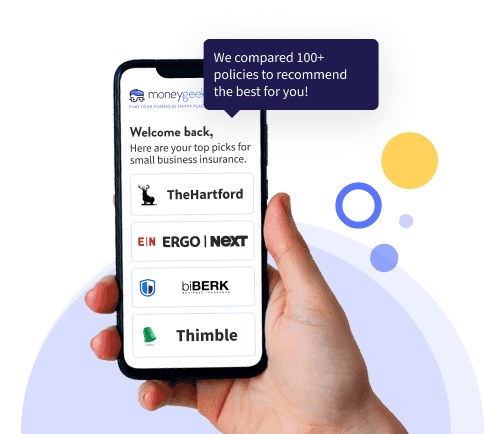



My analysis ranked these companies as the best small business insurers for food trucks and trailers:
Best Food Truck Business Insurance
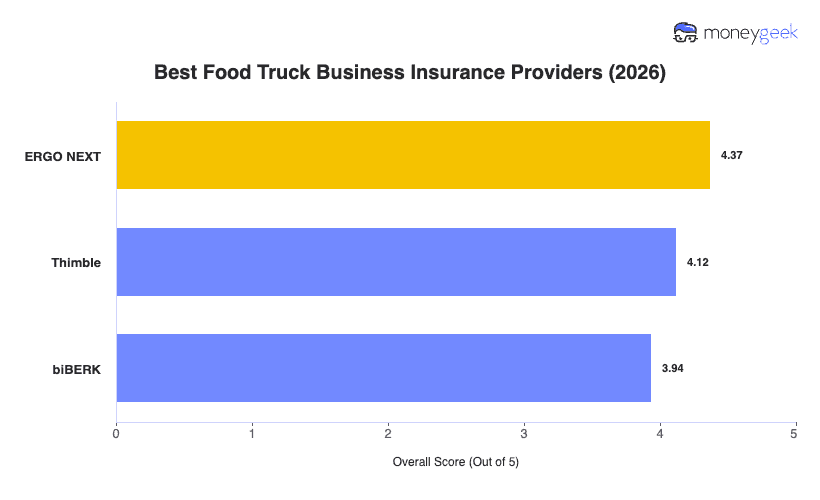
The best insurance for food trucks and trailers is offered by ERGO NEXT, Thimble and biBerk.
MoneyGeek helps you compare the best food truck insurers, coverage types and costs, so you can find the protection your operation needs.
Ready to shop? Use our tool below to get matched with your top provider and start your food truck insurance quote.
Select state
Updated: September 22, 2026
Advertising & Editorial Disclosure
Best Business Insurance Companies For Food Truck
Finding the right insurance for a food truck means weighing risks that don't exist for most small businesses: your kitchen moves, your location changes daily and a single foodborne illness claim can shut down operations. My rankings are built on three things: what you'll actually pay, what happens when you need help and whether the coverage holds up when it counts. I scored each provider across affordability (50%), customer experience (30%) and coverage options (20%), weighted that way because food truck margins sit around 6.8% on average, making premium cost the difference between staying operational and shutting down for a season, but a cheap policy that falls apart during a claim costs more in the end.
This is what made up my analysis of popular insurers, which was assisted (not run) by AI:
- Affordability: I pulled quotes isolating pricing factors across food and beverage sub-industries, all 50 states (plus DC), employee count (5 ranges from 0 to 49), 16 vehicle types and six of the most common coverage types, extrapolating 500,000+ estimates to build a full pricing picture for food truck operations specifically.
- Customer Experience: 300,000+ reviews, forum conversations and industry research were aggregated and manually parsed to identify the patterns that made customers enjoy and dislike service from each insurer. I also went through what an actual food truck owner would go through for all providers analyzed, testing their quoting experiences and policy management tools (excluding claims due to limitations).
- Coverage Options: I read the fine print of policy terms, isolated the exclusions and hidden costs that affect food truck businesses (like equipment-away-from-premises caps, foodborne illness carve-outs and commercial auto eligibility restrictions), and documented every option available for all providers to determine which has the best coverage for your operation now and as it grows.

ERGO NEXT: Best Overall, Best for Value-Focused Food Truck Operators
pros
Lowest average rate among top providers
Instant COIs and additional insured via app
Product liability included in general liability
cons
General liability caps at $1M per occurrence
Claims handled mostly through digital process
Solo operators pay nearly double sub-industry average
COMPANY HIGHLIGHTS
I recommend ERGO NEXT for most food truck operators because it pairs the lowest average premium with the fastest path from quote to proof of coverage. Its average rate runs 25% below the food truck sub-industry average, and the app lets you generate COIs, add event organizers as additional insured and adjust coverage without calling anyone. When a festival coordinator asks for proof of insurance at 6 a.m. on setup day, you can send it from your phone before the generator is running. Product liability is built into the general liability policy, which means foodborne illness claims are covered without buying a separate endorsement.
The trade-off is coverage depth at the edges. General liability caps at $1 million per occurrence, and some larger venue contracts and stadium bookings set that as their floor rather than their ceiling. Claims go through a mostly digital process with limited adjuster access, which can feel impersonal after a significant loss at a high-volume event.
Read Our Review: ERGO NEXT Business Insurance Review

Thimble: Best for Seasonal and Event-Based Operators
pros
Coverage sold by the job, month or year
Instant COIs with custom legal verbiage
Competitive rates for 5 to 19 employee crews
cons
$10,000 cap on equipment away from premises
Claims routed through third-party administrator
BOP eligibility ceiling at 50 employees
COMPANY HIGHLIGHTS
Thimble is the only provider in my study that lets you buy food truck coverage by the job, by the month or by the year. That structure fits the way most food trucks actually operate, with heavy event seasons followed by months where the truck sits idle. If your revenue comes from festival circuits, farmers markets and corporate event bookings rather than a fixed daily route, you can activate coverage at the start of your season and stop paying when it ends. The buying experience ranks second overall, and reviewers on Trustpilot confirm that same-day COIs with custom legal verbiage hold up even when a venue request arrives hours before setup.
Where Thimble falls short is property protection. The BOP covers equipment away from your premises up to $10,000, which leaves a gap if your custom cooking rig, commercial generator or built-out interior is worth more. Claims also route through a third-party administrator rather than staying in-house, so if a complicated liability claim develops after a busy weekend, you won't be working directly with the company that wrote your policy.
Read Our Review: Thimble Business Insurance Review

biBerk: Best for Agent-Guided and Single-Carrier Coverage
pros
Licensed agents available by phone before buying
All major coverage types written under one carrier
Spoilage and equipment breakdown add-ons included
cons
Costs roughly 12% above the sub-industry average
Policy changes go through a submission process
No app or self-service management portal
COMPANY HIGHLIGHTS
biBerk is the provider I'd point to if you want a human being on the other end of the phone before you commit to a policy. It's backed by Berkshire Hathaway's insurance group, which carries an A++ AM Best rating, and it ranks third overall in my study. Neither of the other two top providers on this list offer phone access to licensed agents during business hours, and that matters when you're deciding whether your policy needs a spoilage endorsement, an equipment breakdown add-on or higher commercial auto limits for a second truck. biBerk writes general liability, workers' comp and commercial auto under its own underwriting, so your coverage stays with one carrier instead of getting split across partner arrangements.
The cost reflects that level of service. At an average of $126 per month, biBerk runs about 12% above the food truck sub-industry average. Policy changes and additional insured requests also go through a submission process rather than processing instantly through an app, which can create delays of days rather than minutes when your operating calendar moves fast.
Read Our Review: biBerk Business Insurance Review
What Types of Insurance Do Food Truck Need?
A food truck combines a commercial vehicle, a licensed kitchen and a public-facing service counter into a single operation, and that layered risk profile is what separates it from most small businesses. Commercial auto comes first because your truck is both your primary asset and your only means of getting to work. Without it, a single at-fault accident on the way to a Saturday market could leave you personally liable for six figures in damages and unable to serve the following week. General liability is next because nearly every permit office, event organizer and commissary will ask for proof of it before you can operate. Once you bring on employees, workers' compensation enters the picture, and the coverage list grows from there as you add locations, serve alcohol or take on higher-limit contracts.
The table below summarizes the most common types of business insurance that food truck operators need to meet requirements and cover financial risks.
Liability for injuries and property damage from at-fault accidents, plus physical damage to your truck and permanently attached equipment if collision and comprehensive are added | You drive a motorized food truck on public roads | Personal auto policies exclude vehicles used for business, so a crash on the way to an event leaves your firm fully exposed. Most states require a minimum of $300,000 in commercial auto liability for food service vehicles. | |
Customer injury claims, property damage to venues and foodborne illness lawsuits through the included product liability coverage | Before you serve your first paying customer | Research from Johns Hopkins found that a single foodborne illness outbreak can cost a food business anywhere from $4,000 to $1.9 million depending on how many people get sick and whether lawsuits follow. | |
Medical bills, lost wages and rehabilitation costs when an employee is injured on the job, including burns, slips and repetitive strain | You hire your first employee, including part-time or seasonal crew | The BLS reports that thermal burns in special food services occur at 8.5 cases per 10,000 workers, more than four times the rate across all private industries. | |
Equipment breakdown | Repair or replacement costs when refrigeration units, cooking equipment or generators fail due to mechanical or electrical malfunction | One equipment failure could prevent you from serving for the day or longer | A broken commercial refrigerator or fryer can ground your truck mid-season, and the repair bill plus a day of lost revenue compounds fast when your margins sit around 6.8%. |
Inland marine | Theft or damage to removable equipment while it's being transported or used away from your primary location | You move portable cooking equipment, generators or serving supplies between your commissary and event sites | Standard property policies typically cover items only at a fixed location, so a stolen generator at a festival lot or a damaged smoker in transit falls outside your base coverage. |
Food spoilage | The cost of perishable inventory lost after a covered refrigeration failure or power outage | You carry more food inventory than you could comfortably replace out of pocket | One refrigeration failure the night before a high-volume weekend event can wipe out hundreds of dollars in prep, and that loss comes straight off your margin. |
Bundles general liability with commercial property coverage for items kept at a fixed location and lost income after covered shutdowns | You use a commissary, store inventory at a fixed site or keep equipment at a permanent location | A BOP simplifies coverage for operators who split their time between a commissary kitchen and event locations, often at a lower combined premium than buying each policy separately. | |
Liquor liability | Injury and property damage claims tied to alcohol you sold or served | You sell or serve beer, wine or cocktails from your truck | Many states hold the vendor liable when an intoxicated customer causes harm after being served, and a single alcohol-related incident at a crowded event can generate claims that general liability won't cover. |
Additional liability protection that kicks in after your primary policies hit their limits | A venue contract or catering client requires limits above your base policies | Large festival contracts and corporate campus accounts routinely require $2 million or more in total liability coverage, which exceeds what most base policies provide on their own. | |
Data breach costs, payment system attacks and recovery expenses when customer payment information is compromised | You accept credit cards, take online orders or store customer data for catering | The CDC estimates 48 million Americans get sick from foodborne illness annually, but a payment data breach can generate its own wave of liability, notification costs and lost customer trust that outlasts a single event. | |

WHY GETTING FOOD TRUCK INSURANCE IS IMPORTANT
Your food truck puts a commercial kitchen, a moving vehicle and an open service window within a few feet of each other, and any one of those creates exposure that can exceed your annual revenue in a single incident. General liability premiums for food trucks average $147 per month. Compare that to a single foodborne illness claim, where Johns Hopkins research shows costs ranging from $4,000 for a minor incident to $1.9 million when lawsuits pile on. The NFPA reports that cooking equipment causes 61% of fires in eating and drinking establishments, and a fire in a confined food truck can destroy the vehicle, the equipment inside it and your ability to earn income in a single afternoon. The math is straightforward. A few hundred dollars per month in coverage protects against losses that would otherwise shut most operations down permanently.
How Much Does Food Truck Business Insurance Cost?
Food truck insurance costs for a small operation with 1 to 4 employees average $111 per month across all coverage types, with commercial auto at $259 per month being the most expensive and workers' comp at $34 per month being the least. What you actually pay depends on your truck's value, your cooking setup, the number of employees on your crew and whether your event contracts require higher limits.
Here's an overview of costs for common coverage types:
- Commercial Auto: $259 monthly ($3,103 annually)
- General Liability: $147 monthly ($1,759 annually)
- Cyber Insurance: $77 monthly ($929 annually)
- Commercial Property: $37 monthly ($439 annually)
- Workers' Comp: $34 monthly ($408 annually)
What Are These Costs Based On?
Costs are based on businesses with one to four employees across all 50 states and Washington, D.C. Coverage assumptions include:
- Workers' compensation and commercial auto: State-required coverage
- General liability: $1 million per occurrence and $2 million aggregate
- Commercial property: Average estimated property value across professions
- Cyber insurance: $1 million policy limit
Our business insurance calculator below can give you a more tailored estimate based on your operation's details. It also connects you directly with a provider match when you're ready to get quotes.
Food Truck Insurance Cost Calculator
Select Coverage Type
Select Employee Count
Select Vehicle Type
Select State
Average Monthly Cost—
Select Coverage Type
Average Monthly Cost—
Select Employee Count
Select Vehicle Type
Select State
How To Buy The Best Food Truck Business Insurance
I've outlined the buying process below step by step. If you want something to take with you while gathering quotes, download the food truck business insurance buying worksheet to keep everything organized across providers.
- 1
Identify Required Coverages
Start with the agencies and organizations that control whether your truck can operate. Your state's motor vehicle department sets commercial auto minimums. Your county or city health department ties your food service permit to proof of general liability. Event organizers, commissary kitchens and corporate catering clients each layer on their own requirements, often specifying minimum limits, additional insured endorsements and sometimes liquor liability before you can book a spot. Collect every insurance clause from your permits, commissary agreement and most recent event contract so you have the full picture before contacting a single carrier. If a venue asks for a certificate of insurance (COI), understand that the certificate only proves coverage exists. It does not extend your policy to the venue.
Read More: Business Insurance Requirements
- 2
Map Your Food Truck Risks to Coverage
Walk through a typical operating week and identify where a loss would actually hit. Say your generator fails overnight and a full day's prep spoils in the truck before a Saturday festival. General liability won't cover that because no customer was harmed. Commercial property might, but only if food spoilage is included in your policy or added as an endorsement. Run that same exercise for a grease fire during service, a fender bender pulling into an event lot and an employee burn from a hot fryer. Each scenario points to a different policy, and any gap you find now is cheaper to close than discovering it after the claim.
- 3
Set Limits That Match Your Actual Exposure
Your coverage limits should reflect the worst realistic scenario your truck could face, not just the minimums your permit requires. A foodborne illness claim involving multiple customers at a large festival can generate legal costs and medical bills that blow past a $500,000 policy in weeks. If your event contracts routinely require $1 million per occurrence in general liability, that is the floor for your coverage, not the ceiling. Factor in the replacement value of your truck, your built-in equipment and the revenue you'd lose while waiting for repairs.
Read More: How Much Business Insurance Do I Need?
- 4
Research Providers That Write Food Truck Coverage
Not every insurer underwrites mobile food businesses, and among those that do, the coverage structures vary widely. Some carriers exclude food trucks from their standard commercial auto policies. Others will write general liability but won't add a spoilage endorsement or cover equipment used away from a fixed location. Before requesting quotes, confirm that each provider on your list actually covers motorized food trucks in your state, can handle the specific endorsements your event contracts require and won't cap equipment coverage below your truck's actual build-out value.
- 5
Compare Quotes With Identical Terms
Look up what food truck insurance typically costs for your crew size and operating profile so you have a baseline before quotes start arriving. Then request every quote using the same limits, deductibles and endorsements. A policy that looks cheaper per month but excludes food spoilage, caps equipment coverage at $10,000 or narrows your commercial auto to liability-only is not actually saving you money. Line up the same terms, then compare.
- 6
Review Your Policy Before Signing
Read through the full policy document against your permit requirements, commissary lease and most recent event contract before you commit. Check that your commercial auto policy lists the correct vehicle identification number and covers both liability and physical damage to the truck itself. Confirm that product liability is included in your general liability coverage and that no exclusions carve out foodborne illness claims. Make sure the named insured matches your business's legal name exactly, because even a minor mismatch can hold up a COI request when an event organizer is waiting.
- 7
Reassess Coverage When Your Operation Changes
Adding a second truck, hiring your first employee, starting alcohol service or landing a recurring corporate campus account all change what coverage your food truck needs. A policy that fit a solo operator working weekend farmers markets will not protect a three-person crew running private events with a liquor license. Review your coverage before any major operational change takes effect rather than waiting for renewal to find out your policy no longer matches how your business actually works.
Food Truck Insurance: FAQ
Beyond what this guide covers, I've answered the most common remaining questions food truck operators have before purchasing business insurance.
Food truck business insurance is a set of policies that protect the different parts of your mobile food operation. It responds when a customer claims your food made them sick, your truck is involved in an accident, cooking equipment fails mid-service or an employee gets burned on the line. Because your business combines a commercial vehicle, a kitchen and a public-facing counter in one unit, no single policy covers everything. Your coverage mix should reflect how you drive, where you park, what you cook and who you employ.
Not exactly. A food trailer can't drive itself, so the vehicle coverage works differently. The towing vehicle needs its own commercial auto policy, and the trailer should be listed separately for liability and physical damage coverage. I'd provide the insurer with VINs for both the tow vehicle and the trailer so each is correctly scheduled on the policy. Assuming the trailer is automatically covered because it's attached to an insured vehicle is a common mistake that surfaces when an accident actually happens.
Your requirements depend on where you operate and what agencies regulate your business. State law requires auto liability the moment you drive a commercial vehicle on public roads, and workers' compensation rules kick in as soon as you hire your first employee in most states. Beyond those legal baselines, your city's health department, your commissary landlord and every event venue you book can each impose their own insurance requirements. I'd check with your state's motor vehicle and labor agencies first, then ask each permit office and venue what limits and proof of coverage they expect.
Commercial auto and general liability are the two to lock in first. Commercial auto is legally required in every state for a vehicle used in business, and general liability is what permit offices and event organizers will ask for before you can set up. Add workers' compensation as soon as you bring on any employee, even seasonal or part-time crew for festival weekends. From there, protect any equipment or food inventory you couldn't afford to replace out of pocket. Treat the minimums on your permits and venue contracts as protection for the authority or venue, not necessarily for every part of your operation.
Most organizers will ask for a certificate of insurance showing your active policies, coverage limits and the event dates. Some contracts also require that the venue or organizer be named as an additional insured on your policy, which is a separate endorsement your carrier has to add. A COI by itself only confirms that coverage exists. It does not extend your protection to the venue. Read the contract language carefully to determine whether an endorsement is needed, and request it from your carrier early enough that the paperwork doesn't hold up your booking.
The NFPA now includes food truck regulations under Chapter 17 of NFPA 96, covering ventilation, fire suppression systems and clearance distances for mobile cooking operations. Most insurers will ask whether your truck has a UL-300 compliant suppression system, working hood ventilation and the required fire extinguishers before writing a policy. Some carriers adjust premiums based on whether you're in compliance. Maintaining current inspection tags and keeping your suppression system serviced on schedule also reduces the risk of a claim denial if a fire does occur.
Your coverage requirements shift when you add a second vehicle, hire employees, begin serving alcohol, switch from street permits to private event contracts or sign a recurring corporate catering agreement. Each of those changes introduces new liability exposure or contractual obligations that your existing policies may not address. A liquor license alone can require a separate liquor liability policy that wasn't part of your original coverage. Review your insurance before any of these changes take effect rather than discovering a gap after a claim.
Best Food Truck Business Insurance: The Bottom Line
Your food truck stacks risks that most small businesses spread across separate locations and vehicles into a single unit that moves daily. The right insurance protects all of it, from a grease fire during peak service to a foodborne illness claim that shows up weeks after an event. The wrong insurance looks fine on paper until one of those scenarios actually happens and your policy doesn't cover it.
When you start comparing quotes, pay attention to what sits behind the premium. A cheaper monthly rate that excludes food spoilage, caps equipment coverage well below your build-out value or routes claims through a third party you've never spoken to is not a savings. Match every quote against your permits, your event contracts and the actual replacement cost of your truck and equipment. And as a reminder before you compare, these are my top picks overall for food trucks.
Get Food Truck Business Insurance Quotes
Use our matching tool below to find providers that fit your food truck operation. From there, you can get quotes and compare coverage directly on their site.
About Angelique Palenzuela-Cruz

Angelique Palenzuela-Cruz is a Business Insurance Content Writer at MoneyGeek, where she specializes in general liability, workers’ compensation and professional liability insurance. Her work helps small business owners understand how these policies apply to coverage, including risks like customer injuries, employee injuries, professional mistakes, client contract terms and industry-specific coverage requirements.
She primarily covers service-based businesses where liability and employee coverage decisions are especially important, including cleaning, consulting, beauty and wellness, childcare, education, fitness, food service, pet care, repair and maintenance, and other professional services.
Before joining MoneyGeek, Angelique spent nearly 12 years at Guthrie-Jensen Consultants, one of Southeast Asia’s largest management training firms, where she advanced from Training Consultant to Managing Consultant. In that role, she worked with business clients to assess operational needs, develop training programs and present performance analyses to executive decision-makers. She also helped establish Gladwin Training Consultancy, where she served in learning solutions and client service roles.
Her background gives her practical context for writing about how businesses operate, manage client expectations, structure teams and make risk decisions. At MoneyGeek, she applies that experience to business insurance content, connecting coverage to actual business needs.
LinkedIn: linkedin.com/in/ma-angela-cruz
Email Contact: angelique.palenzuela@moneygeek.com
Sources
- Johns Hopkins Bloomberg School of Public Health. "A Foodborne Illness Outbreak Could Cost a Restaurant Millions, Study Suggests." Accessed September 22, 2026.
- Bureau of Labor Statistics. "Injury and illness rates higher in special food services than in broader food services industry." Accessed September 22, 2026.
- QRFS. "Food Truck Fire Safety Regulations & New NFPA Model Code." Accessed September 22, 2026.
- CDC. "About Food Safety." Accessed September 22, 2026.