
Best Cyber Insurance Companies For Small Businesses

Based on our research, most small businesses can find the best cyber insurance with these providers:

  1. Chubb: Best Overall, Best for Coverage Depth and Claims Reliability
  2. Hiscox: Best for Cyber Crime and Social Engineering Protection
  3. Coalition: Best for Tech-Forward Businesses and Risk Management

For our overall best cyber insurance ratings, we analyzed pricing, coverage options, and customer experience across 408 industries and all 50 states and Washington, D.C. Our analysis focuses on businesses with up to 49 employees, which represent the vast majority of U.S. small businesses, while weighting results for broader industry and location representation.

We evaluated over one million business profiles, more than 1,000 customer experience data points, and performed in-depth analysis of coverage contracts, endorsements, and breach response terms to compare insurers consistently across industries and regions. We then rated each company across categories of affordability (50% of overall score), customer experience (30% of overall score), and coverage options and terms (20% of overall score) to form an overall rating.

For a detailed breakdown of the metrics, scoring methodology, and pricing analysis, see our full methodology.

95%

% of Small Businesses Covered

Over 300,000

Business Profiles Studied

Over 1,000

Customer Experiences Analyzed

Chubb

Chubb

Best Overall, Best for Coverage Depth and Claims Reliability

Chubb earned the top spot in our cyber insurance analysis for its combination of affordability, broad coverage, and strong claims handling. It offers the lowest average premiums of any provider we studied while also ranking first for customer experience and coverage depth, making it the most well-rounded option for businesses that want reliable protection without overpaying.

Where Chubb performs best:

  • Businesses that store sensitive customer data or operate in regulated industries (healthcare, financial services)
  • Companies that prioritize claims reliability and fair settlements
  • Small businesses with 1 to 49 employees wanting the broadest first-party and third-party coverage terms
  • Industries with higher cyber risk exposure where coverage depth matters more than buying speed

Where Chubb performs less competitively:

  • Businesses looking for the fastest, fully digital buying experience
  • Companies that want built-in active risk management tools like threat scanning and vulnerability alerts
  • Sole proprietors focused purely on the lowest possible premium with minimal coverage needs

Learn More: Chubb Insurance Review

Hiscox

Hiscox

Best for Cyber Crime and Social Engineering Protection

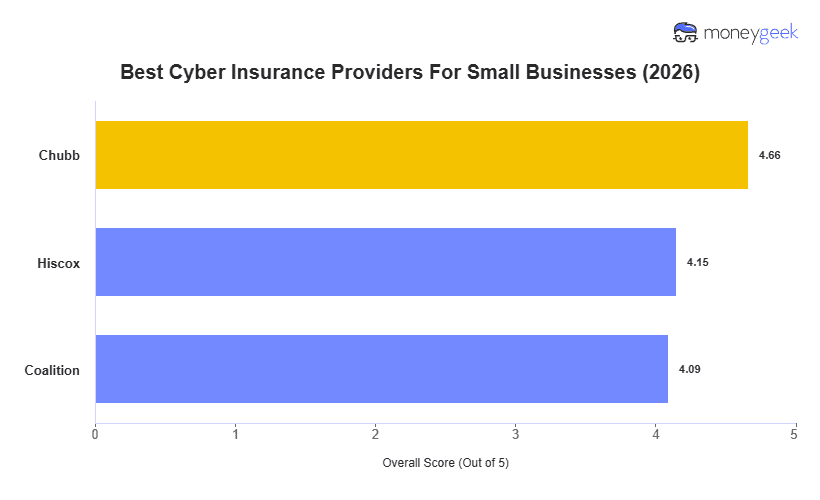
Hiscox ranks second overall in our cyber insurance analysis with an overall score of 4.15 out of 5. Its primary strength is cyber crime and social engineering coverage, where it earned the top score among all providers. For businesses where funds transfer fraud, invoice manipulation, or employee-targeted phishing are top risks, Hiscox offers the strongest policy terms in this category.

Where Hiscox performs best:

  • Businesses with high exposure to social engineering, wire fraud, and phishing attacks
  • Companies in financial services, consulting, or professional services industries
  • Those willing to pay higher base premiums for stronger cyber crime protection
  • Owners who value balanced pricing without paying the highest premiums

Where Hiscox performs less competitively:

  • Businesses needing the deepest first-party or breach response coverage and flexibility
  • Companies wanting built-in active risk management tools or threat monitoring
  • Buyers expecting the fastest or most guided digital buying experience

Learn More: Hiscox Insurance Review

Coalition

Coalition

Best for Tech-Forward Businesses and Risk Management

Coalition ranks third overall with a score and leads in two areas that set it apart from traditional cyber insurers: active risk management and the buying experience. Its coverage includes built-in threat monitoring, vulnerability scanning, and risk scoring that go beyond what a standard policy covers. 

For businesses that want ongoing cyber risk reduction alongside their insurance and more tech forward firms like those in IT or marketing, Coalition is the strongest option. However, keep in mind that the company is a brokerage and can only be purchased through partner insurance companies, not directly.

Where Coalition performs best:

  • Tech-forward businesses that want active threat monitoring and vulnerability alerts alongside coverage
  • Companies looking for the fastest, most guided digital buying experience
  • Businesses in tech/IT, marketing, and digital services where cyber risk management tools add the most value
  • Owners who prioritize prevention alongside financial protection after an incident

Where Coalition performs less competitively:

  • Indirect buying through partner insurers such as ERGO NEXT and The Hartford
  • Cost-sensitive businesses since Coalition is the most expensive provider in our study
  • Companies that prioritize claims handling above all other factors
  • Businesses with low digital exposure that won't benefit from active risk management tools

What Determines The Best Cyber Insurance For You

The best cyber insurance isn't defined by a single factor. The strongest providers balance affordability, customer experience, and coverage options across a wide range of business profiles. Three areas matter most when evaluating which insurer fits your business.

How to Choose The Best Cyber Insurance

Choosing the best cyber insurance comes down to confirming which factors matter most for your business and understanding how insurers differ across those areas. The step-by-step process here can help you narrow your options without starting the comparison process over.

  1. 1
    Assess Your Cyber Risk Profile

    Start by identifying what types of cyber risk your business actually has. Ask yourself:

    • Do you store customer personal data, health records, or financial information?
    • Do you process credit card payments or wire transfers?
    • Do your operations depend on digital systems, cloud services, or third-party software?
    • Have you or businesses like yours been targeted by phishing, ransomware, or social engineering?
    • Do contracts, clients, or regulations require you to carry cyber insurance?

    If your business stores sensitive data and processes payments, you'll need broad cyber insurance first-party and third-party coverage with strong incident response. If your primary risk is funds transfer fraud or employee-targeted phishing, social engineering coverage should be a top priority. And if you have low digital exposure but need a policy for contract requirements, a standard policy with competitive pricing may be enough.

    Read More: How Much Cyber Insurance Do I Need?

  2. 2
    Choose your primary priority

    Once your risk profile is clear, decide which factor will matter most over the next year:

    • Affordability if keeping costs predictable is your main concern
    • Customer experience if you expect to file claims, request certificates, or need fast post-breach support
    • Coverage depth if your risks are complex, regulated, or likely to change

    This priority becomes your main tiebreaker between otherwise strong providers.

  3. 3
    Shortlist Two Providers

    Based on your risk profile and primary priority, narrow your list to two providers. For most small businesses, the decision comes down to one of these pairings based on our top provider list:

    • Chubb vs. Coalition: broadest coverage at the best price (Chubb) vs. active risk management and the fastest buying process (Coalition)
    • Chubb vs. Hiscox: overall value and claims support (Chubb) vs. stronger cyber crime and social engineering terms (Hiscox)
    • Hiscox vs. Coalition: social engineering protection with mid-range pricing (Hiscox) vs. proactive threat monitoring at a higher cost (Coalition)
  4. 4
    Check for Dealbreakers Before Requesting Quotes

    Before investing more time, confirm each provider on your shortlist can meet your non-negotiables:

  5. 5
    Compare Your Finalists Using the Same Three Lenses

    For the providers that remain, compare them consistently across:

    • Affordability for your specific industry, state, and employee count, not just overall averages
    • Customer experience across buying, policy management, and claims, not just one stage
    • Coverage options for the risks that match your profile, not just the total number of features
      Using the same lenses helps you avoid being swayed by one strong feature while missing a weakness that matters for your business.
  6. 6
    Use Quotes as the Final Confirmation

    Once you've identified your best-fitting providers, request quotes to validate pricing and availability for your specific business details. Comparing quotes works best when used to confirm a good cyber insurance choice, not to decide between many unfamiliar options.

Best Small Business Cyber Insurance: Bottom Line

Chubb, Hiscox, and Coalition lead our rankings for cyber insurance, but your ideal provider depends on your industry, cyber risk profile, and coverage priorities. You'll get the best value by assessing your specific cyber risks, comparing two providers using the same coverage limits, and weighing affordability alongside breach response and coverage depth rather than focusing only on price.

Best Cyber Insurance For Small Business Chart

About Mark Flores


Mark Flores, Business Insurance Writer, MoneyGeek

Mark Flores is a Business Insurance Content Writer at MoneyGeek, where he focuses on commercial auto, commercial property, cyber and specialty business insurance coverage. His work simplifies coverage terms, gives business owners a strong baseline for expected costs, and narrows down policies and providers tailored to your operation, regardless of complexity.

Before joining MoneyGeek’s business insurance team, Mark worked as a Senior Content Writer at Clutch.co, where he produced structured B2B reviews and provider analyses based on client interviews, company research and service evaluation. That experience shaped his approach to business insurance content, especially when comparing insurers, explaining coverage differences and translating complex policy features into practical guidance for small business owners.

Mark also spent nearly 4 years as a digital marketing specialist serving small-business clients across industries such as home services, manufacturing and education. That background gives him practical context for how businesses evaluate vendors, manage operational needs and make purchasing decisions.

At MoneyGeek, he applies this research and evaluation experience to build guides that help transportation sectors, those with complex property-related risks (such as hotels and retail stores), and those most at risk of a cyberattack get the coverage they need at a reasonable price.

Linkedin: https://www.linkedin.com/in/mark-jason-flores-7844634a/

Contact Email: mark.flores@moneygeek.com