Cheapest Food Truck Business Insurance Companies

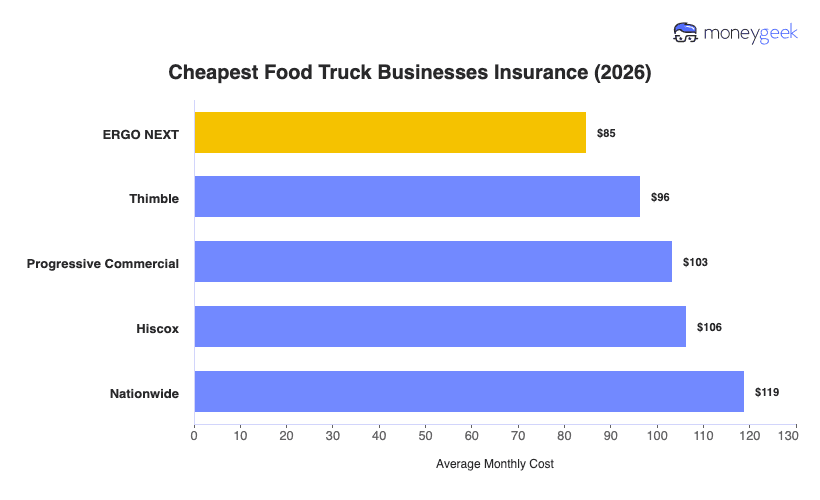
Insurers price food truck policies differently than restaurant coverage because the exposure combines a commercial kitchen with a street-operated vehicle, health permit dependencies and public-facing liability that shifts with every location. ERGO NEXT is the cheapest overall, followed by Thimble and Progressive Commercial. Only three of the seven providers we analyzed price below the food truck sub-industry average. The spread between the three is roughly $19 a month, so once you're comparing providers in this tier, coverage fit matters more than chasing the last few dollars of price difference.

The most affordable business insurance for food truck companies depends on your coverage mix, crew size and operating state. A two-person truck running daily permitted stops prices differently than a solo operator at a fixed weekly market, and those variables shift which of the three leads for your operation.

ERGO NEXT$85$1,017
Thimble$96$1,156
Progressive Commercial$103$1,241
Hiscox$106$1,277
Nationwide$119$1,425
biBERK$126$1,514
The Hartford$129$1,553

How We Determined the Cheapest Food Truck Business Insurance Providers

We gathered quotes for a standardized food truck business with one to four employees across all 50 states and Washington D.C. Coverage limits were $1 million per occurrence and $2 million aggregate for all policy types except workers' compensation, which follows state mandates.

Cheapest Food Truck Business Insurance by Coverage Type

For food truck insurance, the cheapest provider depends on which coverage you're pricing. ERGO NEXT leads on general liability, workers' comp and commercial property. Progressive Commercial takes commercial auto, the coverage your truck needs to legally be on the road. 

The provider that prices lowest on most of your coverages is not the same one that prices lowest on the coverage you can't skip, which means one quote is never enough. To find your lowest total cost, run ERGO NEXT and Progressive Commercial in parallel, compare them on the specific coverages each leads on, and build your coverage picture from both.

Workers' CompERGO NEXT$23$28031%
Commercial PropertyERGO NEXT$27$33025%
General LiabilityERGO NEXT$92$1,09838%
Commercial AutoProgressive Commercial$194$2,33225%

If you want to compare by coverage type, review options for each policy to find the best fit for your budget:

Cheapest Food Truck Business Insurance by State

Except for Hawaii, ERGO NEXT prices lowest across all states and the District of Columbia, making it the starting point for your comparison wherever your truck is based. Even within ERGO NEXT's territory, your state matters: in Idaho, Iowa and Montana, providers price close together and any of the top three gives you a competitive rate.

The states where the difference in savings is widest are also where food trucks concentrate most: New York, California, Texas and Illinois. In those markets, choosing correctly has more financial impact on your total cost there than it would in other states.

Alabama$70$84024%
Alaska$123$1,48020%
Arizona$82$98422%
Arkansas$70$83824%
California$116$1,39026%
Colorado$98$1,17118%
Connecticut$108$1,30222%
Delaware$87$1,03919%
Florida$109$1,30422%
Georgia$77$92828%
Idaho$57$68927%
Illinois$90$1,07530%
Indiana$74$89225%
Iowa$58$69824%
Kansas$71$85325%
Kentucky$75$90524%
Louisiana$82$97925%
Maine$89$1,06819%
Maryland$110$1,32518%
Massachusetts$108$1,29325%
Michigan$113$1,36027%
Minnesota$83$99527%
Mississippi$70$83725%
Missouri$82$98227%
Montana$67$81724%
Nebraska$68$81825%
Nevada$88$1,05322%
New Hampshire$77$92321%
New Jersey$111$1,33623%
New Mexico$70$84420%
New York$107$1,28530%
North Carolina$85$1,01521%
North Dakota$75$90227%
Ohio$93$1,11724%
Oklahoma$69$83227%
Oregon$87$1,04823%
Pennsylvania$74$88718%
Rhode Island$100$1,20120%
South Carolina$84$1,00717%
South Dakota$76$91625%
Tennessee$71$85728%
Texas$90$1,07930%
Virginia$97$1,17318%
Wisconsin$68$82025%
Hawaii$69$83229%
Utah$75$89525%
Vermont$69$83319%
Washington$106$1,27225%
Washington D.C.$127$1,52121%
West Virginia$78$93717%
Wyoming$78$93327%

Is the Cheapest Insurance Right for Your Food Truck Business?

An affordable policy could still be the best food truck business insurance for your operation if it meets your permit requirements, covers your truck's value and handles claims without leaving your kitchen idle. To make sure you're not leaving your operations underinsured, focus on the following:

  • Coverage limits: Make sure GL limits meet your venue and permit requirements, with most food truck locations requiring $1 million per occurrence. Commercial auto limits should reflect your truck's actual replacement cost.
  • Deductibles: A high commercial auto deductible puts your cash flow at real risk. If an accident takes your truck off the road, you need cash available before your kitchen can reopen.
  • Add-ons: Food spoilage coverage and equipment breakdown are the two add-ons your food truck is most likely to need. Check whether your base policy excludes either before assuming both are included.
  • Claims handling and customer service: Every day your truck is out of service after a claim is a day without revenue. Slow claims resolution costs you more than a slightly higher premium would.

Yes: Get matched to cheapest providers

No: How to get more affordable coverage without being underinsured

How to Get More Affordable Coverage Without Being Underinsured

Lowering your food truck business insurance cost doesn't require cutting coverage, though it might require buying it more efficiently. These six strategies can reduce what you pay without leaving your operation exposed.

    smallBusiness icon
    Bundle policies with the same provider

    Your food truck operates as a vehicle, a kitchen and a public-facing business from the same asset, which makes general liability, commercial auto and commercial property a natural bundle. Carrying all three through one provider often qualifies you for a multi-policy discount. Before treating each coverage as a separate purchase, ask any provider you're quoting whether a bundled rate is available for your full coverage set.

    checkList icon
    Check your business classification code

    Insurers partly determine your premium by how they classify your business. Your truck may be filed under restaurant or food service codes that carry different risk assumptions than a mobile vendor operating from a permitted vehicle. If your premium seems high relative to other food truck operators, ask your provider what classification code your policy uses. A wrong code could be the reason.

    money2 icon
    Raise your deductible strategically

    A higher deductible reduces your premium, but the tradeoff matters more on some coverages than others. Raising the deductible on your commercial property coverage, which covers your cooking equipment and supplies, is lower risk than raising it on general liability, where a food safety or customer injury claim can arrive without warning. Adjust where your out-of-pocket exposure is manageable, not across every coverage uniformly.

    vsDocuments icon
    Compare quotes using the same coverage limits

    If you operate at permitted markets or book private events, your venue contracts likely specify minimum general liability limits. Quoting below those thresholds to get a lower number gives you a policy you can't actually use at most locations. Make sure every provider is quoting the same limits, then compare. You're not comparing protection otherwise, you're comparing gaps.

    calendarV2 icon
    Pay annually instead of monthly

    If you pay month to month, your insurer adds a financing fee that quietly raises your annual total. Paying upfront removes it entirely. If your revenue from regular markets, corporate lunch accounts or recurring venue bookings is steady enough to cover the annual premium, the switch almost always costs less overall. For seasonal operations, time the annual payment to your busiest months rather than stretching it across the off-season.

    lowUnemploymentRate icon
    Reduce your claim risk

    Your renewal pricing improves when you go claim-free, and your two highest-frequency risks as a food truck operator are food safety incidents and vehicle accidents. ServSafe certification and documented food handler training reduce your GL exposure. A dash cam on your truck protects you in commercial auto disputes. Slip-resistant matting at your service window and documented equipment maintenance records show insurers a lower-risk operation at renewal.

Cheap Food Truck Business Insurance: Bottom Line

ERGO NEXT, Thimble and Progressive Commercial are the most affordable options for food truck insurance, but which carrier gets you to the lowest total cost depends on how your operation is built. A single truck with a small crew and beer-and-wine service can likely consolidate with one carrier, while a multi-truck operation with a larger staff, alcohol service and private event bookings probably can't. Your operational complexity, not your location, determines how many carriers you need to compare to find affordable food truck business insurance.

Cheap Food Truck Business Insurance: Next Steps

Before comparing rates, know that your food truck's cost splits along the same line as its risks: vehicle coverage prices differently from kitchen coverage. Your crew size, road time and venue type determine which side drives your total.

When you're ready to compare, start by separating vehicle risk from kitchen risk, because the providers that price each lowest are not the same. Get quotes on the same limits, compare providers on the coverages each leads on and check whether bundling changes your total.

If your truck crosses state lines for events or festival circuits

If your truck serves beer, wine or spirits

If your operation has changed since your last renewal

If you primarily work private events rather than street permits

How We Determined the Cheapest Food Truck Business Insurance Providers

To identify the cheapest food truck business insurers, we analyzed real pricing data from seven major providers and modeled a large set of standardized pricing estimates across common U.S. food truck business profiles.

Dataset scope and assumptions

  • Providers analyzed: 7 major insurance providers
  • Geography: all U.S. states and territories (including Washington, D.C.)
  • Employee count bands: 0, 1–4, 5–9, 10–19 and 20–49 employees
  • Policy baseline: standard $1 million per occurrence / $2 million aggregate for all coverage types except workers' comp, which uses state-mandated coverage limits
  • Pricing estimates modeled: 196,000 total estimates

We also incorporated modeled average revenues and payrolls across food truck food truck profiles to improve pricing accuracy.

How we determined which provider was "cheapest"

We used this dataset to determine which insurers were most often the lowest-cost option across different food truck business profiles. Our "cheapest" rankings include both:

  • General Recommendation: Provider rankings based on average estimated pricing for a standardized 1–4 employee business profile across all food truck sub-industries in our dataset.
  • Factor Combination Recommendations: Provider rankings based on which insurer was most often cheapest within specific business factor combinations. For example:
    • Food Truck pricing was compared using a standardized 1–4 employee profile
    • Coverage type affordability was derived by comparing aggregated pricing trends across food truck sub-industries

Important note: These results represent standardized pricing estimates, not personalized quotes. Actual pricing can vary based on your business classification, revenue/payroll, claims history and the specific limits, deductibles and endorsements you choose. For the most accurate cheapest-provider answer, we recommend comparing quotes apples-to-apples using the same coverage limits.

About Connor Bolton


Connor Bolton headshot

Connor Bolton is Senior SEO and Content Manager at MoneyGeek, where he leads the business and pet insurance editorial teams. As editorial lead for both verticals, Connor sets the research framework, data standards, and content structure that his writers execute, directly authoring in-depth guides himself and reviewing all team content for accuracy and practical value before it goes live. With over four years evaluating insurance products across personal, commercial, and specialty lines, he brings cross-vertical knowledge to every guide the team produces.

Connor architected MoneyGeek's insurance research infrastructure across all major verticals including auto, home, renters, life, health, business, and pet, building systems for pricing analysis, provider-level research, customer experience evaluation, and coverage analysis with AI support. The infrastructure includes over 6 million data points for business insurance across 408 industry areas, all 50 states, and 16 vehicle types, and over 5 million pet insurance profiles across 18 major providers and hundreds of breed and age combinations. Connor's insurance cost research and his team's work has been cited by the U.S. Chamber of Commerce, Allstate, Liberty Mutual, CBS News, Forbes and LegalZoom.

Beyond the data, Connor stays connected to how the market actually operates, drawing on direct conversations with underwriters and carrier liaisons at Ethos, The Hartford, NEXT Insurance, Nationwide, and State Farm, and monitoring business and pet owner communities including Reddit, to inform how he interprets findings and frames guidance for real buyers.

He is the direct editorial contact for methodology questions at connor@moneygeek.com and can be found on LinkedIn.