Best California Workers' Comp Insurance: Fast Answers

What are the best and cheapest workers' comp insurance providers in California?

Is workers' comp insurance required in California?

How much does workers' comp insurance cost in California?

How do you get workers' comp insurance in California?

What does California workers' comp insurance cover?

Best Workers' Comp Insurance Companies in California

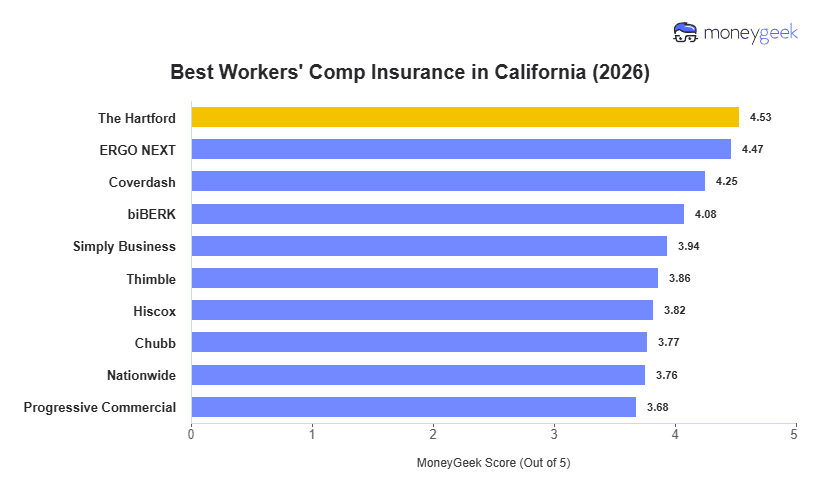
The Hartford leads California workers' comp rankings with the top MoneyGeek score, combining the second-highest affordability score in the state with a strong claims performance ranking. ERGO NEXT ranks second with the lowest overall monthly rate among all California providers at $188 per employee.

The rate spread between ERGO NEXT ($188/month) and the most expensive provider, Progressive Commercial ($286/month), is $98. California's rate range is compressed relative to the dollar spread because all carriers face the same elevated California loss costs. For professional-sector employers, the rate advantage at the low end is most pronounced in financial services and consulting categories.

The Hartford4.53$19333
ERGO NEXT4.47$18816
Coverdash4.25$24651
biBERK4.08$24488
Simply Business3.94$28022
Thimble3.86$25199
Hiscox3.82$275610
Chubb3.77$31344
Nationwide3.76$28265
Progressive Commercial3.68$28697

How Did We Determine These Rates and Rankings?

While the top workers' comp insurers presented here could be your ideal overall match, that not always the case. Industry needs for coverage, affordability and actual experience with dealing with claims and issues related to running your company are vastly different between providers. 

Investigate our recommendations specific to your industry below for a more tailored match.

The Hartford

The Hartford

Best Workers' Comp Insurance in California

MoneyGeek Rating
4.5/ 5
4.6/5Affordability Score
4.1/5Customer Experience Score
3.8/5Coverage Score
  • Average Monthly Cost

    $193
  • Claims Processing Score

    4.1/5
  • Policy Management Score

    4/5
  • Buying Process Score

    4/5
ERGO NEXT

ERGO NEXT

Best California Workers' Comp Insurance: Runner-Up

MoneyGeek Rating
4.5/ 5
4.7/5Affordability Score
4/5Customer Experience Score
3.5/5Coverage Score
  • Average Monthly Cost

    $188
  • Claims Processing Score

    4/5
  • Policy Management Score

    4.1/5
  • Buying Process Score

    4.4/5

Cheapest Workers' Comp Insurance in California

ERGO NEXT offers the cheapest workers' comp coverage in California at $188 per month, but the more useful finding from our analysis is how close the next tier runs. The Hartford comes in at $193, just $5 more per month, with a claims network and customer service infrastructure that a digital-first carrier like ERGO NEXT doesn't match. For most California small businesses, that $60 annual difference is worth evaluating against what you're giving up in service access.
The $125 monthly gap between ERGO NEXT and Chubb is the widest spread in our California workers' comp data. That gap represents nearly $1,500 in potential annual savings over the most expensive option on this list.

ERGO NEXT$188$2,256
The Hartford$193$2,316
biBERK$244$2,928
Coverdash$246$2,952
Thimble$251$3,012
Hiscox$275$3,300
Simply Business$280$3,360
Nationwide$282$3,384
Progressive Commercial$286$3,432
Chubb$313$3,756

Cheapest Workers' Comp Insurance in California by Industry

When comparing the cheapest worker's comp providers by industry in California, the pattern that jumps out most in our analysis is the provider split: ERGO NEXT prices wins in physical, labor-intensive industries, while The Hartford leads in desk-based and professional services. Construction workers' comp runs $446 per month through ERGO NEXT. Consulting, by contrast, costs $33 per month through The Hartford.

The Hartford has the cheapest rates for every low-risk professional category in our analysis, including financial services at $16 per month and real estate at $35 per month. Those rates reflect both The Hartford's underwriting appetite for white-collar risk and California's classification system, which ties premiums directly to job hazard level.

Agriculture & Natural ResourcesERGO NEXT$262$3,144
Arts, Media & EntertainmentERGO NEXT$180$2,160
Beauty, Body & Wellness ServicesERGO NEXT$24$288
Childcare ServicesERGO NEXT$75$900
Cleaning ServicesERGO NEXT$210$2,520
Construction & ContractingERGO NEXT$446$5,352
Consulting ServicesThe Hartford$33$396
EducationERGO NEXT$124$1,488
Financial ServicesThe Hartford$16$192
Fitness ServicesERGO NEXT$129$1,548
Food & BeverageERGO NEXT$80$960
Healthcare & MedicalThe Hartford$87$1,044
Hospitality, Travel & TourismThe Hartford$82$984
ManufacturingERGO NEXT$285$3,420
Marketing & CommunicationsERGO NEXT$45$540
Nonprofit & AssociationsThe Hartford$118$1,416
Other Professional ServicesThe Hartford$39$468
Pet Care ServicesERGO NEXT$107$1,284
Real Estate & Property ServicesThe Hartford$35$420
Recreation & SportsERGO NEXT$196$2,352
Repair & MaintenanceERGO NEXT$146$1,752
Retail & Product RentalThe Hartford$107$1,284
Tech/ITThe Hartford$64$768
Transportation & LogisticsERGO NEXT$556$6,672
Wholesale & DistributionERGO NEXT$359$4,308

Cheapest for one coverage type doesn't necessarily mean the lowest cost for all of your business's coverage needs. Each policy covers different risk, and depending on a company's appetite to cover them, pricing will be vary widely. To get more detail on who has the most affordable coverage overall for your company, review the industry resources below.

How Much Is Workers' Comp Insurance in California?

In our analysis, California workers' comp costs are well above the national average across nearly every industry, averaging $256 per month overall. The $747 monthly gap between California's cheapest and most expensive industries is the most striking finding in our data. Financial services employers pay $25 per month while construction and transportation companies pay $728 and $772 respectively. That spread exists because workers' comp pricing is built around injury probability and claim severity.
The split between knowledge-work industries and physical-labor industries is sharper here than in most states. California's workers' comp system includes some of the highest medical cost benchmarks in the country, which compresses savings at the low end and amplifies costs at the high end.

Financial Services$25$300
Beauty, Body & Wellness Services$32$384
Consulting Services$48$576
Other Professional Services$49$588
Real Estate & Property Services$52$624
Marketing & Communications$60$720
Childcare Services$95$1,140
Tech/IT$97$1,164
Food & Beverage$107$1,284
Hospitality, Travel & Tourism$109$1,308
Healthcare & Medical$127$1,524
Retail & Product Rental$147$1,764
Pet Care Services$151$1,812
Nonprofit & Associations$153$1,836
Education$166$1,992
Fitness Services$169$2,028
Repair & Maintenance$198$2,376
Arts, Media & Entertainment$238$2,856
Recreation & Sports$277$3,324
Cleaning Services$300$3,600
Agriculture & Natural Resources$356$4,272
Manufacturing$371$4,452
Wholesale & Distribution$478$5,736
Construction & Contracting$728$8,736
Transportation & Logistics$772$9,264

Commercial insurance costs seldom come down to just workers' comp and other coverage types like general liability and commercial auto are a part of most people's bundles. So, to get a better grasp on what pricing looks like in total, use our industry level guides below.

California Workers' Comp Insurance Cost Factors

California's workers' comp system is administered by the Division of Workers' Compensation under the California Department of Industrial Relations. The Workers' Compensation Insurance Rating Bureau of California (WCIRB) develops pure premium rates; carriers file their own rates independently with the California Department of Insurance. California's regulatory complexity, high wage base, and mandatory Medical Provider Network requirements are among the primary cost drivers for employers in the state.

How Much Workers' Comp Insurance Do I Need in California?

California law requires workers' compensation coverage for every employer, regardless of team size. Required benefits include full medical coverage with no dollar cap, temporary disability payments at two-thirds of average weekly wages and permanent disability benefits tied to injury severity. Premiums are calculated based on payroll and industry classification.

Failing to carry required workers' comp coverage is a serious violation in California that can result in criminal charges, $10,000 in fines and possible imprisonment.

California Workers' Comp Insurance Exemptions

While coverage is often required in California, some business categories are exempt from workers' comp requirements:

  • Sole proprietors: California law bars sole proprietors from being employees of their own company, so self-employed workers don't need workers' comp for themselves. Roofers must get coverage even when working alone.
  • Independent contractors: Contractors must pass California's three-part ABC test to qualify for exemption from contractor workers' comp. The test confirms they work independently, outside your control or direction.
  • Corporate officers (10%+ ownership): Officers owning at least 10% can opt out by filing a written waiver and keeping active health insurance.
  • General partners and LLC managing members: Managing members can waive coverage by filing written documentation with their insurance carrier.
  • Family members: California exempts your parent, spouse or child from workers' comp requirements when you employ them.
  • Domestic workers (limited hours): Workers employed fewer than 52 hours or earning under $100 within 90 days qualify for exemption.
  • Volunteers: Unpaid volunteers at nonprofit organizations don't require coverage.
  • Professional corporation owners: Licensed professionals can waive workers' comp by maintaining health insurance and filing the required documentation.
mglogo icon
FEDERAL WORKERS' COMP PROGRAMS OVERRIDE STATE REQUIREMENTS

Federal employees working in California fall under the Federal Employees' Compensation Act (FECA). Railroad workers are covered by FELA rather than California law. Workers at California's ports and harbors performing qualifying maritime work are covered by the Longshore and Harbor Workers' Compensation Act. California's AB5 independent contractor rules do not affect the federal exemptions, but they do affect which California workers are classified as employees subject to state coverage mandates.

While most people need workers' comp if they have employees, you often need more coverage than just this to stay compliant and keep your business financially protected from risk. Below we've left guides that break down your coverage needs by industry for your review to fill in any gaps.

How to Get the Best Workers' Comp Insurance in California

Follow these steps to get the right workers' comp coverage for your California business, including options through the State Compensation Insurance Fund.

  1. 1
    Confirm Coverage Is Required

    The state of California requires workers' compensation coverage for any employer with at least one employee. Sole proprietors and certain corporate officers may qualify for exemptions. The California Division of Workers' Compensation administers the requirement, and willful non-compliance is a criminal offense.

  2. 2
    Classify Employees Under California's Class Code System

    California uses the WCIRB class code system, which differs from the NCCI codes used in most other states. Identify the correct California class code for each job function before binding coverage. Misclassification triggers audit adjustments that can add hundreds or thousands of dollars to your final premium.

  3. 3
    Understand California's MPN Requirements

    State employers who establish a Medical Provider Network (MPN) can direct injured workers' medical care and manage costs more effectively. Carriers will advise whether their MPN is active in your location. Review MPN access before choosing a carrier, as it affects both claims management and employee experience.

  4. 4
    Request Quotes from Multiple Carriers and the State Fund

    The California State Compensation Insurance Fund accepts most employers without restrictive underwriting, making it a practical starting point for businesses that have struggled to find coverage in the private market. Include State Fund alongside The Hartford, ERGO NEXT and Coverdash when comparing quotes. Its filed rates serve as a reliable benchmark for evaluating private market pricing.

  5. 5
    Compare Rates by Your Specific Industry Class Code

    California's per-industry rate variation is large. Financial services employers pay roughly $25/month (state average); construction employers pay $728/month on average (state average). Match your class code against the cheapest-by-industry data before finalizing a carrier choice.

  6. 6
    Bind Coverage and File with the California Division of Workers' Compensation

    Proof of coverage is required before employees begin work. California also requires employers to post the "notice to employees" form provided by the carrier. Keep the certificate current and accessible at your worksite.

  7. 7
    Prepare for California's Annual Payroll Audit

    Workers' comp premiums are audited annually. California's dynamic economy, with seasonal construction, agricultural, and entertainment industry employment patterns, creates payroll variability. Maintain detailed payroll records by class code throughout the year to minimize audit disputes.

Bottom Line and Next Steps

The Hartford has the best workers' comp insurance in California with the strongest MoneyGeek score and the best provider-specific rates for financial services, tech, consulting, and health care. ERGO NEXT follows with the lowest overall monthly rate at $188 and the best per-industry rates for beauty, marketing, food, and agricultural categories. The right choice for you should balance the state's high wage replacement costs, mandatory MPN compliance, and claims performance against the rate that matches your specific industry class code.

Best Workers' Comp Insurance in California Chart

Next Steps

California's AB5 classification requirements affect which workers must be covered as employees, so confirm worker classification before finalizing your headcount for premium calculation. The State Compensation Insurance Fund should be included in any California quote comparison alongside private carriers.

mglogo icon
WANT TO LEARN MORE ABOUT OTHER BUSINESS INSURANCE TYPES?

Workers' comp is only one part of commercial insurance that you likely need. Check our other resources for coverage in the state below to ensure you have comprehensive coverage:

California Workers' Compensation Insurance FAQs

What are the criminal vs. civil penalties for workers' comp non-compliance in California?

Are remote and work-from-home employees covered under California workers' comp?

How does California's experience rating system affect my workers' comp premium?

Can corporate officers and sole owners opt out of California workers' comp?

What is the difference between workers' comp and employer's liability in a California policy?

How long does a workers' comp claim stay on a California employer's record?

MoneyGeek analyzed workers' comp insurance rates and provider performance across Michigan using small business profiles with 1 to 4 employees spanning 408 major industries. Companies earn up to five points in each category in our scoring system. We then use a weighted average of these category scores to calculate a MoneyGeek score out of five.

  • Affordability (55%): Based on average payroll for the most common employee code per industry and state classification, priced per employee for a 1 to 4 employee business.
  • Customer Experience (35%): Evaluates buying (20%), which covers quote access, pricing accuracy and sales support; policy management (30%), which covers payroll reporting, audits, billing and loss control; and claims (50%), which covers FNOL speed, adjuster support, medical access, wage replacement and dispute handling.
  • Coverage Options (10%): Assesses coverage completeness (35%), including employers' liability and wage and medical reimbursement; policy flexibility and endorsements (25%); eligibility, state and industry breadth (20%); and policy terms, limits and exclusions (20%).

About Connor Bolton


Connor Bolton, Senior SEO and Content Manager (Business & Pet), MoneyGeek

Connor Bolton is Senior SEO and Content Manager at MoneyGeek, where he leads the business and pet insurance editorial teams. He sets the research framework, data standards and content structure for his team. All content goes through his accuracy review before publication. Connor also writes in-depth guides and has spent more than four years covering insurance products across personal, commercial and specialty lines.

The research infrastructure Connor built covers auto, home, renters, life, health, business and pet insurance across pricing analysis, carrier research, customer experience and coverage evaluation. It includes over 6 million data points for business insurance across 408 industry areas, all 50 states and 16 vehicle types. The pet insurance side covers over 5 million profiles across 18 major providers, 100+ breeds and ages up to 20 years. Connor’s insurance research and his team's work has been cited by the U.S. Chamber of Commerce, Allstate, Liberty Mutual, CBS News, Forbes and LegalZoom.

Connor also talks with underwriters and carrier liaisons at Ethos, The Hartford, ERGO NEXT, Nationwide and State Farm, and monitors business and pet owner communities on Reddit. Those sources shape how his team evaluates carriers, structures rate analysis and writes for human buyers rather than search engines.

For questions about MoneyGeek's business and pet insurance content, contact him at connor@moneygeek.com or on LinkedIn.


Sources