
Best Workers' Comp Insurance Companies For Small Businesses

No single workers' comp insurer fits every small business, but the following five companies offer the strongest combination of pricing, service quality, and policy features across industries and business profiles.

  • ERGO NEXT: Best overall, Best for hands-on industries
  • The Hartford: Best for Professional Services
  • Coverdash: Best for Personal Service and Fitness Businesses
  • Nationwide: Best for Agricultural Businesses
  • biBERK: Best for Recreation and Sports Businesses

These providers balance affordability, customer experience, and coverage options, making them reliable starting points for small businesses. The sections below explain why each insurer made the top five and where its strengths align with specific business needs.

ERGO NEXT
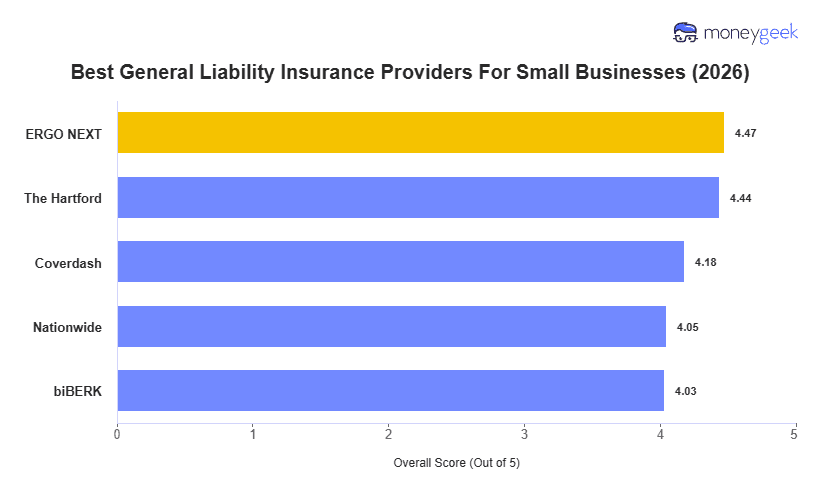
4.47
Best overall balance of affordability and digital buying experience, with the strongest value for very small businesses in hands-on industries.
The Hartford
4.44
Strong policy management and claims coordination across professional service industries, with competitive rates for established firms.
Coverdash
4.18
Multi-carrier platform finds the most competitive rates for service and fitness businesses, with top coverage options and fast quote generation for same-day coverage.
Nationwide
4.05
Reliable claims handling with dedicated adjusters and return-to-work support, especially competitive for agricultural operations and mid-sized employers.
biBERK
4.03
Instant online quoting with competitive rates for recreation and sports businesses prioritizing fast digital purchasing over claims support.

For our overall best workers' comp insurance ratings, we analyzed pricing, coverage options, and customer experience across 408 industries and all 46 competitive states and Washington, D.C. Our analysis focuses on businesses with 1–49 employees, which represent approximately 81% of U.S. small businesses, using the most common workers' comp classification codes for each industry to ensure rate accuracy.

To do this, we evaluated over one million business profiles with per-employee pricing calculations, more than 180,000 customer experience data points, and performed in-depth analysis of employers' liability limits, owner coverage options, and endorsement availability to compare insurers consistently across industries and regions. We then rated each company across categories of affordability (55% of overall score), customer experience (35% of overall score), and coverage options and terms (10% of overall score) to form an overall rating.

For a detailed breakdown of the metrics, scoring methodology, and pricing analysis, see our full methodology.

92%
% of Small Businesses Covered
Over 700,000
Business Profiles Studied
Over 180,000
Customer Experiences Analyzed

Find The Best Workers' Comp Insurance For Your Business

Select your industry and state to get a customized quote from your best workers' comp insurer match.

Industry
State
Company Image
Best Overall, Best for Hands-on Industries

ERGO NEXT

ERGO NEXT ranks first overall, delivering the strongest value across affordability and digital experience. The platform generates quotes in 10 minutes with instant certificates and leads in policy management tools, while average rates of $86 per employee monthly save businesses 24% compared to the national average.

Where ERGO NEXT performs best:

  • Very small businesses (one to four employees)
  • Hands-on industries like contracting, beauty, repair and maintenance
  • Businesses in Southeast, Midwest, Mountain and Pacific regions
  • Companies that prioritize speed, digital access and ease of purchase

Where ERGO NEXT performs less competitively:

  • Product-based firms needing completed operations coverage customization
  • Businesses requiring advanced endorsements or high coverage limits

Learn More: ERGO NEXT Business Insurance Review

Company Image
Best for Professional Services

The Hartford

The Hartford comes in second in our analysis, ranking third for coverage and customer experience. The provider is second in affordability, with professional service businesses across 27 states saving 18% on average compared to the national average. While its strong policy management tools work well for established businesses, the buying process ranks lower with setup delays after purchase and slower quote turnaround times.

Where The Hartford performs best:

  • Professional service firms with 5-19 employees across 27 states
  • Businesses needing agent-supported policy management and certificate generation
  • Companies requiring large provider networks and dedicated claims case managers
  • Established firms prioritizing cost predictability over fast self-service quoting

Where The Hartford performs less competitively:

  • Very small businesses or hands-on industries seeking lowest rates
  • Companies prioritizing fast online quoting without agent involvement

Learn More: The Hartford Business Insurance Review

Company Image
Best for Personal Service and Fitness Businesses

Coverdash

Coverdash ranks third overall, leading in coverage options while performing less competitively in customer experience and mid-pack in affordability. Service-based and fitness businesses find the lowest rates through its multi-carrier comparison platform, though class code accuracy and guidance require businesses to verify details independently rather than relying on platform support. 

Where Coverdash performs best:

  • Personal service and fitness businesses seeking competitive carrier-comparison rates
  • Businesses comfortable verifying class codes and coverage details independently
  • Companies prioritizing fast quote generation and same-day coverage availability
  • Employers needing flexible owner/officer coverage across different business structures

Where Coverdash performs less competitively:

  • Businesses requiring ongoing broker support beyond initial policy purchase
  • Companies preferring guided class code selection and detailed coverage explanations

Learn More: Coverdash Review

Company Image
Best for Agricultural Businesses

Nationwide

Nationwide ranks fourth overall with reliable claims handling through dedicated adjusters and return-to-work coordination. Agricultural businesses and mid-sized employers save 4% on average. Agent-dependent quoting causes slower turnaround and potential class code errors requiring audit corrections. 

Where Nationwide performs best:

  • Agricultural operations like small farms, poultry, dairy, and greenhouses
  • Mid-sized businesses with 20–49 employees seeking competitive rates
  • Employers prioritizing dedicated adjusters and return-to-work programs
  • Businesses valuing flexible premium audit submission options

Where Nationwide performs less competitively:

  • Businesses requiring instant online quoting without agent involvement
  • Companies with complex operations needing precise class code assignment

Learn More: Nationwide Review

Company Image
Best for Recreation and Sports Businesses

biBerk

biBERK delivers instant online workers' comp quoting and binding for recreation, sports, and entertainment businesses seeking fast coverage without agent involvement. Its digital platform excels at speed but sacrifices post-purchase support. Claims service lags with limited adjuster communication, and coverage options remain fixed at standardized limits. 

Where biBERK performs best:

  • Recreation and sports businesses like gyms, entertainment venues, sports coaching
  • Companies needing immediate coverage without agent callback delays
  • Businesses comfortable with digital policy management and instant certificate access
  • Low-injury operations valuing purchase speed over claim coordinator relationships

Where biBERK performs less competitively:

  • Businesses expecting frequent injuries requiring dedicated adjuster support
  • Companies needing flexible employers' liability limits beyond fixed $1 million
  • Operations requiring extensive endorsements or on-site safety consultations

Learn More: biBERK Review

Explore The Best Workers' Comp Insurance By Industry

If you want more a more personalized best workers' comp insurance provider recommendations, we've provided industry level resources below.

Explore The Best Workers' Comp Insurance By State

Workers' comp requirements and rates vary significantly by state. Find your state below to see which providers offer the best combination of affordability, coverage, and claims support in your area.

What Determines The Best Workers' Comp Insurance For You

The provider with the best workers' comp insurance balances pricing stability, service quality, policy features and reliable performance across different business profiles. These four factors separate insurers that work well on paper from those that work well in practice.

    money2 icon
    Stable Pricing That Doesn't Spike at Renewal

    Workers' comp pricing reflects your business's risk profile, and costs can shift when your operations change. Predictable pricing over time outweighs low initial quotes. Factors that affect your premium include:

    • Industry classification code and associated injury rates
    • Total payroll and number of employees
    • Claims history and loss experience
    • State requirements and where your employees work

    Surprise rate increases at renewal disrupt budgets, especially for businesses that hire seasonally or expand into new locations.

    talk icon
    Responsive Support and Less Disruptive Audits

    Workers' comp requires regular interaction with your insurer, from day-to-day policy management to required audits. The strongest insurers make these interactions straightforward:

    • Getting certificates of insurance for client contracts
    • Reporting payroll changes and workforce adjustments
    • Filing claims when employees get injured
    • Clear guidance on what paperwork audits need
    • Correct job classifications during audits
    • Fast audit completion without repeated requests

    Because workers' comp is highly regulated, insurers audit your business to verify your payroll and employee information. When touchpoints with your insurer break down or audits require multiple rounds of paperwork, you'll likely experience contract delays, frustrated employees, and surprise premium adjustments that disrupt your budget.

    insurance2 icon
    Policy Features That Make Coverage Work Better

    Your state dictates coverage limits for employee medical benefits and lost wages, but employer's liability limits (Part B of your policy) protect you if an employee sues outside the workers' comp system. Insurers that offer higher limits beyond the standard $100,000 provide better protection for businesses with larger payrolls or higher-risk operations. You should also consider features that simplify policy management:

    • Pay-as-you-go payroll reporting (prevents surprise audit bills)
    • Online certificate generation (instant proof of coverage for contracts)
    • Streamlined audit processes (less paperwork at year-end)
    building icon
    Consistent Performance Regardless of Your Business Profile

    The best insurers maintain reliable service quality, competitive pricing, and responsive claims handling across industries, team sizes, and locations. This consistency matters when you expand your business, hire across state lines, or change your service offerings.

How to Choose The Best Workers' Comp Insurance

Choosing the right workers' comp provider starts with clarifying what matters most for your business and understanding how insurers differ across pricing, service, and policy features. The steps below help you narrow options in a logical order without restarting from scratch.

  1. 1
    Determine your coverage needs and policy structure

    Workers' comp coverage is required by law in most states, but you control decisions like employer's liability limits, whether to include owners and partners, and optional endorsements like waiver of subrogation. Your industry classification, payroll structure, and number of employees also affect what you need.

    Ask yourself:

    • Do I need higher employer's liability limits based on my payroll size or contract requirements?
    • Should I elect coverage for business owners or partners who aren't required to be covered?
    • Do my client contracts require waiver of subrogation or other endorsements?
    • Will my workforce or locations change significantly during the policy term?
  2. 2
    Determine what matters most

    Decide which factor matters most right now: affordability, customer experience or policy features. Your unique business profile affects which priority makes the most sense.

    • Affordability: Prioritize if you need predictable budgeting and your business has stable operations with low claims risk.
    • Customer experience: Prioritize if you frequently need certificates for contracts, manage multiple locations or have employees who file claims regularly.
    • Policy features: Prioritize if you need streamlined payroll reporting, higher liability limits, or specific endorsements for client contracts.

    Use this to break any ties when you compare similar providers.

  3. 3
    Shortlist your top providers

    Narrow to two to three insurers that match your chosen priority and can handle your industry classification, team size, and operating locations. Verify each provider writes workers' comp in your state and has experience with businesses similar to yours. Skip providers that don't offer the policy features you identified in step one, like pay-as-you-go payroll reporting or online certificate generation.

  4. 4
    Double-check dealbreakers early

    Confirm non-negotiables before investing time in detailed comparisons. Common dealbreakers for workers' comp include:

    • Eligibility restrictions for your industry or business size
    • Limited availability in states where your employees work
    • Lack of required endorsements (waiver of subrogation, additional insured)
    • No online certificate access or slow turnaround for contract documentation
    • Poor claims service reputation in your industry
  5. 5
    Compare top providers using the same three lenses

    Evaluate your shortlist across all three factors to see where each provider excels:

    • Affordability: Look at renewal pricing predictability and how the insurer handles payroll audits, not just the initial quote.
    • Customer experience: Look at turnaround times for certificates, ease of reporting payroll changes, and responsiveness when filing claims.
    • Policy features: Look at employer's liability limit options, pay-as-you-go availability and whether the insurer offers the endorsements you need.

    Use your primary priority from the second step to break ties when providers perform similarly across all three areas.

  6. 6
    Use quotes as the final confirmation step

    Request quotes from your two or three finalists to validate pricing and confirm they can support your actual business details. Quotes verify the insurer can handle your specific industry classification, payroll structure and locations where employees work, helping you confirm the right fit before committing.

Best Small Business Workers' Comp Insurance: Bottom Line

ERGO NEXT, The Hartford, Coverdash, Nationwide and biBERK lead the rankings for workers' comp insurance, but the right fit depends on your industry classification, business size and where your employees work. The strongest choice balances pricing stability, responsive service and policy features rather than defaulting to the lowest quote. This approach matches coverage to your actual risk profile and budget.

Best General Liability Insurance For Small Business Chart

Best Workers' Comp Insurance For Small Business: Next Steps

If you're ready to move forward, narrow your options to one or two providers and confirm pricing and availability using the same coverage assumptions for your business. This way, you'll avoid misleading comparisons and validate which insurer offers the best combination of affordability and policy features for your industry classification, payroll and locations.

If you need to confirm what workers' comp will actually cost

Understanding typical cost ranges and what drives pricing helps you set realistic expectations before requesting quotes, since workers' comp premiums vary widely based on your industry's risk level, payroll size and claims history.

If you're unsure whether standard coverage is enough

Clarifying your coverage needs now prevents discovering gaps when you file a claim or when clients request proof of insurance.

If you're ready to request quotes and compare options

Use quotes to validate assumptions from your shortlist and confirm eligibility and pricing tied to your specific industry classification, payroll and operating locations. Quotes help you verify fit, not restart your search.

Find The Best Workers' Comp Insurer For Your Business

Select your industry and state to get a customized quote from your top workers' comp insurance match.

Industry
State

How We Chose the Best Workers' Comp Insurance Companies

To identify the best workers' comp insurance companies for small businesses, we evaluated insurers across pricing, customer experience, and coverage options using a standardized, data-driven approach. Our goal was not to identify the cheapest option in every scenario, but to determine which providers deliver the most consistent overall value across common small business profiles.

Our best recommendations reflect insurers that perform well across multiple dimensions and remain competitive across industries, states, and business sizes.

Data and Analysis Scope

Our analysis is based on standardized estimates designed to represent the majority of U.S. small businesses:

  • Providers analyzed: 10 major insurers
  • Industries covered: 408 industries
  • Geography: 46 competitive states, plus Washington, D.C.
  • Employee counts: 1–49 employees (representing ~81% of small businesses)
  • Policy baseline: Per-employee rates based on the most representative classification code for each industry
  • Pricing modeled: Just over 1 million standardized estimates

Modeled average revenues and payrolls were incorporated to improve pricing accuracy.

Our Scoring Model

Each insurer received a composite score based on the weighted categories below.

  • Affordability (55% of overall score): Affordability reflects how competitively and consistently an insurer prices workers' comp coverage across all business profiles studied. We evaluated per-employee rates using the most common classification codes for each industry to ensure accuracy.
  • Customer experience (35% of overall score): Customer experience measures how well insurers support businesses throughout the policy lifecycle from purchase to claims. We studied each level of buying, policy management, and claims sub-parts of the process that make it easier and more reliable within each as well for accuracy and comprehensive understanding.
  • Coverage options (10% of overall score): Coverage options reflect how well insurers support common small business risks and allow for flexibility as businesses grow or change. This includes employers' liability limits, owner coverage options, and endorsement availability.

About Angelique Palenzuela-Cruz


Angelique Palenzuela-Cruz headshot

Angelique Palenzuela-Cruz is a Content Writer at MoneyGeek specializing in business insurance. She focuses on general liability, workers' compensation and professional liability coverage, helping small business owners cut through policy jargon and understand what they're actually buying.

Angelique has spent over five years reporting on personal finance, with deep experience in both insurance and lending markets. Her psychology background also gives her a unique understanding of how people actually process difficult financial decisions, allowing her to meet readers where they are, simplify complex concepts and build decision making frameworks that give them confidence. Whether you're learning about policies, comparing providers or trying to figure out requirements, Angelique does the legwork, digging into regulations, analyzing policy language and testing her explanations against agent-level standards so you get straight answers without fluff.


Copyright © 2026 MoneyGeek.com. All Rights Reserved