




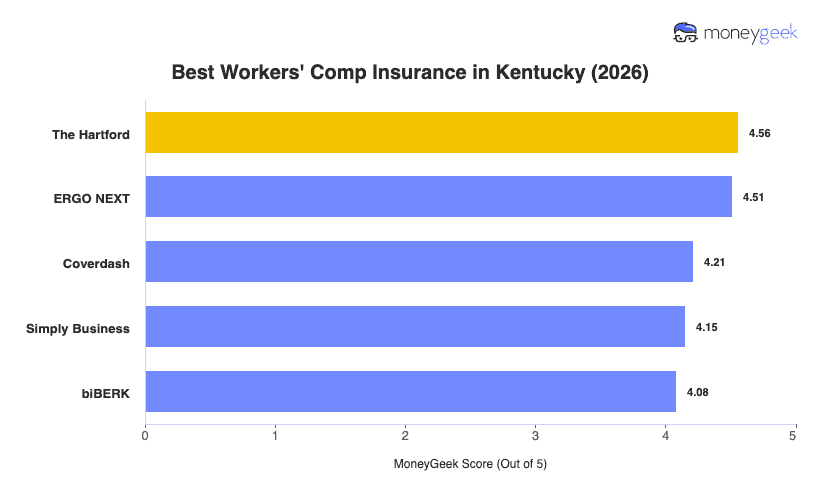
The best workers' comp insurance provider in Kentucky in my analysis is The Hartford. It's average monthly premium of $59 per employee isn't the lowest among the insurers in my study, but it still sits 25% below the state average. That gives you a $20 savings each month. Once you're covered, The Hartford has dedicated teams for different industries, which gives your more tailored support. That could make the slightly higher cost worth considering.
Best Workers' Comp Insurance in Kentucky (2026)
With rates starting at $9 monthly, The Hartford, ERGO NEXT and Coverdash offer the cheapest and best workers' comp insurance in Kentucky.
Our matching tool can connect you to top Kentucky workers' comp insurance providers and find your ideal coverage.
Select state
Updated: August 27, 2026
Advertising & Editorial Disclosure
Best Workers' Comp Insurance Companies in Kentucky
| The Hartford | 4.56 | $59 | 3 | 3 |
| ERGO NEXT | 4.51 | $56 | 1 | 6 |
| Coverdash | 4.21 | $77 | 5 | 1 |
| Simply Business | 4.15 | $79 | 2 | 2 |
| biBERK | 4.08 | $74 | 8 | 8 |
MoneyGeek analyzed workers' comp insurance rates and provider performance across Kentucky using small business profiles with one to four employees spanning 408 major industries. Companies earn up to five points in each category in our scoring system. We then use a weighted average of these category scores to calculate a MoneyGeek score out of five.
- Affordability (55%): Based on average payroll for the most common employee code per industry and state classification, priced per employee for a one to four employee business.
- Customer Experience (35%): Evaluates buying (20%), which covers quote access, pricing accuracy and sales support; policy management (30%), which covers payroll reporting, audits, billing and loss control; and claims (50%), which covers FNOL speed, adjuster support, medical access, wage replacement and dispute handling.
- Coverage Options (10%): Assesses coverage completeness (35%), including employers' liability and wage and medical reimbursement; policy flexibility and endorsements (25%); eligibility, state and industry breadth (20%); and policy terms, limits and exclusions (20%).
Data and rankings are reviewed regularly to reflect current market conditions. Rates shown reflect 2026 estimates.

The Hartford
Best Workers' Comp Insurance in Kentucky
MoneyGeek Rating
4.6/ 5
4.4/5Affordability Score
4.1/5Customer Experience Score
4.5/5Coverage Score
Average Monthly Cost
$59Claims Processing Score
4.1/5Policy Management Score
4/5Buying Process Score
4/5

ERGO NEXT
Best Kentucky Workers' Comp Insurance: Runner-Up
MoneyGeek Rating
4.5/ 5
4.6/5Affordability Score
4.3/5Customer Experience Score
3.8/5Coverage Score
Average Monthly Cost
$56Claims Processing Score
4/5Policy Management Score
4.1/5Buying Process Score
4.4/5
Cheapest Workers' Comp Insurance in Kentucky
When I analyzed workers' comp rates across 25 industries in Kentucky, I found that ERGO NEXT is the cheapest workers' compensation provider in 20 of them. The more useful takeaway, though, is how strongly the industry itself drives cost. The five industries where The Hartford beats ERGO NEXT are all desk-based or low-physical-risk categories. For Kentucky businesses in those verticals, The Hartford's pricing advantage is worth getting a direct quote rather than defaulting to ERGO NEXT.
| Agriculture & Natural Resources | ERGO NEXT | $90 | $1,080 |
| Arts, Media & Entertainment | ERGO NEXT | $52 | $624 |
| Beauty, Body & Wellness Services | ERGO NEXT | $9 | $108 |
| Childcare Services | ERGO NEXT | $22 | $264 |
| Cleaning Services | ERGO NEXT | $62 | $744 |
| Construction & Contracting | ERGO NEXT | $130 | $1,560 |
| Consulting Services | The Hartford | $11 | $132 |
| Education | ERGO NEXT | $38 | $456 |
| Financial Services | The Hartford | $9 | $108 |
| Fitness Services | ERGO NEXT | $38 | $456 |
| Food & Beverage | ERGO NEXT | $23 | $276 |
| Healthcare & Medical | The Hartford | $27 | $324 |
| Hospitality, Travel & Tourism | The Hartford | $25 | $300 |
| Manufacturing | ERGO NEXT | $81 | $972 |
| Marketing & Communications | ERGO NEXT | $9 | $108 |
| Nonprofit & Associations | ERGO NEXT | $35 | $420 |
| Other Professional Services | ERGO NEXT | $15 | $180 |
| Pet Care Services | ERGO NEXT | $35 | $420 |
| Real Estate & Property Services | The Hartford | $12 | $144 |
| Recreation & Sports | ERGO NEXT | $61 | $732 |
| Repair & Maintenance | ERGO NEXT | $40 | $480 |
| Retail & Product Rental | ERGO NEXT | $30 | $360 |
| Tech/IT | The Hartford | $23 | $276 |
| Transportation & Logistics | ERGO NEXT | $166 | $1,992 |
| Wholesale & Distribution | ERGO NEXT | $106 | $1,272 |
How to Get the Best Workers' Comp Insurance in Kentucky
To get workers' compensation insurance in Kentucky, you'll need to match coverage to your specific business risks at competitive rates.
- 1Confirm Kentucky Coverage Requirements
Kentucky requires workers’ comp insurance once you hire one employee. Part-time, temporary and family workers count, while limited exceptions apply to certain agricultural workers and business owners. Out-of-state businesses also need a policy that specifically covers work performed in Kentucky. An “all states” endorsement alone does not meet this requirement.
- 2Identify Your NCCI Class Codes
Kentucky uses NCCI class codes to group businesses with similar injury risks. Insurers assign your governing code based mainly on your company’s operations, not each employee’s job title. Describe what your business does clearly, including any work that carries different risks, so the insurer can classify your payroll correctly.
- 3Document Payroll, Employee Count and Claims History
Prepare estimated payroll for the coming policy year and separate it by class code. Include part-time and temporary workers even if they work limited hours. Insurers may also request loss runs, which summarize your previous workers’ comp claims, to evaluate your business’s claim history and calculate its rate.
- 4Request Quotes From Kentucky-Licensed Carriers
Use the same payroll and business description so you can compare business insurance quotes fairly. Pay attention to whether the policy covers every Kentucky location and worker. If standard insurers decline your business, Kentucky Employers’ Mutual Insurance, or KEMI, serves as the state’s workers’ comp market of last resort.
- 5Review the Carrier’s Medical Care Process
Ask how each carrier coordinates treatment after an injury. Kentucky allows approved managed care programs that use a designated physician to direct an employee’s care and specialist referrals. A network with accessible providers can make the process easier for your employees, especially if they work outside major cities.
- 6Bind Coverage and Set Up Injury Reporting
Confirm the policy’s start date and give employees a clear way to report injuries. You must notify your insurer within three working days after learning of an injury. If the employee misses at least one workday, the insurer files a First Report of Injury, the state’s initial record of the incident.
- 7Review Your Policy at Renewal
Your annual premium audit replaces estimated payroll with what you actually paid. Check the audit for incorrect payroll or class codes before accepting any adjustment. Review your experience modifier as well. This factor compares your claims with those of similar businesses and can raise or lower your renewal premium.
Best Kentucky Workers' Compensation Insurance: Bottom Line
The Hartford, ERGO NEXT and Coverdash lead Kentucky's workers' comp insurance market. What's ideal for you depends on your business risks and employee needs. Research each company's service quality, maximize discounts and select coverage that fits your budget.

LEARN MORE ABOUT KENTUCKY BUSINESS INSURANCE
Whether you have a restaurant or in construction, workers' comp is only one of the coverages in you Kentucky business insurance policy. To make sure you have enough financial protection, check these resources for the top providers for other coverages.
Kentucky Workers' Compensation Insurance FAQ
The Hartford has the best workers' compensation insurance in Kentucky with the top MoneyGeek score, and ERGO NEXT is the cheapest by overall monthly rate at $56:
- ERGO NEXT: $56 a month
- The Hartford: $59 a month
- biBERK: $74 a month
- Thimble: $75 a month
- Coverdash: $77 a month
Kentucky requires workers' comp for all employers with one or more employees. The Kentucky Labor Cabinet, Department of Workers' Claims administers the program. Employers who fail to carry coverage could receive substantial penalties for non-compliance.
The average cost of workers' comp in Kentucky is $79 per employee monthly, just above the $74 national average. Beauty, Body & Wellness Services ($14 a month) and Marketing ($14 a month) are the most affordable industries in the state, while Transportation & Logistics ($237 a month) and Construction ($218 a month) are the most expensive.
Kentucky operates as a competitive private market with no state fund. Employers who can't obtain voluntary coverage may access the Kentucky Workers' Compensation Assigned Risk Pool through NCCI.
Kentucky workers' comp insurance covers the following:
- Medical expenses: Covers all reasonable and necessary medical treatment; Kentucky's Department of Workers' Claims administers the fee schedule.
- Wage loss benefits: Pays temporary total disability at 66⅔% of the employee's average weekly wage.
- Vocational rehabilitation: Provides retraining and job placement support for workers unable to return to their pre-injury occupation.
- Death benefits: Pays burial expenses and wage-based compensation to qualifying dependents.
About Angelique Palenzuela-Cruz

Angelique Palenzuela-Cruz is a Business Insurance Content Writer at MoneyGeek, where she specializes in general liability, workers’ compensation and professional liability insurance. Her work helps small business owners understand how these policies apply to coverage, including risks like customer injuries, employee injuries, professional mistakes, client contract terms and industry-specific coverage requirements.
She primarily covers service-based businesses where liability and employee coverage decisions are especially important, including cleaning, consulting, beauty and wellness, childcare, education, fitness, food service, pet care, repair and maintenance, and other professional services.
Before joining MoneyGeek, Angelique spent nearly 12 years at Guthrie-Jensen Consultants, one of Southeast Asia’s largest management training firms, where she advanced from Training Consultant to Managing Consultant. In that role, she worked with business clients to assess operational needs, develop training programs and present performance analyses to executive decision-makers. She also helped establish Gladwin Training Consultancy, where she served in learning solutions and client service roles.
Her background gives her practical context for writing about how businesses operate, manage client expectations, structure teams and make risk decisions. At MoneyGeek, she applies that experience to business insurance content, connecting coverage to actual business needs.
LinkedIn: linkedin.com/in/ma-angela-cruz
Email Contact: angelique.palenzuela@moneygeek.com