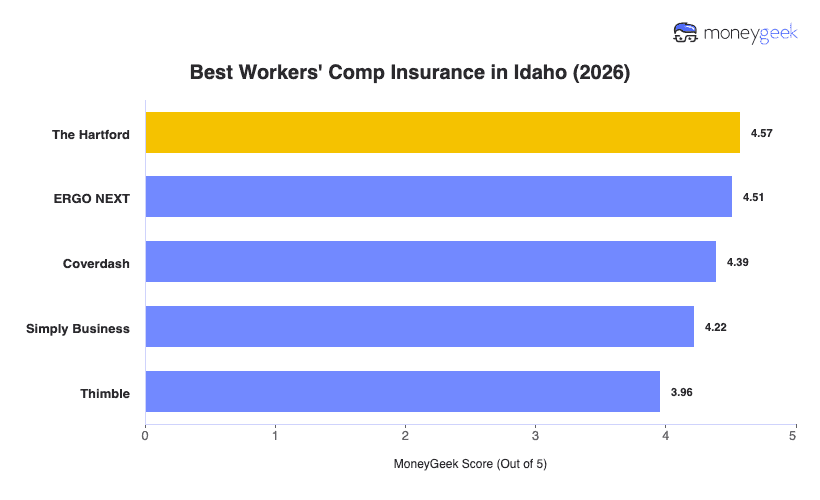

The Hartford is the best workers’ comp insurance provider in Idaho, with a top MoneyGeek score of 4.57 out of 5, followed closely by ERGO NEXT at 4.51. ERGO NEXT is the most affordable option overall, with an average rate of $50 per month, while Chubb is the most expensive at $91 per month. Price differences matter more for low-risk, professional businesses. For higher-risk industries in our analysis, pricing gaps narrow, making coverage quality and policy features more important considerations.
Best Workers' Comp Insurance in Idaho (2026)
With rates starting at $8 per month, The Hartford, ERGO NEXT and Coverdash have the best workers' comp insurance in Idaho.
Get matched to top Idaho workers' comp insurance providers and find your ideal coverage.

Updated: May 29, 2026
Advertising & Editorial Disclosure
Best Idaho Workers' Comp Insurance: Fast Answers
What are the best and cheapest workers' comp insurance providers in Idaho?
The Hartford earns the top MoneyGeek score among Idaho workers' comp providers. For employers focused on the cheapest options, here are the five lowest-rate providers for Idaho, sorted by monthly rate:
- ERGO NEXT: $50/month
- The Hartford: $51/month
- Coverdash: $63/month
- Thimble: $66/month
- Simply Business: $70/month
Is workers' comp insurance required in Idaho?
Idaho requires workers' comp coverage for employers with one or more employees. The Idaho Industrial Commission oversees compliance and enforcement statewide. Employers who fail to maintain required coverage may inflict civil fines, stop-work orders, and personal liability for all injury costs incurred by uninsured workers.
How much does workers' comp insurance cost in Idaho?
The average cost of workers' comp insurance in Idaho is $71 per employee monthly, just below the $74 national average. Costs vary widely by industry. Marketing and Communications employers pay as little as $13 per month per employee, while Transportation and Logistics employers pay as much as $211 per month.
How do you get workers' comp insurance in Idaho?
Idaho operates a competitive private market with no mandatory state fund. Most employers can get workers' compensation insurance directly from private carriers. The Idaho State Insurance Fund is a competitive state fund that also serves as the assigned risk pool for employers who cannot secure voluntary market coverage.
What does Idaho workers' comp insurance cover?
Idaho workers' comp policies cover four core benefit categories:
- Medical expenses: Covers all necessary medical treatment for work-related injuries; the Idaho Industrial Commission administers the fee schedule.
- Wage loss benefits: Pays temporary total disability at 60% of the employee's average weekly wage (verify 2026 maximum weekly benefit against the Idaho Industrial Commission).
- Vocational rehabilitation: Provides retraining and placement services for workers unable to return to their pre-injury occupation.
- Death benefits: Pays burial expenses and compensation to qualifying dependents based on the deceased's average weekly wage.
Best Workers' Comp Insurance Companies in Idaho
| The Hartford | 4.57 | $51 | 3 | 3 |
| ERGO NEXT | 4.51 | $50 | 1 | 6 |
| Coverdash | 4.39 | $63 | 5 | 1 |
| Simply Business | 4.22 | $70 | 2 | 2 |
| Thimble | 3.96 | $66 | 8 | 9 |
| Hiscox | 3.83 | $77 | 6 | 10 |
| Chubb | 3.75 | $91 | 3 | 4 |
| biBERK | 3.75 | $78 | 8 | 8 |
| Progressive Commercial | 3.74 | $78 | 8 | 7 |
| Nationwide | 3.73 | $81 | 6 | 5 |
How Did We Determine These Rates and Rankings?
These rates are estimates based on MoneyGeek's analysis of small businesses with 1 to 4 employees across 408 major industries. Actual rates vary based on your business location, industry risk factors, claims history, coverage limits and individual insurer underwriting criteria. Contact insurers directly for personalized quotes.
The Hartford
Best Workers' Comp Insurance in Idaho
Average Monthly Cost
$51Claims Processing Score
4.1/5Policy Management Score
4/5Buying Process Score
4/5
- pros
Strong claims support and return-to-work programs
Competitive monthly rates
Broad industry eligibility well suited to Idaho's mixed employer base
consRequires contacting the company for some workers’ comp quotes
Higher premiums for high-risk industries
The Hartford is the best workers' comp insurer in Idaho, balancing competitive rates with strong claims performance. Its $51/month average rate is among the cheapest options available in the state.
With more than 200 years of experience and top-tier financial strength ratings, it offers reliability that many small businesses prioritize. Its workers’ comp policies include access to a large medical provider network, flexible payment options, and bundling opportunities with other business coverages. Customers consistently highlight responsive service and an efficient claims process.Â
Read our full The Hartford review.
Idaho employers who prioritize the lowest possible rate and a streamlined buying process may find ERGO NEXT a better fit. ERGO NEXT's MoneyGeek buying process score of 4.4 exceeds The Hartford's 4.0, and its $50/month rate is marginally cheaper. High-volume, digitally managed small businesses in Idaho may prefer ERGO NEXT's streamlined approach.

ERGO NEXT
Best Idaho Workers' Comp Insurance: Runner-Up
Average Monthly Cost
$50Claims Processing Score
4/5Policy Management Score
4.1/5Buying Process Score
4.4/5
- pros
Streamlined digital application process with fast approval
Lowest average monthly rate in Idaho
consLimited coverage flexibility for complex or high-risk businesses
Fully digital model means less access to agents or in-person help
ERGO NEXT is the cheapest workers' comp provider in Idaho with an average rate of $50 per month. The company is a particularly strong fit for small businesses that prioritize affordability and speed. As a digital-first insurer backed by Munich Re, it offers a streamlined online experience that allows employers to get quotes, purchase coverage, and access certificates of insurance within minutes.Â
Its workers’ comp policies cover essential protections for employee injuries while integrating with broader business insurance options like general liability and professional liability.Â
Read our full ERGO NEXT review.
ERGO NEXT stands out for its low pricing and ease of use, ranking highly for affordability and customer experience, especially among businesses with simple risk profiles. However, its fully digital model and more limited claims support may be less ideal for companies with complex operations or higher-risk needs. Idaho employers in high-injury-risk industries, where claims frequency is elevated, will benefit more from The Hartford's stronger claims performance.
Cheapest Workers' Comp Insurance in Idaho
ERGO NEXT is the most affordable workers' comp insurance company in our analysis at $50 per month, but the more useful finding is the cluster just behind it. The Hartford, a carrier most Idaho businesses already recognize, comes in at $51, a $1 monthly difference for stronger brand familiarity and claims infrastructure.
The spread between the cheapest and most expensive option in our data is $41 per month, or $492 per year. For a small business owner buying a single policy, that gap is real money. For a business with multiple employees driving up premium volume, the decision deserves a harder look at what each carrier actually offers.
| ERGO NEXT | $50 | $600 |
| The Hartford | $51 | $612 |
| Coverdash | $63 | $756 |
| Thimble | $66 | $792 |
| Simply Business | $70 | $840 |
| Hiscox | $77 | $924 |
| biBERK | $78 | $936 |
| Progressive Commercial | $78 | $936 |
| Nationwide | $81 | $972 |
| Chubb | $91 | $1,092 |
Cheapest Workers' Comp Insurance in Idaho by Industry
Two providers split Idaho's workers' comp market across every major industry in our analysis: The Hartford and ERGO NEXT. The Hartford has the lowest rates in lower-risk, office-based industries like financial services, consulting, tech and healthcare, while ERGO NEXT leads in nearly every other category, including all of Idaho's highest-hazard sectors.
The cheapest workers' comp rate in Idaho is $8/month for Financial Services employers through The Hartford. The most expensive industry is Transportation and Logistics, where the cheapest available provider rate is $145/month through ERGO NEXT. These figures reflect the lowest per-provider rate in each industry, not the Idaho state average.
| Financial Services | The Hartford | $8 | $96 |
| Beauty, Body & Wellness Services | ERGO NEXT | $9 | $108 |
| Marketing & Communications | ERGO NEXT | $9 | $108 |
| Consulting Services | The Hartford | $10 | $120 |
| Real Estate & Property Services | The Hartford | $11 | $132 |
| Other Professional Services | ERGO NEXT | $14 | $168 |
| Childcare Services | ERGO NEXT | $19 | $228 |
| Food & Beverage | ERGO NEXT | $20 | $240 |
| Tech/IT | The Hartford | $21 | $252 |
| Hospitality, Travel & Tourism | The Hartford | $23 | $276 |
| Healthcare & Medical | The Hartford | $24 | $288 |
| Retail & Product Rental | ERGO NEXT | $27 | $324 |
| Nonprofit & Associations | The Hartford | $31 | $372 |
| Pet Care Services | ERGO NEXT | $31 | $372 |
| Education | ERGO NEXT | $34 | $408 |
| Fitness Services | ERGO NEXT | $35 | $420 |
| Repair & Maintenance | ERGO NEXT | $36 | $432 |
| Arts, Media & Entertainment | ERGO NEXT | $47 | $564 |
| Cleaning Services | ERGO NEXT | $54 | $648 |
| Recreation & Sports | ERGO NEXT | $54 | $648 |
| Manufacturing | ERGO NEXT | $72 | $864 |
| Agriculture & Natural Resources | ERGO NEXT | $79 | $948 |
| Wholesale & Distribution | ERGO NEXT | $94 | $1,128 |
| Construction & Contracting | ERGO NEXT | $116 | $1,392 |
| Transportation & Logistics | ERGO NEXT | $145 | $1,740 |
How Much Is Workers' Comp Insurance in Idaho?
When we pulled Idaho workers' comp rates across 25 industry categories, the spread was wider than most small business owners expect. Beauty and financial services businesses pay $14 a month, while Transportation and logistics operators pay $271, nearly 20 times more.
The gap isn't arbitrary. Workers' comp premiums are driven by the physical risk workers carry on the job. Desk-based industries (financial services, marketing, consulting) cluster between $14 and $22 monthly because injury claims are rare and low-severity. Industries where workers operate equipment, handle freight, or work on job sites anchor the top of the table.
| Beauty, Body & Wellness Services | $14 | $168 |
| Financial Services | $14 | $168 |
| Marketing & Communications | $15 | $180 |
| Consulting Services | $19 | $228 |
| Real Estate & Property Services | $20 | $240 |
| Other Professional Services | $22 | $264 |
| Childcare Services | $33 | $396 |
| Food & Beverage | $37 | $444 |
| Hospitality, Travel & Tourism | $38 | $456 |
| Tech/IT | $39 | $468 |
| Healthcare & Medical | $46 | $552 |
| Retail & Product Rental | $49 | $588 |
| Nonprofit & Associations | $52 | $624 |
| Pet Care Services | $56 | $672 |
| Fitness Services | $59 | $708 |
| Education | $60 | $720 |
| Repair & Maintenance | $66 | $792 |
| Arts, Media & Entertainment | $83 | $996 |
| Recreation & Sports | $102 | $1,224 |
| Cleaning Services | $107 | $1,284 |
| Manufacturing | $127 | $1,524 |
| Agriculture & Natural Resources | $147 | $1,764 |
| Wholesale & Distribution | $163 | $1,956 |
| Construction & Contracting | $250 | $3,000 |
| Transportation & Logistics | $271 | $3,252 |
Idaho Workers' Comp Insurance Cost Factors
The Idaho Industrial Commission oversees the state's workers' comp system, while the NCCI serves as Idaho's rating bureau. Idaho operates a competitive private market with no mandatory state fund. Idaho's agricultural and transportation sectors drive above-average rates in those class codes compared to the state's average.
NCCI files loss costs in Idaho; individual carriers then file their own multipliers. Idaho employers are rated per $100 of payroll using NCCI class codes. The class code assigned to each employee reflects the risk level of that job function. Idaho's economy includes a substantial share of agricultural, manufacturing and construction employers, which means many Idaho businesses carry class codes with above-average loss costs. Accurate payroll classification before quoting is important to avoid audit adjustments at policy year-end.
Idaho operates a fully competitive private market. There is no mandatory state fund, and private carriers compete openly for Idaho employers across all industries and risk classes. The Idaho State Insurance Fund participates as a competitive carrier and also serves as the assigned risk pool for employers who cannot get voluntary market coverage. This dual role gives the state fund a broad presence in Idaho. Market depth is strong for standard risks, though high-hazard employers in rural Idaho may find fewer carriers willing to write their class codes voluntarily.
Idaho pays temporary total disability benefits at 60% of the injured worker's average weekly wage. The maximum weekly benefit is subject to annual adjustment by the Idaho Industrial Commission. Permanent partial disability is rated using the AMA Guides. Idaho has a structured return-to-work program that can reduce claim duration and, over time, an employer's experience modification rate. Employers with active light-duty programs tend to see lower long-term premium impact from claims.
Idaho's state average of approximately $60 per employee per month compares favorably to the $74 national benchmark. Idaho's relatively lower average reflects a mix of lower-hazard professional and service industries alongside higher-hazard agricultural and transportation sectors. According to WCRI and NASI data, Idaho sits in the lower half of states by average workers' comp cost per employee. Transportation and Logistics and Agriculture drive Idaho's above-average industry rates, while Marketing and Communications and Financial Services pull the average down.
The Idaho State Insurance Fund serves as both a competitive carrier and the assigned risk pool for Idaho employers who cannot get voluntary market coverage. Employers placed in the assigned risk pool typically pay rates above voluntary market levels, reflecting the higher-risk profiles that led voluntary carriers to decline coverage. Common assigned risk pool candidates in Idaho include employers with poor loss histories, new businesses in high-hazard industries and small agricultural employers. Employers can exit the pool once they demonstrate a clean loss history over multiple policy periods.
Idaho's geographic spread creates a structural cost factor not present in more urbanized states. Rural employers in eastern and northern Idaho may have limited access to medical providers within the fee schedule network, which can extend claim duration and increase indemnity costs. The Idaho Industrial Commission administers the medical fee schedule, but provider network gaps in rural counties mean some claims require out-of-network care. Employers in these regions benefit from carriers with strong managed care networks and nurse case management programs that can coordinate care across Idaho's dispersed geography.
How Much Workers' Comp Insurance Do I Need in Idaho?
Idaho law requires workers' compensation coverage for any business with at least one employee. You'll need your policy active before your first hire. Idaho doesn't set specific dollar limits for your required workers' compensation coverage. Your policy amount depends on your actual payroll and what type of work your employees do.
Your coverage pays 67% of an injured employee's average weekly wage for temporary disability and 55% of the state average weekly wage for permanent disability. Skip the required workers' comp insurance coverage and you're personally liable for all medical bills and lost wages, plus a 10% penalty, attorney fees, daily fines of $2 per employee or $25 (whichever costs more), and possible criminal charges under Idaho Code 72-210.
Idaho Workers' Comp Insurance Exemptions
While you're often required to have coverage in Idaho, some business categories are exempt from workers' comp requirements:
- Agricultural crop spraying pilots: You're exempt if you fly aircraft to apply fertilizers or pesticides, but you'll need alternative insurance with at least $25,000 accidental death coverage, $10,000 for medical expenses, and $500 monthly disability income for 48 months.
- Commission-only real estate professionals: Your real estate brokers and salespersons paid strictly through commissions don't need coverage.
- High school athletic officials: Officials refereeing or umpiring secondary school sports events are exempt.
- Family members in single-member LLCs: Family employees working for your single-member LLC (taxed as a sole proprietorship) are automatically exempt if they live with you.
- Business owners: As a sole proprietor, working partner or working LLC member, you're exempt but can choose to add coverage through a written agreement with your insurer.
- Family living in your household: Family members who live with you and work in your sole proprietorship are exempt.
- Corporate officers with significant ownership: Officers who own at least 10% of voting stock and serve as directors can opt out of coverage.
- Household domestic workers: Employees providing services in private homes are exempt from Idaho's workers' comp requirements.
- Casual workers: Employees doing occasional or irregular work unrelated to your core business operations don't need coverage.
- Outworkers: People who work from home using materials you provide are exempt from coverage requirements.
- Federal employees: Workers already covered under federal compensation laws don't need separate Idaho coverage.
Three federal programs supersede Idaho's state workers' comp requirement for specific worker categories. The Federal Employees' Compensation Act covers civilian federal employees, including those at Idaho's federal agencies and military installations. The Federal Employers' Liability Act covers interstate railroad workers. The Longshore and Harbor Workers' Compensation Act covers maritime and port workers. Idaho's proximity to federal lands and the presence of federal contractors and military facilities means these overlaps are relevant for a meaningful share of Idaho employers.
How to Get the Best Workers' Comp Insurance in Idaho
Follow these steps to secure the right workers' comp coverage for your Idaho business.
- 1
Confirm Your Coverage Obligation
Verify whether your Idaho business meets the coverage threshold. The Idaho Industrial Commission administers the requirement for employers with one or more employees. Confirm your employee count and worker classifications before proceeding.
- 2
Identify Your Industry Class Codes
Idaho uses NCCI class codes to categorize employee job functions by risk level. Verify your payroll classification for each employee type before requesting quotes. Incorrect class codes are a common source of audit adjustments at policy year-end.
- 3
Compile Payroll and Loss History
Gather three years of loss runs and payroll data organized by class code. Clean loss records improve your rate position with voluntary market carriers. Incomplete records may result in conservative underwriting assumptions that increase your quoted rate.
- 4
Request Quotes from Multiple Carriers
Contact multiple carriers, including The Hartford (Idaho's top-ranked provider at $51/month) and ERGO NEXT (Idaho's lowest-rate provider at $50/month). Include the Idaho State Insurance Fund in your comparison, as it participates as a competitive carrier alongside private insurers in Idaho.
- 5
Evaluate Coverage Breadth Alongside Rate
The Hartford leads Idaho's coverage rankings. For employers in high-injury-risk industries, coverage completeness and claims support can matter more than a marginal rate difference. Compare coverage scores alongside monthly rates before binding.
- 6
Bind Coverage and File with Idaho Industrial Commission
Coverage must be in place before employees begin work. Maintain a current certificate of insurance and file required documentation with the Idaho Industrial Commission. Gaps in coverage expose Idaho employers to civil fines and personal liability for injury costs.
- 7
Prepare for the Annual Payroll Audit
Idaho workers' comp policies are audited annually. Idaho's mix of agricultural, construction and professional employers means payroll can shift across class codes during the year. Keep detailed payroll records by class code throughout the policy period to avoid unexpected audit premiums.
Bottom Line and Next Steps
The Hartford, ERGO NEXT and Coverdash are Idaho's top three workers' comp insurance providers. The right choice depends on your business profile. The Hartford leads on claims performance, while ERGO NEXT leads on rate and buying experience, and Coverdash offers a middle-ground option.

Next Steps
Idaho's rate variation across industries and class codes means quotes from different providers can differ more than the state averages suggest. Use the tools below to compare your options.
Estimate your Idaho workers' comp cost based on your industry, payroll and employee count. Idaho's wide industry rate spread means the calculator can surface meaningful differences across class codes. Use the workers' comp calculator to get a baseline before requesting quotes.
Request quotes from multiple Idaho carriers, including The Hartford, ERGO NEXT and the Idaho State Insurance Fund. Idaho's competitive market means rates can vary by $40 or more per month for the same risk profile. Start comparing through our workers' comp quotes tool.
Confirm your coverage obligations, exemption eligibility and compliance deadlines with the Idaho Industrial Commission. Idaho's exemption rules for agricultural workers, corporate officers and independent contractors require careful verification before relying on an exclusion.
Idaho Workers' Compensation Insurance FAQs
What are the penalties for not having workers' comp insurance in Idaho?
Idaho employers who fail to carry required workers' comp coverage may face civil fines, stop-work orders issued by the Idaho Industrial Commission and personal liability for all medical and wage costs incurred by injured workers. The Idaho Industrial Commission can pursue enforcement action regardless of whether an injury has occurred.
Are remote and work-from-home employees covered under Idaho workers' comp?
Yes. Idaho workers' comp coverage follows the employee, not the physical location. Remote workers who are injured while performing job duties from a home office are generally covered under an Idaho policy. Employers with remote workers in other states should verify that their policy extends to those states as well.
How does an experience modification rate affect Idaho workers' comp premiums?
Idaho employers with three or more years of loss history are subject to experience rating through the NCCI. An EMR above 1.0 increases your premium; an EMR below 1.0 reduces it. A single large claim in Idaho can elevate your EMR for up to three policy years, making proactive claims management and return-to-work programs important cost controls.
Can owners and officers opt out of workers' comp coverage in Idaho?
Officers of closely held corporations in Idaho may elect to exclude themselves from workers' comp coverage. The election must be filed with the insurer and documented properly. Sole proprietors without employees are not required to carry coverage but may elect to cover themselves voluntarily. Partners in a general partnership are generally not treated as employees under Idaho law.
What is the difference between workers' comp and employer's liability in an Idaho policy?
Workers' comp (Part A of a standard policy) pays statutory benefits to injured employees regardless of fault. Employer's liability (Part B) covers the employer against lawsuits by employees who claim negligence beyond the workers' comp system. Both coverages are included in a standard Idaho workers' comp policy. Employers' liability limits are typically $100,000/$500,000/$100,000 unless higher limits are requested.
How long does a workers' comp claim stay on an Idaho employer's experience record?
Under NCCI's experience rating plan, claims affect an Idaho employer's experience modification rate for the three most recent completed policy years. A claim filed in the current policy year will not appear in the EMR calculation until the following year and will roll off after three years of inclusion in the rating window.
MoneyGeek analyzed workers' comp insurance rates and provider performance across Idaho using small business profiles with 1 to 4 employees spanning 408 major industries. Companies earn up to five points in each category in our scoring system. We then use a weighted average of these category scores to calculate a MoneyGeek score out of five.
- Affordability (55%): Based on average payroll for the most common employee code per industry and state classification, priced per employee for a 1 to 4 employee business.
- Customer Experience (35%): Evaluates buying (20%), which covers quote access, pricing accuracy and sales support; policy management (30%), which covers payroll reporting, audits, billing and loss control; and claims (50%), which covers FNOL speed, adjuster support, medical access, wage replacement and dispute handling.
- Coverage Options (10%): Assesses coverage completeness (35%), including employers' liability and wage and medical reimbursement; policy flexibility and endorsements (25%); eligibility, state and industry breadth (20%); and policy terms, limits and exclusions (20%).

About Connor Bolton

Connor Bolton is Senior SEO and Content Manager at MoneyGeek, where he leads the business and pet insurance editorial teams. He sets the research framework, data standards and content structure for his team. All content goes through his accuracy review before publication. Connor also writes in-depth guides and has spent more than four years covering insurance products across personal, commercial and specialty lines.
The research infrastructure Connor built covers auto, home, renters, life, health, business and pet insurance across pricing analysis, carrier research, customer experience and coverage evaluation. It includes over 6 million data points for business insurance across 408 industry areas, all 50 states and 16 vehicle types. The pet insurance side covers over 5 million profiles across 18 major providers, 100+ breeds and ages up to 20 years. Connor’s insurance research and his team's work has been cited by the U.S. Chamber of Commerce, Allstate, Liberty Mutual, CBS News, Forbes and LegalZoom.
Connor also talks with underwriters and carrier liaisons at Ethos, The Hartford, ERGO NEXT, Nationwide and State Farm, and monitors business and pet owner communities on Reddit. Those sources shape how his team evaluates carriers, structures rate analysis and writes for human buyers rather than search engines.
For questions about MoneyGeek's business and pet insurance content, contact him at connor@moneygeek.com or on LinkedIn.
Sources
- Idaho Industrial Commission. "Benefits FAQs." Accessed June 13, 2026.
- Idaho Industrial Commission. "Employers FAQs." Accessed June 13, 2026.
- Idaho Industrial Commission. "Employer Information." Accessed June 13, 2026.
- Idaho Industrial Commission. "NCCI Rates 2025 - 1/1/25-12/31/25." Accessed June 13, 2026.
- Idaho Legislature. "Title 72 Workers' Compensation and Related Laws -- Industrial Commission." Accessed June 13, 2026.
- LegalClarity. "Idaho Workers' Compensation: Eligibility and Benefits Guide." Accessed June 13, 2026.