




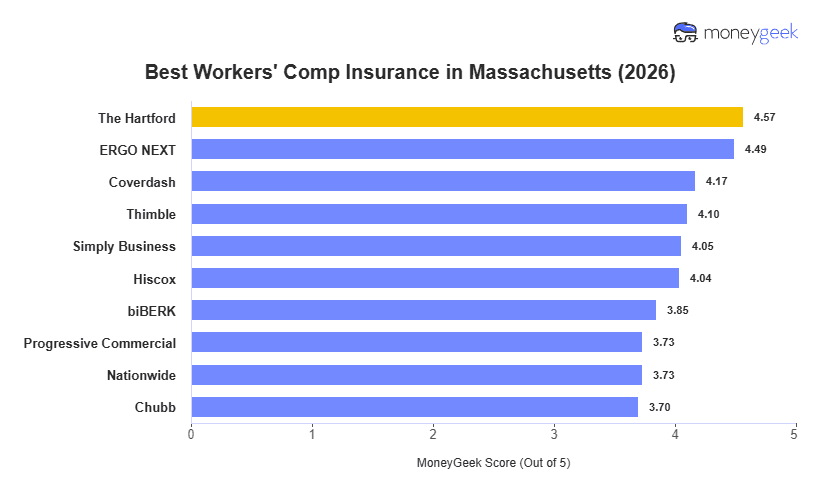
The Hartford is the best workers' comp insurance in Massachusetts, averaging $134 per employee per month and ranking first for affordability among the 10 providers MoneyGeek reviewed. ERGO NEXT matches that price exactly at $134 and ranks second overall, leading the group in customer experience. Both are well ahead of the field on cost. The next cheapest option, Thimble, averages $163 per month.
Best Workers' Comp Insurance in Massachusetts (2026)
With rates starting at $12 monthly, The Hartford, ERGO NEXT, and Coverdash have the best workers' comp insurance in Massachusetts.
Get matched to top Massachusetts workers' comp insurance providers and find your ideal coverage.
Select state
Updated: June 26, 2026
Advertising & Editorial Disclosure
Best Massachusetts Workers' Comp Insurance: Fast Answers
The Hartford is the best workers' comp provider overall based on MoneyGeek score and ties ERGO NEXT as the cheapest option, averaging $134 per month:
- The Hartford: $134 a month
- ERGO NEXT: $134 a month
- Thimble: $163 a month
- Hiscox: $182 a month
- Coverdash: $185 a month
Massachusetts requires workers' comp coverage for any employer with one or more employees. The Department of Industrial Accidents (DIA) oversees compliance and enforcement statewide. Employers who fail to carry coverage face civil fines, stop-work orders, and personal liability for all injury costs their employees incur.
The average cost of workers' compensation insurance in Massachusetts is $184 a month per employee, based on our analysis of 408 industries in 25 categories. Costs range from $19 a month for Financial Services businesses to $562 a month for Transportation & Logistics businesses.
Massachusetts operates a competitive private market with no state fund. The state uses its own rating bureau, the Workers Compensation Rating and Inspection Bureau of Massachusetts (WCRIBMA), not NCCI, to file loss costs. Employers who can't get voluntary market coverage may access the Massachusetts Workers Compensation Assigned Risk Pool (MARP), administered by WCRIBMA.
Massachusetts workers' comp policies cover the following:
- Medical expenses: Covers all necessary medical treatment for work-related injuries; the Department of Industrial Accidents (DIA) administers the fee schedule.
- Wage loss benefits: Pays temporary total disability at 60% of the employee's average weekly wage.
- Vocational rehabilitation: provides retraining and placement services for workers unable to return to their pre-injury occupation.
- Death benefits: Pays burial expenses and compensation to qualifying dependents based on the deceased's average weekly wage.
Best Workers' Comp Insurance Companies in Massachusetts
| The Hartford | 4.57 | $134 | 3 | 3 |
| ERGO NEXT | 4.49 | $134 | 1 | 6 |
| Coverdash | 4.17 | $185 | 5 | 1 |
| Thimble | 4.10 | $163 | 8 | 9 |
| Simply Business | 4.05 | $194 | 2 | 2 |
| Hiscox | 4.04 | $183 | 6 | 10 |
| biBERK | 3.85 | $193 | 8 | 8 |
| Progressive Commercial | 3.73 | $202 | 8 | 7 |
| Nationwide | 3.73 | $209 | 6 | 5 |
| Chubb | 3.70 | $246 | 3 | 4 |
How Did We Determine These Rates and Rankings?
These rates are estimates based on MoneyGeek's analysis of small businesses with one to four employees across 408 major industries. Actual rates vary based on your business location, industry risk factors, claims history, coverage limits and individual insurer underwriting criteria. Contact insurers directly for personalized quotes.

The Hartford
Best Workers' Comp Insurance in Massachusetts
MoneyGeek Rating
4.6/ 5
4.8/5Affordability
4.1/5Customer Experience
3.9/5Coverage
Average Monthly Cost
$134Claims Processing Score
4.1/5Policy Management Score
4/5Buying Process Score
4/5

ERGO NEXT
Best Massachusetts Workers' Comp Insurance: Runner-Up
MoneyGeek Rating
4.5/ 5
4.8/5Affordability
4.4/5Customer Experience
3.5/5Coverage
Average Monthly Cost
$134Claims Processing Score
4/5Policy Management Score
4.1/5Buying Process Score
4.4/5

LEARN MORE ABOUT MASSACHUSETTS BUSINESS INSURANCE
Cheapest Workers' Comp Insurance in Massachusetts
The Hartford and ERGO NEXT are tied for the cheapest workers' comp insurance in Massachusetts at $134 per month. That's $112 less per month than Chubb, the priciest option at $246. For small businesses choosing between the two extremes, that gap adds up to $1,344 per year.
| ERGO NEXT | $134 | $1,608 |
| The Hartford | $134 | $1,608 |
| Thimble | $163 | $1,956 |
| Hiscox | $183 | $2,196 |
| Coverdash | $185 | $2,220 |
| biBERK | $193 | $2,316 |
| Simply Business | $194 | $2,328 |
| Progressive Commercial | $202 | $2,424 |
| Nationwide | $209 | $2,508 |
| Chubb | $246 | $2,952 |
Cheapest Workers' Comp Insurance in Massachusetts by Industry
The Hartford is the most affordable in white-collar and office-based industries, while ERGO NEXT prices physical-labor and higher-exposure categories more competitively.
ERGO NEXT leads in 17 of the 25 industries we analyzed, more than any other carrier on this list. It's a specialty workers' comp insurer that prices physical-labor industries more aggressively than most traditional carriers.
| Financial Services | The Hartford | $12 | $144 |
| Beauty, Body & Wellness Services | ERGO NEXT | $17 | $204 |
| Marketing & Communications | ERGO NEXT | $17 | $204 |
| Consulting Services | The Hartford | $23 | $276 |
| Real Estate & Property Services | The Hartford | $25 | $300 |
| Other Professional Services | The Hartford | $27 | $324 |
| Tech/IT | The Hartford | $45 | $540 |
| Childcare Services | ERGO NEXT | $53 | $636 |
| Food & Beverage | ERGO NEXT | $57 | $684 |
| Hospitality, Travel & Tourism | The Hartford | $57 | $684 |
| Healthcare & Medical | The Hartford | $60 | $720 |
| Retail & Product Rental | The Hartford | $71 | $852 |
| Nonprofit & Associations | ERGO NEXT | $79 | $948 |
| Pet Care Services | ERGO NEXT | $84 | $1,008 |
| Education | ERGO NEXT | $90 | $1,080 |
| Fitness Services | ERGO NEXT | $93 | $1,116 |
| Repair & Maintenance | ERGO NEXT | $100 | $1,200 |
| Arts, Media & Entertainment | ERGO NEXT | $130 | $1,560 |
| Recreation & Sports | ERGO NEXT | $151 | $1,812 |
| Cleaning Services | ERGO NEXT | $155 | $1,860 |
| Manufacturing | ERGO NEXT | $202 | $2,424 |
| Agriculture & Natural Resources | ERGO NEXT | $222 | $2,664 |
| Wholesale & Distribution | ERGO NEXT | $258 | $3,096 |
| Construction & Contracting | ERGO NEXT | $319 | $3,828 |
| Transportation & Logistics | ERGO NEXT | $407 | $4,884 |
How Much Is Workers' Comp Insurance in Massachusetts?
Workers' comp costs in Massachusetts vary by more than 29 times between the cheapest and most expensive industries in our data. Financial services businesses pay $19 monthly on average, while transportation and logistics operators pay $562. That spread reflects how differently Massachusetts insurers price physical risk across sectors.
| Financial Services | $19 | $228 |
| Beauty, Body & Wellness Services | $23 | $276 |
| Marketing & Communications | $23 | $276 |
| Consulting Services | $34 | $408 |
| Other Professional Services | $36 | $432 |
| Real Estate & Property Services | $37 | $444 |
| Childcare Services | $68 | $816 |
| Tech/IT | $69 | $828 |
| Food & Beverage | $76 | $912 |
| Hospitality, Travel & Tourism | $77 | $924 |
| Healthcare & Medical | $90 | $1,080 |
| Nonprofit & Associations | $101 | $1,212 |
| Retail & Product Rental | $101 | $1,212 |
| Education | $117 | $1,404 |
| Pet Care Services | $118 | $1,416 |
| Fitness Services | $119 | $1,428 |
| Repair & Maintenance | $137 | $1,644 |
| Arts, Media & Entertainment | $169 | $2,028 |
| Recreation & Sports | $213 | $2,556 |
| Cleaning Services | $222 | $2,664 |
| Manufacturing | $264 | $3,168 |
| Agriculture & Natural Resources | $304 | $3,648 |
| Wholesale & Distribution | $336 | $4,032 |
| Construction & Contracting | $517 | $6,204 |
| Transportation & Logistics | $562 | $6,744 |
Massachusetts Workers' Comp Insurance Cost Factors
The Department of Industrial Accidents (DIA) administers Massachusetts's workers' comp system, while the Workers Compensation Rating and Inspection Bureau of Massachusetts (WCRIBMA) files loss costs used to set base rates. Massachusetts operates a competitive private market with no state fund. One distinguishing cost driver is the state's high average wage base, which directly affects wage replacement benefit costs and, in turn, carrier pricing.
How Much Workers' Comp Insurance Do I Need in Massachusetts?
Massachusetts law requires all employers, regardless of size, to carry workers' compensation insurance. You need coverage starting with your first employee, even part-time workers. The only exception: domestic employees working fewer than 16 hours weekly.
Your coverage amounts depend on total payroll and employee classifications using WCRIBMA codes, not the dollar limits you select. Massachusetts mandates unlimited medical coverage for work-related injuries and temporary disability benefits equal to 60% of average weekly wages for up to 156 weeks. Operating without the required workers' compensation coverage triggers $100 daily fines, potential criminal charges and a three-year debarment from public contracts.
Massachusetts Workers' Comp Insurance Exemptions
While Massachusetts requires workers' comp coverage, some business categories are exempt:
- Sole proprietors can skip coverage for themselves but must cover every employee on their payroll, including part-time workers.
- Partners in partnerships aren't required to buy coverage for themselves as self-employed individuals but must cover all employees.
- LLC members can operate without personal coverage but must cover all non-member employees.
- LLP partners can exclude themselves from coverage, but any employees who aren't partners need workers' comp insurance.
- Corporate officers holding at least 25% ownership can request an exemption by filing Form 153 with the Massachusetts Division of Industrial Accidents.
- Domestic workers employed fewer than 16 hours per week are exempt from Massachusetts workers' compensation requirements.
- Real estate agents working solely on commission don't need coverage if they have written agreements confirming their non-employee status for federal tax purposes.
- Direct sales representatives selling consumer products on commission or buy-sell terms outside retail settings are exempt with proper written documentation of their non-employee status.
- Taxi drivers leasing their vehicles on a flat-fee basis unrelated to passenger fares don't need coverage when classified as non-employees under federal tax law.
- Professional athletes whose contracts guarantee wage payments during injury-related disabilities are exempt from Massachusetts workers' comp requirements.
- Maritime workers on interstate or foreign commerce vessels get coverage through federal programs rather than Massachusetts workers' compensation.
- Independent contractors who satisfy Massachusetts's strict three-part ABC test don't need workers' compensation coverage.

FEDERAL WORKERS' COMP PROGRAMS OVERRIDE STATE REQUIREMENTS
Federal workers' comp programs supersede Massachusetts state requirements for covered employee classes. Federal employees are covered under the Federal Employees' Compensation Act (FECA). Interstate railroad workers are covered under the Federal Employers' Liability Act (FELA). Port and maritime workers at Massachusetts facilities, including those at the Port of Boston, may be covered under the Longshore and Harbor Workers' Compensation Act (LHWCA) rather than the state system. Federal contractors working on military installations in Massachusetts, such as Hanscom Air Force Base, may also fall under federal coverage programs.
How to Get the Best Workers' Comp Insurance in Massachusetts
Follow these steps to find and bind the right workers' comp coverage for your Massachusetts business.
- 1
Confirm Your Coverage Obligation
Check whether your Massachusetts business meets the coverage threshold. Any employer with one or more employees must carry workers' comp under Massachusetts law. The Department of Industrial Accidents (DIA) administers the requirement and can answer questions about specific employment arrangements or exemption eligibility.
- 2
Identify Your Industry Class Codes
Massachusetts uses WCRIBMA class codes to classify workers by job function and injury risk. Check your payroll classification before requesting quotes, since an incorrect class code can result in a mid-term audit adjustment or a rate change at renewal. Your broker or insurer can help confirm the right codes for your workforce.
- 3
Compile Payroll and Loss History
Gather three years of loss runs and payroll data organized by class code. Clean loss records improve your rate position in the voluntary market and reduce the likelihood of MARP placement. Accurate payroll figures also prevent audit surprises at year-end, which are common for Massachusetts employers with variable workforces.
- 4
Request Quotes from Multiple Carriers
Get quotes from at least three carriers. In Massachusetts, The Hartford and ERGO NEXT both offer rates at $134 a month and are the most competitive starting points for most small businesses. Coverdash is also worth quoting, particularly for employers who want a digital-first experience with flexible coverage options.
- 5
Evaluate Coverage Breadth Alongside Rate
Rate alone shouldn't drive the decision. Review each carrier's coverage score and employers' liability limits. The Hartford leads Massachusetts's coverage rankings, which matters for employers in industries with third-party liability exposure. A lower-rate policy with narrower coverage may cost more when a complex claim comes in.
- 6
Bind Coverage and File with the Department of Industrial Accidents
Coverage must be in place before employees begin work. Once bound, keep your certificate of insurance on file and make sure it reflects accurate class codes and payroll. Massachusetts employers must post proof of coverage at the worksite and may need to provide a certificate to clients or general contractors.
- 7
Prepare for the Annual Payroll Audit
Massachusetts workers' comp policies are audited each year to reconcile estimated payroll against actual payroll. Employers in industries with seasonal or project-based workforces, such as construction and hospitality, should keep detailed payroll records by class code throughout the year. Audit adjustments can result in additional premium owed or a return premium credit, depending on actual payroll.
Bottom Line and Next Steps
The Hartford, ERGO NEXT and Coverdash are the best workers' comp providers for most Massachusetts small businesses. The Hartford is the best pick for employers who want top claims support at a competitive rate. ERGO NEXT suits employers who value a streamlined buying process. Coverdash fits businesses seeking flexible digital coverage.
Next Steps
Massachusetts rates vary more than in most states because WCRIBMA files loss costs independently of NCCI, and individual carriers apply their own multipliers on top. That means the same class code can carry notably different rates across carriers. Continue your research with these tools:
Massachusetts Workers' Compensation Insurance FAQ
Massachusetts employers without required coverage can face civil fines, stop-work orders issued by the Department of Industrial Accidents (DIA) and personal liability for all medical and wage replacement costs incurred by injured employees. The DIA can also refer cases for criminal prosecution when non-compliance is willful.
Yes. Massachusetts workers' comp coverage follows the employee, not the worksite. Remote employees injured while performing work duties from a home office are covered under the employer's Massachusetts policy. Employers should confirm that remote workers are listed under the correct class code and that payroll is accurately reported for audit purposes.
An EMR compares your actual claims history to the expected loss history for your industry class code. An EMR below 1.0 reduces your premium; an EMR above 1.0 increases it. In Massachusetts, WCRIBMA calculates EMRs for eligible employers, generally those with enough payroll volume. Keeping a clean loss record over three years is the most reliable way to improve your EMR and lower your rate.
Officers of closely held corporations may elect to exclude themselves from workers' comp coverage by filing the appropriate exclusion form with their insurer and notifying the DIA. Sole proprietors without employees aren't required to carry coverage but can elect it voluntarily. Partners in a general partnership are generally treated as non-employees and aren't automatically covered.
Workers' comp (Part One of a standard policy) covers statutory benefits owed to injured employees under Massachusetts law, including medical costs and wage replacement. Employer's liability (Part Two) protects employers against civil lawsuits brought by employees or third parties alleging negligence. Massachusetts's exclusive remedy doctrine limits most employee lawsuits, but employers' liability coverage still matters for third-party claims and dual-capacity suits.
In Massachusetts, a workers' comp claim affects an employer's experience modification calculation for three policy years following the year in which the claim occurred. WCRIBMA uses a rolling three-year window of loss data to calculate the EMR. Claims that are closed with no payment or minimal payment have less impact than open or high-cost claims on the final modification factor.
MoneyGeek analyzed workers' comp insurance rates and provider performance across Massachusetts using small business profiles with one to four employees spanning 408 major industries. Companies earn up to five points in each category in our scoring system. We then use a weighted average of these category scores to calculate a MoneyGeek score out of five.
- Affordability (55%): Based on average payroll for the most common employee code per industry and state classification, priced per employee for a one to four employee business.
- Customer Experience (35%): Evaluates buying (20%), which covers quote access, pricing accuracy and sales support; policy management (30%), which covers payroll reporting, audits, billing and loss control; and claims (50%), which covers FNOL speed, adjuster support, medical access, wage replacement and dispute handling.
- Coverage Options (10%): Assesses coverage completeness (35%), including employers' liability and wage and medical reimbursement; policy flexibility and endorsements (25%); eligibility, state and industry breadth (20%); and policy terms, limits and exclusions (20%).
About Connor Bolton

Connor Bolton is Senior SEO and Content Manager at MoneyGeek, where he leads the business and pet insurance editorial teams. He sets the research framework, data standards and content structure for his team. All content goes through his accuracy review before publication. Connor also writes in-depth guides and has spent more than four years covering insurance products across personal, commercial and specialty lines.
The research infrastructure Connor built covers auto, home, renters, life, health, business and pet insurance across pricing analysis, carrier research, customer experience and coverage evaluation. It includes over 6 million data points for business insurance across 408 industry areas, all 50 states and 16 vehicle types. The pet insurance side covers over 5 million profiles across 18 major providers, 100+ breeds and ages up to 20 years. Connor’s insurance research and his team's work have been cited by the U.S. Chamber of Commerce, Allstate, Liberty Mutual, CBS News, Forbes and LegalZoom.
Connor also talks with underwriters and carrier liaisons at Ethos, The Hartford, ERGO NEXT, Nationwide and State Farm, and monitors business and pet owner communities on Reddit. Those sources shape how his team evaluates carriers, structures rate analysis and writes content for real pet owners.
Questions about MoneyGeek's business or pet insurance content? Reach him at connor@moneygeek.com or on LinkedIn.
Sources
- Mass.gov. "Workers Compensation Insurance." Accessed August 5, 2026.
- Mass.gov. "Workers' Compensation Insurance Requirements." Accessed August 5, 2026.
- Massachusetts General Laws. "Chapter 152, Section 25C." Accessed August 5, 2026.
- WCRIBMA. "Residual Market." Accessed August 5, 2026.