



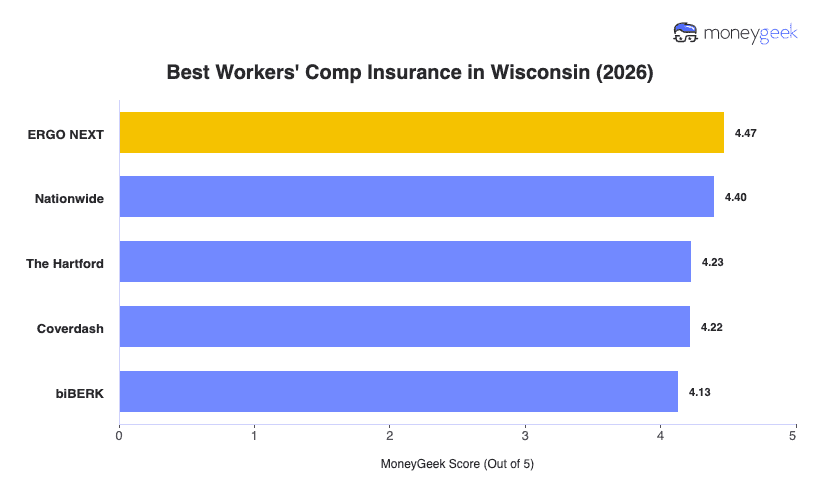
If you're looking for workers' comp in Wisconsin, I'd recommend ERGO NEXT based on my analysis. It has one of the lowest average rate among the providers in my study, tying with Nationwide at $73 per month per employee. That translates to monthly savings of around $95 when compared to the state benchmark. Beyond cost, ERGO NEXT also makes buying coverage convenient, making it the best workers' comp insurer in the state. You can get quoted and purchase a policy in about 10 minutes. Once you're covered, you can use its app to request for unlimited certificates of insurance at no additional cost.
Best Workers' Comp Insurance in Wisconsin (2026)
With rates starting at $10 monthly, ERGO NEXT, Nationwide and The Hartford have the cheapest and best workers' comp insurance in Wisconsin.
With our matching tool, you can get connected to top Wisconsin workers' comp insurance providers and find your ideal coverage.
Select state
Updated: August 27, 2026
Advertising & Editorial Disclosure
Best Workers' Comp Insurance Companies in Wisconsin
| ERGO NEXT | 4.47 | $73 | 1 | 6 |
| Nationwide | 4.4 | $73 | 6 | 5 |
| The Hartford | 4.23 | $94 | 3 | 3 |
| Coverdash | 4.22 | $92 | 5 | 1 |
| biBERK | 4.13 | $86 | 8 | 8 |
MoneyGeek analyzed workers' comp insurance rates and provider performance across Wisconsin using small business profiles with one to four employees spanning 408 major industries. Companies earn up to five points in each category in our scoring system. We then use a weighted average of these category scores to calculate an overall MoneyGeek score out of five.
- Affordability (55%): Based on average payroll for the most common employee code per industry and state classification, priced per employee for a one to four employee business.
- Customer Experience (35%): Evaluates buying (20%), which covers quote access, pricing accuracy and sales support; policy management (30%), which covers payroll reporting, audits, billing and loss control; and claims (50%), which covers FNOL speed, adjuster support, medical access, wage replacement and dispute handling.
- Coverage Options (10%): Assesses coverage completeness (35%), including employers' liability and wage and medical reimbursement; policy flexibility and endorsements (25%); eligibility, state and industry breadth (20%); and policy terms, limits and exclusions (20%).

ERGO NEXT
Best Workers' Comp Insurance in Wisconsin
MoneyGeek Rating
4.5/ 5
4.8/5Affordability Score
4.2/5Customer Experience Score
4.1/5Coverage Score
Average Monthly Cost
$73Claims Processing Score
4/5Policy Management Score
4.1/5Buying Process Score
4.4/5

Nationwide
Best Wisconsin Workers' Comp Insurance: Runner-Up
MoneyGeek Rating
4.4/ 5
4.7/5Affordability Score
4/5Customer Experience Score
4.2/5Coverage Score
Average Monthly Cost
$73Claims Processing Score
4/5Policy Management Score
3.9/5Buying Process Score
3.8/5
Cheapest Workers' Comp Insurance Companies in Wisconsin
When comparing the cheapest workers’ compensation providers by industry in Wisconsin, The Hartford and ERGO NEXT offered the lowest rates in nearly every category we analyzed. The Hartford led in nine industries, primarily lower-risk office and professional service sectors where premiums stayed below $40 monthly per employee. ERGO NEXT provided the cheapest pricing in 15 industries, especially in businesses involving more physical labor and higher workplace risk.
The pricing split highlights how differently the two insurers approach risk. ERGO NEXT is more competitive in higher-risk industries, while The Hartford is cheaper for office-based and white-collar businesses. biBerk is the cheapest for only one category, childcare services, at about $28 monthly per employee.
| Financial Services | The Hartford | $10 | $120 |
| Beauty, Body & Wellness Services | ERGO NEXT | $11 | $132 |
| Marketing & Communications | ERGO NEXT | $12 | $144 |
| Consulting Services | The Hartford | $14 | $168 |
| Real Estate & Property Services | The Hartford | $15 | $180 |
| Other Professional Services | The Hartford | $18 | $216 |
| Childcare Services | biBERK | $28 | $336 |
| Tech/IT | The Hartford | $29 | $348 |
| Food & Beverage | ERGO NEXT | $31 | $372 |
| Hospitality, Travel & Tourism | The Hartford | $33 | $396 |
| Healthcare & Medical | The Hartford | $35 | $420 |
| Retail & Product Rental | The Hartford | $39 | $468 |
| Nonprofit & Associations | The Hartford | $45 | $540 |
| Pet Care Services | ERGO NEXT | $46 | $552 |
| Fitness Services | ERGO NEXT | $50 | $600 |
| Education | ERGO NEXT | $51 | $612 |
| Repair & Maintenance | ERGO NEXT | $53 | $636 |
| Arts, Media & Entertainment | ERGO NEXT | $71 | $852 |
| Recreation & Sports | ERGO NEXT | $81 | $972 |
| Cleaning Services | ERGO NEXT | $83 | $996 |
| Manufacturing | ERGO NEXT | $110 | $1,320 |
| Agriculture & Natural Resources | ERGO NEXT | $119 | $1,428 |
| Wholesale & Distribution | ERGO NEXT | $138 | $1,656 |
| Construction & Contracting | ERGO NEXT | $173 | $2,076 |
| Transportation & Logistics | ERGO NEXT | $220 | $2,640 |
How to Get the Best Workers' Comp Insurance in Wisconsin
The right workers' comp coverage for your Wisconsin business comes from following these steps. MoneyGeek's guide on how to get workers' compensation insurance has a more detailed walkthrough.
- 1
Confirm Wisconsin Coverage Requirements
Wisconsin’s workers’ compensation requirements apply the day you hire your third employee. However, you might need coverage sooner if you pay one or more workers at least $500 in combined gross wages during a calendar quarter. In that case, coverage must begin by the 10th day of the following quarter. Farmers follow a separate workforce test.
- 2
Identify Your WCRB Class Codes
The Wisconsin Compensation Rating Bureau (WCRB) assigns class codes based on the risks common to each type of business. Describe your operations and your employees’ regular duties so the insurer can select the right classifications. If workers perform duties under more than one code, keep payroll records that clearly support the division.
- 3
Document Payroll, Employee Count and Claims History
Track employee count throughout the year, not only when you request a quote. A third worker can trigger coverage even if all three overlap for a short period. Gather payroll by class code and loss runs showing prior claims. If you use independent contractors, confirm that they meet Wisconsin’s nine-part classification test and keep proof of their insurance. A contract alone does not determine whether someone qualifies as an independent contractor.
- 4
Request Quotes From Multiple Licensed Wisconsin Carriers
Compare business insurance quotes with Wisconsin listed as a covered state on each proposed policy. Carriers use WCRB rates but can still differ in pricing and underwriting. If insurers refuse to cover your business, you can apply through the Wisconsin Worker’s Compensation Insurance Pool, which WCRB administers for employers unable to find coverage in the regular market.
- 5
Compare on Quality, Not Just Price
Wisconsin lets an injured employee choose their treating medical provider. The worker may make a second choice after notifying you or the insurer, while further changes generally require everyone’s agreement. Compare how clearly carriers explain these rights and coordinate records with the selected provider.
- 6
Complete Purchase and Establish Payroll and Audit Reporting
Give employees a clear way to report workplace injuries and send every report to your insurer, including claims involving medical care only. Wisconsin gives you seven days after learning about an injury or illness to notify the carrier. A fatality must be reported within 24 hours. The insurer then handles the required reporting to the state using the First Report of Injury process.
- 7
Review at Annual Renewal
Check the audit against payroll records, class codes and contractor documentation before accepting the final premium. Do not cancel coverage simply because your workforce falls below the original threshold. Once Wisconsin’s requirements apply, you may need to maintain the policy through the next full calendar year before requesting withdrawal.
Best Workers' Compensation Insurance in Wisconsin: Bottom Line
ERGO NEXT, Nationwide and The Hartford have the best workers' comp insurance in Wisconsin. Research each company's service quality, maximize discounts and select coverage that fits your budget. The right choice depends on your industry, employee count, and how much weight you place on price versus service quality.

LEARN MORE ABOUT WISCONSIN BUSINESS INSURANCE
The best small business insurance in Wisconsin means carrying coverages other then workers' comp. Whether you're industry's in advanced manufacturing or food and beverage, you'll have risks that workers' comp can't address. To see our recommended providers for coverage types you might need, check our the resources below.
Wisconsin Workers' Compensation Insurance FAQ
ERGO NEXT and Nationwide are tied as Wisconsin's cheapest workers' comp providers at $73 a month, while ERGO NEXT is our top choice for the best workers' comp insurance in the state.
- ERGO NEXT: $73 a month
- Nationwide: $73 a month
- biBerk: $86 a month
- Coverdash: $92 a month
- The Hartford: $94 a month
Wisconsin mandates workers' comp insurance for most employers with three or more employees. Sole proprietors, partnerships and LLCs with fewer than three employees are exempt. Corporate officers and family members may also qualify for exemptions. Violating this requirement results in fines up to $25 per day per employee, plus potential criminal penalties.
Workers' compensation insurance costs in Wisconsin average $95 monthly per employee across all industries. Your actual premium depends heavily on your industry and payroll size. Low-risk industries like Financial Services pay around $10 per month, while high-risk industries such as Transportation and Logistics pay $220.
You can get workers' comp coverage in Wisconsin by:
- Purchasing from private insurance companies licensed to sell workers' comp in the state
- Buying through the assigned risk pool if standard market coverage isn't available
- Self-insuring if your business meets Wisconsin's strict financial and operational requirements
Many business owners compare quotes online or through brokers to get the best rate and compliance support.
Workers' compensation in Wisconsin covers:
- Medical expenses for workplace injuries, from a slip at a Milwaukee brewery to equipment accidents at Green Bay manufacturing plants
- Wage replacement benefits during recovery periods when employees cannot work
- Permanent disability compensation for lasting impairments that affect earning capacity
- Death benefits for families of workers who suffer fatal workplace incidents
About Angelique Palenzuela-Cruz

Angelique Palenzuela-Cruz is a Business Insurance Content Writer at MoneyGeek, where she specializes in general liability, workers’ compensation and professional liability insurance. Her work helps small business owners understand how these policies apply to coverage, including risks like customer injuries, employee injuries, professional mistakes, client contract terms and industry-specific coverage requirements.
She primarily covers service-based businesses where liability and employee coverage decisions are especially important, including cleaning, consulting, beauty and wellness, childcare, education, fitness, food service, pet care, repair and maintenance, and other professional services.
Before joining MoneyGeek, Angelique spent nearly 12 years at Guthrie-Jensen Consultants, one of Southeast Asia’s largest management training firms, where she advanced from Training Consultant to Managing Consultant. In that role, she worked with business clients to assess operational needs, develop training programs and present performance analyses to executive decision-makers. She also helped establish Gladwin Training Consultancy, where she served in learning solutions and client service roles.
Her background gives her practical context for writing about how businesses operate, manage client expectations, structure teams and make risk decisions. At MoneyGeek, she applies that experience to business insurance content, connecting coverage to actual business needs.
LinkedIn: linkedin.com/in/ma-angela-cruz
Email Contact: angelique.palenzuela@moneygeek.com