




ERGO NEXT offers the best workers' comp insurance in Montana based on my analysis of 10 major insurers. With a monthly average premium of $62 per month per employee, it saves you around $33 each month or $392 per year. ERGO NEXT is an excellent match if you prefer to manage your policy on your own, since its app allows you to make changes to your coverage and request for certificates of insurance without having to speak with an agent.
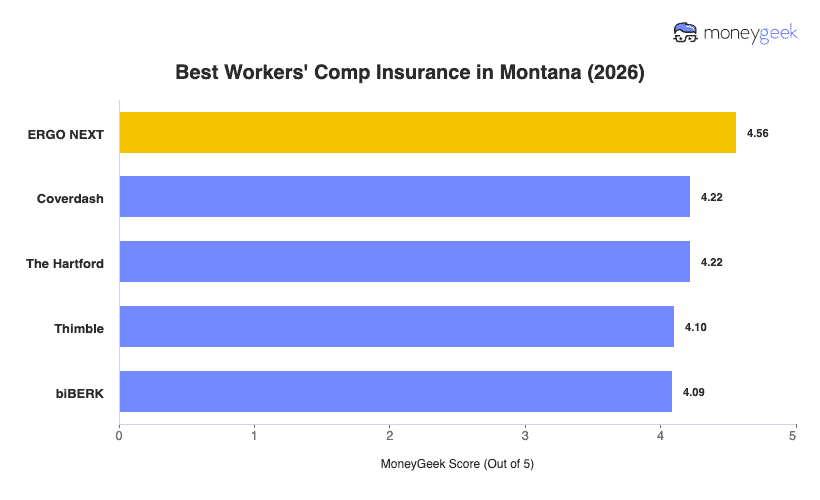
Best Workers' Comp Insurance in Montana (2026)
With rates starting at $10 monthly, ERGO NEXT, Coverdash and The Hartford offer the cheapest and best workers' comp insurance in Montana.
Get connected to top Montana workers' comp insurance providers and find your ideal coverage with our matching tool.
Select state
Updated: August 27, 2026
Advertising & Editorial Disclosure
Best Workers' Comp Insurance Companies in Montana
| ERGO NEXT | 4.56 | $62 | 1 | 6 |
| Coverdash | 4.22 | $92 | 5 | 1 |
| The Hartford | 4.22 | $95 | 3 | 3 |
| Thimble | 4.1 | $85 | 8 | 9 |
| biBERK | 4.09 | $92 | 8 | 8 |
MoneyGeek analyzed workers' comp insurance rates and provider performance across Montana using small business profiles with one to four employees spanning 408 major industries. Companies earn up to five points in each category in our scoring system. We then use a weighted average of these category scores to calculate a MoneyGeek score out of five.
- Affordability (55%): Based on average payroll for the most common employee code per industry and state classification, priced per employee for a one to four employee business.
- Customer Experience (35%): Evaluates buying (20%), which covers quote access, pricing accuracy and sales support; policy management (30%), which covers payroll reporting, audits, billing and loss control; and claims (50%), which covers FNOL speed, adjuster support, medical access, wage replacement and dispute handling.
- Coverage Options (10%): Assesses coverage completeness (35%), including employers' liability and wage and medical reimbursement; policy flexibility and endorsements (25%); eligibility, state and industry breadth (20%); and policy terms, limits and exclusions (20%).

ERGO NEXT
Best Workers' Comp Insurance in Montana
MoneyGeek Rating
4.6/ 5
5/5Affordability Score
4.2/5Customer Experience Score
4.1/5Coverage Score
Average Monthly Cost
$62Claims Processing Score
4/5Policy Management Score
4.1/5Buying Process Score
4.4/5

Coverdash
Best Montana Workers' Comp Insurance: Runner-Up
MoneyGeek Rating
4.2/ 5
4.1/5Affordability Score
4.1/5Customer Experience Score
4.8/5Coverage Score
Average Monthly Cost
$92Claims Processing Score
4/5Policy Management Score
4/5Buying Process Score
4/5
Cheapest Workers' Comp Insurance Companies in Montana
ERGO NEXT is the most affordable workers' comp insurance provider in 24 out of 25 industries in our analysis. The cheapest available workers' comp rate in Montana is $10 a month, offered by ERGO NEXT in Beauty, Body & Wellness Services and by The Hartford in Financial Services. These companies have the lowest individual provider rates within each industry.
The spread between the cheapest industry-specific rate and the most expensive runs from $10 to $187 per month (Transportation & Logistics with ERGO NEXT). Low-hazard service businesses have the most to gain from shopping providers, while high-hazard industries show smaller variation between providers.
| Beauty, Body & Wellness Services | ERGO NEXT | $10 | $120 |
| Financial Services | The Hartford | $10 | $120 |
| Marketing & Communications | ERGO NEXT | $10 | $120 |
| Consulting Services | ERGO NEXT | $14 | $168 |
| Real Estate & Property Services | ERGO NEXT | $15 | $180 |
| Other Professional Services | ERGO NEXT | $16 | $192 |
| Childcare Services | ERGO NEXT | $24 | $288 |
| Food & Beverage | ERGO NEXT | $26 | $312 |
| Hospitality, Travel & Tourism | ERGO NEXT | $29 | $348 |
| Tech/IT | ERGO NEXT | $29 | $348 |
| Healthcare & Medical | ERGO NEXT | $34 | $408 |
| Retail & Product Rental | ERGO NEXT | $34 | $408 |
| Nonprofit & Associations | ERGO NEXT | $38 | $456 |
| Pet Care Services | ERGO NEXT | $39 | $468 |
| Fitness Services | ERGO NEXT | $42 | $504 |
| Education | ERGO NEXT | $43 | $516 |
| Repair & Maintenance | ERGO NEXT | $45 | $540 |
| Arts, Media & Entertainment | ERGO NEXT | $60 | $720 |
| Cleaning Services | ERGO NEXT | $68 | $816 |
| Recreation & Sports | ERGO NEXT | $69 | $828 |
| Manufacturing | ERGO NEXT | $93 | $1,116 |
| Agriculture & Natural Resources | ERGO NEXT | $100 | $1,200 |
| Wholesale & Distribution | ERGO NEXT | $119 | $1,428 |
| Construction & Contracting | ERGO NEXT | $146 | $1,752 |
| Transportation & Logistics | ERGO NEXT | $187 | $2,244 |
How to Get the Best Workers' Comp Insurance in Montana
Follow these steps to get the workers' comp coverage that fits your Montana business best.
- 1
Confirm Montana Coverage Requirements
In Montana, an employee’s schedule does not determine whether you need coverage. The state’s workers’ comp requirement applies if you have full-time, part-time, seasonal and occasional workers, so even short-term help may need to appear on your policy. Limited exemptions exist for certain owners and occupations.
- 2
Identify Your NCCI Class Codes
A class code should describe where an employee works and what they do there. Montana follows National Council on Compensation Insurance (NCCI) classifications, including state-specific rules that may change how a national code applies. Give your agent enough operational detail to distinguish office work from field duties. NCCI’s Class Look-Up tool lets you review each code’s wording before accepting the quote.
- 3
Document Payroll, Employee Count and Claims History
Do not leave contractor status to an invoice or verbal agreement. A Montana independent contractor generally needs workers’ compensation coverage or a valid Independent Contractor Exemption Certificate (ICEC). Without either, the state may treat that person as your employee, leaving you responsible for claim costs and additional premium. Verify each certificate through Montana’s ICEC program while gathering payroll and prior loss runs.
- 4
Request Quotes From Multiple Licensed Montana Carriers
Montana gives you two practical places to shop: authorized private insurers and Montana State Fund. The State Fund acts as the guaranteed market, meaning it must make coverage available to Montana employers, but that does not automatically make it your cheapest option. Send matching class codes and payroll figures to several carriers when you compare business insurance quotes, then weigh the State Fund quote against the voluntary market.
- 5
Compare on Quality, Not Just Price
Medical access deserves extra scrutiny because provider control can change after a claim begins. An injured employee may choose the initial provider, but the insurer can later approve or designate the treating physician after accepting the claim. It may also direct care through a managed care or preferred provider network. Ask each carrier how it handles that transition and whether its network reaches your employees’ locations. Montana’s provider-selection law outlines these rules.
- 6
Complete Purchase and Establish Payroll and Audit Reporting
Choose who will complete the First Report of Injury before an incident occurs. Once you learn of an injury or occupational disease, Montana gives you six days to send the report to your insurer. Reporting minor cases as well as serious ones gives the carrier a complete record if an employee’s condition later worsens. Montana State Fund provides a useful overview of the information needed to report a claim.
- 7
Review at Annual Renewal
Begin by rechecking every ICEC rather than assuming last year’s contractor records remain valid. Then reconcile audited payroll with your NCCI classifications and review claims affecting your experience modification, the factor that adjusts premiums for eligible businesses based on past losses. If job duties or worksites changed, describe them before carriers quote the renewal so you are comparing policies built on current operations.
Best Workers' Compensation Insurance in Montana: Bottom Line
ERGO NEXT, Coverdash and The Hartford are the top workers' comp insurance providers in Montana. The right choice depends on your priorities: price-focused employers will prefer ERGO NEXT, coverage-breadth-focused employers will find Coverdash a strong fit, and those wanting dedicated agent support may lean toward The Hartford. The strongest choice balances monthly cost, coverage completeness, and claims service quality for your specific industry and employee count.

LEARN MORE ABOUT MONTANA BUSINESS INSURANCE
When you're building your Montana business insurance policy, you'll need more than workers' comp to make sure you have enough financial protection. You can review additional coverage options through these resources:
Montana Workers' Compensation Insurance FAQs
ERGO NEXT is both the cheapest workers' comp provider in Montana at $62 a month and the best option in the state based on MoneyGeek's rankings. The most affordable providers in the state include:
- ERGO NEXT: $62 a month
- Thimble: $85 a month
- biBERK: $92 a month
- Coverdash: $92 a month
- The Hartford: $95 a month
Montana requires workers' comp insurance for most employers with employees. Key exemptions include sole proprietors without employees, some agricultural workers and domestic workers in private homes. Non-compliant employers incur penalties up to $1,000 per employee plus potential criminal charges and civil liability for workplace injuries.
Montana workers' comp insurance costs an average of $95 monthly per employee, based on MoneyGeek's analysis. The cheapest industry average is Beauty, Body & Wellness Services at $15 a month, while Transportation & Logistics has the highest industry average at $287 a month.
Montana is a competitive state where employers can get workers' comp coverage from the Montana State Fund or private carriers. The Montana State Fund is a nonprofit competitive fund available alongside private market options. The assigned risk pool (NCCI Residual Market) provides coverage for businesses that cannot obtain private coverage.
Montana workers' comp covers the following:
- Medical expenses for work-related injuries and illnesses
- Wage loss benefits replacing a portion of lost income during recovery (Montana pays 66 2/3% of the worker's average weekly wage)
- Vocational rehabilitation services to help injured workers return to employment
- Death benefits and burial expenses for families of workers killed on the job
About Connor Bolton

Connor Bolton is Senior SEO and Content Manager at MoneyGeek, where he leads the business and pet insurance editorial teams. He sets the research framework, data standards and content structure for his team. All content goes through his accuracy review before publication. Connor also writes in-depth guides and has spent more than four years covering insurance products across personal, commercial and specialty lines.
The research infrastructure Connor built covers auto, home, renters, life, health, business and pet insurance across pricing analysis, carrier research, customer experience and coverage evaluation. It includes over 6 million data points for business insurance across 408 industry areas, all 50 states and 16 vehicle types. The pet insurance side covers over 5 million profiles across 18 major providers, 100+ breeds and ages up to 20 years. Connor’s insurance research and his team's work have been cited by the U.S. Chamber of Commerce, Allstate, Liberty Mutual, CBS News, Forbes and LegalZoom.
Connor also talks with underwriters and carrier liaisons at Ethos, The Hartford, ERGO NEXT, Nationwide and State Farm, and monitors business and pet owner communities on Reddit. Those sources shape how his team evaluates carriers, structures rate analysis and writes content for real pet owners.
Questions about MoneyGeek's business or pet insurance content? Reach him at connor@moneygeek.com or on LinkedIn.