




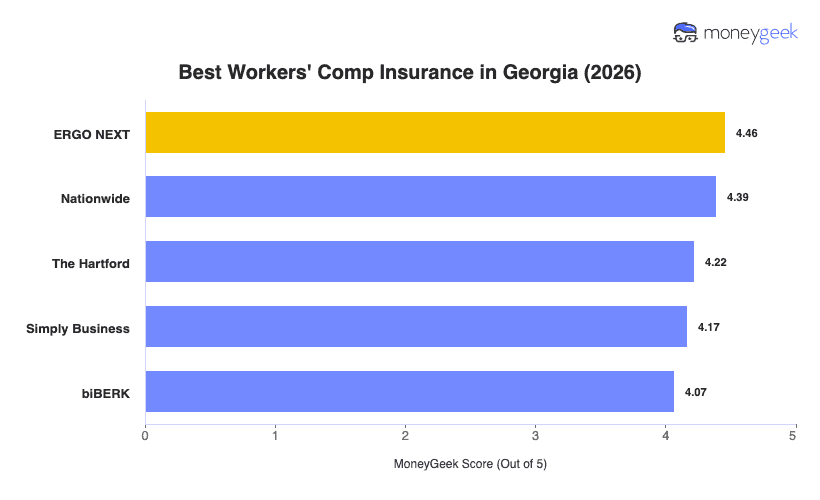
After analyzing 10 major insurers in Georgia, ERGO NEXT tops our list as the best workers' compensation insurance company in the state. With a monthly average premium of $78, it has the lowest rates in my study, along with Nationwide. You can get covered in around 10 minutes without needing to speak with an agent and request unlimited certificates of insurance for no additional cost.
Best Workers' Comp Insurance in Georgia (2026)
With rates starting at $10 monthly, ERGO NEXT, Nationwide and The Hartford offer the best workers' comp insurance in Georgia.
Get matched to top Georgia workers' comp insurance providers and find your ideal coverage using our tool below.
Select state
Safe & SecureVerified and VettedTrusted Brands
Updated: August 26, 2026
Advertising & Editorial Disclosure
Best Workers' Comp Insurance Companies in Georgia
| ERGO NEXT | 4.46 | $78 | 1 | 6 |
| Nationwide | 4.39 | $78 | 6 | 5 |
| The Hartford | 4.22 | $99 | 3 | 3 |
| Simply Business | 4.17 | $100 | 2 | 2 |
| biBERK | 4.07 | $94 | 8 | 8 |
MoneyGeek analyzed workers' comp insurance rates and provider performance across Georgia using small business profiles with one to four employees spanning 408 major industries. Companies earn up to five points in each category in our scoring system. We then use a weighted average of these category scores to calculate a MoneyGeek score out of five.
- Affordability (55%): Based on average payroll for the most common employee code per industry and state classification, priced per employee for a one to four employee business.
- Customer Experience (35%): Evaluates buying (20%), which covers quote access, pricing accuracy and sales support; policy management (30%), which covers payroll reporting, audits, billing and loss control; and claims (50%), which covers FNOL speed, adjuster support, medical access, wage replacement and dispute handling.
- Coverage Options (10%): Assesses coverage completeness (35%), including employers' liability and wage and medical reimbursement; policy flexibility and endorsements (25%); eligibility, state and industry breadth (20%); and policy terms, limits and exclusions (20%).

ERGO NEXT
Best Workers' Comp Insurance in Georgia
MoneyGeek Rating
4.5/ 5
4.8/5Affordability
4.2/5Customer Experience
4.1/5Coverage
Average Monthly Cost
$78Claims Processing Score
4/5Policy Management Score
4.1/5Buying Process Score
4.4/5

Nationwide
Best Georgia Workers' Comp Insurance: Runner-Up
MoneyGeek Rating
4.4/ 5
4.7/5Affordability
4/5Customer Experience
4.2/5Coverage
Average Monthly Cost
$78Claims Processing Score
4/5Policy Management Score
3.9/5Buying Process Score
3.8/5
Cheapest Workers' Comp Insurance in Georgia
I analyzed workers comp quotes across 25 industries in Georgia, and found that two carriers split the market. ERGO NEXT is the cheapest workers' comp insurance insurer for every labor-intensive industry, including construction, transportation, manufacturing and agriculture. The Hartford led every professional service industry, from financial services to tech and health care.
The gap between the two carriers is largest where physical risk is highest. Transportation and logistics have the highest industry rates in Georgia at $236 per month with ERGO NEXT, more than 20 times the $10 monthly rate The Hartford offers financial services firms. The physical danger of construction is more visible, but transportation exposes workers to liability across hundreds of miles and multiple jurisdictions daily. That broader risk profile pushes its workers' comp rate above even the most physically demanding trade categories.
| Agriculture & Natural Resources | ERGO NEXT | $131 | $1,572 |
| Arts, Media & Entertainment | ERGO NEXT | $75 | $900 |
| Beauty, Body & Wellness Services | ERGO NEXT | $11 | $132 |
| Childcare Services | biBERK | $30 | $360 |
| Cleaning Services | ERGO NEXT | $88 | $1,056 |
| Construction & Contracting | ERGO NEXT | $185 | $2,220 |
| Consulting Services | The Hartford | $15 | $180 |
| Education | ERGO NEXT | $54 | $648 |
| Financial Services | The Hartford | $10 | $120 |
| Fitness Services | ERGO NEXT | $52 | $624 |
| Food & Beverage | ERGO NEXT | $33 | $396 |
| Healthcare & Medical | The Hartford | $37 | $444 |
| Hospitality, Travel & Tourism | The Hartford | $34 | $408 |
| Manufacturing | ERGO NEXT | $117 | $1,404 |
| Marketing & Communications | ERGO NEXT | $12 | $144 |
| Nonprofit & Associations | The Hartford | $47 | $564 |
| Other Professional Services | The Hartford | $18 | $216 |
| Pet Care Services | ERGO NEXT | $50 | $600 |
| Real Estate & Property Services | The Hartford | $16 | $192 |
| Recreation & Sports | ERGO NEXT | $88 | $1,056 |
| Repair & Maintenance | ERGO NEXT | $58 | $696 |
| Retail & Product Rental | The Hartford | $42 | $504 |
| Tech/IT | The Hartford | $30 | $360 |
| Transportation & Logistics | ERGO NEXT | $236 | $2,832 |
| Wholesale & Distribution | ERGO NEXT | $154 | $1,848 |
How to Get the Best Workers' Comp Insurance in Georgia
Having a guide on how to get workers comp insurance can make the process easier for you. You'll know what to look for in providers and what information to consider to make sure you get the best policy for your business in Georgia.
- 1Confirm Georgia Coverage Requirements
Most Georgia businesses need to carry workers’ comp once they regularly employ three people, including part-time and seasonal workers. Corporate officers and LLC members count toward that threshold even if they reject coverage for themselves. Sole proprietors and partners do not count unless they elect coverage.
- 2Identify Your NCCI Class Codes
Georgia uses NCCI class codes to group businesses by their work and injury risk. Confirm that each code reflects your actual operations rather than relying on job titles alone. Separating office employees from field workers correctly can prevent an inflated quote or an unexpected adjustment later.
- 3Document Payroll, Employee Count and Claims History
Provide insurers with payroll by class code, your employee count and recent loss runs. Account for changes in staffing and the coverage status of corporate officers or LLC members. Consistent information helps each carrier calculate its quote from the same risk profile.
- 4Request Quotes From Multiple Licensed Georgia Carriers
Georgia has no state workers’ compensation fund, so businesses typically buy policies through private insurers. Compare business insurance quotes from several carriers using the same classifications and payroll estimates. If you cannot secure coverage in the voluntary market, NCCI administers Georgia’s Assigned Risk Plan.
- 5Compare Quality, Not Just Price
Your insurer should help you establish a compliant medical care process. Georgia employers generally use a posted panel of at least six physicians or a certified managed care organization. Consider the insurer’s provider access and claims coordination because problems with the medical panel may allow an injured employee to choose a provider outside it.
- 6Complete the Purchase and Set Up Payroll and Audit Reporting
Once the policy takes effect, confirm your coverage through the state’s online verification system. Set up payroll tracking by class code and post the required workers’ compensation notice and physician information at each business location.
- 7Review at Annual Renewal
Use the premium audit to compare estimated payroll with what you actually paid during the policy term. Before renewing, update your class codes, employee count and officer elections. Check your physician panel as well so employees still have reasonable access to the listed providers.
Best Workers' Compensation Insurance in Georgia: Bottom Line
ERGO NEXT and Nationwide are Georgia's best workers' compensation providers at $78 per employee monthly. ERGO NEXT leads on customer experience and buying process, while Nationwide leads marginally on coverage score. The Hartford is the better choice for Georgia businesses in financial services, consulting, and health care, where it posts lower per-industry rates. The strongest choice for your business balances rate, the state's physician panel requirement, and the claims support infrastructure that matches your industry's injury exposure.

WANT TO LEARN MORE ABOUT OTHER BUSINESS INSURANCE TYPES?
Workers' comp is only one part of commercial insurance that you likely need. Check our other resources for business insurance in Georgia to ensure you have comprehensive coverage:
Georgia Workers' Compensation Insurance FAQ
ERGO NEXT has the best workers' compensation insurance in Georgia with the top MoneyGeek score. Nationwide is a strong alternative, nearly tied on both rate and score. The five cheapest providers in the state are:
- ERGO NEXT: $78 a month
- Nationwide $78 a month
- biBERK: $94 a month
- Thimble: $96 a month
- The Hartford: $99 a month
Georgia requires workers' comp for employers with three or more employees, with narrow exceptions for certain agricultural and domestic workers. The State Board of Workers' Compensation oversees the requirement and enforces compliance across the state. Employers should review current workers' comp requirements to confirm their obligations. Non-compliance exposes employers to civil penalties and personal liability for all injury costs.
Based on our analysis of over 408 industries, the average cost of workers' comp insurance in Georgia is $99 per month per employee, but rates vary by industry. The most affordable industries in the state are Beauty/Body & Wellness ($15 a month), Financial Services ($15 a month) and Marketing ($15 a month), while Construction ($277 a month) and Transportation & Logistics ($301 a month) are the most expensive. Note that the Transportation & Logistics figure reflects the Georgia state average across all employers in that industry and is distinct from the cheapest individual provider rate available.
Georgia is a competitive private market with no state fund, so employers get workers' comp coverage directly from private insurers. Employers who cannot get voluntary market coverage may access the Georgia Workers' Compensation Assigned Risk Pool administered through NCCI. Self-insurance is permitted for qualifying large employers under the State Board of Workers' Compensation.
You can get workers' comp coverage in Georgia by:
- Purchase coverage from private insurance carriers licensed in Georgia
- Buy through the assigned risk pool if standard market options aren't available
- Self-insure if your business meets Georgia's strict financial requirements
Many business owners compare quotes online or through brokers to get the best rate and compliance support.
About Angelique Palenzuela-Cruz

Angelique Palenzuela-Cruz is a Business Insurance Content Writer at MoneyGeek, where she specializes in general liability, workers’ compensation and professional liability insurance. Her work helps small business owners understand how these policies apply to coverage, including risks like customer injuries, employee injuries, professional mistakes, client contract terms and industry-specific coverage requirements.
She primarily covers service-based businesses where liability and employee coverage decisions are especially important, including cleaning, consulting, beauty and wellness, childcare, education, fitness, food service, pet care, repair and maintenance, and other professional services.
Before joining MoneyGeek, Angelique spent nearly 12 years at Guthrie-Jensen Consultants, one of Southeast Asia’s largest management training firms, where she advanced from Training Consultant to Managing Consultant. In that role, she worked with business clients to assess operational needs, develop training programs and present performance analyses to executive decision-makers. She also helped establish Gladwin Training Consultancy, where she served in learning solutions and client service roles.
Her background gives her practical context for writing about how businesses operate, manage client expectations, structure teams and make risk decisions. At MoneyGeek, she applies that experience to business insurance content, connecting coverage to actual business needs.
LinkedIn: linkedin.com/in/ma-angela-cruz
Email Contact: angelique.palenzuela@moneygeek.com