




The Hartford is Michigan's best workers' comp provider, with the lowest premium on average in my analysis. You can save up to $20 per month per employee since its rates are lower than the state average by around 17%. The Hartford also provides risk management resources to help prevent workers' comp claims. But in the event that you need to file a claim, it also offers strong support during the process.
Best Workers' Comp Insurance in Michigan (2026)
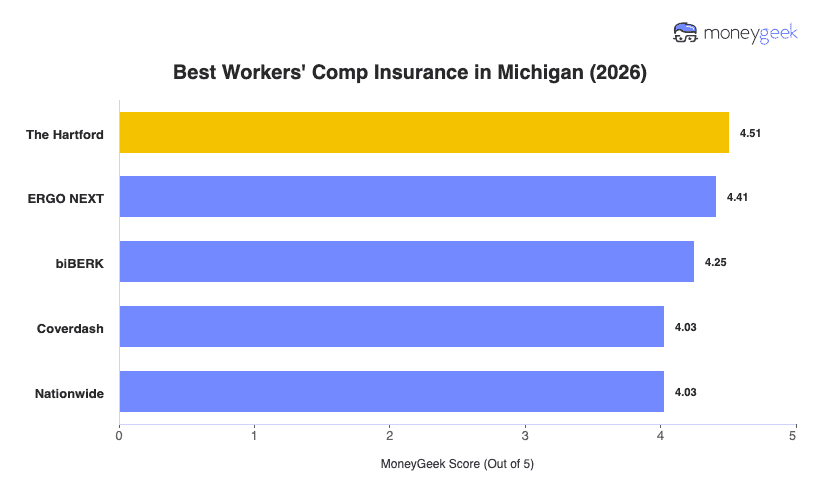
With rates starting at $12 monthly, The Hartford, ERGO NEXT and biBERK offer the cheapest and best workers' comp insurance in Michigan.
Get matched to top Michigan workers' comp insurance providers and find your ideal coverage with our tool below.
Select state
Updated: October 1, 2026
Advertising & Editorial Disclosure
Best Workers' Comp Insurance Companies in Michigan
| The Hartford | 4.51 | $95 | 3 | 3 |
| ERGO NEXT | 4.41 | $94 | 1 | 6 |
| biBERK | 4.25 | $99 | 8 | 8 |
| Coverdash | 4.03 | $119 | 5 | 1 |
| Nationwide | 4.03 | $110 | 6 | 5 |
MoneyGeek analyzed workers' comp insurance rates and provider performance across Michigan using small business profiles with one to four employees spanning 408 major industries. The $97 a month Michigan state average is derived from this full 408-industry dataset and is not limited to the providers reviewed on this page. Companies earn up to five points in each category in our scoring system. We then use a weighted average of these category scores to calculate a MoneyGeek score out of five.
- Affordability (55%): Based on average payroll for the most common employee code per industry and state classification, priced per employee for a one to four employee business.
- Customer Experience (35%): Evaluates buying (20%), which covers quote access, pricing accuracy and sales support; policy management (30%), which covers payroll reporting, audits, billing and loss control; and claims (50%), which covers FNOL speed, adjuster support, medical access, wage replacement and dispute handling.
- Coverage Options (10%): Assesses coverage completeness (35%), including employers' liability and wage and medical reimbursement; policy flexibility and endorsements (25%); eligibility, state and industry breadth (20%); and policy terms, limits and exclusions (20%).

The Hartford
Best Workers' Comp Insurance in Michigan
MoneyGeek Rating
4.5/ 5
4.8/5Affordability Score
4.1/5Customer Experience Score
4.5/5Coverage Score
Average Monthly Cost
$95Claims Processing Score
4/5Policy Management Score
4.1/5Buying Process Score
4/5

ERGO NEXT
Best Michigan Workers' Comp Insurance: Runner-Up
MoneyGeek Rating
4.4/ 5
4.7/5Affordability Score
4.2/5Customer Experience Score
4.1/5Coverage Score
Average Monthly Cost
$94Claims Processing Score
4.4Policy Management Score
4Buying Process Score
4.1
Cheapest Workers' Comp Insurance Companies in Michigan
ERGO NEXT's $12 a month rate for Beauty, Body & Wellness Services makes it the cheapest workers' comp insurer for any Michigan industry in our analysis. That's $4 below the average for that industry across all providers.
The spread between the cheapest industry rate (Beauty, Body & Wellness Services at $12 a month) and the most expensive (Transportation & Logistics at $271 a month) is $259 per employee monthly. Michigan professional services businesses carry far lower workers' comp costs than physical industries. That gap can narrow when a professional services business takes on field work or client-site operations that trigger a higher-risk NCCI class code assignment.
| Beauty, Body & Wellness Services | ERGO NEXT | $12 | $148 |
| Marketing & Communications | ERGO NEXT | $14 | $167 |
| Consulting Services | The Hartford | $16 | $197 |
| Financial Services | The Hartford | $17 | $206 |
| Real Estate & Property Services | The Hartford | $18 | $214 |
| Other Professional Services | The Hartford | $21 | $249 |
| Childcare Services | biBERK | $32 | $379 |
| Tech/IT | The Hartford | $34 | $405 |
| Food & Beverage | biBERK | $39 | $468 |
| Hospitality, Travel & Tourism | The Hartford | $40 | $474 |
| Healthcare & Medical | The Hartford | $43 | $515 |
| Retail & Product Rental | The Hartford | $48 | $571 |
| Nonprofit & Associations | The Hartford | $54 | $650 |
| Pet Care Services | biBERK | $57 | $680 |
| Fitness Services | biBERK | $58 | $698 |
| Education | ERGO NEXT | $63 | $751 |
| Repair & Maintenance | ERGO NEXT | $69 | $831 |
| Arts, Media & Entertainment | biBERK | $88 | $1,055 |
| Recreation & Sports | biBERK | $103 | $1,232 |
| Cleaning Services | ERGO NEXT | $107 | $1,288 |
| Manufacturing | biBERK | $138 | $1,650 |
| Agriculture & Natural Resources | biBERK | $152 | $1,827 |
| Wholesale & Distribution | biBERK | $170 | $2,037 |
| Construction & Contracting | ERGO NEXT | $215 | $2,583 |
| Transportation & Logistics | Progressive Commercial | $271 | $3,256 |
How to Get the Best Workers' Comp Insurance in Michigan
Follow these steps to find and get workers' comp insurance coverage for your Michigan business.
- 1
Confirm Michigan Coverage Requirements
Michigan requires coverage once you reach a certain headcount. Hours worked can trigger the mandate as well. You'll need coverage if you employ at least three people at once, including part-time workers. Coverage also becomes mandatory when one employee works at least 35 hours per week for 13 weeks during a 52-week period. Different thresholds apply to agricultural and domestic workers, so weigh your staffing arrangement against the state's workers' comp insurance requirements.
- 2
Identify Your CAOM Class Codes
Michigan's Compensation Advisory Organization of Michigan (CAOM) maintains the class codes used to describe different work activities. A class code connects an employee's duties with the level of injury risk insurers expect from that work. Go over assignments with your agent or CAOM's class code lookup tool, especially when office employees and field crews do different jobs.
- 3
Document Payroll, Employee Count and Claims History
Separate payroll by class code. Then gather loss runs, which show the claims made under earlier policies. Identify any owners or family members in your workforce as well. Some businesses can exclude qualifying individuals using Form WC-337. The exclusion only counts once the Workers' Disability Compensation Agency stamps it as filed. Michigan limits its use to businesses whose workers all meet the statutory criteria, so confirm your eligibility before removing anyone from a quote.
- 4
Request Quotes From Multiple Licensed Michigan Carriers
Michigan lets insurers set their own workers' compensation rates, so two carriers may quote the same payroll at different prices. Compare business insurance quotes using matching class codes and coverage details. If voluntary insurers decline your business, you can apply through the Michigan Workers' Compensation Placement Facility, the assigned-risk program created for employers unable to find coverage elsewhere.
- 5
Compare on Quality, Not Just Price
Look at what happens after an employee gets hurt, not only what you pay each month. Michigan recommends weighing carriers' claims service and loss-control support, which helps you spot workplace hazards before they cause injuries. Ask who will manage your claims and how quickly the carrier can connect an injured employee with medical care.
- 6
Complete Purchase and Establish Payroll and Audit Reporting
After binding the policy, give managers clear instructions for sending every workplace injury to your carrier, even when the employee misses little or no work. You must also file Form WC-100 with the state when an injury causes death, a defined loss such as losing a body part, or at least seven days of disability. Michigan's reporting guidance spells out which incidents require the form.
- 7
Review at Annual Renewal
Match the insurer's payroll audit to your wage records before accepting the final premium. Look for employees placed under the wrong class code and confirm any ownership or staffing changes appear correctly. CAOM also produces experience modification factors, which adjust eligible employers' premiums based on their claims history. Your agent can help you go over that factor to catch incorrect claim or payroll data before it affects another policy term.
Best Workers' Compensation Insurance in Michigan: Bottom Line
The Hartford, ERGO NEXT and biBerk are Michigan's top three workers' comp providers by MoneyGeek score. Industry risk level and employee count narrow the field. Whether you prioritize claims strength or price determines the rest. A low per-employee rate means less if the carrier lacks experience handling Michigan workers' comp claims in your industry.

LEARN MORE ABOUT MICHIGAN BUSINESS INSURANCE
The best business insurance in Michigan includes other coverages besides workers' comp. See which providers we recommend from our analysis of other coverage types.
Michigan Workers' Compensation Insurance FAQ
ERGO NEXT offers the lowest average monthly rate in Michigan. The Hartford earns the top MoneyGeek rating for best workers' comp insurance. For Michigan businesses focused on price, here are the five cheapest providers ordered by monthly rate:
- ERGO NEXT: $94 a month
- The Hartford: $95 a month
- biBERK: $99 a month
- Nationwide: $110 a month
- Progressive Commercial: $111 a month
Michigan requires workers' comp insurance for employers with one or more employees, including part-time and seasonal workers. Sole proprietors, partners and corporate officers owning 10% or more of the company can opt out. Violations trigger fines up to $1,000 daily plus potential criminal charges and civil liability for workplace injuries.
Michigan's workers' comp insurance costs average $97 per employee monthly, based on MoneyGeek's analysis across 408 industries in the state. Beauty, Body & Wellness Services is the cheapest industry by state average at $16 per month, while Transportation & Logistics is the most expensive at $350 per month. The cheapest available provider rate within any industry may be lower than that industry's average.
Michigan has no state-run workers' comp fund. The Workers' Disability Compensation Agency (WDCA) administers the system, and the Michigan Assigned Claims Facility (MACF) serves as the fallback for employers who can't secure coverage in the voluntary market. Get workers' compensation insurance by comparing quotes from private carriers first. Turn to MACF only if necessary, since its rates run 20% to 30% above voluntary market rates.
Michigan workers' compensation insurance covers the following for work-related injuries and occupational diseases:
- Medical expenses for work-related injuries and occupational illnesses
- Wage loss benefits that replace part of your income during recovery
- Vocational rehabilitation for workers who can't return to their previous role
- Death benefits for families when a worker dies from a job-related incident
About Angelique Palenzuela-Cruz

Angelique Palenzuela-Cruz is a Business Insurance Content Writer at MoneyGeek, where she specializes in general liability, workers’ compensation and professional liability insurance. Her work helps small business owners understand how these policies apply to coverage, including risks like customer injuries, employee injuries, professional mistakes, client contract terms and industry-specific coverage requirements.
She primarily covers service-based businesses where liability and employee coverage decisions are especially important, including cleaning, consulting, beauty and wellness, childcare, education, fitness, food service, pet care, repair and maintenance, and other professional services.
Before joining MoneyGeek, Angelique spent nearly 12 years at Guthrie-Jensen Consultants, one of Southeast Asia’s largest management training firms, where she advanced from Training Consultant to Managing Consultant. In that role, she worked with business clients to assess operational needs, develop training programs and present performance analyses to executive decision-makers. She also helped establish Gladwin Training Consultancy, where she served in learning solutions and client service roles.
Her background gives her practical context for writing about how businesses operate, manage client expectations, structure teams and make risk decisions. At MoneyGeek, she applies that experience to business insurance content, connecting coverage to actual business needs.
LinkedIn: linkedin.com/in/ma-angela-cruz
Email Contact: angelique.palenzuela@moneygeek.com