How Much Does General Liability Insurance Cost in Idaho?

The average cost of general liability insurance in Idaho is $97 per month, or $1,166 annually, for businesses with one to four employees. This benchmark sits 21% below the national average of $123 per month, placing Idaho among the 10 most affordable states for this coverage.

Adjacent states show a clear split: Idaho clusters with Montana at the low end, while Oregon and Washington cost 42% to 57% more. The broader Mountain West region follows a similar pattern: Montana through Utah range from 10% to 23% below the national average, while Nevada and Colorado exceed it by 7% to 19%. Within the mountain region, Idaho ranks second most affordable.

These state averages reflect general patterns, not guaranteed quotes. Final pricing varies based on industry risk, revenue, claims history and coverage limits. When evaluating a quote, Idaho's position offers a useful baseline for comparison. A Idaho general liability insurance cost calculator is available below for a more personalized estimate.

To estimate average general liability insurance costs in Idaho, we analyzed quote data from major U.S. small business insurance providers and modeled standardized premium estimates across common business profiles. These modeled results are designed to provide a consistent state benchmark and show how premiums vary by key baseline factors, including business size, industry and location within Idaho.

Dataset Scope and Assumptions

Our cost modeling uses standardized inputs for consistent comparisons across Idaho businesses.

  • Providers analyzed: 10 major insurance providers
  • Industries covered: 25 general industry categories relevant to Idaho's business landscape
  • Employee count bands: Zero, one to four, five to nine, 10 to 19 and 20 to 49 employees
  • Policy baseline: Standard general liability policy with $1 million per occurrence/$2 million aggregate limits
  • Total estimates modeled: Over 20,000 standardized pricing estimates across Idaho industry and employee count combinations

We also incorporated modeled average revenue and payroll personalized across all combinations of Idaho regions, industry and employee counts to improve the accuracy of pricing. To model these assumptions against our cost factors, we used data from these sources:

  • CBP (for employee size class density in Idaho by NAICS)
  • QCEW (for wage/payroll intensity by industry in Idaho)
  • Economic Census/SUSB (for receipts/output intensity by industry)
  • Calibrated against:
    • Private comp databases
    • IRS SOI totals

How We Calculated Average General Liability Costs in Idaho

Our published averages represent modeled premiums for standardized business profiles and were aggregated in two ways:

  • Idaho state average: The Idaho average cost reflects the modeled premium for a standardized one to four-employee small business across all industries included in our dataset for a standard general liability policy.
  • Segment averages: To show how costs vary within Idaho, we calculated average modeled premiums for our state base profile and isolated for variables, including:
    • Employee count (business size ranges)
    • General industry categories

Segment averages were produced by aggregating modeled pricing trends across the full dataset so readers can compare how premiums shift across business types and regions within Idaho.

Read our full business insurance methodology.

If you want a more personalized estimate, use our Idaho general liability insurance cost calculator before comparing rates.

Business Insurance Rates by State and Industry

Select your general industry and employee count for a personalized general liability insurance cost estimate for your Idaho business. Estimates are based for a $1 million per occurrence and $2 million aggregate policy.

Select Industry
Select Employee Count
Average Monthly Rate

What Factors Affect General Liability Insurance Costs in Idaho?

General liability insurance in Idaho reflects business size in its pricing. Compared to Idaho's state average, businesses with 20 to 49 employees pay roughly 1,650% more. At the other end, sole proprietors pay 43% less. More employees typically mean greater exposure to third-party claims.

Industry classification drives substantial variation as well. Construction and contracting businesses pay 142% above the state average, while tech and IT operations fall 75% below it. Insurers price this gap based on claim frequency and severity patterns tied to physical versus low-contact work.

Beyond these universal factors, Idaho-specific conditions also shape pricing:

  • congress icon
    Idaho's Liability-Limiting Legal Framework

    Idaho's comparative negligence rule bars plaintiffs from recovering damages if they are 50% or more at fault. The state also limits joint and several liability, requiring defendants to pay only their share of damages. These rules reduce insurer exposure and contribute to lower premiums statewide.

  • money2 icon
    Idaho's Non-Economic Damages Cap

    Idaho caps non-economic damages at $509,013 as of July 2025. This ceiling limits what plaintiffs can recover for pain and suffering, giving insurers more predictable claim exposure. States without such caps tend to see higher liability costs due to greater verdict variability. The cap adjusts annually based on Idaho Industrial Commission wage data.

  • contractor icon
    Idaho's Contractor Insurance Mandates

    General contractors in Idaho must carry at least $300,000 in general liability coverage to register with the state. This regulatory floor creates consistent underwriting expectations and shapes carrier competition in the construction sector.

  • money2 icon
    Idaho's Industry Mix

    Idaho's economy blends high-risk industries like construction and agriculture with low-risk sectors like tech and professional services. Construction and agriculture drive higher average premiums due to greater physical exposure, while office-based businesses pull costs down. This distribution shapes the state's overall claims profile and average pricing.

  • fire icon
    Idaho's Wildfire Exposure

    Businesses in fire-prone areas of Idaho may see reduced carrier availability or adjusted premiums as insurers reassess commercial risk. Idaho's populated areas rank higher for wildfire risk than 96% of U.S. states, creating conditions that can influence general liability market availability in affected zones.

Average General Liability Insurance Costs in Idaho by Business Size

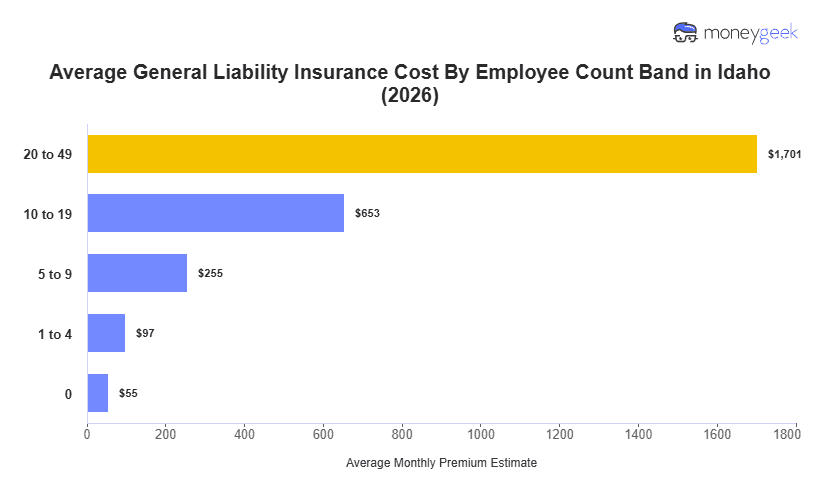
General liability costs in Idaho range from $55 per month for sole proprietors to $1,701 for businesses with 20 to 49 employees, a 31-times spread across five employee bands. Costs scale with headcount because more employees lead to more third-party interactions and greater exposure to liability claims.

The highest jump occurs at the next tier: hiring a fifth employee pushes costs to $255 per month, a 163% increase, so businesses planning to grow past four employees should factor this shift into their budgets. From there, each tier adds roughly 1.5 to 1.6 times the previous cost. The table shows monthly and annual estimates by employee count.

General Liability Insurance Cost in Idaho Chart

Average General Liability Insurance Costs in Idaho by Industry

General liability costs in Idaho vary widely across 25 general industries, ranging from $25 per month for tech and IT businesses to $235 for construction and contracting companies, nearly a 10-times spread. Insurers price this gap based on physical exposure and claims frequency, with office-based work carrying lower risk than hands-on contracting. Most industries fall below the state average: only four exceed it, meaning a small number of high-risk sectors pull the overall average upward. The table shows monthly and annual estimates by industry.

Data filtered by:
Select
Agriculture & Natural Resources$80$96217%
Arts, Media & Entertainment$30$36569%
Beauty, Body & Wellness Services$29$35270%
Childcare Services$88$1,0609%
Cleaning Services$72$86826%
Construction & Contracting$235$2,824-142%
Consulting Services$31$36769%
Education$37$44662%
Financial Services$31$36769%
Fitness Services$82$98615%
Food & Beverage$93$1,1135%
Healthcare & Medical$161$1,936-66%
Hospitality, Travel & Tourism$76$91621%
Manufacturing$50$60348%
Marketing & Communications$29$34471%
Nonprofit & Associations$44$53354%
Other Professional Services$59$71039%
Pet Care Services$71$85427%
Real Estate & Property Services$43$51256%
Recreation & Sports$112$1,342-15%
Repair & Maintenance$54$64844%
Retail & Product Rental$102$1,221-5%
Tech/IT$25$29675%
Transportation & Logistics$74$88724%
Wholesale & Distribution$72$86826%

Use these resources to explore costs for your industry.

How to Lower General Liability Insurance Costs Without Sacrificing Coverage

Idaho businesses can reduce premiums without compromising protection by adjusting how they buy and manage their policies. These strategies help you find lower rates for general liability insurance in Idaho, but avoid cutting coverage below what your operations actually require.

  • shoppingCart icon
    Compare multiple insurers

    Requesting general liability quotes from several carriers helps you see how pricing varies for your specific operation. A Coeur d'Alene landscaping company might find one insurer pricing its seasonal work patterns favorably while another charges more for the same exposure. Beyond price, compare carrier financial strength and how they handle claims. Review policy terms carefully, as general liability exclusions differ between carriers and affect what's covered when you file.

  • building icon
    Bundle general liability into business owner's policies (BOP)

    A business owner's policy combines general liability with commercial property coverage into a single package, typically at a lower combined rate than buying each separately. This works well for a gift shop in downtown Ketchum or a family-owned hardware store in Rexburg that needs both liability and property protection. Review the cost of a BOP to see if bundling fits your setup.

  • calendarV2 icon
    Pay annually instead of monthly

    Insurers often add installment fees to monthly payment plans, typically 5 to 10% of your premium. Paying annually eliminates these fees. If you run a fishing guide service near McCall or a rafting outfitter on the Salmon River, setting aside funds during the off-season lets you pay upfront when your policy renews. 

    Monthly payments may work better for newer businesses still building cash reserves or operations with unpredictable revenue, where keeping cash on hand matters more than avoiding the installment fee. Evaluate whether the fee savings outweigh the flexibility of spreading payments when you need general liability coverage.

  • insurance2 icon
    Adjust your coverage limits

    Match your general liability limits to your actual exposure rather than carrying more coverage than you need. A solo IT consultant working remotely from Meridian likely needs less than a physical therapy clinic in Pocatello with daily patient visits. Check your lease agreements and client contracts for minimum requirements, then evaluate how much general liability you need based on your operations.

  • graph icon
    Improve your loss profile over time

    Your claims history directly affects what insurers charge. Businesses with frequent or costly claims pay higher premiums, while those with clean records qualify for better rates over multiple policy cycles.

    A Sun Valley property management company that documents maintenance issues before they become slip-and-fall claims, or a Nampa food truck operator that tracks safety inspections, builds a favorable loss profile. Insurers reward this consistency at renewal, and the savings compound over time.

General Liability Insurance Cost in Idaho: Bottom Line

General liability costs in Idaho depend on three primary factors: employee count, industry classification, and state market conditions. The state average offers a reference point, but actual quotes vary based on where a business falls within these variables.

When evaluating a quote, consider:

  1. Does your quote reflect your actual risk profile? A cleaning service and a consulting firm may have similar revenue, but insurers price them differently based on physical exposure. If your quote seems high or low relative to the industry benchmarks above, ask what's driving the difference.
  2. Are you paying for coverage you don't need or missing coverage you do? Limits, deductibles, and bundling options all affect cost. A quote that looks affordable may carry exclusions that leave gaps; a higher quote may include protection that matches your contract requirements.
  3. What changes in the next 12 months could shift your pricing? Hiring a fifth employee, adding a service line or signing a lease with insurance minimums can all trigger cost adjustments. Factoring these into your decision now avoids surprises at renewal.

Idaho's economy blends high-risk sectors like construction and agriculture with a growing base of low-risk service and tech businesses. A quote that looks high or low compared to the state average may simply reflect where your operation fits within that mix.

General Liability Insurance Cost in Idaho: Next Steps

Moving from cost research to quote evaluation requires consistent inputs. Before requesting quotes, confirm that your industry classification and employee count are accurate. Insurers use these as primary rating factors, and errors affect the quotes you receive.

When comparing providers in Idaho, use the same coverage limits, deductibles and policy terms across all requests so pricing differences reflect the carrier, not different inputs. If cost reduction is a priority, focus on factors within your control: adjusting limits to match actual exposure, raising deductibles if cash reserves allow or switching to annual payment to avoid installment fees.

About Connor Bolton


Connor Bolton, Senior SEO and Content Manager (Business & Pet), MoneyGeek

Connor Bolton is Senior SEO and Content Manager at MoneyGeek, where he leads the business and pet insurance editorial teams. He sets the research framework, data standards and content structure for his team. All content goes through his accuracy review before publication. Connor also writes in-depth guides and has spent more than four years covering insurance products across personal, commercial and specialty lines.

The research infrastructure Connor built covers auto, home, renters, life, health, business and pet insurance across pricing analysis, carrier research, customer experience and coverage evaluation. It includes over 6 million data points for business insurance across 408 industry areas, all 50 states and 16 vehicle types. The pet insurance side covers over 5 million profiles across 18 major providers, 100+ breeds and ages up to 20 years. Connor’s insurance research and his team's work has been cited by the U.S. Chamber of Commerce, Allstate, Liberty Mutual, CBS News, Forbes and LegalZoom.

Connor also talks with underwriters and carrier liaisons at Ethos, The Hartford, ERGO NEXT, Nationwide and State Farm, and monitors business and pet owner communities on Reddit. Those sources shape how his team evaluates carriers, structures rate analysis and writes for human buyers rather than search engines.

For questions about MoneyGeek's business and pet insurance content, contact him at connor@moneygeek.com or on LinkedIn.


Sources