
How Much Does General Liability Insurance Cost in Indiana?

The average cost of general liability insurance in Indiana is $106 monthly ($1,272 annually) for businesses with one to four employees and coverage limits of $1 million per occurrence/$2 million aggregate. Indiana is the 19th most affordable state, with its monthly cost falling 14% below the national benchmark.

Indiana's premiums are lower than neighboring Midwest states. Wisconsin, Ohio and Michigan are the closest comparisons, each less than 10% higher. Illinois is 33% more expensive at $141 a month, which is a gap explained by higher claim costs and a more aggressive commercial liability environment.

The statewide average is a reference point, not a price guarantee. The final premium depends on industry-specific claim exposure, operational risk factors and loss history, even when two businesses select identical coverage limits.

For an estimate closer to your actual profile, the Indiana general liability insurance cost calculator below accounts for your specific business details.


To estimate average general liability insurance costs in Indiana, we analyzed quote data from major U.S. small business insurance providers and modeled standardized premium estimates across common business profiles. These modeled results are designed to provide a consistent state benchmark and show how premiums vary by key baseline factors including business size, industry and location within Indiana.

Dataset Scope and Assumptions

Our cost modeling uses standardized inputs for consistent comparisons across Indiana businesses.

  • Providers analyzed: 10 major insurance providers
  • Industries covered: 25 general industry categories relevant to Indiana's business landscape
  • Employee count bands: zero, one to four, five to nine, 10 to 19 and 20 to 49 employees
  • Policy baseline: standard general liability policy with $1 million per occurrence / $2 million aggregate limits
  • Total estimates modeled: over 20,000 standardized pricing estimates across Indiana industry and employee count combinations

We also incorporated modeled average revenue and payroll personalized across all combinations of Indiana regions, industry and employee counts to improve the accuracy of pricing. To model these assumptions against our cost factors, we used data from these sources:

  • CBP (for employee size class density in Indiana by NAICS)
  • QCEW (for wage/payroll intensity by industry in Indiana)
  • Economic Census / SUSB (for receipts/output intensity by industry)
  • Calibrated against:
    • Private comp databases
    • IRS SOI totals

How We Calculated Average General Liability Costs in Indiana

Our published averages represent modeled premiums for standardized business profiles and were aggregated in two ways:

  • Indiana state average: The Indiana average cost reflects the modeled premium for a standardized one to four-employee small business across all industries included in our dataset for a standard general liability policy.
  • Segment averages: To show how costs vary within Indiana, we calculated average modeled premiums for our state base profile and isolated for variables, including:
    • Employee count (business size ranges)
    • General industry categories

Segment averages were produced by aggregating modeled pricing trends across the full dataset so readers can compare how premiums shift across business types and regions within Indiana.

Our Indiana general liability insurance cost calculator below gives you more personalized estimates so you can accurately compare rates.

Indiana General Liability Insurance Cost Estimate Calculator

Select your general industry and employee count for a personalized general liability insurance cost estimate for your Indiana business. Estimates are based on a $1 million per occurrence and $2 million aggregate policy.

Select General Industry
Select Employee Count
Monthly rate estimate

What Factors Affect General Liability Insurance Costs in Indiana?

The cost of general liability insurance in Indiana is a function of universal business characteristics (employee count and industry classification) plus state-specific elements including legal frameworks, weather patterns and economic conditions. Knowing which category each factor belongs to helps identify where rates are fixed and where there's room to reduce them.

Indiana Agnostic General Liability Insurance Cost Factors

Two factors set every baseline premium: employee count and industry classification. Each one signals a different level of exposure to insurers.

  • smallBusiness icon
    Business size

    Business size shapes general liability pricing because headcount serves as a proxy for operational scale and claim exposure. More employees mean higher transaction volumes, broader customer contact and greater potential for incidents that trigger coverage.

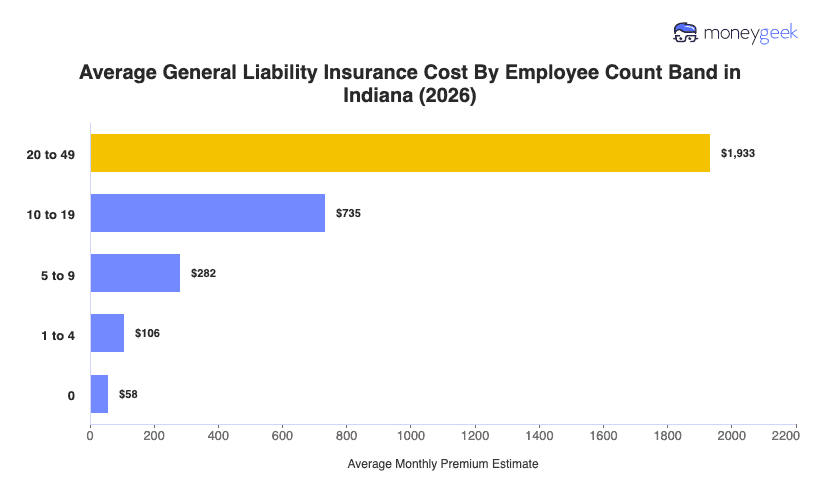
    Indiana's smallest operations, sole proprietors, pay 45% below the state average, while companies employing 20 to 49 workers see premiums jump 1,724% higher.

  • contractor icon
    Industry classification

    Different business types carry distinct liability exposures: office-based operations have minimal physical risk compared to businesses involving hands-on work, customer premises or hazardous materials. These factors directly shape claim frequency and severity.

    In Indiana, Tech and IT pay 76% below the state average, reflecting low-risk desk work with limited customer interaction. Construction and contracting operations sit at the opposite end, running 165% above average due to worksite hazards, third-party property exposure and elevated injury potential.

Indiana-Specific General Liability Insurance Cost Factors

State-level factors add another pricing layer beyond employee count and industry classification. Indiana's comparative fault laws, construction regulations, severe weather risk, tourism activity and manufacturing economy all influence what you pay for general liability coverage.

  • congress icon
    Indiana's Comparative Fault and Tort Climate

    Indiana bars injured parties from recovering damages when they're 51% or more at fault for an accident. If you're 50% or less responsible, your compensation drops by your fault percentage. The state also caps certain damages, enforces tight statutes of limitations and requires notice-and-cure processes for construction defects. These legal protections reduce claim severity and frequency, allowing insurers to price general liability coverage more competitively.

  • houseRebuild icon
    Indiana's Construction Liability Standards

    Indiana gives property owners 10 years from project completion to file construction defect claims against you. The state Supreme Court ruled in Sheehan Construction Company v. Continental Casualty Company that general liability policies can cover unintentional faulty workmanship, expanding what insurers may pay. This decade-long exposure window raises premiums for construction businesses.

  • tornado icon
    Indiana's Severe Weather Risk

    Indiana battles frequent tornadoes, severe thunderstorms and damaging hail throughout spring and summer. The 2024 season brought multiple EF-2 and EF-3 tornadoes, including a 155-165 mph twister that devastated Winchester in March. These storms damage your property and create liability hazards like broken walkways, scattered debris and flooding on your premises. Insurers price this storm risk into premiums.

  • Trourist icon
    Indiana's Tourism and Customer Volume

    Indiana welcomed record tourism numbers in 2024, with 83 million visitors generating $16.9 billion in spending. Major events like the Indianapolis 500, NBA All-Star Game and Taylor Swift concerts fueled growth. More visitors walking through your doors means more slip-and-fall exposure and premises liability risk. Restaurants, hotels and retail businesses pay higher rates because constant foot traffic increases claim frequency.

  • contractor icon
    Industrial and Manufacturing Economy

    Indiana ranks among the top manufacturing states nationally, with heavy concentrations in automotive production, steel fabrication and industrial machinery. These industries involve hazardous materials, heavy equipment and third-party contractor relationships that elevate general liability exposure. Insurers price for this industrial risk profile, with added weight for businesses in supply chains serving manufacturing, construction and logistics sectors throughout the state.

Average General Liability Insurance Costs in Indiana by Business Size

Larger workforces create more exposure to customer interactions, workplace accidents and third-party claims. Indiana solopreneurs pay $58 monthly, and having one to four employees increases costs by $48.

The largest percentage increase occurs when you hire your fifth employee, where premiums jump 165%. When you have a larger team size (10 to 19 employees), your monthly premium reaches $735, more than what owner-only businesses pay for an entire year. 

This table shows monthly and annual costs for each workforce tier. Use it to estimate your premium based on current and projected employee count.

General Liability Insurance Cost in Indiana Chart

Average General Liability Insurance Costs in Indiana by Industry

Industry determines your general liability premium before insurers consider business size or location. A tech startup pays $26 monthly while a construction contractor pays $281 for identical coverage limits. Across 25 general industries in Indiana, your classification alone can swing premiums by $255 monthly before any other rating factors apply.

Indiana's industry cost data shows four patterns.

  1. Most Indiana businesses pay below the state average. Sixteen of 25 industries cost more than 20% below the $106-a-month baseline. Only two (Health Care and Construction) exceed the average by more than 20%. Individual quotes tend to come in below statewide figures because most Indiana businesses are in below-average cost categories.
  2. Manufacturing costs are low despite heavy equipment exposure. Indiana's largest employment sector pays $58 a month, or 45% below average. The state has roughly twice as many manufacturing jobs as most states, so insurers have deep experience with these risks and price accordingly. Mature safety protocols and a competitive insurance market keep premiums low even with product liability and machinery exposure.
  3. Agriculture costs are below average despite real liability risk. As a top producer of corn, soybeans and hogs, Indiana's agricultural sector pays $88 a month (17% below average) despite tractor accidents and agrichemical liability. Indiana's established agricultural infrastructure leads insurers to treat these operations as lower-risk.
  4. Physical hazards matter more than customer volume. Food service businesses with hundreds of daily customers pay 1% above average ($107 a month). Construction contractors pay 165% more ($281 a month) because of jobsite hazards and property damage exposure. Retail stores with constant foot traffic pay $105 a month, which is nearly the same as the state baseline. The physical work environment is a stronger pricing signal than customer count.
Data filtered by:
Select
Agriculture & Natural Resources$88$1,06217%
Arts, Media & Entertainment$34$40268%
Beauty, Body & Wellness Services$34$40468%
Childcare Services$105$1,2541%
Cleaning Services$84$1,00721%
Construction & Contracting$281$3,376-165%
Consulting Services$32$37970%
Education$44$52659%
Financial Services$35$42667%
Fitness Services$97$1,1619%
Food & Beverage$107$1,280-1%
Healthcare & Medical$187$2,245-77%
Hospitality, Travel & Tourism$90$1,07615%
Manufacturing$58$70045%
Marketing & Communications$30$36172%
Nonprofit & Associations$49$58954%
Other Professional Services$66$79438%
Pet Care Services$69$83434%
Real Estate & Property Services$45$53958%
Recreation & Sports$65$77839%
Repair & Maintenance$63$75741%
Retail & Product Rental$105$1,2631%
Tech/IT$26$31076%
Transportation & Logistics$79$95225%
Wholesale & Distribution$90$1,08115%

Use these resources to explore costs for your industry.

How to Lower General Liability Insurance Costs Without Sacrificing Coverage

Indiana businesses can lower general liability premiums through payment timing, accurate underwriting information and claims prevention. Some methods cut costs within one billing cycle; others build toward more affordable general liability insurance through better loss profiles and documented risk controls.

Quick General Liability Cost Lowering Methods

You can reduce your Indiana general liability premium within one billing cycle through payment adjustments, accurate underwriting information and strategic insurer comparison. These six do exactly that without requiring operational changes to your business.

  • insurance2 icon
    Provide clean, accurate underwriting information

    Fort Wayne defense contractors providing incomplete operational details receive generic manufacturing quotes 40% to 60% higher than specialized aerospace rates. Submit accurate square footage, employee counts, equipment values and detailed service descriptions upfront to avoid repricing surprises. 

    Indiana's industrial economy requires precise classification, so describe your actual operations like "titanium CNC machining for medical devices" rather than vague "metal fabrication." Clean underwriting information prevents misclassification and helps quotes reflect your true risk profile.

  • shoppingCart icon
    Compare multiple insurers

    Indiana's 10-year window for construction defect claims creates long-tail exposure that insurers price inconsistently. Indianapolis contractors building the city's $9 billion capital projects receive quotes varying 30% to 50% between carriers for identical coverage. Compare at least three insurers familiar with Indiana's statute of repose for construction defects. Regional carriers serving Indianapolis commercial development often outprice national insurers unfamiliar with Indiana's contractor-friendly legal framework.

  • building icon
    Bundle general liability into a business owner's policy (BOP)

    Warsaw retailers serving medical tourism can reduce premiums by bundling general liability with property coverage into a Business Owner's Policy (BOP). The cost of a BOP averages less than purchasing coverages separately, and single-policy management simplifies orthopedic device showroom operations. Bundling works best for businesses with under 100 employees operating from owned or leased commercial space in Warsaw's medical district.

  • coins2 icon
    Pay annually instead of monthly

    When you can cover the full year's premium upfront (around $1,050 for Lafayette agricultural operations) annual payment saves 5% to 10% and eliminates monthly billing fees. A Tippecanoe County corn and soybean operation paying $88 monthly saves approximately $53 to $106 annually by prepaying after harvest. Farms receive harvest income in October, making that the natural time to prepay the full year's premium and lock in immediate savings.

  • money2 icon
    Increase your deductible (if you can afford it)

    Raising your deductible from $500 to $2,500 reduces premiums 15% to 25%, but only makes financial sense if you maintain enough emergency reserves. Evansville food service operations need at least $10,000 cash available to absorb higher deductibles without operational disruption. Indiana's severe weather risk, such as tornadoes and hurricanes, makes this strategy dangerous without reserves. Skip higher deductibles if covering a $2,500 claim would strain your business finances.

  • loanReview icon
    Adjust your coverage limits

    Indiana's 51% comparative fault bar reduces claim severity compared to other states, potentially justifying lower limits for some businesses. South Bend medical facilities still carry high premises exposure despite favorable liability laws. Evaluate whether your current amount of general liability coverage matches your actual customer volume and slip-and-fall risk before reducing from $1M/$2M standard limits to save on premium costs.

Long-Term General Liability Cost Lowering Methods

Long-term methods reduce Indiana general liability costs through operational improvements that prevent claims over multiple renewal cycles. These can generate savings within three to five years.

General Liability Insurance Cost in Indiana: Bottom Line

Indiana general liability premiums reflect how insurers assess exposure to customer injuries, property damage and legal settlements. A Warsaw orthopedic device showroom and a Kokomo metal fabrication shop pay different rates because their claim patterns and operational risks are different. Employee count, revenue and Indiana-specific conditions are also factors.

Three questions frame a useful evaluation:

  1. Where do you sit in Indiana's economy? Fort Wayne defense contractors and Brown County tourism outfitters with the same employee count face different risk profiles.
  2. What drives your premium relative to similar businesses? The relevant variables are baseline industry risk, Indiana's comparative fault legal climate and seasonal customer volume.
  3. What would actually lower your cost? Coverage limit adjustments, deductible increases, documented safety programs and a three-year clean loss history are the levers available.

Get quotes from multiple Indiana insurers to see how your premium varies by classification, location and operational risk.

General Liability Insurance Cost in Indiana: Next Steps

Additional resources include:

To get coverage, contact at least three Indiana-licensed insurers. Provide accurate employee counts, revenue figures and operational details upfront so quotes reflect your actual risk profile rather than generic industry estimates.

About Connor Bolton


Connor Bolton, Senior SEO and Content Manager (Business & Pet), MoneyGeek

Connor Bolton is Senior SEO and Content Manager at MoneyGeek, where he leads the business and pet insurance editorial teams. He sets the research framework, data standards and content structure for his team. All content goes through his accuracy review before publication. Connor also writes in-depth guides and has spent more than four years covering insurance products across personal, commercial and specialty lines.

The research infrastructure Connor built covers auto, home, renters, life, health, business and pet insurance across pricing analysis, carrier research, customer experience and coverage evaluation. It includes over 6 million data points for business insurance across 408 industry areas, all 50 states and 16 vehicle types. The pet insurance side covers over 5 million profiles across 18 major providers, 100+ breeds and ages up to 20 years. Connor’s insurance research and his team's work has been cited by the U.S. Chamber of Commerce, Allstate, Liberty Mutual, CBS News, Forbes and LegalZoom.

Connor also talks with underwriters and carrier liaisons at Ethos, The Hartford, ERGO NEXT, Nationwide and State Farm, and monitors business and pet owner communities on Reddit. Those sources shape how his team evaluates carriers, structures rate analysis and writes for human buyers rather than search engines.

For questions about MoneyGeek's business and pet insurance content, contact him at connor@moneygeek.com or on LinkedIn.


Sources