
Best General Liability Insurance Companies for Small Businesses in Indiana

Manufacturing plants, farm equipment dealers and healthcare providers drive Indiana's economy, and each faces different liability exposures. Finding the best general liability insurance means matching coverage to your specific operations, not just picking the cheapest policy. These five insurers balance cost with service quality and coverage flexibility:

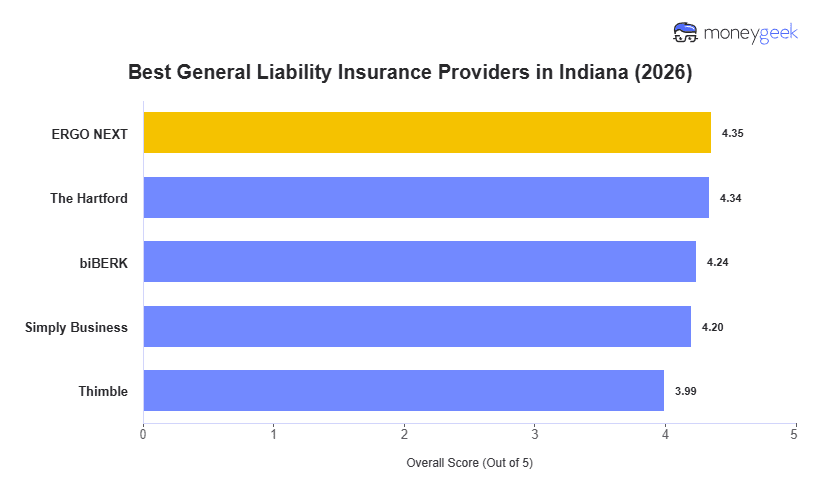
  1. ERGO NEXT: Best Overall, Best for Very Small Businesses in Hands-On Industries
  2. The Hartford: Best Cheap General Liability Insurance
  3. biBERK: Best for Service-Oriented Businesses
  4. Simply Business: Best for Comparing Carriers
  5. Thimble: Best for On-Demand Coverage

An auto repair shop in South Bend needs different protection than a consulting firm in Fishers or a cleaning service in Evansville. Here's what distinguishes each provider:

ERGO NEXT
4.35
Provides instant digital quotes and most savings for Indiana's smallest businesses. Especially valuable for hands-on operators like contractors and repair services needing straightforward coverage without agent involvement.
The Hartford
4.34
Gives savings that scale as businesses grow, reaching 20% for companies with 10+ employees. Particularly competitive for professional services through agent-based underwriting and extensive coverage customization.
biBERK
4.24
Delivers 19% to 29% savings for Indiana businesses like fitness centers, cleaning services and recreation operations. Quick quote access through a hybrid digital-agent model makes it ideal for straightforward coverage needs.
Simply Business
4.20
Broker platform connects Indiana businesses with multiple carrier partners in one place, allowing comparison shopping. Quick quote accessibility ideal for Tech/IT companies and businesses comfortable evaluating options independently.
Thimble
3.99
On-demand platform offers hourly, daily or monthly coverage for Indiana gig workers, freelancers and seasonal contractors. Instant digital quotes ideal for businesses needing flexible short-term protection without year-round commitments.

For our Indiana general liability insurance ratings, we analyzed pricing, coverage options, and customer experience across 408 industries within the state. Our analysis focuses on 1-to-4-person businesses, which represent nearly half of Indiana's small businesses, while weighting results to ensure broader industry and location representation across Indianapolis, Fort Wayne, Evansville and smaller markets throughout the state.

To do this, we evaluated over 20,000 business profiles, more than 2,000 customer experience data points and performed in-depth analysis of coverage contracts and endorsements to compare how insurers serve Indiana businesses consistently across different industries and regions. We then rated each company across categories of affordability (50% of overall score), customer experience (30% of overall score) and coverage options and terms (20% of overall score) to form an overall rating. For a detailed breakdown of the metrics, scoring methodology, and pricing analysis specific to Indiana, see our full methodology.

95%

% of Small Businesses Covered

Over 20,000

Business Profiles Studied

2,026

Customer Experiences Analyzed

ERGO NEXT
Best Overall, Best for Very Small Businesses in Hands-On Industries

ERGO NEXT

On ERGO NEXT's site

ERGO NEXT ranks first overall for general liability insurance in Indiana, leading in affordability and customer experience. Most businesses save 13% compared to the state benchmark at $93 a month, with the biggest savings going to hands-on industries like construction, childcare and manufacturing. The buying process delivers instant quotes and certificate generation with no agent involvement.

Coverage ranks lower. Options are straightforward but limited, and businesses needing specialized endorsements or custom modifications will find fewer choices than with traditional carriers. The buying process is smooth, but claims handling is weaker. Communication is poor and settlement results often disappoint.

Where ERGO NEXT performs best:

  • Indiana small businesses that want fast quotes and low rates
  • Contractors and service businesses with standard liability exposures
  • Businesses comfortable managing policies through digital-only tools
  • Sole proprietors and micro-businesses (one to four employees) focused on affordability

Where ERGO NEXT performs less competitively:

  • Businesses expecting complex claims that need hands-on adjuster support
  • Companies needing specialized endorsements beyond standard additional insured coverage
  • Operations that require custom underwriting for unique liability risks

Learn More: ERGO NEXT Insurance Review

The Hartford
Best Cheap General Liability Insurance

The Hartford

On The Hartford's site

The Hartford saves Indiana businesses 17% compared to the state average at $88 a month ($1,053 annually). Savings grow with business size: 16% for sole proprietors and 20% for companies with 10 or more employees. Rates are especially competitive for professional services like consulting, financial services and healthcare. Coverage is a strength too, with broad endorsement options for complex liability needs.

Policy management and claims handling are top-ranked, with reliable support through The Hartford's agent network in Indianapolis and Fort Wayne. The agent-dependent buying process is the tradeoff: quote access is slower than with digital competitors, which pulls down its customer experience score.

Where The Hartford performs best:

  • Professional services and office-based Indiana businesses that want tailored coverage
  • Growing companies with five or more employees that benefit from higher savings
  • Businesses that want agent relationships and responsive policy modifications
  • Operations needing complex endorsements beyond standard additional insured coverage

Where The Hartford performs less competitively:

  • Businesses that want instant online quotes over personalized agent service
  • Hands-on industries like manufacturing and real estate where savings are weaker
  • Operations that prefer self-service digital platforms

Learn More: The Hartford Business Insurance Review

biBerk
Best for Service-Oriented Businesses

biBerk

Service industries see the strongest savings with biBERK in Indiana, with fitness centers, cleaning services, real estate offices and recreation businesses saving 19% to 29% compared to the state benchmark. Overall, Indiana businesses save 8% at $97 monthly, putting biBERK at third for affordability. 

Customer experience ranks slightly lower at fourth, as its hybrid digital-agent model delivers quick quote access with strong underwriting transparency. biBERK offers good, but not stellar, responsiveness with policy management and claims handling ranking mid-pack. Despite an extensive agent network, coverage is more limited than traditional carriers, placing it seventh among providers in our study.

Where biBERK performs best:

  • Service-oriented Indiana businesses with lower-risk, standard coverage needs
  • Fitness centers, cleaning services and recreation businesses seeking competitive rates
  • Businesses that want quick quote access and transparent underwriting
  • Operations comfortable with straightforward coverage and basic endorsements

Where biBERK performs less competitively:

  • Construction and higher-risk businesses, where biBERK's rates run above what Indiana benchmarks show
  • Companies with complex coverage needs or endorsements beyond the standard menu
  • Businesses that file policy changes frequently or expect hands-on claims support

Learn More: biBERK Review

Simply Business
Best for Comparing Carriers

Simply Business

Simply Business is an online insurance broker in Indiana that connects businesses with multiple carrier partners rather than covering them directly. The aggregator model lets Indiana businesses compare policies from several insurers in one place and ranks high for customer experience through quick quote access. The tradeoff is that customers navigate carrier options on their own with less guidance than direct insurers provide.

It’s the fifth most affordable provider in our analysis, putting it right in the middle, with Indiana businesses saving just 3% at $103 monthly. Tech and IT companies see exceptional 23% savings, but most other industries face minimal savings or pay more than the state benchmark, such as marketing (15% more), nonprofits (8% more) and professional services (11% more).

Where Simply Business performs best:

  • Tech/IT companies in Indiana that can save 23% through broker rates
  • Businesses comfortable comparing multiple carrier options on their own
  • Operations that want access to several carriers in one platform
  • Companies that want fast online quotes over hands-on guidance

Where Simply Business performs less competitively:

  • Marketing, nonprofit and professional service businesses, where Simply Business rates come in above the state average
  • Businesses that want guidance choosing between carrier options rather than comparing independently
  • Operations that want one carrier to handle all policies rather than a broker managing severalmanagement

Learn More: Simply Business Review

Thimble
Best for On-Demand Coverage

Thimble

Thimble offers on-demand general liability coverage in Indiana, available by the hour, day, month or year through its digital platform. This flexibility of this coverage model ranks second for buying experience with instant quotes and clear pricing, though coverage options rank last since Thimble offers very limited endorsements and lower damage to rented premises sublimits ($100,000 vs. industry standard $300,000).

Thimble ranks sixth for customer experience. Businesses report poor communication, slow claim resolution and low satisfaction with settlements. On price, Indiana businesses save about 7% at $98 a month. Construction and manufacturing get the best rates of any sector.

Where Thimble performs best:

  • Gig workers and freelancers who need short-term or hourly coverage
  • Event contractors and seasonal businesses that don't need year-round policies
  • Construction and manufacturing businesses looking for competitive on-demand rates
  • Businesses that want instant digital quotes

Where Thimble performs less competitively:

  • Businesses with high premises liability that need sublimits above the standard
  • Operations with complex coverage needs or endorsements beyond the basics
  • Businesses that expect active adjuster involvement on claims

Learn More: Thimble Review

Explore The Best General Liability Insurance in Indiana By Industry

Indiana's business landscape spans precision manufacturing, retail and professional services. MoneyGeek has compiled industry-specific resources to help you find coverage that fits your operational risks and budget.

What Determines the Best General Liability Insurance for Indiana Businesses

The best general liability insurers in Indiana issue certificates the same day, process policy changes fast and hold rates steady through busy and slow seasons. Four things separate reliable carriers from the rest: stable pricing, quick responses to policy changes, coverage matched to your actual risks and consistent performance across all three.

    coins2 icon
    Affordability without pricing volatility

    Indiana businesses with seasonal revenue patterns need insurers who keep rate changes predictable and proportional. A landscaping company in Carmel might bring in most of its annual revenue between April and September, then operate lean through winter. An event venue in Bloomington sees the opposite: packed schedules during football season and graduation, quieter months in between.

    Your premium will adjust when you add workers or expand operations, and that's normal. But affordable general liability coverage shouldn't come with surprise rate spikes at renewal or penalize seasonal businesses just because income fluctuates. Strong insurers explain what drives rate changes and maintain consistent pricing formulas year over year.

    talk icon
    Responsive service throughout your policy term

    Indiana businesses can't afford to wait days for insurance paperwork when opportunities move fast. Contractors bidding on commercial projects need same-day certificate turnaround to stay competitive, and manufacturers adding second shifts require quick policy updates to maintain coverage. When issues arise like severe weather damage, client injuries or coverage questions, you need immediate answers instead of days of back-and-forth with your insurer.

    Strong insurers match your operational speed: they issue certificates the day you request them, process policy changes quickly when you hire workers or expand locations and answer coverage questions without insurance jargon. If your business depends on meeting client deadlines or responding to seasonal demand spikes, service speed directly affects your ability to operate.

    insurance2 icon
    Coverage options that fit common small business risks

    Indiana businesses need policies built around their actual exposures, not standardized packages. A home-based IT consultant in Carmel doesn't face the same liability risks as a restaurant serving customers in Bloomington. A construction crew working on commercial sites across the state needs different protection than either one. Coverage should adapt when your operations change, whether you're adding employees, taking on bigger contracts or expanding into new service areas.

    Look for providers that let you modify limits and endorsements as your business grows:

    • Can you add hired auto coverage when workers start driving to client sites?
    • Will your insurer increase liability limits mid-term for larger contracts?
    • Can you adjust your policy when opening a second location without starting over?

    Flexible insurers make these changes straightforward instead of forcing you into rigid coverage structures that don't fit your business.

    building icon
    Why consistency across all three areas matters most

    Choosing an insurer based only on price or service speed creates problems when you actually need coverage. A Fort Wayne manufacturer might save $400 annually with one carrier but lose contracts waiting days for certificates. Fast service doesn't help an Indianapolis retailer if surprise rate increases at renewal erase any savings from the previous year. Balance affordability, service responsiveness and coverage flexibility before committing to a provider.

How to Choose the Best General Liability Insurance in Indiana

Finding the right general liability coverage for your Indiana business starts with understanding what risks you actually face. A Fort Wayne metal fabricator deals with different exposures than a Carmel event planner or an Evansville contractor. These six steps help you evaluate insurers based on your specific operations and priorities, not one-size-fits-all advice.

  1. 1
    Identify your actual risk exposure

    Coverage limits should reflect where claims actually come from in your business. An HVAC contractor working in commercial buildings across Indianapolis needs different protection than a freelance photographer shooting weddings. Most Indiana businesses start with $1 million per occurrence and $2 million aggregate. Manufacturers serving the auto industry or contractors bidding on large projects often need higher limits to meet client requirements. Work through these three questions before choosing your limits:

    • Do clients visit your location where injuries could occur?
    • Do you work on client property where you could cause damage?
    • Do your contracts require specific coverage amounts?

    Set limits based on what you actually need. Too little leaves you exposed on a serious claim. Too much wastes money on coverage your business doesn't require.

  2. 2
    Choose your primary priority

    Different insurers do different things well. An Indianapolis event planner who needs certificates within hours cares more about service speed than saving $200 a year. Your priority depends on how your business operates.

    • Affordability: Stable rates matter when revenue swings seasonally, like lawn care companies in slow winters or tax preparers between filing periods
    • Customer experience: Fast responses matter if you bid on time-sensitive contracts or need policy changes processed quickly when adding workers mid-season
    • Coverage flexibility: Businesses expanding across Indiana or moving from residential to commercial work need policies that adapt without a carrier switch

    Compare insurers on what actually affects your operations, not what sounds most important on paper.

  3. 3
    Shortlist two to three providers

    Find which insurers actually deliver on your priority. Check reviews and ask other Indiana business owners which companies hold rates steady or turn around certificates fast. Stop at two or three because a longer list makes it harder to spot differences between your best options.

  4. 4
    Double check for dealbreakers before investing more time

    Verify each shortlisted insurer meets your non-negotiables before requesting quotes:

    • Policy limits that satisfy your highest contract requirements (e.g., $2 million per occurrence for Indiana commercial or municipal projects)
    • Certificate turnaround fast enough for your deadlines (same-day for construction bids or under 48 hours for event venue bookings)
    • A service model that fits how you work (local agent or full digital self-service)

    Catching mismatches here saves time you'd otherwise spend on insurers that can't serve your business.

  5. 5
    Compare your finalists using the same three lenses

    Put each shortlisted insurer through the same evaluation:

    • Affordability: Do premiums hold steady when revenue dips between busy and slow periods?
    • Customer experience: How fast do they process claims during Indiana's storm season? Can they update coverage quickly when you add workers for spring construction?
    • Coverage flexibility: Can they adjust your policy as you expand from the Indianapolis metro to surrounding counties, or move from residential to commercial contracts with higher liability requirements?

    Evaluating all three prevents picking on price alone and finding out later the insurer can't handle claims or adapt as you grow.

  6. 6
    Get quotes to confirm your choice

    Request general liability quotes from your two or three finalists. Include operational details that affect rates: manufacturing tied to automotive cycles, event services during summer peak season, year-round versus seasonal construction work. Quotes convert your research into a side-by-side comparison you can act on.

Best Small Business General Liability Insurance in Indiana: Bottom Line

ERGO NEXT, The Hartford and Simply Business rank highest in MoneyGeek's Indiana analysis. The right choice depends on what your business actually needs. Start with your exposure, then pick the provider that delivers on your priority.

Request quotes from the one or two insurers that match that priority. Use the same coverage limits across every quote so you're comparing real value, not policies with different protection levels.

Best General Liability Insurance for Small Businesses in Indiana: Next Steps

When you're ready to take action, request quotes from the one or two insurers that match your priority. If stable pricing matters most, focus on rate consistency through renewal. If you need fast service, confirm certificate turnaround times. If flexibility drives your decision, verify how easily they adjust coverage as your business grows. Request quotes using the same limits so you can identify the best value instead of comparing policies with different protection levels.

If you want to confirm cost before deciding

Knowing what other Indiana businesses in your industry typically pay helps you evaluate whether quotes are reasonable or identify pricing that's unusually high or suspiciously low.

If you’re unsure how much coverage you need

Coverage requirements vary by client and contract type. Commercial projects in Indiana often require $2 million limits instead of standard $1 million policies. Checking actual requirements before requesting quotes ensures you're comparing coverage that meets your needs.

If you’re ready to check quotes now

Quotes show how each insurer prices your actual business, not just industry averages. You'll see how they account for your Indiana location, seasonal operations and specific work type. 

  • Compare general liability insurance quotes using the same limits
  • Validate coverage terms before making a final decision

How We Chose the Best General Liability Insurance Companies

To identify the best general liability insurance companies for Indiana small businesses, we evaluated insurers across pricing, customer experience, and coverage options using a standardized, data-driven approach. Our goal was not to identify the cheapest option in every scenario, but to determine which providers deliver the most consistent overall value across common Indiana small business profiles.

Our best recommendations reflect insurers that perform well across multiple dimensions and remain competitive across industries and business sizes in Indiana.

Data and Analysis Scope

Our analysis is based on standardized estimates designed to represent the majority of Indiana small businesses:

  • Providers analyzed: 10 major insurers serving Indiana
  • Industries covered: 408 industries
  • Employee counts: 0–49 employees
  • Policy baseline: $1M per occurrence / $2M aggregate general liability policy
  • Pricing modeled: Just over 20,000 standardized estimates for Indiana businesses

Modeled average revenues and payrolls were incorporated to improve pricing accuracy for Indiana.

Our Scoring Model

Each insurer received a composite score based on these weighted categories:

  • Affordability (50% of overall score): Affordability reflects how competitively and consistently an insurer prices general liability coverage across all Indiana business profiles studied.
  • Customer experience (30% of overall score): Customer experience measures how well insurers support Indiana businesses throughout the policy lifecycle from purchase to claims. We also studied at each level of buying, policy management and claims sub-parts of the process that make it easier and more reliable within each as well for accuracy and comprehensive understanding.
  • Coverage options (20%): Coverage options reflect how well insurers support common Indiana small business risks and allow for flexibility as businesses grow or change.

About Connor Bolton


Connor Bolton headshot

Connor Bolton is Senior SEO and Content Manager at MoneyGeek, where he leads the business and pet insurance editorial teams. As editorial lead for both verticals, Connor sets the research framework, data standards, and content structure that his writers execute, directly authoring in-depth guides himself and reviewing all team content for accuracy and practical value before it goes live. With over four years evaluating insurance products across personal, commercial, and specialty lines, he brings cross-vertical knowledge to every guide the team produces.

Connor architected MoneyGeek's insurance research infrastructure across all major verticals including auto, home, renters, life, health, business, and pet, building systems for pricing analysis, provider-level research, customer experience evaluation, and coverage analysis with AI support. The infrastructure includes over 6 million data points for business insurance across 408 industry areas, all 50 states, and 16 vehicle types, and over 5 million pet insurance profiles across 18 major providers and hundreds of breed and age combinations. Connor's insurance cost research and his team's work has been cited by the U.S. Chamber of Commerce, Allstate, Liberty Mutual, CBS News, Forbes and LegalZoom.

Beyond the data, Connor stays connected to how the market actually operates, drawing on direct conversations with underwriters and carrier liaisons at Ethos, The Hartford, NEXT Insurance, Nationwide, and State Farm, and monitoring business and pet owner communities including Reddit, to inform how he interprets findings and frames guidance for real buyers.

He is the direct editorial contact for methodology questions at connor@moneygeek.com and can be found on LinkedIn.