Cheapest Indiana General Liability Insurance Companies

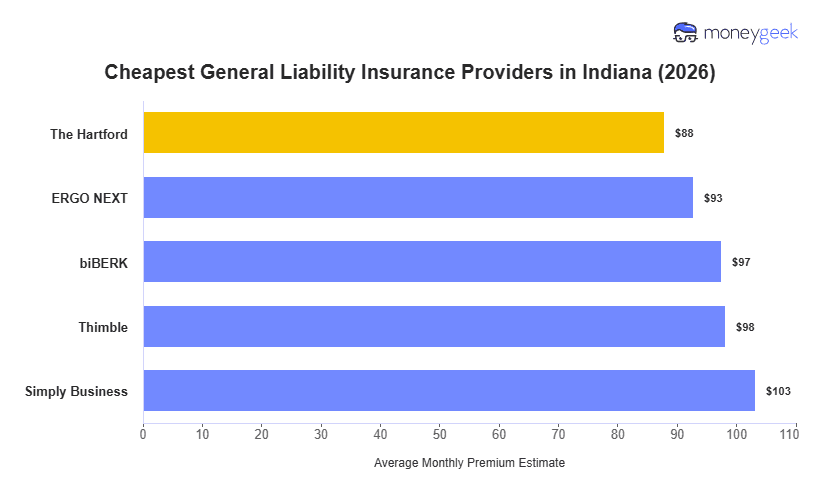
Based on our analysis of 408 industries in Indiana, these are the three cheapest general liability insurance providers in the state:

  • The Hartford: Cheapest for professional services and creative businesses (management, IT, photography, videography)
  • ERGO NEXT: Most affordable for trades and customer-facing operations (roofing, painting, barber shops, tattoo shops)
  • biBerk: Cheapest for health care and fitness businesses (chiropractors, physical therapy, yoga studios, CrossFit gyms)

[Click Each Provider to Learn More]

Rates vary based on your industry, revenue, employee count and claims history in Indiana, so use these providers as a starting point for comparing quotes tailored to your business.

The Hartford$88$1,05317%
ERGO NEXT$93$1,11213%
biBERK$97$1,1688%
Thimble$98$1,1777%
Simply Business$103$1,2383%
Coverdash$110$1,319-4%
Progressive Commercial$112$1,345-6%
Hiscox$119$1,425-12%
Nationwide$119$1,433-13%
Chubb$121$1,447-14%

How We Determined the Cheapest General Liability Insurance Providers

mglogo icon
CHEAPEST GENERAL LIABILITY INSURANCE IN INDIANA DOESN'T MEAN BEST FIT

The lowest-priced general liability policy won't necessarily serve your Indiana business best. A South Bend event planner has different liability risks than a Carmel HVAC contractor or a Fishers software consultant because your specific exposure drives what coverage actually protects you, not just what costs least.

Review what each policy covers, what it excludes and how insurers handle claims in your industry before deciding based on price alone. Our guide to the best general liability insurance companies in Indiana provides a detailed breakdown of coverage quality and customer service for the top providers.

The Hartford

The Hartford: Cheapest for Professional and Creative Businesses

On The Hartford's site
COMPANY HIGHLIGHTS

The Hartford ranks cheapest for seven out of 25 general industries in Indiana, and is most often the low-cost option for professional services (consulting, financial services), creative businesses (photography, videography, arts), health care providers and education services. Small businesses in these sectors save around 13% with The Hartford, paying $88 per month for general liability coverage.

Most often cheapest for these business profiles:

  • General industries: Arts, media & entertainment, consulting services, education, financial services, health care & medical, marketing & communications, retail & product rental
  • Employee count: Zero to 49 employees

Not a fit? Jump to: ERGO NEXT or biBerk

ERGO NEXT

ERGO NEXT: Cheapest for Trades and Customer-Facing Businesses

On ERGO NEXT's site
COMPANY HIGHLIGHTS

At $93 monthly ($1,112 annually), general liability insurance from ERGO NEXT falls 13% below Indiana's average. Manufacturing businesses, such as screen printing, soap making, woodworking and cabinet making, get the biggest savings, with monthly premiums 40% lower than the average.

Most often cheapest for these business profiles:

  • General industries: Beauty, Body and Wellness Services, Childcare Services, Construction and Contracting, Food and Beverage, Hospitality, Travel and Tourism, Manufacturing, Pet Care Services, Repair and Maintenance, Transportation and Logistics, Wholesale and Distribution

Not a fit? Jump to: The Hartford or biBerk

biBerk

biBerk: Cheapest for Health Care and Fitness Businesses

COMPANY HIGHLIGHTS

Health care providers and fitness businesses save the most with biBerk, especially anesthesiologists, oral surgeons, psychiatrists and chiropractors, who pay around 30% less than average monthly rates. biBerk ranks cheapest for five out of 25 general industries in Indiana at $97 monthly, giving most small businesses 10% savings compared to the state average.

Most often cheapest for these business profiles:

  • General industries: Cleaning Services, Fitness Services, Other Professional Services, Real Estate and Property Services, Recreation and Sports

Not a fit? Jump to: The Hartford or ERGO NEXT

Explore the Cheapest General Liability Insurance in Indiana by Industry

General liability insurance costs depend on your Indiana business operations and claim risks. Manufacturing operations in Hammond deal with equipment injuries, while Indianapolis marketing agencies worry about missed deadlines, causing client losses. Browse the industry breakdowns below to find which insurers price your specific risk profile lowest.

Is the Cheapest General Liability Insurance Right for Your Indiana Business?

It only makes sense to get the policy with the lowest premium if it really covers the risks your Indiana business has. A Terre Haute welding shop with equipment on job sites deals with different liability exposures than a Noblesville graphic design studio working from home. Before you choose based on price alone, verify these four factors align with your operations:

  • Policy limits that protect against your biggest risks and meet what clients require in contracts
  • A deductible that won't drain your operating budget when you file your first claim
  • Access to additional coverages that fit your budget as your business grows
  • Responsive claims handling and support, not just low prices during the sales process

Don't sacrifice coverage for savings. Indiana businesses, whether you're running a Bloomington catering company or managing a Muncie auto repair shop, need coverage that scales with actual risk. If you're tight on cash, start with contract-required minimums, then increase your limits as your business grows and revenue gives you room to get more financial protection.

For an in-depth understanding of this coverage type: General liability insurance guide

Is the Cheapest Right for Your Business?

How to Get Cheaper General Liability Insurance in Indiana

  • bag icon
    Compare general liability quotes using the same limits

    Comparing a $1 million policy from one insurer against a $2 million policy from another won't tell you who prices your risk lower. Coverage amounts drive premiums more than carrier choice, so you need identical limits across every quote to see real price differences.

    Request the same per-occurrence limit, aggregate limit and deductible from each Indiana insurer you're evaluating. A South Bend plumbing contractor comparing three quotes should ask all three carriers for the same $1 million/$2 million structure. Without matching coverage parameters, you're just guessing which insurer saves you money versus which one quoted less protection.

  • hammer icon
    Ensure your business classification (class code) is correct

    Insurers price your business based on classification codes that define your actual work and risk exposure. Get coded incorrectly, even by one category, and you're paying premiums calculated for work you don't do. An HVAC installer in Terre Haute who was mistakenly coded as a general contractor pays roughly 25% more monthly because the insurer assumes broader liability exposure.

    Review your policy's business description right now. Does it match what you actually sell or provide? If your classification is wrong, contact your Indiana insurer to correct it. Premiums drop 20% to 30% once you're coded correctly.

  • insurance2 icon
    Only pay for general liability coverage limits you actually need

    Base your limits on three factors: what client contracts require, what damage your operations could realistically cause and your annual revenue. Buying maximum coverage limits because they're available drains your budget without reducing risk.

    A Fort Wayne lawn care company with residential accounts and $80,000 revenue doesn't need the same $5 million policy that a Gary manufacturing supplier uses to meet industrial client requirements. Buy enough coverage to satisfy your largest contracts and protect against your actual exposure, not the highest limits your insurer offers. You can always increase coverage when you land bigger contracts or expand into higher-risk work.

  • money2 icon
    Use general liability deductibles and payments strategically

    Higher deductibles lower premiums but you need accessible cash when claims happen. A Kokomo consulting firm with $15,000 in reserves can handle a $2,500 deductible easily, but a startup Michigan City food truck with tight margins can't afford that hit mid-summer. Choose deductibles you can pay without borrowing or missing payroll.

    Paying annually instead of monthly saves 5% to 8% with most Indiana insurers, but only if it doesn't empty your cash reserves. A Richmond contractor needs working capital for materials, and a Greenfield retail shop can't drain funds right before holiday inventory season. If annual payment creates cash flow problems, monthly installments cost slightly more but keep your business operations stable.

  • coins2 icon
    Bundle general liability insurance when it lowers your total cost

    Bundling multiple policies with one Indiana insurer can save 10% to 25%, but only if you're not overpaying on individual coverage types within the package. A Fishers retail shop might save $400 annually bundling general liability and property insurance through a Business Owner's Policy (BOP), while a Muncie plumbing contractor pays less buying general liability from one insurer and workers' comp from a trade-focused carrier. Always compare bundled pricing against buying each policy separately to find your actual lowest cost.

  • falling icon
    Lower your claim risk in ways Indiana insurers reward

    Insurers price your business partly on preventable claim patterns they see in your industry and region. If you can show that you're actively managing the risks most common to your operations through documentation, training or physical improvements, carriers usually reduce premiums 10% to 20%. What triggers discounts align with what typically causes claims in Indiana:

    • Document winter property maintenance and ice management: Slip-and-fall claims from icy parking lots and walkways are common in Indiana's November-to-March freeze-thaw cycles. Keep dated logs of salting and snow removal.
    • Maintain updated severe weather emergency procedures: Indiana averages 20+ tornadoes annually. Businesses with documented shelter plans, employee drills and communication protocols reduce injury liability when severe weather hits.
    • Require safety certifications for equipment operators: Manufacturing and warehouse operations are a major part of Indiana's economy. Documented forklift, crane or machinery training reduces workplace injury claims that drive general liability and workers' comp costs.
    • Install commercial security systems in high-theft areas: Indianapolis, Fort Wayne and Evansville see elevated property crime. Monitored alarms, cameras and documented security protocols lower theft and vandalism claim frequency.

Affordable General Liability Insurance in Indiana: Bottom Line

No single insurer wins across every Indiana industry. A Fort Wayne metal fabrication shop, a Bloomington event venue and a Lafayette home inspection service each carry different risk profiles, so their best-priced carrier won't be the same.

Use these rankings to narrow your search, then compare quotes from multiple carriers using identical coverage limits. Overpaying for coverage you don't need wastes money. Cutting limits too low to save on premium leaves you exposed.

If you're ready to get quotes: Get matched

Cheapest General Liability Insurance in Indiana Chart

Cheap General Liability Insurance in Indiana: Next Steps

Your lowest rate comes from comparing actual quotes, not rankings alone. A Mishawaka auto body shop and an Anderson consulting firm both need $1 million in coverage, but insurers price them differently based on claim patterns in each industry. Get quotes using identical limits from the three cheapest carriers for your business type because that's where pricing gaps show up clearly.

If you need additional context, we've gathered resources on general liability insurance for small businesses in Indiana.

How We Determined the Cheapest General Liability Insurance Providers in Indiana

To identify the cheapest general liability insurers for Indiana businesses, we analyzed real pricing data from 10 major providers and modeled a large set of standardized pricing estimates across common small business profiles in Indiana.

Dataset scope and assumptions

  • Providers analyzed: 10 major insurance providers
  • Industries covered: 408 industries
  • Employee count bands: Zero, one to four, five to nine, 10 to 19 and 20 to 49 employees
  • Policy baseline: Standard $1 million per occurrence/$2 million aggregate general liability policy
  • Pricing estimates modeled: Over 20,000

We also incorporated modeled average revenues and payrolls across Indiana business profiles to improve pricing accuracy.

How we determined which provider was "cheapest"

We used this dataset to determine which insurers were most often the lowest-cost option across different Indiana business profiles. Our "cheapest" rankings include both:

  • General Recommendation: Provider rankings based on average estimated pricing for a standardized one-to-four employee business profile across all industries in Indiana.
  • Factor Combination Recommendations: Provider rankings based on which insurer was most often cheapest within specific business factor combinations. For example:
    • Industry × Indiana pricing was compared using a standardized one-to-four employee profile
    • Employee count affordability was derived by comparing aggregated pricing trends across industries in Indiana

These results represent standardized pricing estimates, not personalized quotes. Actual pricing can vary based on your Indiana business classification, revenue/payroll, claims history and the specific limits, deductibles and endorsements you choose. For the most accurate cheapest-provider answer, we recommend comparing quotes apples-to-apples using the same coverage limits.

About Angelique Palenzuela-Cruz


Angelique Palenzuela-Cruz, Business Insurance Writer, MoneyGeek

Angelique Palenzuela-Cruz is a Business Insurance Content Writer at MoneyGeek, where she specializes in general liability, workers’ compensation and professional liability insurance. Her work helps small business owners understand how these policies apply to coverage, including risks like customer injuries, employee injuries, professional mistakes, client contract terms and industry-specific coverage requirements.
She primarily covers service-based businesses where liability and employee coverage decisions are especially important, including cleaning, consulting, beauty and wellness, childcare, education, fitness, food service, pet care, repair and maintenance, and other professional services.
Before joining MoneyGeek, Angelique spent nearly 12 years at Guthrie-Jensen Consultants, one of Southeast Asia’s largest management training firms, where she advanced from Training Consultant to Managing Consultant. In that role, she worked with business clients to assess operational needs, develop training programs and present performance analyses to executive decision-makers. She also helped establish Gladwin Training Consultancy, where she served in learning solutions and client service roles.
Her background gives her practical context for writing about how businesses operate, manage client expectations, structure teams and make risk decisions. At MoneyGeek, she applies that experience to business insurance content, connecting coverage to actual business needs.

LinkedIn: linkedin.com/in/ma-angela-cruz

Email Contact: angelique.palenzuela@moneygeek.com