




Choose where to jump to next based on your needs:
Average General Liability Insurance Cost in New York (2026 Report)
General liability insurance in New York ranges from $33 to $560 per month, with your industry classification and business size accounting for most of the variation in what you'll pay.
If you're ready for a quote, get matched to the right general liability carrier for your New York business with our tool below.
Select state
Updated: September 8, 2026
Advertising & Editorial Disclosure
How Much Does General Liability Insurance Cost in New York?
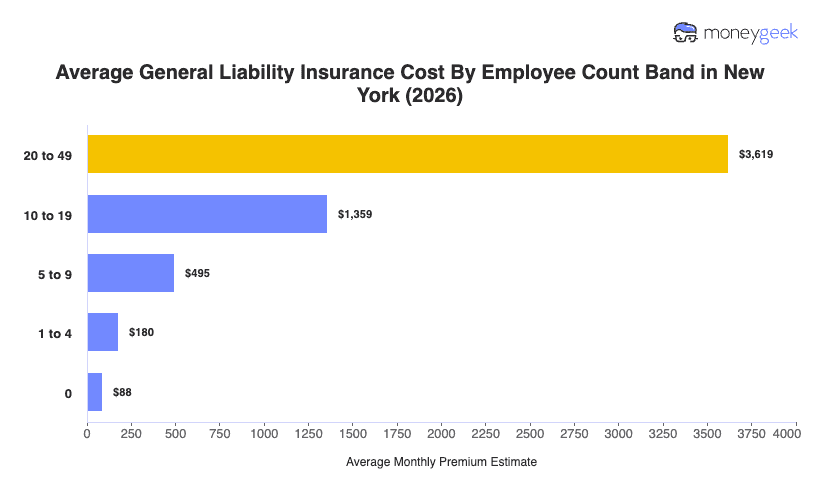
The average general liability insurance cost for New York businesses with one to four employees is $180 per month ($2,157 annually), based on MoneyGeek's analysis of premium estimates across over 400 business types statewide. New York's premium sits $57 above the national average, making it the second-most expensive state nationally.
These state averages provide market orientation but don't determine your individual quote. Use New York's average to gauge where your business sits relative to the broader market, then examine the breakdowns below to see which operational factors shape your specific cost.
To estimate average general liability insurance costs in New York, we analyzed quote data from 10 major U.S. small business insurance providers and modeled over 20,000 standardized premium estimates across 25 general industry categories and five employee count bands (zero, one to four, five to nine, 10 to 19 and 20 to 49). All estimates assume a standard $1 million per occurrence/$2 million aggregate policy. We also incorporated modeled average revenue and payroll calibrated across New York regions, industries and employee counts using CBP, QCEW and Economic Census/SUSB data.
The New York state average reflects the modeled premium for a standardized one to four-employee small business across all industries in our dataset. Segment averages isolate for variables like employee count and general industry category so readers can compare how premiums shift across business types within the state. These are benchmarks, not personalized quotes. For an estimate closer to your profile, use the calculator below. Read full methodology.
Featured Partner

The Hartford
- The Hartford ranks first in New York for general liability, at $97 a month, and for business owner's policies, at $135, per MoneyGeek's overall New York small business analysis.
- Across 48 states including New York, The Hartford writes small business coverage.
- Recognized as a World's Most Ethical Company 17 times, The Hartford was one of only two property and casualty insurers on Ethisphere's 2026 list.
- More than 1.5 million small business customers are insured by The Hartford.
*MoneyGeek featured partner. Editorial rankings below are independent of this placement. Rates, rankings and savings comparisons are based on MoneyGeek's independent research and Hartford-reported data as of 2026. Figures are estimates and averages, not a guarantee of any individual quote, premium or discount.
What Factors Affect General Liability Insurance Costs in New York?
General liability pricing in New York is shaped by universal underwriting factors that apply in every state and by state-specific market conditions that separate New York's rates from national benchmarks. Understanding both layers explains where your premium comes from and which parts you can influence.
New York Agnostic General Liability Insurance Cost Factors
Some pricing factors affect general liability premiums regardless of where your business operates. These baseline variables explain why quotes vary even among businesses in the same state.\
 Business size
Employee count shapes general liability pricing because larger operations generate more customer interactions, handle higher work volumes and carry greater claim probability as complexity scales. In New York, sole proprietors pay 51% below the state average, while businesses with 20 to 49 employees pay 1,913% above it. Each hiring tier adds exposure that compounds rather than scales linearly, so budgeting for premium increases before expanding headcount prevents surprises at renewal.
 Industry classification
Industry type drives pricing based on how work happens and where liability can emerge. Office-based operations with limited customer contact carry lower claim potential than hands-on work involving physical hazards or direct service delivery at customer locations.
In New York, Tech and IT businesses run 82% below the state average because desk work with minimal physical exposure keeps claim frequency low. Construction and contracting sit at the opposite end, running 211% above average due to worksite hazards, heavy equipment use and the elevated injury risk inherent in building trades.
If your business spans multiple industry activities, insurers will classify you by the highest-risk work you perform. Confirming your classification code is accurate and reflects your primary operations prevents overpaying for risk you don't carry.
New York-Specific General Liability Insurance Cost Factors
Beyond universal pricing variables, several conditions unique to New York push general liability costs above national averages. The state's legal standards, insurer concentration and exposure to coastal weather events all create localized cost pressure that shifts premiums based on where and how you operate.

New York's Scaffold Law and Absolute Liability Standard
New York is the only state with absolute liability under the Scaffold Law. Contractors and property owners bear full financial responsibility for all elevation-related injuries, even when workers share fault. No comparative negligence defense exists. Insurers assume worst-case outcomes for each incident, driving construction premiums higher than in any state that allows shared-fault defenses.

New York's Litigation Frequency and Nuclear Verdict Environment
Courts across New York award settlements and judgments that routinely reach millions. The average nuclear verdict jumped from $21.5 million in 2020 to $41.1 million in 2022, according to Marathon Strategies analysis of court records. Juries deliver unpredictable awards, and insurers maintain larger reserves to absorb that volatility. Legal fees compound the cost, and businesses ultimately pay through higher premiums.

New York's Cost of Living and Wage Pressures
How much insurers pay when claims go to court reflects New York's cost of living. Juries calculate lost wages and future earning capacity using the state's wage base, which runs higher than most states. Medical care costs more here than in most of the nation. Insurers factor these elevated economic conditions into every premium because claim settlements reflect New York's price floor.

New York's Insurance Market Competition and Urban Density
Major carriers like Berkshire Hathaway and State Farm have pulled back from New York, reducing competition on price. NYC's crowded streets create distinct liability risks through limited space, heavy pedestrian traffic and high-rise construction. Dense populations and constant commercial activity mean more chances for third-party injuries and property damage. Rate increases of 20% or more have become routine across the state.

New York's Hurricane and Coastal Weather Risk
Coastal exposure creates distinct pricing patterns across the state's geography. Hurricane risk concentrates along downstate corridors, including the five boroughs, Long Island and Westchester's shoreline. Hurricane Sandy caused an estimated $50 billion in damages across the U.S. in 2012, according to NOAA, with New York bearing losses that triggered premium increases in hard-hit zones. Winter storm severity in upstate regions adds seasonal claim risk that coastal businesses don't confront.
Get a NY General Liability Insurance Cost Estimate
Use the general liability insurance calculator below to estimate your costs based on your industry and employee count. All estimates assume a standard policy with $1 million in coverage per occurrence and a $2 million aggregate limit. You can also click Get Quotes to be matched with insurers that may fit your business based on the details you provide.
New York General Liability Cost Estimate Calculator
Select your state and industry to view average business insurance premiums in your area. Rates are calculated based on a business with 5 employees and $500,000 in annual revenue.
Select General Industry
Select Employee Count
Monthly rate estimate—
Select General Industry
Monthly rate estimate—
Select Employee Count
How to Lower General Liability Insurance Costs Without Sacrificing Coverage
Cutting premiums doesn't require cutting protection. Policy adjustments, shopping practices and operational improvements each reduce costs without changing what's covered.
Cheap general liability insurance in New York is most accessible to businesses that understand which tactics produce immediate savings and which take several renewal cycles to pay off.
Quick General Liability Cost Lowering Methods
Some cost-reduction strategies take effect immediately when you adjust your policy or shopping approach. You can implement them at your next renewal or when requesting quotes, and premiums drop within the current coverage period.
 Provide clean, accurate underwriting information
Seasonal workforce changes during Buffalo's harsh winters create underwriting complexity for construction businesses. Insurers price general liability based on average headcount, project scope and annual revenue, and misreporting these figures triggers mid-term premium adjustments. A contractor understating winter layoffs by three workers can owe retroactive charges of $400 to $800 once insurers discover the discrepancy during year-end audits.
 Compare multiple insurers
Comparing business insurance quotes from four to five insurers reveals competitive pricing gaps. A Long Island restaurant operating near busy sidewalks might receive quotes ranging from $145 to $260 monthly for identical $1 million per occurrence/$2 million aggregate limits, as carriers price pedestrian slip-and-fall exposure differently. Regional insurers familiar with suburban foot traffic patterns often quote 15% to 25% below national carriers.
- Bundle general liability into a business owner's policy (BOP)
Business owner's policies combine general liability with commercial property coverage, reducing total costs by 10% to 20% compared to separate policies. Syracuse retailers gain dual protection for both winter slip-and-fall liability and physical damage from roof collapses under heavy snow loads. Understanding BOP costs helps you compare bundling savings against standalone policy pricing and eliminate duplicate administrative fees.
 Pay annually instead of monthly
When you can cover the full year's premium upfront, which is typically $1,300 to $2,200 for Rochester optics manufacturers with five to nine employees, annual payment saves 5% to 10% and eliminates monthly billing fees of $3 to $8. A precision equipment manufacturer paying $185 monthly ($2,220 annually) saves $110 to $220 by prepaying the full amount in January.
 Increase your deductible (if you can afford it)
Compare premium savings to out-of-pocket costs before raising deductibles from $500 to $2,500. Manhattan finance firms with strong cash reserves can handle higher costs per claim. Coastal storm exposure makes this strategy worthwhile, as businesses in lower Manhattan learned after Hurricane Sandy caused major property damage across the borough. Increasing deductibles to $2,500 cuts annual premiums by 15% to 30%, typically $200 to $450 yearly.
 Adjust your coverage limits
Match your coverage limits to your actual liability exposure rather than defaulting to maximum coverage. Albany healthcare providers serving high-earning professionals justify $2 million limits, while a Syracuse retailer with minimal physical customer contact may need only $1 million. Buying more coverage than your contract requirements demand means paying 20% to 35% more in premiums than necessary.
Read More: How Much General Liability Insurance Do You Need?
Long-Term General Liability Cost Lowering Methods
Other strategies require consistent effort across multiple policy periods before premiums decrease. Building a clean claims history and implementing verifiable safety measures takes one to three years to influence underwriting decisions, but these changes create compounding savings that grow with each renewal.
General Liability Insurance Cost in New York: Bottom Line
New York's $180 monthly average spans 408 industries and employee counts from zero to 49, so it functions as a market reference point rather than a predictor for any single business.
Three questions pinpoint what drives your rate:
- Where does your industry fall within New York's cost spectrum? Construction, healthcare and hands-on service businesses pay multiples of what office-based operations spend. Physical liability exposure sets the floor before any business-specific factors are applied.
- How do location and operational scale affect your baseline rate? Metro density, coastal exposure and winter weather patterns each affect pricing differently across the state. Employee count and revenue place your business within an industry pricing tier that can shift substantially with each new hire.
- Which variables respond to your decisions versus market forces you can't change? Claims history, deductible selection and documented safety measures adjust premiums within your baseline. New York's legal environment, the Scaffold Law and regional workforce patterns are fixed regardless of what any individual business does.
Compare your current rate against these factors to determine whether your premium reflects controllable risk or the fixed costs of operating in New York.
About Angelique Palenzuela-Cruz

Angelique Palenzuela-Cruz is a Business Insurance Content Writer at MoneyGeek, where she specializes in general liability, workers’ compensation and professional liability insurance. Her work helps small business owners understand how these policies apply to coverage, including risks like customer injuries, employee injuries, professional mistakes, client contract terms and industry-specific coverage requirements.
She primarily covers service-based businesses where liability and employee coverage decisions are especially important, including cleaning, consulting, beauty and wellness, childcare, education, fitness, food service, pet care, repair and maintenance, and other professional services.
Before joining MoneyGeek, Angelique spent nearly 12 years at Guthrie-Jensen Consultants, one of Southeast Asia’s largest management training firms, where she advanced from Training Consultant to Managing Consultant. In that role, she worked with business clients to assess operational needs, develop training programs and present performance analyses to executive decision-makers. She also helped establish Gladwin Training Consultancy, where she served in learning solutions and client service roles.
Her background gives her practical context for writing about how businesses operate, manage client expectations, structure teams and make risk decisions. At MoneyGeek, she applies that experience to business insurance content, connecting coverage to actual business needs.
LinkedIn: linkedin.com/in/ma-angela-cruz
Email Contact: angelique.palenzuela@moneygeek.com
Sources
- Marathon Strategies. "Corporate Verdicts Go Thermonuclear." Accessed September 30, 2026.
- National Oceanic and Atmospheric Administration. "National Ocean Service Post-Sandy Support." Accessed September 30, 2026.
- New York City Economic Development Corporation. "State of the New York City Economy 2024." Accessed September 30, 2026.
- New York State Legislature. "New York Labor Law § 240." Accessed September 30, 2026.