
Cheapest New York General Liability Insurance Companies

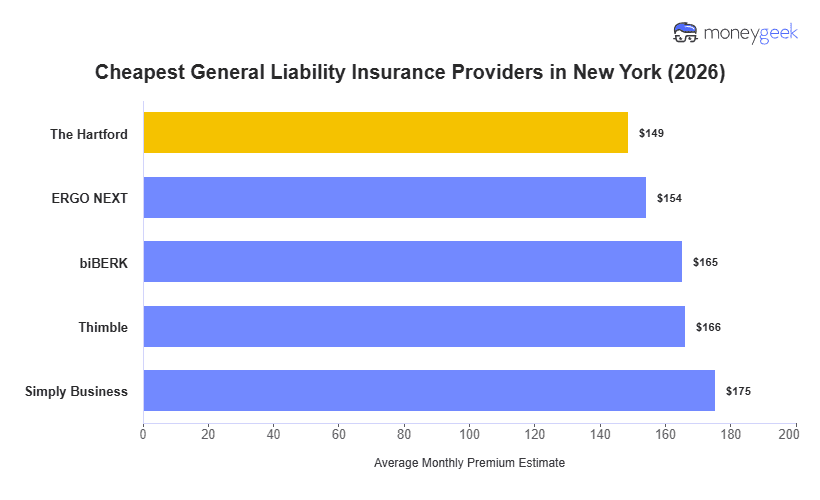
If you're comparing options by price, these three insurers most often offer the lowest general liability insurance rates across over 400 New York small businesses. Your best fit still depends on your business type and location.

  • The Hartford: Cheapest for professional services (tech/IT, financial services, education, health care and medical)
  • ERGO NEXT: Most affordable for hands-on trades and food services (construction contractors, food and beverage, manufacturing)
  • biBerk: Offers the lowest rates for personal and property services (cleaning services, fitness studios, pet care, real estate agencies)

[Click Each Provider to Learn More]

These patterns show where each insurer tends to price most competitively across New York industries. Your actual premium depends on your specific operations, revenue, employee count and location. Use this as your starting point, then request quotes from at least two of these providers to confirm which offers the lowest rate.

The Hartford$149$1,78317%
ERGO NEXT$154$1,85114%
biBERK$165$1,9858%
Thimble$166$1,9938%
Simply Business$175$2,1042%
Coverdash$188$2,251-4%
Progressive Commercial$193$2,312-7%
Hiscox$201$2,413-12%
Chubb$202$2,426-12%
Nationwide$204$2,453-14%

How We Determined the Cheapest General Liability Insurance Providers

mglogo icon
CHEAPEST GENERAL LIABILITY INSURANCE IN NEW YORK DOESN'T MEAN BEST FIT

Finding the lowest premium is only part of the equation. A graphic design studio in Manhattan has different liability exposures than a plumbing contractor working across Long Island, and the cheapest policy won't help if it excludes the claims you're most likely to file. Coverage limits, exclusions and how insurers handle claims matter as much as your monthly cost. 

For a fuller picture of which insurers deliver the best combination of price and protection, see our guide to the best general liability insurance providers in New York, which evaluates coverage and service quality alongside affordability.

The Hartford

The Hartford: Cheapest for Professional Services

On The Hartford's site
COMPANY HIGHLIGHTS

The Hartford ranks cheapest for the widest range of New York businesses. It comes out as the lowest-cost across 31% of all business types in our analysis. The Hartford most often offers the best rates for professional services and health care operations, including tech/IT firms, financial advisors, educational services and medical practices. Most small businesses in New York pay $149 per month with The Hartford, 15% below the state average. For optometry practices, flight instructors and hair salons, rates run 35% to 50% below average.

Most often cheapest for these business profiles:

  • General industries: Agriculture and Natural Resources, Arts, Media and Entertainment, Beauty, Body and Wellness Services, Education, Financial Services, Health Care and Medical, Retail and Product Rental, Tech/IT
  • Employee count: Zero to 49 employees

Not a fit? Jump to: ERGO NEXT or biBerk

ERGO NEXT

ERGO NEXT: Cheapest for Hands-On Trades and Food Services

On ERGO NEXT's site
COMPANY HIGHLIGHTS

New York small businesses pay an average of $154 per month with ERGO NEXT, 14% below the state average. Catering services, food trucks and mobile operations save the most, 42% to 48% below the state average.

ERGO NEXT ties with The Hartford for the widest coverage across New York small businesses, coming in cheapest for 31% of all business types studied. Construction contractors, consulting firms, manufacturers and hospitality businesses also get competitive pricing statewide.

Most often cheapest for these business profiles:

  • General industries: Childcare Services, Construction and Contracting, Consulting Services, Food and Beverage, Hospitality, Travel and Tourism, Manufacturing, Marketing and Communications, Other Professional Services, Transportation and Logistics, Wholesale and Distribution

Not a fit? Jump to: The Hartford or biBerk

biBerk

biBerk: Cheapest for Personal and Property Services

COMPANY HIGHLIGHTS

Small service businesses often find their lowest rates with biBerk, particularly in personal care and property management. Cleaning companies average $127 per month, fitness studios $113, and pet care providers $74, all below typical New York rates. Across biBerk's coverage areas, most small businesses pay an average of $165 monthly, or 9% less than the state average.

Repair and maintenance operations see especially strong value, with auto body shops, tire stores and motorcycle repair businesses saving 33% to 36% compared to average costs. 

Most often cheapest for these business profiles:

  • General industries: Cleaning Services, Fitness Services, Pet Care Services, Real Estate and Property Services, Recreation and Sports, Repair and Maintenance

Not a fit? Jump to: The Hartford or ERGO NEXT

Explore the Cheapest General Liability Insurance in New York by Industry

Liability exposures vary across New York businesses depending on what you do and where you operate. A coffee roaster in Brooklyn dealing with foot traffic and product liability has completely different risks than an upstate HVAC contractor working on job sites, and premiums reflect those distinctions. 

Browse our industry-specific guides below to find which insurers deliver the lowest rates for your type of operation, or check the cost of general liability insurance in New York for a broader context on what businesses across the state typically pay.

Is the Cheapest General Liability Insurance Right for Your New York Business?

The lowest premium works for some New York businesses. For others, it leaves gaps that surface when a client files a claim. The right policy matches your specific operations and location. Budget coverage often misses four things New York businesses need:

  • Commercial lease requirements: Manhattan landlords and outer-borough property managers routinely demand $2 million aggregate limits and landlord additional insured endorsements, which budget policies often exclude or upcharge.
  • Certificate of insurance turnaround: City building managers and state agency offices expect same-day COI delivery. Budget insurers take three to five business days, delaying contract signatures.
  • Additional insured endorsements: Contractors bidding on MTA or Port Authority projects and vendors working in Class A office buildings need multiple additional insureds, which budget carriers limit or charge per request.
  • Premises liability in high-traffic areas: Retail shops, restaurants and service businesses in dense urban areas statewide see more slip-and-fall claims that budget policies often exclude.

Cheap coverage works for home-based consultants and remote service providers without lease requirements or multi-party contracts. Businesses operating in commercial real estate, bidding on public projects or managing storefronts in busy areas often need mid-range policies with built-in endorsements.

For more details about this coverage type: General liability insurance guide

Is the Cheapest Right for Your Business?

How to Get Cheaper General Liability Insurance in New York

Lowering your premium without creating coverage gaps means matching your policy to what your business actually needs and showing insurers you manage risk well.

  • bag icon
    Compare general liability quotes using the same limits

    Requesting quotes with different coverage amounts from each insurer makes it impossible to identify who actually offers the lowest price. Ask every carrier for identical limits, such as $1 million per occurrence and $2 million aggregate. Most Manhattan commercial leases and outer-borough property managers require these limits, so you're comparing true cost differences, not just different levels of protection. Identical limits show which insurer prices your specific risk profile most competitively.

  • hammer icon
    Ensure your business classification (class code) is correct

    Insurers use industry codes to price your policy, and getting misclassified can cost you hundreds or thousands annually in New York's expensive insurance market. A Brooklyn food truck operator coded as a full-service restaurant pays significantly more because insurers assume sit-down dining liability, or a Westchester landscaper misclassified as a tree service company gets charged for high-risk climbing work they never do.

    Review your classification with your agent before binding coverage, especially if you run a mixed-use business: bagel shops that also cater, contractors who do both renovation and new construction or fitness instructors who teach at multiple studio locations across the city.

  • insurance2 icon
    Only pay for general liability coverage limits you actually need

    Start with what your contracts and leases require. Manhattan office leases typically demand $2 million aggregate, while Brooklyn warehouse spaces and upstate properties may only require $1 million. Buying $5 million when no client, landlord, or agency asks for it means overpaying for protection you don't need.

    Consider your real exposure before settling on minimums. A catering company serving 200-person weddings at Long Island venues or a contractor renovating pre-war Bronx apartment buildings carries more slip-and-fall risk than a home-based bookkeeper, even if both meet the same contract minimums.

  • money2 icon
    Use general liability deductibles and payments strategically

    Raising your deductible from $500 to $2,500 can lower your premium by 15% to 25%, but only makes sense if you can cover that amount when a claim hits. A Queens restaurant with steady foot traffic or a Syracuse contractor on year-round commercial projects might see multiple small claims and benefit from a lower deductible, while a consultant in a Manhattan co-working space could handle a higher deductible and bank the monthly savings.

    Paying annually instead of monthly saves 5% to 10% on your total premium in New York's high-cost market, but you need the upfront cash to make it work.

  • coins2 icon
    Bundle general liability insurance when it lowers your total cost

    A business owner's policy bundles general liability with property coverage and can cost 20% to 30% less than buying both separately, but only if you need both. The cost of a BOP makes sense for a Brooklyn retail shop, Buffalo cafe or Albany accounting firm with physical locations and property to protect.

    Skip the bundle if you operate from home, work at client locations like mobile dog groomers across Westchester or store tools in your truck rather than a shop. Compare bundled versus separate prices before committing.

  • falling icon
    Lower your claim risk in ways New York insurers reward

    Insurers price policies based on how likely you are to file claims, and New York businesses can reduce premiums by demonstrating risk controls:

    • Non-slip mats and handrails: Essential for storefronts in high-foot-traffic areas like Manhattan's Flatiron District or Brooklyn's Park Slope.
    • Winter sidewalk maintenance: Clear walkways during Buffalo or Rochester winters when slip-and-fall claims spike across upstate New York.
    • Employee safety training documentation: Required for contractors working on scaffolding across the five boroughs or handling construction equipment.
    • Certificate of insurance organization: Keep COIs accessible for quick turnaround when Manhattan landlords or corporate clients request proof of coverage.

    Keep documentation ready for audits. Insurers view administrative reliability as a predictor of overall risk management and may offer renewal discounts of 5% to 15%.

Affordable General Liability Insurance in New York: Bottom Line

There's rarely a single cheapest general liability insurer for every New York business, as your industry, business size and location within the state shift, and which carrier offers the lowest price. The most affordable option only works when it covers your actual exposure and meets requirements like certificate turnaround for Manhattan building managers, additional insured endorsements for public projects or coverage limits in your lease.

Use this page to narrow options, then compare quotes using identical coverage terms to validate who delivers the lowest cost for your situation. The goal is adequate coverage at the lowest price, not simply the absolute cheapest rate.

If you're ready to get quotes: Get matched

Cheapest General Liability Insurance in New York Chart

Cheap General Liability Insurance in New York: Next Steps

If you want to confirm which insurer delivers the lowest cost for your business, request quotes from multiple carriers using identical terms: same limits, additional insured endorsements and certificate of insurance requirements your landlord or clients need. A personalized match based on your industry and New York location helps ensure you're comparing options built for your profile, whether you run a Brooklyn cafe, Albany consulting firm or Buffalo contracting company.

If you're still uncertain about coverage fit, the resources on this page explain how New York businesses balance cost against protection needs and evaluate tradeoffs between lower premiums and adequate coverage.

How We Determined the Cheapest General Liability Insurance Providers in New York

To identify the cheapest general liability insurers for New York businesses, we analyzed real pricing data from 10 major providers and modeled thousands of standardized pricing estimates across common small business profiles in New York.

Dataset scope and assumptions

  • Providers analyzed: 10 major insurance providers
  • Industries covered: 408 industries
  • Employee count bands: Zero, one to four, five to nine, 10 to 19 and 20 to 49 employees
  • Policy baseline: Standard $1 million per occurrence/$2 million aggregate general liability policy
  • Pricing estimates modeled: Over 20,000

We also factored in average revenues and payrolls across New York business profiles to improve pricing accuracy.

How we determined which provider was "cheapest"

We used this dataset to determine which insurers were most often the lowest-cost option across different New York business profiles. Our "cheapest" rankings include both:

  • General recommendation: Provider rankings based on average estimated pricing for a standardized one-to-four employee business profile across all industries in New York.
  • Factor combination recommendations: Provider rankings based on which insurer was most often cheapest within specific business factor combinations. For example:
    • Industry × New York pricing was compared using a standardized one-to-four employee profile
    • Employee count affordability was derived by comparing aggregated pricing trends across industries in New York

These results represent standardized pricing estimates, not personalized quotes. Actual pricing can vary based on your New York business classification, revenue, payroll, claims history and the specific limits, deductibles and endorsements you choose. For the most accurate cheapest-provider answer, we recommend comparing quotes apples-to-apples using the same coverage limits.

About Angelique Palenzuela-Cruz


Angelique Palenzuela-Cruz, Business Insurance Writer, MoneyGeek

Angelique Palenzuela-Cruz is a Business Insurance Content Writer at MoneyGeek, where she specializes in general liability, workers’ compensation and professional liability insurance. Her work helps small business owners understand how these policies apply to coverage, including risks like customer injuries, employee injuries, professional mistakes, client contract terms and industry-specific coverage requirements.
She primarily covers service-based businesses where liability and employee coverage decisions are especially important, including cleaning, consulting, beauty and wellness, childcare, education, fitness, food service, pet care, repair and maintenance, and other professional services.
Before joining MoneyGeek, Angelique spent nearly 12 years at Guthrie-Jensen Consultants, one of Southeast Asia’s largest management training firms, where she advanced from Training Consultant to Managing Consultant. In that role, she worked with business clients to assess operational needs, develop training programs and present performance analyses to executive decision-makers. She also helped establish Gladwin Training Consultancy, where she served in learning solutions and client service roles.
Her background gives her practical context for writing about how businesses operate, manage client expectations, structure teams and make risk decisions. At MoneyGeek, she applies that experience to business insurance content, connecting coverage to actual business needs.

LinkedIn: linkedin.com/in/ma-angela-cruz

Email Contact: angelique.palenzuela@moneygeek.com