Best General Liability Insurance Companies for Small Businesses in New York

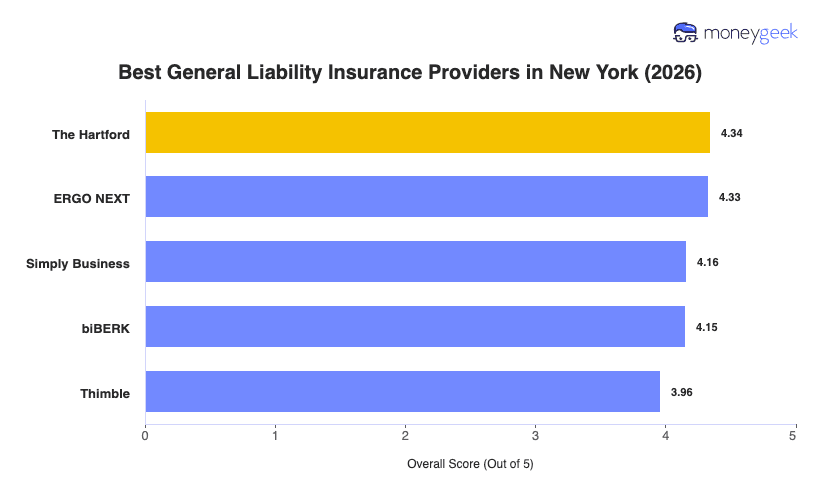
Finding the best general liability insurance means identifying providers that handle New York's regulatory requirements while keeping costs reasonable. These five companies rank highest for businesses from Buffalo to the Bronx based on affordability, service quality and coverage options.

  1. The Hartford: Best Overall, Best for Professional Services
  2. ERGO NEXT: Best for Customer-Facing Service Businesses
  3. Simply Business: Best for Coverage Options
  4. biBerk: Best for Service-Based Businesses
  5. Thimble: Best for Freelancers and Gig Workers

Each of these insurers offers solid performance across price and customer experience for New York businesses. The analysis below shows where they rank in specific categories and what makes each one worth considering for your operation.

The Hartford
4.34
Leads in affordability with the biggest savings for New York businesses in education, healthcare and tech businesses. Also provides top-rated policy management and claims handling.
ERGO NEXT
4.33
Has a top-rated digital buying experience with instant quotes and coverage. Provides the most savings for food service and hospitality businesses in New York.
Simply Business
4.16
Broker platform connects New York businesses with multiple carriers through one submission, ideal for businesses wanting to compare pricing and coverage options.
biBerk
4.15
Offers competitive rates and has a hybrid digital-agent model. Fitness, cleaning, real estate and recreation businesses in New York enjoy the biggest savings..
Thimble
3.96
On-demand coverage by the hour or day for project-based work, ideal for New York freelancers who activate policies only when working specific jobs.

For our New York general liability insurance ratings, we analyzed pricing, coverage options and customer experience across 408 industries within the state. Our analysis focuses on one-to-four-person businesses, which represent nearly half of New York's small businesses, while weighting results to ensure broader industry and location representation across New York City, Buffalo, Rochester, Syracuse and smaller markets throughout the state.

To do this, we evaluated over 20,000 business profiles, more than 5,700 customer experience data points and performed in-depth analysis of coverage contracts and endorsements to compare how insurers serve New York businesses consistently across different industries and regions. We then rated each company across affordability (50%), customer experience (30%) and coverage options and terms (20%) to form an overall rating. For a detailed breakdown of the metrics, scoring methodology and pricing analysis specific to New York, see our full methodology.

95%

% of Small Businesses Covered

Over 20,000

Business Profiles Studied

5,739

Customer Experiences Analyzed

The Hartford

The Hartford

Best Overall, Best for Professional Services
On The Hartford's site

The Hartford tops our analysis of general liability insurers in New York, leading in affordability and ranking strong for coverage options. It saves New York businesses 17% on average and is the most affordable option for companies with one to 49 employees. Businesses in education, health care and agriculture see the most savings with The Hartford. 

While it leads nationally for policy management and claims handling, the buying experience is less competitive. The Hartford’s model requires you to speak with an agent to finish purchasing your policy, leading to quotes taking two to three business days rather than completing everything online.

Where The Hartford performs best:

  • New York health care, education or tech businesses seeking deep savings
  • Growing businesses ( five to 49 employees) needing affordable expanded coverage
  • Contractors requiring fast certificate processing for NYC jobs
  • Businesses needing responsive policy changes or billing flexibility

Where The Hartford performs less competitively:

  • Businesses prioritizing instant online quotes without agent contact
  • Food service, hospitality or real estate operations
  • Very small operations seeking bare-minimum coverage at the lowest price

Learn More: The Hartford Business Insurance Review

ERGO NEXT

ERGO NEXT

Best for Customer-Facing Service Businesses
On ERGO NEXT's site

ERGO NEXT ranks second overall for New York small businesses. Its strength is service quality; customers rated the buying experience first and policy management second. Claims ranks sixth; the fully digital platform gets you quoted and covered in 15 minutes, but policyholders have reported concerns about settlement fairness and communication delays.
Most New York businesses pay $154 monthly, 13% below the state average. Food service and hospitality businesses get the lowest rates, saving up to 30% monthly. Coverage options rank ninth because of limited endorsements and lower sublimits. ERGO NEXT covers damage to rented premises up to $100,000 versus the standard $300,000, which may not be enough for NYC businesses in high-rent commercial spaces.

Where ERGO NEXT performs best:

  • Sole proprietors and very small businesses (zero to four employees)
  • Food service, hospitality or construction businesses seeking deep savings
  • Businesses needing instant quotes and immediate coverage without agents
  • NYC contractors requiring instant certificate generation for building access

Where ERGO NEXT performs less competitively:

  • Education, health care or fitness businesses (costs more than benchmark)
  • Businesses with high claims frequency expectations or complex claims
  • Businesses needing specialized endorsements or high damage-to-premises sublimits

Learn More: ERGO NEXT Business Insurance Review

Simply Business

Simply Business

Best for Coverage Options

Simply Business ranks third for customer experience because it connects New York small businesses with multiple carriers, Hiscox, Travelers, The Hartford and others, through one submission. Coverage options rank fourth; you can compare multiple carriers' structures, though evaluating different sublimits and endorsements across quotes adds complexity. Post-purchase service depends entirely on which carrier underwrites your policy.

New York businesses pay $175 monthly, 2% below the state average. Retail and repair businesses see the strongest savings at 16% to 17%.

Where Simply Business performs best:

  • Retail, food service or repair businesses seeking carrier choice
  • Businesses comfortable comparing coverage options independently without agent guidance
  • Companies wanting access to multiple carriers' pricing and coverage
  • New York construction businesses comparing carriers' Scaffold Law approaches

Where Simply Business performs less competitively:

  • Agriculture, construction or marketing businesses (costs 7% to 15% more)
  • Businesses with 10 to 49 employees (costs more than benchmark)
  • Companies prioritizing single point of contact for ongoing service

Learn More: Simply Business Review

biBerk

biBerk

Best for Service-Based Businesses

biBerk ranks fourth overall for New York small businesses, balancing competitive affordability and buying experience with mid-pack policy management and coverage. Owned by Berkshire Hathaway, it offers a hybrid model where agents are available during purchase to help navigate New York requirements. Reviewers specifically mention agents explaining Scaffold Law disclosures and liquor liability without the rushed feel of traditional carriers. 

New York businesses pay $165 monthly (8% savings), with particularly strong rates in service industries: hospitality saves 30%, repair and maintenance 28% and health care 24%. Post-purchase service is less competitive as New York contractors report mixed COI experiences, with simple requests processed instantly but complex NYC commercial real estate requirements taking one to two days for agent review.

Where biBerk performs best:

  • Hospitality, health care or repair businesses seeking deep savings
  • Fitness, pet care or real estate businesses (20% to 21% savings)
  • Sole proprietors and very small businesses (zero to four employees)
  • Businesses wanting agent guidance during purchase without traditional slowdowns

Where biBerk performs less competitively:

  • Beauty and wellness businesses (costs 30% more than benchmark)
  • Agriculture, construction or childcare operations (costs 5% to 8% more)
  • NYC businesses needing high damage-to-premises sublimits or specialty endorsements

Learn More: biBerk Review

Thimble

Thimble

Best for Freelancers and Gig Workers

Thimble ranks fifth overall for New York small businesses, offering a unique on-demand insurance model but with significant coverage and affordability limitations. The platform's strength is flexible coverage periods; New York freelancers and gig workers can activate policies by the hour or day for specific projects, then deactivate between jobs. However, affordability is inconsistent: most New York businesses pay $166 monthly (8% savings), but the platform costs 26% more than benchmark for hospitality and 17% more for marketing firms. 

Coverage ranks last because Thimble does not cover New York construction businesses with Scaffold Law exposure, offers no liquor liability, and provides very limited endorsements. Claims handling is weaker relative to top options as New York reviewers report settlement offers 30% below repair quotes and weeks without communication updates.

Where Thimble performs best:

  • New York freelancers and gig workers needing project-based coverage
  • Photographers, event planners or consultants with intermittent work schedules
  • Businesses wanting instant digital quotes without agent involvement
  • Project-based work requiring flexible hourly or daily coverage periods

Where Thimble performs less competitively:

  • New York construction businesses (no Scaffold Law coverage available)
  • Hospitality, marketing or professional service firms (costs 15% to 26% more)
  • Restaurants and bars (no liquor liability available)
  • Businesses needing specialty endorsements or high damage-to-premises sublimits

Learn More: Thimble Review

Explore the Best General Liability Insurance in New York by Industry

A Brooklyn restaurant owner worries about customer injuries and food safety claims, while a construction contractor in Buffalo needs coverage for jobsite accidents and equipment damage. The liability risks you deal with depend on what your business actually does and where you operate. The industry breakdowns below show which insurers perform best for specific sectors across New York and what coverage priorities matter most for your operation.

What Determines the Best General Liability Insurance for New York Businesses

Providers for general liability insurance in New York vary for different businesses. The best insurer for a Brooklyn bakery isn't the same as the right fit for a Syracuse HVAC contractor or a Manhattan consulting firm. What matters most depends on how you operate, what risks you deal with and how your business might change. An insurer that only offers low rates or quick service creates problems when you need coverage flexibility or stable pricing through growth.

These four factors separate insurers that look good on paper from those that work well in practice:

  • coins2 icon
    Affordability without pricing volatility

    The best general liability insurers in New York keep rates predictable as your business changes, not just when you first buy. A Queens contractor sees premiums jump 30% at renewal after hiring two workers. A Rochester retail shop budgets for affordable general liability coverage in New York, then faces surprise charges when opening a second location.

    In New York's tight-margin environment, stable pricing matters more than the lowest initial quote. Strong insurers hold rates steady when you add staff, expand services or grow revenue. Unstable pricing forces you to shop around annually or absorb unexpected costs.

  • talk icon
    Responsive service throughout your policy term

    New York businesses need general liability insurers that respond quickly at the moments that matter most: when you need a certificate for a Manhattan contract deadline, when you're adding seasonal workers in the Finger Lakes or when a customer gets injured at your Buffalo location.

    Quality service matters most during these touchpoints:

    • Fast certificate issuance for contract work and client requirements
    • Simple online tools for mid-term policy changes (adding locations, updating revenue, adjusting coverage)
    • Claims teams that assign adjusters within 24 to 48 hours and understand New York liability laws
    • Quick responses for renewal questions and coverage adjustments

    When service breaks down, you lose contracts, pay out-of-pocket for claims you should be covered for or waste hours on hold trying to make basic policy updates.

  • insurance2 icon
    Coverage options that fit common small business risks

    General liability policies in New York vary in the endorsements and limits they offer, and the right fit depends on what your business actually does. A Brooklyn restaurant serving wine needs liquor liability added on. A contractor working across the boroughs needs completed operations coverage that extends protection after projects finish. 

    As your business grows or changes, your policy should adapt with endorsements that match new risks:

    • Higher liability limits for larger contracts and commercial clients
    • Additional insured endorsements when clients or landlords require them
    • Product liability extensions if you start selling physical goods
    • Liquor liability for restaurants and event spaces serving alcohol
    • Completed operations coverage for contractors working on long-term projects

    Policies with limited endorsement options or rigid coverage structures leave gaps when you expand services, hire more employees or work with commercial clients who demand specific coverage requirements.

  • building icon
    Why consistency across all three areas matters most

    The strongest general liability insurers in New York balance pricing, service and coverage, not just leverage on one. Imagine a Buffalo manufacturer locking in a competitive rate but not being able to product liability coverage when launching a new product line, forcing them to shop for a second policy. Or a Manhattan event planner getting fast certificate turnaround but experiencing premiums spike 40% at renewal after bringing on three employees. Excelling in one area while failing in others creates problems as your business changes.

How to Choose the Best General Liability Insurance in New York

The right general liability insurer in New York depends on knowing what your business needs and where providers differ on pricing stability, service responsiveness and coverage flexibility. These steps narrow the field and produce a comparison that holds up at renewal.

  1. 1
    Optimize your payment and coverage structure

    Start by identifying the liability risks your New York business actually carries and what coverage levels match your operations. A Bronx food service business serving alcohol needs different limits and endorsements than a freelance graphic designer working from home in Rochester. Work through these questions first:

    • Do your NYC commercial clients or landlords require specific liability limits or additional insured endorsements?
    • Do you need liquor liability for events, product liability for goods you sell or completed operations coverage for construction work?
    • Does your Manhattan office lease or Westchester contract work require limits above $1 million per occurrence?
    • Do corporate clients in the five boroughs require proof of $2 million aggregate coverage?
    • Will your business change in the next 12 months — a second location upstate, seasonal hires or expanded services across the state?

    Most New York small businesses start at $1 million per occurrence and $2 million aggregate, but actual needs depend on what you do and who you work with. A Manhattan event planning company managing high-value weddings needs higher limits and host liquor liability. A solo IT consultant working from home in Buffalo can stay at standard coverage.

  2. 2
    Choose your primary priority

    Pick the factor that matters most right now. It becomes the tiebreaker when providers score similarly.

    • Affordability: Focus on rate if you're launching a Brooklyn retail shop or Albany consulting firm on tight startup cash flow, working on thin margins where a 20% premium increase forces cuts elsewhere or running predictable, low-risk operations where steady rates matter more than endorsements.
    • Customer experience: Focus on service if you're a contractor bidding on NYC projects that require certificates within 24 hours, a Syracuse event planner making frequent policy updates for seasonal staff and venue changes or working with Manhattan commercial clients who need fast documentation.
    • Coverage options: Focus on policy features if you run a Rochester restaurant serving alcohol, a construction company working across multiple boroughs or a business expanding from Buffalo into downstate markets. Higher-risk operations and clients with specific endorsement requirements need coverage that scales.
  3. 3
    Shortlist two to three providers

    Narrow to two or three insurers that match your priority and can cover your New York business. A provider suited to a Manhattan retail shop may not write policies for construction companies across the five boroughs. Strong customer service upstate doesn't help a Brooklyn restaurant that needs liquor liability endorsements.
    Confirm each shortlisted provider covers your industry, your New York locations and the coverage structure you identified in step one.

  4. 4
    Double check for dealbreakers before investing more time

    Before going deeper on any provider, confirm it can meet your non-negotiables. One dealbreaker removes it immediately:

    • Does it write policies for your industry and business type in New York?
    • Can it issue certificates fast enough for your contract deadlines, important for NYC project work?
    • Does it have the endorsements your landlord, clients or contracts require?
    • Can it cover businesses across multiple New York locations or counties?
    • Does it have an online portal for mid-term changes and certificate requests?
    • Do its adjusters understand New York liability law and respond within 24 to 48 hours?
  5. 5
    Compare your finalists using the same three lenses

    One priority narrows the list. It doesn't replace a full comparison. A provider that excels on one dimension and fails on the other two creates problems at renewal. Evaluate each finalist across all three:

    • Affordability: Check renewal rate stability, how premium changes are communicated and whether audit processes are transparent. Predictable long-term pricing matters more than the lowest opening quote.
    • Customer experience: Check certificate turnaround for New York contract work, how easy mid-term policy changes are online, claims response speed and whether adjusters know state liability law.
    • Coverage options: Confirm endorsement availability (liquor liability, additional insured, product liability), limit flexibility for a growing business and whether the policy can expand as you move into new parts of New York.
  6. 6
    Use quotes as the final confirmation step

    Request general liability quotes from your top two finalists using your actual business details. Quotes confirm the provider can cover your Brooklyn storefront or Albany office, handle your industry classification and revenue size and write the endorsements your Manhattan clients or upstate contracts need. Use quotes to validate your comparison, not to start the process over.

Best Small Business General Liability Insurance in New York: Bottom Line

The Hartford, ERGO NEXT, Simply Business, biBerk and Thimble lead for New York small business general liability, though the best fit depends on your industry's liability exposure, how many employees you have and which New York counties you serve. 

Weighing long-term rate stability, responsiveness during policy changes and claims and available endorsements for your specific risks ensures your coverage aligns with how your business actually operates. It also allows you to scale without requiring a carrier change when you hire staff or add locations.

Best General Liability Insurance for Small Business in New York Chart

Best General Liability Insurance for Small Businesses in New York: Next Steps

Narrow to one or two providers and confirm actual pricing based on your New York operations, industry classification and coverage needs. That final step shows which insurer holds up on both price and policy features for how your business operates across the state.

If you want to confirm cost before deciding

Knowing what Brooklyn restaurants or Buffalo contractors typically pay for general liability, and how your revenue, employee count and New York locations affect pricing, helps you budget realistically before requesting quotes.

If you’re unsure how much coverage you need

Clarifying your coverage needs now prevents discovering you're underinsured when a patron gets injured at your Albany restaurant, a Buffalo commercial client requires product liability coverage or your lease in Brooklyn's DUMBO district mandates higher limits than you carry.

If you’re ready to check quotes now

Getting quotes from your top two finalists shows what you'll actually pay based on your specific New York operations. A Brooklyn caterer pays differently than a Rochester plumber, even with identical coverage limits. Quotes verify that your shortlist choice works for your business, not just on paper.

  • Compare general liability insurance quotes using the same limits
  • Validate coverage terms before making a final decision

How We Chose the Best General Liability Insurance Companies

To identify the best general liability insurance companies for New York small businesses, we evaluated insurers across pricing, customer experience, and coverage options using a standardized, data-driven approach. Our goal was not to identify the cheapest option in every scenario, but to determine which providers deliver the most consistent overall value across common New York small business profiles.

Our best recommendations reflect insurers that perform well across multiple dimensions and remain competitive across industries and business sizes in New York.

Data and Analysis Scope

Our analysis is based on standardized estimates designed to represent the majority of New York small businesses:

  • Providers analyzed: 10 major insurers serving New York
  • Industries covered: 408 industries
  • Employee counts: Zero to 49 employees
  • Policy baseline: $1 million per occurrence/$2 million aggregate general liability policy
  • Pricing modeled: Just over 20,000 standardized estimates for New York businesses

Modeled average revenues and payrolls were incorporated to improve pricing accuracy for New York's business landscape.

Our Scoring Model

Each insurer received a composite score based on the weighted categories below.

  • Affordability (50%): Affordability reflects how competitively and consistently an insurer prices general liability coverage across all New York business profiles studied.
  • Customer experience (30%): Customer experience measures how well insurers support New York businesses throughout the policy lifecycle from purchase to claims. We also studied at each level of buying, policy management and claims sub-parts of the process that make it easier and more reliable within each as well for accuracy and comprehensive understanding.
  • Coverage options (20%): Coverage options reflect how well insurers support common New York small business risks and allow for flexibility as businesses grow or change.

About Connor Bolton


Connor Bolton, Senior SEO and Content Manager (Business & Pet), MoneyGeek

Connor Bolton is Senior SEO and Content Manager at MoneyGeek, where he leads the business and pet insurance editorial teams. He sets the research framework, data standards and content structure for his team. All content goes through his accuracy review before publication. Connor also writes in-depth guides and has spent more than four years covering insurance products across personal, commercial and specialty lines.

The research infrastructure Connor built covers auto, home, renters, life, health, business and pet insurance across pricing analysis, carrier research, customer experience and coverage evaluation. It includes over 6 million data points for business insurance across 408 industry areas, all 50 states and 16 vehicle types. The pet insurance side covers over 5 million profiles across 18 major providers, 100+ breeds and ages up to 20 years. Connor’s insurance research and his team's work has been cited by the U.S. Chamber of Commerce, Allstate, Liberty Mutual, CBS News, Forbes and LegalZoom.

Connor also talks with underwriters and carrier liaisons at Ethos, The Hartford, ERGO NEXT, Nationwide and State Farm, and monitors business and pet owner communities on Reddit. Those sources shape how his team evaluates carriers, structures rate analysis and writes for human buyers rather than search engines.

For questions about MoneyGeek's business and pet insurance content, contact him at connor@moneygeek.com or on LinkedIn.