
Cheapest Commercial Property Insurance Companies

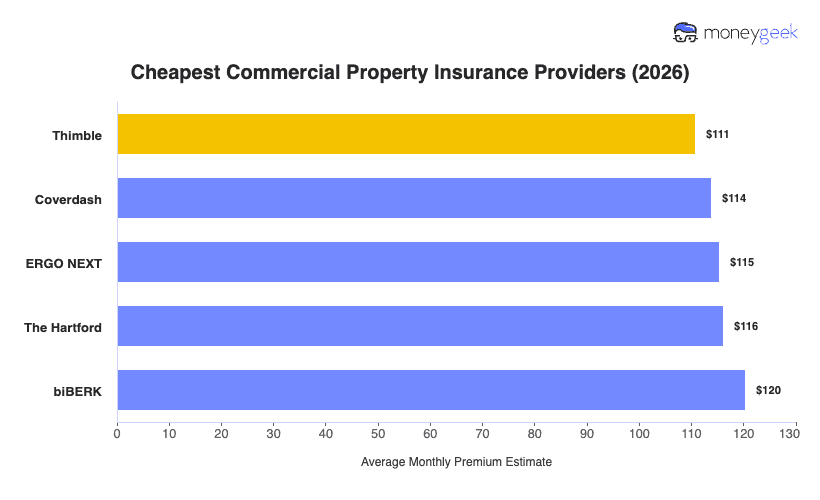
Below are the three cheapest commercial property insurance providers in MoneyGeek's analysis:

  • Thimble: At $111 per month, Thimble prices 11% below the national average and holds the top overall affordability rank in MoneyGeek's analysis. It prices most competitively in the Southeast and Appalachian states, and is the cheapest option for businesses in Alabama, Arkansas, Georgia, Kentucky, Mississippi, South Carolina, Tennessee and West Virginia.
  • Coverdash: Averaging $114 per month, it prices 9% below the national average and leads in 12 Northeast and mid-Atlantic states, including New York, New Jersey, Massachusetts, Connecticut and Pennsylvania. It's the strongest option for businesses operating in that region.
  • ERGO NEXT: With the widest industry and state footprint of the three, it averages $115 per month, 8% below the national average, and prices lowest in 10 of 25 general industries and 31 of 51 states and territories in MoneyGeek's analysis.

These top three picks are not the lowest-cost option for every business. Your commercial property insurance costs will vary by industry, number of employees, property location and coverage limits selected. Use these rankings as a starting point and compare quotes for your specific profile.


Thimble$111$1,33011%
Coverdash$114$1,3669%
ERGO NEXT$115$1,3838%
The Hartford$116$1,3937%
biBERK$120$1,4444%
Nationwide$122$1,4622%
Simply Business$126$1,510-1%
Progressive Commercial$128$1,534-2%
Hiscox$146$1,747-17%
Chubb$151$1,808-21%

How We Determined the Cheapest Commercial Property Insurance Providers

lightbulb icon
CHEAPEST DOESN'T ALWAYS MEAN BEST

The lowest monthly rate doesn't guarantee the best commercial property coverage for your property. Compare providers on building replacement cost limits, business personal property coverage, business interruption terms, ordinance and law coverage and claims service quality, not just price. For a value-based comparison, see MoneyGeek's guide to the best commercial property insurance companies.

We break down the states and general industry categories where each provider prices most competitively, so you can find the cheapest option for your specific business profile.

Cheapest Commercial Property Insurance by Industry

ERGO NEXT ranks first in affordability for 10 of the 25 general industries in MoneyGeek's analysis, with its strongest showing in service-oriented sectors including marketing, arts, cleaning, fitness and food and beverage. The Hartford leads in seven industries, covering professional services, financial services, real estate, tech and healthcare. Nationwide prices lowest in four industries (nonprofit, education, agriculture and hospitality), while Progressive Commercial leads in transportation and logistics and wholesale and distribution.

Data filtered by:
Select
Agriculture & Natural ResourcesNationwide$8225%
Arts, Media and EntertainmentNEXT Insurance$1824%
Beauty, Body & Wellness ServicesNEXT Insurance$1923%
Childcare ServicesSimply Business$1822%
Cleaning ServicesNEXT Insurance$2024%
Construction & ContractingNEXT Insurance$9924%
Consulting ServicesThe Hartford$1025%
EducationNationwide$4023%
Financial ServicesThe Hartford$1925%
Fitness ServicesNEXT Insurance$2325%
Food & BeverageNEXT Insurance$5225%
Healthcare & MedicalThe Hartford$21224%
Hospitality, Travel & TourismNationwide$15824%
ManufacturingChubb$33928%
Marketing & CommunicationsNEXT Insurance$1024%
Nonprofit & AssociationsNationwide$3325%
Other Professional ServicesThe Hartford$4119%
Pet Care ServicesNEXT Insurance$2226%
Real Estate & Property ServicesThe Hartford$927%
Recreation and SportsNEXT Insurance$4422%
Repair and MaintenanceNEXT Insurance$3925%
Retail and Product RentalThe Hartford$16625%
Tech/ITThe Hartford$2428%
Transportation & LogisticsProgressive Commercial$5124%
Wholesale & DistributionProgressive Commercial$36724%

If you want to find the cheapest commercial property insurance for your specific industry, we have dedicated resources below.

Cheapest Commercial Property Insurance by Employee Count

Thimble has the lowest rate for sole proprietors and businesses with 1 to 4 employees, at $23 per month and $111 per month respectively, which are 11% below the tier average in both cases. ERGO NEXT prices lowest for the 5 to 9 employee tier at $197 per month, 12% below average. The Hartford offers the lowest rates for larger businesses, at $264 per month for the 10 to 19 employee tier and $360 per month for the 20 to 49 employee tier, 12% below the tier average in both.

Data filtered by:
1 to 4
1 to 4Thimble$11111%
1 to 4Coverdash$1149%
1 to 4NEXT Insurance$1158%
1 to 4The Hartford$1167%
1 to 4Nationwide$1213%
1 to 4biBERK$1241%
1 to 4Simply Business$126-1%
1 to 4Progressive Commercial$127-2%
1 to 4Hiscox$145-16%
1 to 4Chubb$151-21%

Cheapest Commercial Property Insurance by State

ERGO NEXT is the cheapest commercial property insurer in 31 of 51 states and territories in MoneyGeek's analysis, maintaining its pricing advantage across most of the country including major markets like California, Texas, Florida and Illinois. Coverdash leads in 12 states, concentrated in the Northeast and mid-Atlantic region. Thimble prices lowest in eight states, primarily in the Southeast and Appalachian region.

Data filtered by:
Select
AlabamaThimble$10212%
AlaskaNEXT Insurance$1306%
ArizonaNEXT Insurance$1176%
ArkansasThimble$9912%
CaliforniaNEXT Insurance$1356%
ColoradoNEXT Insurance$1216%
ConnecticutCoverdash$12213%
DelawareCoverdash$11413%
District of ColumbiaCoverdash$12713%
FloridaNEXT Insurance$12312%
GeorgiaThimble$10912%
HawaiiNEXT Insurance$1386%
IdahoNEXT Insurance$1116%
IllinoisNEXT Insurance$11610%
IndianaNEXT Insurance$10310%
IowaNEXT Insurance$10010%
KansasNEXT Insurance$10010%
KentuckyThimble$10112%
LouisianaNEXT Insurance$11312%
MaineCoverdash$10413%
MarylandCoverdash$11713%
MassachusettsCoverdash$12413%
MichiganNEXT Insurance$10710%
MinnesotaNEXT Insurance$11010%
MississippiThimble$10012%
MissouriNEXT Insurance$10210%
MontanaNEXT Insurance$1087%
NebraskaNEXT Insurance$1036%
NevadaNEXT Insurance$1196%
New HampshireCoverdash$10813%
New JerseyCoverdash$12713%
New MexicoNEXT Insurance$1096%
New YorkCoverdash$13013%
North CarolinaNEXT Insurance$10912%
North DakotaNEXT Insurance$1026%
OhioNEXT Insurance$10710%
OklahomaNEXT Insurance$1077%
OregonNEXT Insurance$1236%
PennsylvaniaCoverdash$11513%
Rhode IslandCoverdash$11913%
South CarolinaThimble$10812%
South DakotaNEXT Insurance$9910%
TennesseeThimble$10412%
TexasNEXT Insurance$1246%
UtahNEXT Insurance$1156%
VermontCoverdash$10513%
VirginiaNEXT Insurance$11112%
WashingtonNEXT Insurance$1266%
West VirginiaThimble$9912%
WisconsinNEXT Insurance$10610%
WyomingNEXT Insurance$1056%

Is the Cheapest Commercial Property Insurance Right for Your Business?

Cheap commercial property policies cover the core risks most businesses need, including fire, theft, vandalism and weather damage to buildings and business personal property. Where they fall short is in exclusions, coverage limits and building values that only become problems at claim time. The scenarios below show where budget policies have left business owners with uncovered costs.

  • Underinsured building after a fire: A retail shop owner bought a policy with a building limit based on the purchase price from five years prior. After a fire caused structural damage, the replacement cost came in 40% above the policy limit. The coinsurance penalty reduced the payout on the partial loss, leaving the owner paying tens of thousands out of pocket on top of the deductible.
  • Flood exclusion for a restaurant: A restaurant owner chose a budget policy assuming flood coverage was included. A heavy rainfall event caused water to back up through floor drains, damaging kitchen equipment and flooring. The insurer denied the claim under the flood and water backup exclusion. The owner replaced the equipment without any insurance payment.
  • Business interruption limit too short for a contractor: A general contractor's fire made the office and storage facility unusable. The cheap policy's business interruption coverage had a 90-day limit. The rebuild took seven months. After 90 days, coverage stopped and the contractor paid four months of payroll and temporary space costs out of pocket.
  • Equipment breakdown exclusion for a food distributor: A food distributor's commercial refrigeration system failed mechanically, destroying a full inventory of perishables. The budget policy covered fire and theft but excluded equipment breakdown. The distributor absorbed the full cost of both the spoiled inventory and the repair.
  • Ordinance and law gap for an older building: A property owner filed a claim after wind damage to a building from the 1970s. The insurer paid to restore it to pre-loss condition, but local codes required updated electrical and structural work on the repaired sections. The policy excluded ordinance and law coverage. The owner paid the code-compliance costs separately.
  • Stale property schedule for a growing wholesaler: A wholesale distributor added warehouse space and inventory over two years without updating its property schedule. When a break-in occurred, the insurer calculated the payout against the outdated limits. The actual theft loss exceeded the business personal property limit by more than $80,000.
  • A food distributor with refrigeration equipment and perishable stock carries very different property risk than a consulting firm with a laptop and a leased desk. Businesses with owned buildings, high-value equipment, perishable inventory or locations in flood-prone or older structures should evaluate coverage terms before choosing on price alone.

Learn more about this coverage type: Commercial property insurance guide

Is the cheapest provider right for your business?

How To Get Cheaper Commercial Property Insurance Without Sacrificing Protection

These six strategies can lower your commercial property premium without reducing the coverage your business actually needs.

    vs icon
    Compare quotes using identical coverage terms

    A price gap between two quotes usually reflects different coverage terms, not a genuinely cheaper provider. A quote at $111 per month and one at $146 per month may look like a $35 savings, but if the cheaper quote uses a $2,500 deductible instead of $1,000, a basic form instead of a special form, and excludes equipment breakdown, it's a coverage gap, not a price difference. Before comparing prices, confirm each quote matches on building replacement cost limit, business personal property limit, deductible, coverage form and endorsements including flood, equipment breakdown and ordinance and law.

    loanReview icon
    Insure at replacement cost, not market value

    Market value includes land and accounts for depreciation, neither of which an insurer pays when rebuilding after a loss. Replacement cost is what it actually costs to reconstruct the structure at current labor and material prices. Most commercial property policies carry a coinsurance requirement of 80% to 100% of replacement cost, and insuring below that threshold triggers a proportional penalty at claim time, including on partial losses. Ask your insurer to run a replacement cost estimator rather than relying on the tax-assessed value or purchase price, both of which consistently understate what a rebuild actually costs.

    insurance2 icon
    Bundle commercial property with other business policies

    A business owner's policy (BOP) packages commercial property and general liability into one policy, typically saving 15% to 25% compared to purchasing those coverages separately. BOP eligibility applies to most standard occupancies with lower revenue thresholds, including retail stores, offices and service businesses. For businesses outside BOP eligibility, such as restaurants, manufacturers and larger operations, bundling workers' compensation or commercial auto under the same carrier can still produce multi-policy savings.

    locationPin icon
    Install monitored security, fire suppression and alarm systems

    UL-listed monitored burglar alarms, automatic sprinkler systems, central station fire alarms and deadbolt locks on all exterior doors directly affect the Protection factor in underwriter COPE analysis. Properties with qualifying systems can save 5% to 15% on commercial property premiums, but discounts require proof of active UL-listed monitoring contracts, not just the hardware installed. Notify your insurer before renewal so the credit is applied at renewal rather than retroactively.

    trendingUp icon
    Raise your deductible if your business has a clean claims history

    Increasing your deductible from $500 to $2,500 typically cuts your commercial property premium by 15% to 20%. Two conditions should both apply before making this change: a clean claims history of two or more years and sufficient cash reserves to cover the higher deductible after a loss. Choosing a deductible your business can't actually afford at claim time eliminates the financial benefit of having coverage.

    variableRate icon
    Update your property schedule and values at every renewal

    The property schedule lists your covered locations, building values and business personal property limits. Commercial reconstruction costs have increased more than 36% since 2020, per Verisk's reconstruction cost analysis, meaning a building insured at its pre-2020 replacement cost value is likely underinsured today. Stale schedules create two problems: overinsuring unused or removed assets means paying for coverage you don't need, while underinsuring triggers a coinsurance penalty on claims. A renewal review of your schedule takes 15 to 30 minutes and catches most gaps before they surface at claim time.

Affordable Commercial Property Insurance: Bottom Line

The cheapest provider in MoneyGeek's analysis isn't necessarily the cheapest for your business. Your rate depends on your industry, how many employees you have, where your property is located and the coverage limits you select. Get quotes from at least three insurers with the same building replacement cost limit, business personal property limit, deductible and endorsements, then evaluate on price and coverage together.

Ready to confirm your cheapest option? Get matched to your cheapest commercial property insurer.

Cheap Commercial Property Insurance: Next Steps

Comparing rates is only half the job. Make sure the policy you're considering actually covers your property at the right value, with the correct coverage form, deductible and endorsements in place. Take the time to understand what you need before you commit.

Recommended: If You're Still Learning About Commercial Property Coverage

Most coverage disputes come down to one thing: the business owner didn't know what the policy excluded until a claim was filed. Understanding what commercial property insurance actually covers, what it doesn't and what your business specifically needs to protect saves you from finding out the hard way.

If You Want to Confirm Cost Before Deciding

If You Need Related Business Coverage

How We Determined The Cheapest Commercial Property Insurance Providers

MoneyGeek analyzed pricing estimates from 10 providers that met our criteria for pricing availability, customer experience feedback and coverage transparency. Insurers were studied across 25 general industry categories, five employee count tiers and all 50 states plus Washington, D.C.

How rankings work: Overall recommendations reflect average estimated rates across all industries, business sizes and states combined. Factor-specific recommendations (by industry, employee count or state) reflect which provider ranks lowest within that specific segment.

What these rates represent: Figures are standardized pricing estimates for comparison, not personalized quotes. Actual premiums depend on your property replacement value, building age and construction type, business occupancy, location, claims history, selected limits, deductibles and endorsements. Compare quotes from at least three insurers with identical coverage parameters for the most accurate result.

About Connor Bolton


Connor Bolton headshot

Connor Bolton is Senior SEO and Content Manager at MoneyGeek, where he leads the business and pet insurance editorial teams. As editorial lead for both verticals, Connor sets the research framework, data standards, and content structure that his writers execute, directly authoring in-depth guides himself and reviewing all team content for accuracy and practical value before it goes live. With over four years evaluating insurance products across personal, commercial, and specialty lines, he brings cross-vertical knowledge to every guide the team produces.

Connor architected MoneyGeek's insurance research infrastructure across all major verticals including auto, home, renters, life, health, business, and pet, building systems for pricing analysis, provider-level research, customer experience evaluation, and coverage analysis with AI support. The infrastructure includes over 6 million data points for business insurance across 408 industry areas, all 50 states, and 16 vehicle types, and over 5 million pet insurance profiles across 18 major providers and hundreds of breed and age combinations. Connor's insurance cost research and his team's work has been cited by the U.S. Chamber of Commerce, Allstate, Liberty Mutual, CBS News, Forbes and LegalZoom.

Beyond the data, Connor stays connected to how the market actually operates, drawing on direct conversations with underwriters and carrier liaisons at Ethos, The Hartford, NEXT Insurance, Nationwide, and State Farm, and monitoring business and pet owner communities including Reddit, to inform how he interprets findings and frames guidance for real buyers.

He is the direct editorial contact for methodology questions at connor@moneygeek.com and can be found on LinkedIn.