
What Is Food & Beverage Business Insurance?

Food and beverage operations handle hot equipment, serve alcohol, employ hourly workers, and send drivers out on deliveries. Business insurance is what covers the exposures that come with running this type of operation, including the ones below:

  • A customer burned by hot food or beverages spilled during table service or at a self-serve station
  • A kitchen fire damaging equipment, inventory, and the physical space
  • A foodborne illness claim tied to something prepared or sold on-site
  • A delivery driver getting into an accident while making a pizza run
  • A liquor liability claim after an intoxicated guest causes injury or property damage
  • Spoilage of refrigerated inventory after a compressor failure overnight

A food truck and a banquet hall look similar on paper, but their coverage needs are different. The truck needs commercial auto and mobile equipment protection, while the banquet hall needs higher liability limits and liquor coverage for large private events. The right mix depends on how the business operates.

If you run a restaurant, food truck, catering operation or another specific business type, more detailed resources are available below.

What Types of Insurance Do Food & Beverage Businesses Need?

Most food and beverage businesses are legally required to carry workers' compensation once they hire employees. General liability is almost always required by landlords, venues and catering clients before work begins, and in some states liquor liability is legally required as a condition of holding a liquor license.

Beyond those requirements, the right mix depends on how the business runs. Commercial auto is necessary if the business uses vehicles for delivery, catering or mobile service. Commercial property covers the kitchen equipment, refrigeration units and inventory a fixed location depends on, while product liability becomes relevant when packaged goods are sold beyond the business's own location. Use the dropdowns below to see how each coverage type may fit into your operation.

How Much Does Food & Beverage Business Insurance Cost?

Food and beverage business insurance costs typically range from $46 to $181 per month depending on the coverage type. Commercial auto runs the highest because food trucks, delivery drivers and mobile catering operations introduce vehicle liability exposure that other industries don't carry at the same scale.

Workers' compensation and general liability are where most food and beverage businesses start, as both are either legally required or contractually expected before operations begin. Operations running online ordering systems or storing customer payment data should factor in cyber coverage as well. Average monthly costs across the most common coverage types for food and beverage operations break down as follows:

How did we determine business insurance rates for food and beverage businesses?

What a food and beverage business actually pays depends on how the operation runs: whether it serves alcohol, how many drivers are on the road, the value of kitchen equipment and refrigeration on-site, and how many employees work the line. A full-service restaurant with a liquor license and delivery drivers sits in a very different risk category than a sole-operator juice bar. Use our small business insurance calculator to build an estimate that reflects your actual operation.

Estimate Your Monthly Food & Beverage Insurance Cost

Enter your coverage type, number of employees and type of vehicle (if you need commercial auto coverage) to get a pricing estimate that fits your business. We do not collect any personal information, and all rates are aggregated for all 50 states and Washington D.C. Workers' comp rate estimates are provided on a per employee basis and all coverage types assume standard industry limit recommendations for most businesses.

Select Coverage Type
Select State
Select Employee Count
Select Vehicle Type
Average Monthly Cost

How to Choose the Right Food & Beverage Business Insurance

Choosing the right coverage for a food and beverage business is a process that starts with understanding your operation and builds from there. These six steps will help you work through it.

  1. 1
    Understand your food business's risk profile

    Food and beverage businesses carry a wide range of exposures depending on how they operate. A bakery selling packaged goods at a farmers market has a different risk profile than a full-service restaurant with a bar program and delivery drivers. Start by mapping what your business actually does: where it operates, what it serves, how many people it employs and whether it uses vehicles or sells products for resale.

  2. 2
    Determine required vs. recommended coverage types

    Some coverages are legally required before you can operate. Workers' compensation kicks in once you hire employees in most states, and many venues, landlords and catering clients require proof of general liability before work begins.

    Some coverage types depend on how and where the operation runs. Liquor liability is mandatory in some states as a condition of holding a liquor license and practically essential for any operation that serves alcohol. Product liability matters if you sell packaged goods, and commercial auto becomes necessary the moment a vehicle goes out for a delivery or catering job.

  3. 3
    Choose the right coverage limits

    Minimum limits get you compliant, but they may not be enough to cover a real claim. Food and beverage operations can generate large, fast-moving costs when something goes wrong: legal defense fees, medical expenses, equipment replacement and lost income can exceed basic policy limits quickly. Set limits that reflect your worst-case scenario, not just the minimum a landlord or client requires.

  4. 4
    Evaluate providers who understand food businesses

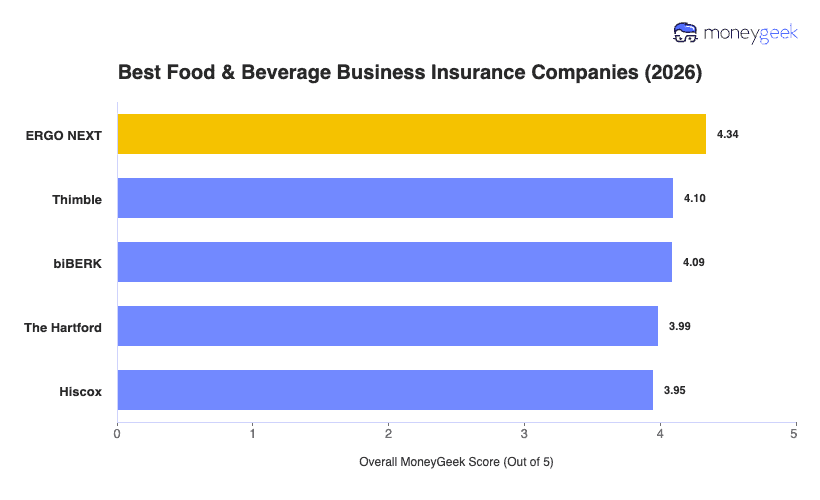
    Not every insurer writes food and beverage policies with the same depth. Look for providers with experience in the industry, competitive pricing for your operation type, flexible coverage options for businesses that serve alcohol or operate vehicles, and claims support that moves quickly when a kitchen fire or vehicle accident puts operations on hold. A provider that understands the difference between a food truck and a banquet hall will write a more fitting policy than one treating all food service businesses the same.

    Read more about the best: Best Food & Beverage Business Insurance

  5. 5
    Get compliance-ready

    Most food and beverage businesses need more than an insurance policy to operate legally. A certificate of insurance (COI) is often required before signing a commercial lease, booking a venue or starting a catering contract. Depending on the operation, you may also need a food handler's permit, a liquor license, a health department certification or a surety bond. Get these in order before the first shift, event or delivery.

  6. 6
    Revisit your coverage as your food business grows

    Most food and beverage operations look different after a year or two. Adding delivery service, hiring seasonal staff, expanding into catering, moving to a larger kitchen space or introducing alcohol service can all shift your risk profile and leave existing coverage gaps. Review your policies at least once a year and before any major contract renewals or operational changes to make sure your coverage still fits.

Food & Beverage Business Insurance: Next Steps

Two food and beverage businesses can have nearly identical coverage requirements and still end up with very different premiums. A high-volume sports bar and a small personal chef operation may both need general liability and workers' compensation, but what they actually pay and which provider fits them best can look very different. Getting coverage through a provider that isn't built for your type of operation often means paying too much or ending up with coverage that doesn't match how the business actually runs.

Different food and beverage businesses are also at different points in the process. Some are just getting licensed and need to know where to start. Others are growing, adding services or reacting to a specific client request or renewal notice. Whichever stage you're at, the scenarios below can help you find the right next move.

If you're just starting out

If you're adding alcohol service

If a client, venue or landlord is asking for proof of insurance

If you're growing your operation

Get Food & Beverage Business Insurance Quotes

Pricing for food and beverage business insurance varies by insurer, and the right provider for one operation isn't always the right fit for another. A food truck operator needs a carrier that writes commercial auto and mobile equipment coverage well. A banquet hall with a full bar program needs one with depth in liquor liability and large-event coverage. The fastest way to find the right match for your operation is by requesting business insurance quotes and comparing options side by side.

About Connor Bolton


Connor Bolton headshot

Connor Bolton is Senior SEO and Content Manager at MoneyGeek, where he leads the business and pet insurance editorial teams. As editorial lead for both verticals, Connor sets the research framework, data standards, and content structure that his writers execute, directly authoring in-depth guides himself and reviewing all team content for accuracy and practical value before it goes live. With over four years evaluating insurance products across personal, commercial, and specialty lines, he brings cross-vertical knowledge to every guide the team produces.

Connor architected MoneyGeek's insurance research infrastructure across all major verticals including auto, home, renters, life, health, business, and pet, building systems for pricing analysis, provider-level research, customer experience evaluation, and coverage analysis with AI support. The infrastructure includes over 6 million data points for business insurance across 408 industry areas, all 50 states, and 16 vehicle types, and over 5 million pet insurance profiles across 18 major providers and hundreds of breed and age combinations. Connor's insurance cost research and his team's work has been cited by the U.S. Chamber of Commerce, Allstate, Liberty Mutual, CBS News, Forbes and LegalZoom.

Beyond the data, Connor stays connected to how the market actually operates, drawing on direct conversations with underwriters and carrier liaisons at Ethos, The Hartford, NEXT Insurance, Nationwide, and State Farm, and monitoring business and pet owner communities including Reddit, to inform how he interprets findings and frames guidance for real buyers.

He is the direct editorial contact for methodology questions at connor@moneygeek.com and can be found on LinkedIn.