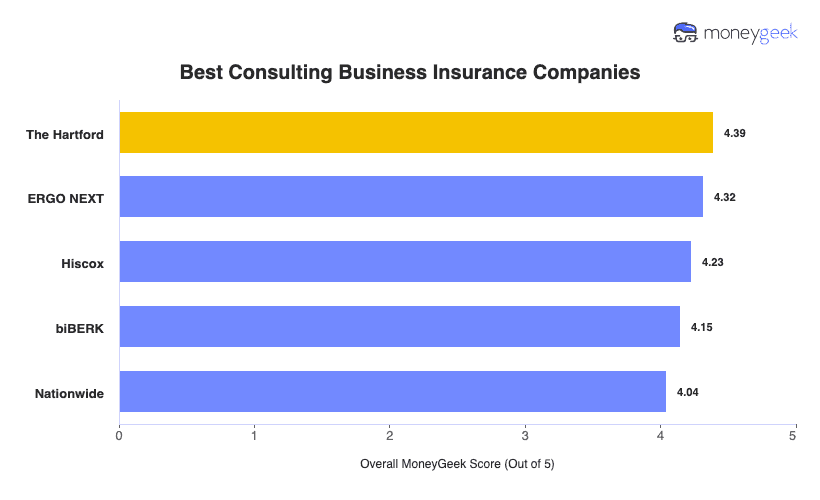

What Is Consulting Business Insurance?

Consulting business insurance is a bundle of policies that covers the financial risks of delivering professional services: client disputes over advice or deliverables, data incidents involving systems you access during engagements and physical incidents at client sites or your own workspace. While the exposures vary by practice, a few risks show up consistently:

  • A client holds you financially responsible for a failed implementation or missed outcome
  • Sensitive client data or internal systems you access during an engagement are compromised
  • Someone is injured during an on-site assessment or a client visit to your office
  • A laptop, specialized device or piece of business equipment is stolen or damaged
  • A contract requires proof of coverage before work can begin

The right mix depends on how your practice operates. A management consultant serving enterprise clients carries different liability exposure than a life coach billing individuals for fixed-fee sessions.

If you want to know more about business insurance for your specific consulting business, our resources below provide more details:

What Types of Insurance Do Consulting Businesses Need?

Most consulting businesses start with three core coverages. Professional liability covers what the work actually produces: client claims over failed implementations, disputed recommendations or deliverables that didn't meet scope. General liability covers the physical side of client relationships: site visits, on-site assessments and leased workspaces where professional liability stops. Cyber liability addresses the system access and sensitive data that most consulting engagements involve by default. While none of these three are legally required, clients and commercial leases drive the expectation. Workers' compensation is the exception since the law mandates it in most states, but only once you hire W-2 employees.

From there, the right mix shifts depending on how the business operates. An HR consulting firm adding field-based safety staff has different needs than an independent strategy consultant whose entire practice runs through video calls. The sections below show each coverage type in detail.

How Much Does Consulting Business Insurance Cost?

The average cost of consulting business insurance varies depending on the coverage types you carry, with monthly premiums ranging from $13 to $104. Cyber liability runs higher because consulting businesses that carry it often work across several client environments at once, with access to internal systems and sensitive data at each, meaning a single breach can affect more than one client relationship. 

Similarly, commercial auto costs more because agricultural, environmental and safety consultants who need it drive regularly to job sites and field locations, and the miles they log tend to push rates higher compared to desk-based consulting work. Professional liability, which is the most common coverage type for consulting businesses, sits in the mid-range of what most consultants pay across their full coverage portfolio. What consulting businesses pay on average, by coverage type:

How did we determine business insurance rates for consulting businesses?

What a consulting business pays depends on more than the coverage type. A solo marketing consultant buying professional liability only pays very differently from a small environmental firm carrying commercial auto, workers' comp and cyber liability across a field-based team. The sub-type of consulting work, how many active client engagements involve system access or on-site work and whether the business has W-2 employees doing field assessments all push the number in different directions. 

MoneyGeek's small business insurance calculator builds an estimate around your unique business profile.

Estimate Your Monthly Consulting Insurance Cost

Enter your coverage type, number of employees and type of vehicle (if you need commercial auto coverage) to get a pricing estimate that fits your business. We do not collect any personal information, and all rates are aggregated for all 50 states and Washington D.C. Workers' comp rate estimates are provided on a per employee basis and all coverage types assume standard industry limit recommendations for most businesses.

Select Coverage Type
Select Employee Count
Select Vehicle Type
Average Monthly Cost

How to Choose the Right Consulting Business Insurance

Choosing the right consulting insurance is a process that depends on your services, clients and how your business operates. These steps help you build a coverage plan that fits your consulting practice.

  1. 1
    Understand your consulting business's risk profile

    Every consulting business carries a different mix of exposures depending on what it does and how it works. An IT consultant managing infrastructure for enterprise clients carries different risks than an agricultural consultant conducting field assessments on active farm properties. Start by mapping your core exposures: professional liability from client engagements, cyber risk from data or system access, physical risk from on-site work and operational risk from employees or business property. That risk map drives every coverage decision that follows.

  2. 2
    Determine required vs. recommended coverage types

    Most consulting businesses don't face a long list of legally mandated coverage requirements. Workers' comp is the most common legal obligation and it only applies once you hire W-2 employees. 

    The more important question for most consultants is what client contracts and practical risk exposure make essential. Professional liability is rarely required by law but is expected by most business clients. General liability is commonly specified in contracts and commercial leases. Identify what your state requires, what your clients require and what your risk profile makes necessary.

  3. 3
    Choose the right coverage limits

    Coverage limits should reflect your worst-case scenario, not just the minimum a contract specifies. For consulting businesses, that means thinking through the financial impact of a disputed engagement at your largest client, the legal and settlement costs of a professional liability claim that goes to court or the medical costs of a serious on-site incident. A management consultant working with enterprise clients faces a different worst case than a solo life coach, and limits should reflect that difference. Use contract requirements as a floor, not a ceiling.

  4. 4
    Evaluate providers who understand consulting businesses

    Not all insurers price or structure coverage the same way for consulting businesses. Look for providers that offer professional liability as a core product rather than an add-on, can cover your specific mix of policies and have experience handling professional services claims. 

    A provider that processes general contractor claims all day may not be the right fit for a consultant whose biggest exposure is a disputed deliverable or a data incident. Compare providers on coverage structure, claims handling and how well their policy terms match the actual risks your consulting work creates.
    Read more about the best: Best Consulting Business Insurance

  5. 5
    Get compliance-ready

    The most common compliance requirement for consulting businesses is having a COI ready before work begins, and many clients will specify additional insured status, minimum limits or particular coverage types before signing a contract. Beyond that, compliance needs vary by sub-industry and state. Engineering and environmental consultants may need professional licenses that affect insurance requirements, and some states require safety consultants to carry surety bonds. Know what your clients and state require before your first engagement so coverage gaps don't delay the start of a project.

  6. 6
    Revisit your coverage as your consulting business grows

    Insurance that covered your consulting business when you started may not cover it 12 months later. Adding W-2 employees may trigger a workers' comp obligation depending on your state's rules and thresholds. Landing a large corporate client may push you above the professional liability limits your current policy carries. Expanding from advisory work into implementation or on-site services introduces physical exposures your original coverage didn't cover. Review your coverage at least annually and before any contract that significantly changes the size or nature of your consulting work.

Consulting Business Insurance: Next Steps

Pricing and provider fit vary across consulting businesses even when coverage requirements look similar on paper. A solo marketing consultant buying professional liability and cyber coverage has different needs from a small engineering firm carrying commercial auto, workers' comp and general liability, and the provider that prices well for one may not be competitive for the other. Choosing the wrong provider can mean overpaying for coverage that doesn't match how your consulting business actually operates.

Different consulting businesses also come to insurance at different points. Some are setting up for the first time, others are responding to a contract requirement or a growth milestone. Use the scenarios below to find guidance that fits where you are right now.

If you're just starting your consulting business

If a client just asked for proof of insurance

If your consulting business is growing

If you work from home

If your renewal is coming up

Get Consulting Business Insurance Quotes

Consulting businesses often get a wide range of quotes for the same coverage types because insurers look at factors like industry specialty, claims history and business size differently. What an independent telecom consultant pays for professional liability may look nothing like what a small agricultural consulting firm pays for a comparable policy. Requesting business insurance quotes lets you see what different providers charge for your specific coverage mix. MoneyGeek's comparison tool matches you with providers based on your actual coverage needs and business profile.

About Connor Bolton


Connor Bolton headshot

Connor Bolton is Senior SEO and Content Manager at MoneyGeek, where he leads the business and pet insurance editorial teams. As editorial lead for both verticals, Connor sets the research framework, data standards, and content structure that his writers execute, directly authoring in-depth guides himself and reviewing all team content for accuracy and practical value before it goes live. With over four years evaluating insurance products across personal, commercial, and specialty lines, he brings cross-vertical knowledge to every guide the team produces.

Connor architected MoneyGeek's insurance research infrastructure across all major verticals including auto, home, renters, life, health, business, and pet, building systems for pricing analysis, provider-level research, customer experience evaluation, and coverage analysis with AI support. The infrastructure includes over 6 million data points for business insurance across 408 industry areas, all 50 states, and 16 vehicle types, and over 5 million pet insurance profiles across 18 major providers and hundreds of breed and age combinations. Connor's insurance cost research and his team's work has been cited by the U.S. Chamber of Commerce, Allstate, Liberty Mutual, CBS News, Forbes and LegalZoom.

Beyond the data, Connor stays connected to how the market actually operates, drawing on direct conversations with underwriters and carrier liaisons at Ethos, The Hartford, NEXT Insurance, Nationwide, and State Farm, and monitoring business and pet owner communities including Reddit, to inform how he interprets findings and frames guidance for real buyers.

He is the direct editorial contact for methodology questions at connor@moneygeek.com and can be found on LinkedIn.