
What Is Life Coaching Business Insurance?

Consulting business insurance for life coaches bundles the coverages your practice needs to handle professional liability claims, data breaches and operational disruptions. These risks show up specifically because coaching puts you in an ongoing advisory relationship with clients who trust your guidance to shape real decisions:

  • A client claims your advice contributed to a poor financial or personal outcome
  • A client claims a coaching engagement caused emotional distress or worsened an existing condition
  • A client's sensitive intake information or payment data is exposed in a breach
  • A client is injured during a session at a coworking space or wellness studio you rent by the hour
  • Your practice loses all income immediately when illness or injury pulls you out of sessions, with no employees or passive revenue to bridge the gap

A solo coach running virtual sessions carries a different risk profile than a coach who rents a commercial studio, employs an assistant and sells digital programs. The right coverage mix depends on how your practice is structured, not just that you coach.

What Types of Insurance Do Life Coaching Businesses Need?

Your life coaching practice creates overlapping exposures because the work is simultaneously advisory, relational and operational. Advice-based risk, sensitive client data and physical or contractual obligations all vary by how you run your practice:

  • Professional liability (since every coaching engagement involves guidance your clients act on)
  • Cyber insurance (since you collect sensitive personal information during intake regardless of how you deliver sessions)
  • General liability (if you meet clients in person, rent studio space or host group events)
  • Workers' comp (if you employ anyone, even part-time or in a remote role)
  • Commercial auto (if you drive to corporate client offices, on-site workshops or retreat venues)
  • Commercial property (if you own equipment or furnishings used in sessions that your personal policy excludes)

The right combination depends on how your practice is structured. A virtual coach with individual clients and a coach delivering corporate wellness programs may need the same coverage types but at very different limits and from different providers. The profiles below match recommendations to how your practice operates.

How Much Does Life Coaching Business Insurance Cost?

The average cost of life coaching business insurance runs around $41 per month, but that figure reflects a blended average across different coverage types. Commercial auto sits at the high end of the range and is only relevant if you travel to corporate client offices, deliver on-site workshops or drive to retreat venues since your personal auto policy won't cover a business-related accident. Cyber insurance costs more than most other coverages in this category because the sensitivity of your intake data pushes premiums higher than other service businesses.

Professional liability is where most life coaches start. It directly addresses the central risk of advice-based work: a client dispute over a coaching outcome. Many coaching certification bodies and professional associations recommend carrying it before you take on your first paying client. These are the average costs of the six common coverage types:

How did we determine business insurance rates for life coaching businesses?

What you'll actually pay depends on how your practice is structured. A virtual-only coach working with individual clients pays less than one who rents studio space, travels to corporate engagements or runs group retreats. Renting a studio adds general liability to your baseline, traveling to corporate clients brings in commercial auto and retreats introduce event liability that a standard policy may not cover. The number of active clients you manage affects your professional liability premium. Use the life coaching business insurance calculator to build an estimate around how your practice runs.

Estimate Your Monthly Life Coaching Insurance Cost

Enter your coverage type, state, number of employees and type of vehicle (if you need commercial auto coverage) to get a pricing estimate that fits your business. We do not collect any personal information, and all rates are aggregated for all 50 states and Washington D.C. Workers' comp rate estimates are provided on a per employee basis and all coverage types assume standard industry limit recommendations for most businesses.

Select Coverage Type
Select State
Select Employee Count
Select Vehicle Type
Average Monthly Cost

Best Life Coaching Business Insurance

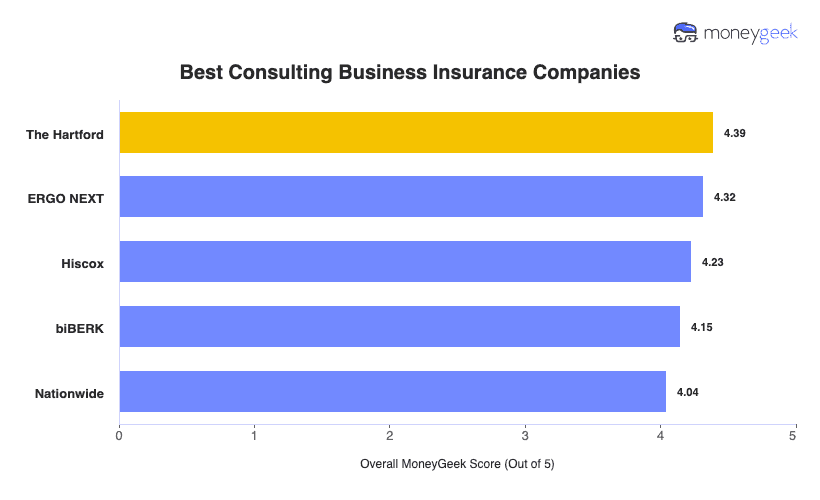
The Hartford ranks first among life coaching business insurance providers in MoneyGeek's analysis, leading on both overall score and affordability at around $31 per month ($368 annually), roughly $10 per month below the sub-industry average. That pricing advantage makes it worth comparing first if you're a solo coach or an early-stage practice keeping overhead lean. The right fit for your practice depends on what you pay, how the insurer responds when a client dispute lands on your policy and whether the coverage terms actually reflect how you deliver coaching: virtually, in person or under corporate contract. Seven providers ranked across all three.

The Hartford4.45$3121
ERGO NEXT4.31$4513
Hiscox4.21$4335
biBERK4.06$4076
Thimble4.03$4747
Nationwide4.01$4662
Progressive Commercial3.93$4854

For our overall best life coaching business insurance ratings, we analyzed pricing, coverage options, and customer experience across all 50 states and Washington, D.C. Our analysis focuses on 1-to-4-person life coaching businesses, while weighting results to ensure broader industry and location representation. To do this, we evaluated over six million business profiles, more than 100,000 customer experience data points and performed in-depth analysis of coverage contracts and endorsements to compare insurers consistently across industries and regions. We then rated each company across categories of affordability (50% of overall score), customer experience (30% of overall score) and coverage options and terms (20% of overall score) to form an overall rating.

See our full business insurance methodology.

The Hartford
Best Overall for Life Coaches

The Hartford

On The Hartford's site

The Hartford tops our life coach rankings on the measures that matter most when a client dispute turns serious: coverage quality and price. Its average premium runs 12% below the sub-industry average, and if a client ever claims a coaching engagement caused them financial harm or emotional distress, its claims infrastructure to back you through it. The one tradeoff is that getting a policy in place takes you more steps than the other providers, so it might not the right pick if you need coverage before the end of the week.

ERGO NEXT
Best for Customer Experience

ERGO NEXT

On ERGO NEXT's site

ERGO NEXT ranks second overall and leads on customer experience. For life coaches, that means getting covered before a new client engagement, sending a COI to a corporate wellness program that just asked for one, or making a quick policy update when you add a group cohort to your roster. But : if a client alleges your program caused them financial or emotional harm and escalates formally, ERGO NEXT's dispute handling and defense counsel might not serve you well.

Hiscox
Best for Life Coaches With International Clients

Hiscox

Hiscox is the only provider in this set whose professional liability policy travels with you. Coach clients in Berlin, Dubai or São Paulo through a virtual session or an in-person retreat overseas, and your coverage holds, provided any claim is filed in the U.S. or Canada. Where it falls short is everything after you buy: if a client dispute escalates or you need to make a mid-year policy change, expect more friction and slower support.

How to Choose the Right Life Coaching Business Insurance

The coverage structure that fits your life coaching practice depends on how you work, who you coach and where your practice is headed. Getting the right business insurance means working through a short set of decisions in the right order, starting with your risk profile and ending with a policy you'll actually need to update as your practice evolves.

  1. 1
    Understand your risk profile and what coverage it requires

    Your risk profile as a life coach comes down to how you deliver sessions, who you serve and whether you employ anyone. If you work virtually with individual clients, professional liability and cyber are your baseline. Add general liability if you meet clients in person. Workers' comp becomes legally required the moment you hire. If you serve corporate clients, you'll need higher limits and proof of GL as a contract condition before most engagements start.

  2. 2
    Choose the right coverage limits

    Limits should reflect your worst-case scenario, not just the minimum a contract requires. A professional liability claim in life coaching can involve a client who attributes a major life decision to your guidance: a career change, a relationship ending, a financial choice that didn't go as planned. These cases can run into tens of thousands of dollars in legal fees before they're resolved. Start at $1 million per occurrence and $2 million aggregate, and move higher if you serve corporate clients or manage a high volume of active coaching relationships.

  3. 3
    Evaluate providers who understand life coaching practices

    Look for insurers with experience writing policies for coaching businesses and balanced performance across price, claims handling and coverage flexibility. A provider that competes on price but handles professional liability disputes slowly or narrowly is a poor fit for your practice. Confirm the policy covers disputed coaching outcomes, emotional distress allegations and client data breaches. These are the claim types most likely to affect a life coach.

  4. 4
    Get compliance-ready

    Your compliance obligations as a life coach center on contract requirements rather than licensing. Before signing a corporate or EAP contract, review the insurance requirements section since most specify minimum limits and whether you need to name the client as an additional insured. Request a certificate of insurance once coverage is in place. Many corporate wellness programs require it before your first session is scheduled, and some coaching platforms require proof of coverage to list your services.

  5. 5
    Revisit your coverage as your life coaching practice grows

    Your coverage needs shift when your practice changes. Adding in-person sessions, hiring your first employee, launching group programs or landing a corporate contract all create exposures your current policy may not reflect. Expanding into therapy-adjacent services or mental health coaching can also change how insurers classify your practice. Flag any significant service changes with your provider before they happen, review your coverage at least annually and check your limits before any contract renewal.

Get Life Coaching Business Insurance Quotes

If you run a virtual practice with individual clients, your coverage needs and your premium will look very different from those of a coach delivering corporate wellness programs under contract. The gap shows up in limits, required coverage types and which insurers are competitive for your profile. Start requesting business insurance quotes for your life coaching practicing using your actual delivery model, client type and headcount so you're comparing providers on equal terms, not just headline rates.

About Connor Bolton


Connor Bolton headshot

Connor Bolton is Senior SEO and Content Manager at MoneyGeek, where he leads the business and pet insurance editorial teams. As editorial lead for both verticals, Connor sets the research framework, data standards, and content structure that his writers execute, directly authoring in-depth guides himself and reviewing all team content for accuracy and practical value before it goes live. With over four years evaluating insurance products across personal, commercial, and specialty lines, he brings cross-vertical knowledge to every guide the team produces.

Connor architected MoneyGeek's insurance research infrastructure across all major verticals including auto, home, renters, life, health, business, and pet, building systems for pricing analysis, provider-level research, customer experience evaluation, and coverage analysis with AI support. The infrastructure includes over 6 million data points for business insurance across 408 industry areas, all 50 states, and 16 vehicle types, and over 5 million pet insurance profiles across 18 major providers and hundreds of breed and age combinations. Connor's insurance cost research and his team's work has been cited by the U.S. Chamber of Commerce, Allstate, Liberty Mutual, CBS News, Forbes and LegalZoom.

Beyond the data, Connor stays connected to how the market actually operates, drawing on direct conversations with underwriters and carrier liaisons at Ethos, The Hartford, NEXT Insurance, Nationwide, and State Farm, and monitoring business and pet owner communities including Reddit, to inform how he interprets findings and frames guidance for real buyers.

He is the direct editorial contact for methodology questions at connor@moneygeek.com and can be found on LinkedIn.