




Choose where to jump to next based on your needs:
Average General Liability Insurance Cost in New Jersey (2026 Report)
Monthly general liability costs in New Jersey span $31 to $482 depending mainly on your industry and the size of your business.
If you're ready for a quote, get matched to the right general liability carrier for your New Jersey business with our tool below.
Select state
Updated: September 13, 2026
Advertising & Editorial Disclosure
How Much Does General Liability Insurance Cost in New Jersey?
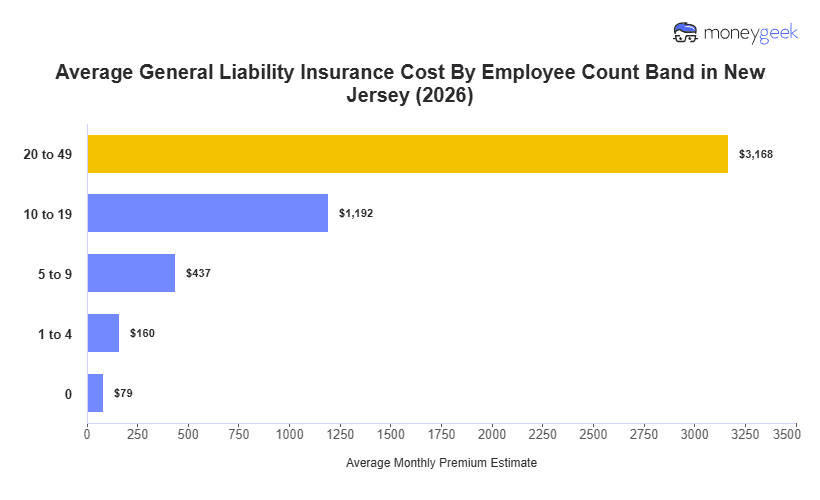
New Jersey ranks as the fourth most expensive state for general liability insurance, with businesses employing one to four people paying an average of $160 monthly ($1,916 annually). Compared to the national average, general liability costs in New Jersey are $37 higher per month.
Even so, this is only representative of premiums across 400+ industries for a 1- to 4-person business, so your rates will vary widely depending on your business's details. You can explore how this differs across general industry areas and business sizes in the dropdowns below.
MoneyGeek estimated general liability insurance costs in New Jersey using quote data from 10 major insurers and more than 20,000 standardized pricing estimates across 25 general industries and businesses with zero to 49 employees. Estimates assume a standard $1 million per occurrence/$2 million aggregate policy and incorporate modeled revenue and payroll using government and private-market data.
The New Jersey state average reflects a standardized business with one to four employees across all industries, while industry and employee-size averages isolate those factors using aggregated modeled pricing trends. These figures are benchmarks rather than personalized quotes, and actual premiums can vary based on a business’s industry, size, revenue or payroll, claims history, location and selected coverage terms.
What Factors Affect General Liability Insurance Costs in New Jersey?
General liability costs in New Jersey draw from both universal business characteristics and state-specific conditions. Some pricing variables apply nationwide (employee count, industry risk, coverage limits) while others stem from New Jersey's regulations, geography and regional economics. Knowing the difference tells you which factors you can control and which you can't.
New Jersey Agnostic General Liability Insurance Cost Factors
Some pricing factors reflect your business fundamentals rather than geography. Insurers apply these universal pricing mechanics nationwide, meaning operational characteristics influence premiums regardless of where you operate.
 Business size
In New Jersey, sole proprietors pay 50% less than the state average, while companies with 20 to 49 employees pay 1,884% more. Employee count drives this spread because larger workforces generate more customer interactions, expand operational complexity and increase claim probability.
Insurers price for cumulative exposure that scales with headcount. Use your employee tier to estimate baseline costs, recognizing that industry risk and claims history also shift individual quotes.
 Industry classification
Tech and IT businesses run 81% below New Jersey's average, anchored by desk-based work with minimal liability exposure. At the opposite end, Construction and Contracting operations run 202% above that benchmark, driven by physical hazards and elevated bodily injury risk.
Industry classification shapes premium variation because operational exposure differs sharply across business types. Low-risk office environments minimize physical interaction and hazard potential, while hands-on operations at customer sites or with equipment increase claim frequency and severity.
Locate your industry tier to estimate baseline costs, recognizing that specific operations within that category also shift individual quotes.
New Jersey-Specific General Liability Insurance Cost Factors
New Jersey adds its own cost complexity on top of employee count and industry classification. Regulatory mandates, environmental legacy and regional economic conditions combine to create a pricing environment that differs from most other states.
 New Jersey's Regulatory Requirements
New Jersey mandates that home improvement contractors carry $500,000 minimum general liability coverage per occurrence. That regulatory floor establishes a baseline premium threshold that shapes contractor insurance costs statewide, regardless of business size or claims history. Businesses in regulated industries carry higher compliance-related insurance expenses relative to those in states with less stringent mandates.
 New Jersey's Population Density
New Jersey leads the nation in population density, packing more businesses and potential liability exposures into smaller geographic areas than any other state. Greater density translates to higher foot traffic, more customer interactions per square mile and an increased probability of slip-and-fall incidents or property damage claims. Insurers reflect these elevated exposure levels in general liability premiums for New Jersey businesses.
 New Jersey's Environmental Liability Exposure
New Jersey holds more federal Superfund sites than any other state, with 115 recorded as of 2024, a direct consequence of decades of industrial activity. Businesses near contaminated areas carry heightened environmental liability risks, including potential cleanup costs, third-party pollution claims and regulatory enforcement actions.
That legacy contamination drives demand for environmental impairment liability coverage and pushes baseline general liability premiums higher in industrialized regions.
 New Jersey's Regional Cost Structure
The New York-Newark-Jersey City metro area, covering most of New Jersey, sits among the nation's most expensive regions for cost of living, with the overall CPI registering 4.3% above the prior year as of December 2024.
Regional economic conditions shape medical care expenses and bodily injury claim settlements, as juries and insurers incorporate local costs into damage awards. Elevated settlement values flow directly into higher general liability premiums for New Jersey businesses.
 New Jersey's Coastal Exposure
New Jersey's 1,792 miles of tidal shoreline generate distinctive liability exposures for businesses in coastal and waterfront zones relative to inland operations. Storm surge risk, flood damage to customer property and weather-related slip-and-fall incidents drive higher claim frequency along the coast. Businesses in hurricane-prone areas or managing waterfront facilities carry premium surcharges that reflect these elevated coastal hazards.
Get a NJ General Liability Insurance Cost Estimate
Based on the industry you work in and your employee count, we can estimate your costs using the general liability insurance calculator below. All estimates are for a standard $1 million per occurrence and $2 million aggregate policy. You can also click Get Quotes to be matched to your insurer fit based on what you enter for estimates.
New Jersey General Liability Cost Estimate Calculator
Select General Industry
Select Employee Count
Monthly rate estimate—
Select General Industry
Monthly rate estimate—
Select Employee Count
How to Lower General Liability Insurance Costs Without Sacrificing Coverage
Reducing premiums doesn't require downgrading protection levels. Strategic policy adjustments, smarter shopping and operational improvements all lower what you pay while maintaining full coverage.
Cheap general liability insurance in New Jersey is more accessible when you know which cost-reduction tactics produce immediate savings and which require sustained effort across multiple renewals.
Quick General Liability Cost Lowering Methods
Some cost factors come down to coverage decisions made at purchase or renewal. These strategies lower premiums through policy structure adjustments and payment choices, with no operational changes required.
 Provide clean, accurate underwriting information
Misreporting employee counts or annual revenue triggers mid-term premium adjustments that erase initial savings. Insurers price your staff size, square footage and customer interaction levels to establish your rating tier. For example, a Newark medical practice with high patient traffic prices differently than a Princeton consulting firm with occasional client meetings. Review these factors during underwriting to avoid retroactive rate increases, which can include audit penalties for material discrepancies.
 Compare multiple insurers
Carriers price coastal storm and flood exposure based on their regional claims history, creating rate differences of their own for businesses near port areas. A Jersey City warehouse operator comparing business insurance quotes from multiple insurers might find rates ranging from $110 to $240 per month for the same $1 million/$2 million coverage. Regional carriers familiar with nor'easter wind and water damage patterns usually assess risk more precisely than national insurers using broader data sets.
 Bundle general liability into a business owner's policy (BOP)
Shore businesses in Monmouth and Ocean counties need coverage for both customer liability and property damage from nor'easters and hurricanes, especially when summer revenue must sustain year-round operations. Business owner's policies bundle general liability with commercial property protection, often reducing combined premiums by 15% to 25%. A review of BOP costs against your current standalone policies will show whether consolidation makes financial sense.
 Pay annually instead of monthly
Monthly installment plans add $8 to $15 in billing fees per payment, totaling $96 to $180 annually that annual payment eliminates entirely. For Atlantic City hospitality businesses managing New Jersey's high insurance costs, paying the full $900 to $2,100 premium when summer revenue peaks captures an additional 5% to 10% discount. A hotel paying $1,800 annually avoids $144 in fees and gains $90 to $180 in discount savings.
- Increase your deductible (if you can afford it)
Weigh premium savings against out-of-pocket claim costs before raising deductibles as moving from $500 to $2,500 often reduces annual premiums by 15% to 30%. Princeton area consulting and finance firms with strong cash reserves and low claim frequency can better absorb higher per-incident expenses in exchange for immediate rate reductions. A business paying $1,200 annually saves $180 to $360 by raising its deductible, recovering the increase after one to two claim-free years.
 Adjust your coverage limits
Camden contractors working on urban redevelopment projects often need $2 million/$4 million limits due to aging infrastructure liability and municipal contract requirements and that 25% to 40% more than standard $1 million/$2 million policies. Most New Jersey businesses don't face this level of exposure and can operate safely within lower limits. A Princeton consulting firm or shore retail shop rarely encounters claims exceeding $1 million, making the premium increase for higher coverage an unnecessary expense that doesn't match actual operational risk.
Read More: How Much General Liability Insurance Do You Need?
Long-Term General Liability Cost Lowering Methods
Risk controls and claims prevention measures typically require three to five years to produce measurable premium reductions. The commitment is operational in nature, but the savings accumulate with each renewal cycle.
General Liability Insurance Cost in New Jersey: Bottom Line
New Jersey's compressed geography creates sharp cost variations across short distances. A 30-mile shift between coastal and inland locations can move premiums 40% for identical operations.
Three questions help pinpoint what drives the rate:
- Where does the industry fall in New Jersey's cost spectrum? Claim frequency and severity set baseline pricing. High customer traffic and physical work push costs above office-based operations.
- What state-specific factors shape the baseline? Coastal hurricane exposure, population density, freeze-thaw cycles and regulatory requirements all vary by region. Employee count and revenue determine the tier within industry pricing bands.
- Which cost factors are within the operation's control, and which are not? Payment timing, deductibles, coverage limits and claims history are manageable. New Jersey's regulatory environment, aging infrastructure and high regional costs apply to every business in the state.
The real question is not whether the premium looks high. It is whether the rate reflects factors that can be changed or simply the cost of operating in the New Jersey market.
About Connor Bolton

Connor Bolton is Senior SEO and Content Manager at MoneyGeek, where he leads the business and pet insurance editorial teams. He sets the research framework, data standards and content structure for his team. All content goes through his accuracy review before publication. Connor also writes in-depth guides and has spent more than four years covering insurance products across personal, commercial and specialty lines.
The research infrastructure Connor built covers auto, home, renters, life, health, business and pet insurance across pricing analysis, carrier research, customer experience and coverage evaluation. It includes over 6 million data points for business insurance across 408 industry areas, all 50 states and 16 vehicle types. The pet insurance side covers over 5 million profiles across 18 major providers, 100+ breeds and ages up to 20 years. Connor’s insurance research and his team's work have been cited by the U.S. Chamber of Commerce, Allstate, Liberty Mutual, CBS News, Forbes and LegalZoom.
Connor also talks with underwriters and carrier liaisons at Ethos, The Hartford, ERGO NEXT, Nationwide and State Farm, and monitors business and pet owner communities on Reddit. Those sources shape how his team evaluates carriers, structures rate analysis and writes content for real pet owners.
Questions about MoneyGeek's business or pet insurance content? Reach him at connor@moneygeek.com or on LinkedIn.
Sources
- Business.NJ.gov. "Starter Kit - Home Improvement Contractor." Accessed October 5, 2026.
- Department of Environmental Protection. "New Jersey Officials Call on EPA to Resume Cleanup at Roebling Superfund Site (03/P111)." Accessed October 5, 2026.
- NJ Department of Labor and Workforce Development. "Industry Sector Focus." Accessed October 5, 2026.
- NOAA Office for Coastal Management. "New Jersey." Accessed October 5, 2026.
- U.S. Bureau of Labor Statistics. "Consumer Price Index, New York-Newark-Jersey City — December 2024." Accessed October 5, 2026.