




Choose where to jump to next based on your needs:
Average General Liability Insurance Cost in North Carolina (2026 Report)
General liability insurance in North Carolina typically runs $26 to $303 per month, with your industry type and employee count creating most of the variation in what you'll pay.
If you're ready for a quote, get matched to the right general liability carrier for your North Carolina business with our tool below.
Select state
Updated: September 8, 2026
Advertising & Editorial Disclosure
How Much Does General Liability Insurance Cost in North Carolina?
The cost of general liability insurance in North Carolina averages $112 monthly ($1,341 annually) for small businesses with one to four employees, placing the state 23rd for affordability nationally. That puts North Carolina in the middle tier, below Virginia and Maryland but slightly above South Carolina.
That average blends more than 400 business types statewide, so your actual cost depends on which variables push you away from the center point. The breakdowns below show how industry and employee count shift the number.
MoneyGeek analyzed over 6 million general liability data points across 408 industries, all 50 states and five employee count bands (0, 1 to 4, 5 to 9, 10 to 19 and 20 to 49). Every estimate uses a standard $1 million per occurrence and $2 million aggregate policy. Revenue and payroll assumptions adjust within each industry to reflect real operating ranges for businesses of that size.
The North Carolina average reflects the mean across all industries and employee counts for the state. Segment averages by industry or by employee count isolate one variable while averaging across the other. These figures are benchmarks for comparison, not personalized quotes. Read full methodology.
What Factors Affect General Liability Insurance Costs in North Carolina?
North Carolina general liability costs are shaped by two categories of factors. Universal business characteristics set the baseline regardless of location. State-specific conditions tied to North Carolina's legal environment, geographic risks and regional business patterns adjust that baseline further.
North Carolina Agnostic General Liability Insurance Cost Factors
General liability premiums respond to core business characteristics regardless of where you operate. These set the baseline before any North Carolina-specific adjustments apply.
 Business size
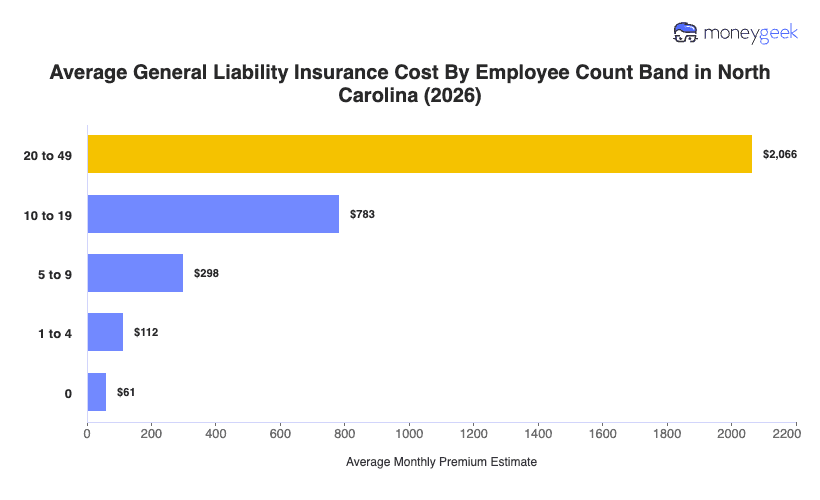
The premium gap between a sole proprietor and a team of 20 to 49 employees reflects more than headcount. A larger workforce means more customer contact and operational complexity, both of which insurers price into higher claim exposure. In North Carolina, sole proprietors sit 46% below the state average, while businesses with 20 to 49 employees sit 1,749% above it. Scaling up pushes premiums faster than headcount grows.
 Industry classification
Industry type drives most of the variation in liability exposure. Businesses with minimal customer contact see fewer claims. Those handling physical materials or working on customer sites face more, especially when heavy equipment is involved.
In North Carolina, Tech and IT businesses run 76% below the state average because of their low physical risk profile. Construction and Contracting sits 171% above that benchmark, driven by job site hazards and injury potential. Matching your NAICS classification accurately is one of the most important steps in getting a fair rate.
North Carolina-Specific General Liability Insurance Cost Factors
North Carolina's liability laws and geographic patterns shape pricing beyond the universal factors. Courts in the state handle claims in ways that differ from neighboring states, and regional risks adjust premiums further.

North Carolina's Contributory Negligence Doctrine
North Carolina is one of only four states where a plaintiff who is even 1% at fault cannot recover damages. That standard makes bodily injury and premises liability claims harder to win against businesses. Insurers pay out less often as a result, and general liability premiums here run lower than in states that use comparative negligence.

North Carolina's Dram Shop Liability Laws
Bars and restaurants that serve alcohol carry liability when serving visibly intoxicated adults or minors who later cause harm. That risk drives higher general liability premiums for hospitality businesses in tourism-heavy areas like Asheville's brewery corridor, Wilmington's coastal bars and Charlotte's nightlife district. Many of these establishments also need separate liquor liability coverage.

North Carolina's Regional Business Concentration
The Research Triangle's office-based tech and biotech sectors carry minimal premises liability exposure. Coastal tourism businesses in Wilmington and the Outer Banks face far more customer contact and slip-and-fall risk. Charlotte's financial district lands in the middle tier. These regional differences mean that where your business operates within the state affects your rate.
North Carolina's Weather and Climate Patterns
Hurricane season and coastal humidity bring seasonal spikes in premises liability. Rain leaves wet floors, storms leave debris and winter adds icy walkways. Coastal businesses carry elevated exposure year-round. Mountain and Piedmont regions see winter-specific hazards instead, with ice storms creating slip-and-fall risk. That seasonal pattern drives claim frequency differently across the state.
Get a NC General Liability Insurance Cost Estimate
Estimate your general liability insurance costs with the general liability insurance calculator below using your industry and employee count. All estimates assume a standard policy with $1 million in coverage per occurrence and a $2 million aggregate limit. You can also click Get Quotes to be matched with insurers that may fit your business based on the details you provide.
North Carolina General Liability Cost Estimate Calculator
Select your state and industry to view average business insurance premiums in your area. Rates are calculated based on a business with 5 employees and $500,000 in annual revenue.
Select General Industry
Select Employee Count
Monthly rate estimate—
Select General Industry
Monthly rate estimate—
Select Employee Count
How to Lower General Liability Insurance Costs Without Sacrificing Coverage
Lowering your general liability premium does not require reducing your protection. North Carolina businesses can cut costs through coverage adjustments, insurer comparisons and operational improvements.
For more on finding affordable general liability coverage in North Carolina, start with the quick methods below and build toward the long-term strategies that earn renewal discounts.
Quick General Liability Cost Lowering Methods
Some adjustments apply during the current policy period. Others take effect at renewal. Neither requires operational changes or a multi-year claims history.
 Provide clean, accurate underwriting information
Insurers look at your industry classification, annual revenue and employee count to set your rating tier. A Raleigh biotech startup with five employees carries different liability exposure than a Durham marketing consultancy, because pharmaceutical development involves product liability risk that marketing work does not. Verify your NAICS code and revenue projections before binding. Getting either wrong can trigger a mid-term adjustment that raises your costs retroactively by 15% to 25%.
 Compare multiple insurers
Request proposals from four to five insurers to identify competitive pricing. Carriers assess risk differently, and regional insurers often price local conditions more accurately than national carriers. An Asheville brewpub carries dram shop liability exposure that a Biltmore-area hotel does not. Identical $1 million/$2 million coverage can range from $140 to $280 monthly depending on each carrier's underwriting approach. Comparing business insurance quotes side by side makes those differences visible.
 Bundle general liability into a business owner's policy (BOP)
Business owner's policies combine general liability with commercial property coverage at a lower total cost than separate policies. A Charlotte retail store gains dual protection, covering customer slip-and-fall claims and inventory damage in one package. Bundling saves 15% to 25%. BOP costs vary by industry, but a SouthPark boutique paying $95 monthly for general liability and $70 for property could bundle into $125, saving roughly $480 a year.
 Pay annually instead of monthly
Paying the full year's premium upfront saves 5% to 10% and eliminates monthly billing fees. That trade-off matters most for Eastern North Carolina agritourism operations that need to lock in rates before hurricane season. A Kinston u-pick farm paying $85 monthly saves $50 to $100 annually by prepaying. Prepaying also avoids potential mid-year rate increases after major storm events.
 Increase your deductible (if you can afford it)
Higher deductibles lower premiums but increase your out-of-pocket responsibility per claim. Construction firms in the Greensboro-Winston-Salem market often carry operating capital from active project pipelines, which lets them absorb more risk. Raising your deductible from $500 to $2,500 can reduce annual premiums by 15% to 30%. That trade-off works when you have cash reserves to cover the larger per-claim cost.
 Adjust your coverage limits
Matching your limits to your actual exposure keeps you from overpaying. Wilmington medical practices carry different liability profiles than surgical centers. A coastal walk-in clinic treating minor injuries does not need the same $2 million aggregate as a facility performing procedures. Review your services, contract requirements and claims history before setting your limits.
Read More: How Much General Liability Insurance Do You Need?
Long-Term General Liability Cost Lowering Methods
A favorable claims history and formal risk controls take multiple policy periods to build. Insurers reward that track record with discounts that grow at each renewal.
General Liability Insurance Cost in North Carolina: Bottom Line
North Carolina's $1,341 annual average for small businesses ranks 23rd nationally for affordability, but that figure blends vastly different risk profiles across more than 400 business types.
Three questions pinpoint what drives your rate:
- Where does your industry sit in North Carolina's cost spectrum? With 84% of industries priced below average, most businesses pay less than the benchmark. Tech and IT operations run 76% below average, while Construction and Healthcare sit well above it. Industry classification sets the starting point.
- Which state-specific factors shape your baseline? Contributory negligence keeps liability payouts lower than in comparative negligence states. But coastal hurricane exposure, dram shop liability in tourism areas and regional concentration shift that baseline depending on location.
- What can you control? Industry and location are fixed. Deductibles, coverage limits, insurer selection and claims history are the levers available to bring your premium down.
Start with the industry and employee count breakdowns above, then compare carriers that underwrite your specific profile.
About Angelique Palenzuela-Cruz

Angelique Palenzuela-Cruz is a Business Insurance Content Writer at MoneyGeek, where she specializes in general liability, workers’ compensation and professional liability insurance. Her work helps small business owners understand how these policies apply to coverage, including risks like customer injuries, employee injuries, professional mistakes, client contract terms and industry-specific coverage requirements.
She primarily covers service-based businesses where liability and employee coverage decisions are especially important, including cleaning, consulting, beauty and wellness, childcare, education, fitness, food service, pet care, repair and maintenance, and other professional services.
Before joining MoneyGeek, Angelique spent nearly 12 years at Guthrie-Jensen Consultants, one of Southeast Asia’s largest management training firms, where she advanced from Training Consultant to Managing Consultant. In that role, she worked with business clients to assess operational needs, develop training programs and present performance analyses to executive decision-makers. She also helped establish Gladwin Training Consultancy, where she served in learning solutions and client service roles.
Her background gives her practical context for writing about how businesses operate, manage client expectations, structure teams and make risk decisions. At MoneyGeek, she applies that experience to business insurance content, connecting coverage to actual business needs.
LinkedIn: linkedin.com/in/ma-angela-cruz
Email Contact: angelique.palenzuela@moneygeek.com
Sources
- North Carolina General Assembly. "Burden of Proof of Contributory Negligence." Accessed October 2, 2026.
- North Carolina General Assembly. "Alcoholic Beverage Control Act." Accessed October 2, 2026.
- NC TECH. "North Carolina State of Technology 2025 Industry Report." Accessed October 2, 2026.
- USAFacts. "What is the Gross Domestic Product (GDP) in North Carolina?." Accessed October 2, 2026.