



Choose where to jump to next based on your needs:
Average General Liability Insurance Cost in Michigan (2026 Report)
General liability insurance in Michigan typically costs $26 to $307 per month, with your industry and number of employees accounting for most of the difference in premiums.
If you're ready for a quote, get matched to the right general liability carrier for your Michigan business with our tool below.
Select state
Updated: October 7, 2026
Advertising & Editorial Disclosure
How Much Does General Liability Insurance Cost in Michigan?
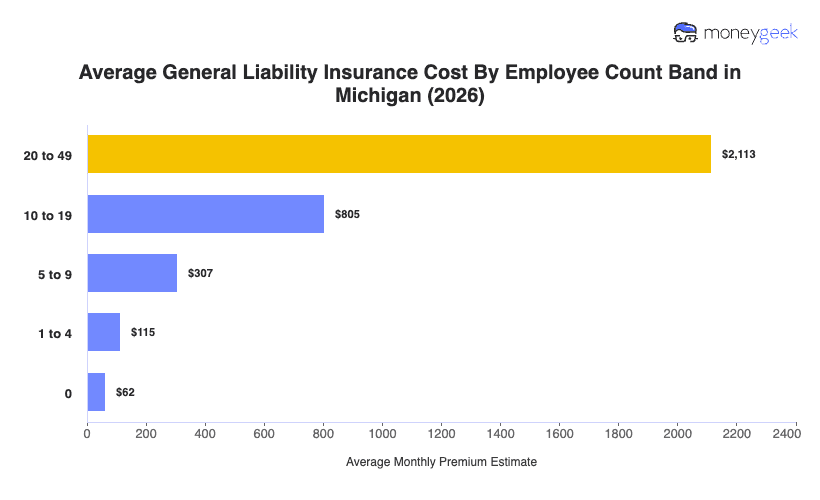
General liability costs in Michigan average $115 per month, or $1,381 annually, for small businesses with one to four employees. That sits 6% below the national average of $123 monthly, placing Michigan 26th nationally for affordability. All three bordering states are cheaper: Indiana at $106, Wisconsin at $108 and Ohio at $110, while Illinois breaks the regional pattern at $141.
Treat Michigan's average as orientation, not prediction. Two businesses in the same state can see very different premiums depending on industry risk, employee count and coverage limits. The breakdowns below show how each factor shifts costs within Michigan.
To estimate average general liability insurance costs in Michigan, we analyzed quote data from 10 major U.S. small business insurance providers and modeled over 20,000 standardized premium estimates across 25 industry categories and five employee count bands (zero, one to four, five to nine, 10 to 19 and 20 to 49). All estimates use a standard $1 million per occurrence/$2 million aggregate policy. We incorporated modeled average revenue and payroll across Michigan regions, industries and employee counts using CBP, QCEW and Economic Census data, calibrated against private compensation databases and IRS SOI totals.
The Michigan state average reflects the modeled premium for a standardized one-to-four-employee business across all industries. Segment averages isolate individual variables, including employee count and general industry category, so readers can compare how premiums shift across business types. These are benchmarks for comparison, not personalized quotes. Read full methodology.
What Factors Affect General Liability Insurance Costs in Michigan?
General liability pricing in Michigan works in two layers. Insurers apply universal business factors first, then layer on state-specific adjustments. Understanding both explains why quotes vary and which cost drivers you can influence through your own business decisions.
Michigan Agnostic General Liability Insurance Cost Factors
Insurers apply the same core pricing factors in every state. These measure how your business characteristics affect claim likelihood and cost, setting the base of general liability pricing before any state-level adjustments.
 Business size
Insurers tie employee count to claim frequency, so larger payrolls mean higher premiums. Each additional worker adds job sites and client contacts, which raises the odds of a covered incident. Businesses with 20 to 49 employees in Michigan pay 1,737% more than the state average. Sole proprietors pay 46% less.
 Industry classification
Industry type affects premiums because insurers price based on claim probability tied to operational exposure. Office-based work involves minimal physical risk, while hands-on services add more customer locations and greater exposure to injury or property damage claims.
Tech and IT businesses in Michigan run 77% below the state average, thanks to low physical risk and digital-only operations. Construction and contracting businesses pay the highest premiums, at 167% above average. Frequent jobsite hazards and heavy equipment use raise the risk of injury, which drives costs up.
Michigan-Specific General Liability Insurance Cost Factors
State-level characteristics add further pricing pressure in Michigan's market beyond these universal inputs. Local conditions affect claim frequency and settlement costs, and Michigan's litigation exposure and seasonal weather patterns influence general liability premiums.

Michigan's Severe Winter Weather
Michigan's winter season lasts five to six months and brings heavy lake-effect snow. Frequent freeze-thaw cycles and black ice create slip-and-fall hazards on business premises, parking lots and walkways from October through April. Business owners need ongoing snow removal and salting to keep these areas safe. Insurers see higher claim frequency during this extended winter exposure, and general liability premiums run higher in Michigan than in warmer states as a result.

Michigan's 2023 Premises Liability Ruling
The Michigan Supreme Court overturned the "open and obvious" doctrine in 2023. This ruling changed winter slip-and-fall liability significantly. Cases once dismissed automatically now go to trial, and juries decide fault instead of judges. The ruling increased settlement amounts and litigation costs for businesses, and Michigan's hazardous winter conditions make the financial impact of these cases even greater.

Michigan's Concentrated Manufacturing Sector
Manufacturing accounts for 16.1% of Michigan's total employment, above the national average, with transportation equipment as the state's top manufacturing industry. General liability policies cover product liability claims, including manufacturing defects, design flaws and failure-to-warn cases. Michigan's heavy manufacturing presence expands the statewide risk pool for product liability exposure, which pushes up average general liability premiums across all industries.

Michigan's Modified Comparative Negligence Law
Michigan follows a 51% bar rule: plaintiffs more than 50% at fault cannot recover non-economic damages like pain and suffering. Economic damages work differently under pure comparative fault, where a plaintiff can recover even at 99% fault, though the award gets reduced proportionally. This framework affects settlement negotiations and claim values across all liability scenarios, and insurers factor it into how they price general liability coverage.
Get a MI General Liability Insurance Cost Estimate
Based on the industry you work in and your employee count, we can estimate your costs using the general liability insurance calculator below. All estimates are for a standard $1 million per occurrence and $2 million aggregate policy. You can also click Get Quotes to be matched to your insurer fit based on what you enter for estimates.
Michigan General Liability Cost Estimate Calculator
Select your state and industry to view average business insurance premiums in your area. Rates are calculated based on a business with 5 employees and $500,000 in annual revenue.
Select General Industry
Select Employee Count
Monthly rate estimate—
Select General Industry
Monthly rate estimate—
Select Employee Count
How to Lower General Liability Insurance Costs Without Sacrificing Coverage
Spending less on general liability in Michigan doesn't mean settling for weaker protection. Buying smarter saves money right away, and a clean claims record brings larger discounts as the years go by.
First, see what affordable general liability coverage in Michigan looks like. That shows you which savings are realistic for a business like yours.
Quick General Liability Cost Lowering Methods
Certain actions at purchase or renewal lower general liability premiums for the upcoming policy period. They apply across Michigan industries, from hospitality to manufacturing, and they don't reduce your coverage quality.
- Provide clean, accurate underwriting information
When applying for coverage, insurers need precise details about your operations, including how many welders work your Dearborn auto parts shop, the total square footage of your Grand Rapids furniture showroom, or the annual catering revenue from your Traverse City restaurant. An inaccurate employee count or misreported revenue can trigger mid-policy audits that increase premiums retroactively. A Flint contractor who doesn't report a three-person framing crew ends up with surprise bills when the insurer discovers the gap during claims review.
 Compare multiple insurers
Five insurers might quote your Ann Arbor software consulting firm anywhere from $400 to $1,200 annually for identical coverage. Some carriers specialize in tech startups, while others focus on established manufacturing. A Mackinac Island hotel owner does best with insurers who know seasonal tourism risk, and carriers familiar with health care liability are a better fit for a Detroit medical clinic. Comparing business insurance quotes from multiple carriers shows which insurers understand your business model and price it competitively.
 Bundle general liability into a business owner's policy (BOP)
A BOP packages liability with property coverage and cuts costs 15% to 25% versus separate policies. It's the right fit if you run a Lansing accounting office, Kalamazoo retail shop or Saginaw physical therapy clinic that needs commercial property insurance for equipment and furnishings. Construction companies and auto repair shops can't use BOPs and buy standalone policies instead. Check the cost of a BOP against separate policies to see if bundling saves money for your business.
 Pay annually instead of monthly
Monthly installments add 5% to 10% in processing fees over the year. If you operate a cherry orchard near Leelanau Peninsula or a ski rental shop in Boyne City, paying your full premium after harvest or winter season matches your cash flow and avoids surcharges. Year-round businesses, such as a Southfield consulting firm, benefit too, since one annual payment eliminates monthly administrative fees entirely.
 Increase your deductible (if you can afford it)
A deductible increase from $500 to $2,500 drops premiums 10% to 20% on average, though you'll pay more out-of-pocket for small claims. A well-established Holland manufacturing plant with cash reserves can handle a minor claim without trouble, but a new Ypsilanti cafe operating on thin margins may struggle to cover a $2,500 slip-and-fall claim. Match your deductible to what you could pay tomorrow without disrupting operations.
 Adjust your coverage limits
Many businesses carry $2 million in coverage when $1 million fits their actual exposure, inflating premiums 30% to 40% for no reason. A Troy IT consultant working from a home office deals with different risks than a Port Huron marina with public boat launches. If you know how much coverage your operations actually require, you avoid overpaying for protection, and extra coverage bought only to satisfy a lease requirement you could negotiate down wastes money. Review your contract requirements before selecting limits.
Read More: How Much General Liability Insurance Do You Need?
Long-Term General Liability Cost Lowering Methods
Michigan businesses managing October-to-April slip-and-fall risks and seasonal tourism cycles build long-term savings beyond quick policy fixes. These strategies take several renewal periods to pay off, but clean claims records and documented safety controls drive growing discounts over time.
General Liability Insurance Cost in Michigan: Bottom Line
What you pay for general liability in Michigan depends on how your business profile meets the state's risk environment. The $115 monthly average is a starting point for comparison, not a prediction of what any one business will pay.
Three questions get at what drives your rate:
- Where does your industry sit in Michigan's cost spectrum? Tech and IT businesses pay $26 a month, while construction operations pay $307. Most Michigan businesses land between $90 and $120, so the state average is a fair benchmark for a typical operation.
- How do Michigan-specific factors shape your baseline? Long winters, the 2023 premises liability ruling, a heavy concentration of manufacturing and the state's modified comparative negligence law all affect how often claims happen and what they cost to settle. The effect differs by industry and location.
- Which cost drivers can you control? Your employee count and industry classification set your baseline. Your deductible, coverage limits, payment schedule and choice of insurer are up to you, and a clean claims history with documented safety protocols earns you more discounts at each renewal.
Seasonal exposure and industrial concentration push Michigan premiums in particular directions. How those forces play out in your own operations tells you more than whether your quote matches an average across thousands of different businesses.
About Angelique Palenzuela-Cruz

Angelique Palenzuela-Cruz is a Business Insurance Content Writer at MoneyGeek, where she specializes in general liability, workers’ compensation and professional liability insurance. Her work helps small business owners understand how these policies apply to coverage, including risks like customer injuries, employee injuries, professional mistakes, client contract terms and industry-specific coverage requirements.
She primarily covers service-based businesses where liability and employee coverage decisions are especially important, including cleaning, consulting, beauty and wellness, childcare, education, fitness, food service, pet care, repair and maintenance, and other professional services.
Before joining MoneyGeek, Angelique spent nearly 12 years at Guthrie-Jensen Consultants, one of Southeast Asia’s largest management training firms, where she advanced from Training Consultant to Managing Consultant. In that role, she worked with business clients to assess operational needs, develop training programs and present performance analyses to executive decision-makers. She also helped establish Gladwin Training Consultancy, where she served in learning solutions and client service roles.
Her background gives her practical context for writing about how businesses operate, manage client expectations, structure teams and make risk decisions. At MoneyGeek, she applies that experience to business insurance content, connecting coverage to actual business needs.
LinkedIn: linkedin.com/in/ma-angela-cruz
Email Contact: angelique.palenzuela@moneygeek.com
Sources
- Michigan Legislature. "MCL 500.3135 - Tort Liability Arising From Ownership, Maintenance, or Use of Motor Vehicle." Accessed October 9, 2026.
- Michigan Supreme Court. "Kandil-Elsayed v F & E Oil, Inc and Pinsky v Kroger Co of Michigan, Docket Nos. 162907 and 163430." Accessed October 9, 2026.
- U.S. Bureau of Economic Analysis. "GDP by State." Accessed October 9, 2026.
- U.S. Bureau of Labor Statistics. "A Look at Manufacturing Jobs on National Manufacturing Day." Accessed October 9, 2026.