




Choose where to jump to next based on your needs:
Average General Liability Insurance Cost in Ohio (2026 Report)
In Ohio, monthly general liability insurance premiums fall between $26 and $294, with the spread driven largely by your industry type and workforce size. Payroll levels and claims history also factor into where your rate lands.
If you're ready for a quote, get matched to the right general liability carrier for your Ohio business with our tool below.
Select state
Updated: September 8, 2026
Advertising & Editorial Disclosure
How Much Does General Liability Insurance Cost in Ohio?
The average cost of general liability insurance in Ohio is $110 per month, or $1,322 annually, for small businesses with one to four employees. That places Ohio 22nd nationally for affordability, roughly 10% below the national average for general liability costs. Ohio's rates align with lower-cost Midwestern states like Kentucky ($102) and Indiana ($106), and sit well below Illinois ($141).
Treat this benchmark as a starting reference. Your actual premium will shift based on industry risk profile, payroll size and claims history. The breakdowns below show how costs move across industries and employee count tiers within Ohio.
To estimate general liability costs in Ohio, we analyzed quote data from 10 major U.S. small business insurance providers and modeled over 20,000 standardized pricing estimates. These span 25 industry categories and five employee count bands (zero through 20 to 49 employees), all based on a standard $1 million per occurrence and $2 million aggregate policy. Revenue and payroll assumptions were modeled across Ohio regions and calibrated against CBP, QCEW, Economic Census and private compensation data.
The Ohio state average reflects the modeled premium for a standardized one to four-employee business across all industries. Segment averages isolate individual variables like employee count and industry category so readers can compare how premiums shift across business types. These figures are benchmarks for comparison, not personalized quotes. Read full methodology.
What Factors Affect General Liability Insurance Costs in Ohio?
General liability insurance in Ohio is shaped by nationwide pricing patterns and state-specific market conditions. Costs vary based on how insurers assess claim probability and severity. Some factors are universal, while others reflect Ohio's regulatory and geographic environment.
Ohio Agnostic General Liability Insurance Cost Factors
Your business characteristics set the baseline premium before state-specific conditions adjust it. These factors apply regardless of location.
 Business size
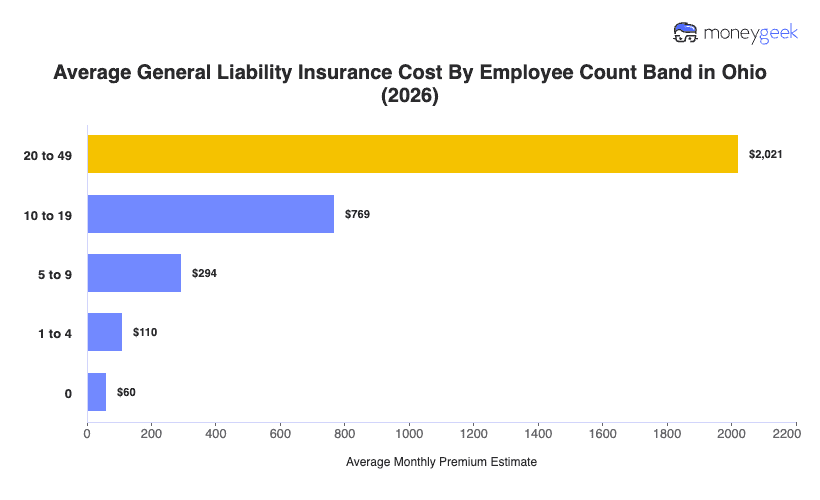
Employee count directly shapes general liability premiums because larger workforces generate more customer interactions, operational complexity and claim exposure. In Ohio, sole proprietors pay 45% less than the state average, while businesses with 20 to 49 employees pay 1,733% more. Even adding a first employee raises premiums by 78%, reflecting the shift to employer-based liability.
 Industry classification
Industry type drives general liability premiums based on physical risk exposure and how operations interact with people and property. Desk-based work with minimal customer contact carries lower claim potential, while hands-on operations involving jobsites, equipment or physical labor generate higher liability.
Tech and IT businesses in Ohio run 76% below the state average, reflecting minimal physical risk and office-based operations. Construction carries premiums 167% above the state benchmark due to worksite hazards, equipment use and elevated injury potential. Your industry classification often matters more than any other single factor.
Ohio-Specific General Liability Insurance Cost Factors
Ohio's legal system, licensing rules and competitive insurance market add a second layer of cost variation on top of the business-level baseline. These factors are unique to the state.

Ohio's Geographic Location and Population Density
Businesses in urban areas like Columbus, Cleveland and Cincinnati typically pay higher premiums than rural counterparts due to increased foot traffic, higher property values and more frequent customer interactions. Dense commercial districts generate more slip-and-fall exposure and property damage risk, which insurers price into premiums.

Ohio's Legal and Tort Environment
Ohio follows a modified comparative negligence system where plaintiffs must be less than 51% at fault to recover damages. The state caps punitive damages and sets a two-year statute of limitations for personal injury claims. The "open and obvious" doctrine can limit property owner liability for visible hazards, potentially reducing claim severity and moderating premium costs.

Ohio's Licensing and Regulatory Requirements
State-licensed contractors must carry minimum general liability coverage between $100,000 and $500,000, depending on trade type and jurisdiction. The Ohio Construction Industry Licensing Board requires $500,000 for electricians, plumbers and HVAC contractors. Municipal requirements vary: Columbus mandates $300,000 per person and $500,000 per occurrence, Cleveland requires $200,000 and Cincinnati requires $100,000. Commercial leases commonly require proof of coverage, reinforcing baseline market demand.

Ohio's Insurance Market Competitiveness
Ohio's general liability costs run approximately 10% below the national average, reflecting a competitive marketplace with multiple carriers. Nearly one million small businesses operate in the state, creating economies of scale for insurers. Market competition and favorable risk conditions contribute to relatively moderate premium levels compared to other states.
Get a OH General Liability Insurance Cost Estimate
Use the general liability insurance calculator below to estimate your costs based on your industry and employee count. The estimates assume a standard policy with $1 million in coverage per occurrence and a $2 million aggregate limit. You can also click Get Quotes to be matched with insurers that may be a good fit based on the information you enter.
Ohio General Liability Cost Estimate Calculator
Select your state and industry to view average business insurance premiums in your area. Rates are calculated based on a business with 5 employees and $500,000 in annual revenue.
Select General Industry
Select Employee Count
Monthly rate estimate—
Select General Industry
Monthly rate estimate—
Select Employee Count
How to Lower General Liability Insurance Costs Without Sacrificing Coverage
Reducing general liability costs doesn't require downgrading the protection your Ohio business carries. Strategic purchasing decisions and long-term risk management can lower premiums while maintaining coverage quality.
For businesses focused on finding the lowest rates, understanding what drives affordable general liability coverage in Ohio helps you identify where savings are realistic without creating gaps in protection.
Quick General Liability Cost Lowering Methods
These six methods lower your general liability costs through smarter purchasing decisions and policy adjustments. Most take effect at renewal or can be implemented through your insurance agent.
 Provide clean, accurate underwriting information
Give your insurer exact details about your operations, workforce size, annual revenue and claims history. A Cincinnati contractor who underreports subcontractor use faces audit penalties and retroactive charges when the insurer discovers the gap during reviews. Overstating safety protocols creates coverage problems during claims investigations when actual practices don't match what you reported. Accurate applications prevent surprise bills and ensure your policy covers what your business actually does.
 Compare multiple insurers
Get general liability quotes from three to five carriers before buying coverage. A Cleveland retail shop might pay $1,200 annually with one insurer and $850 with another for identical protection, based purely on each company's appetite for that industry. Some carriers specialize in restaurants while others focus on tech startups or professional services, creating natural price advantages. Comparing business insurance quotes reveals which insurers compete hardest for your business type.
 Bundle general liability into a business owner's policy (BOP)
BOP costs run 15% to 25% lower than buying general liability and commercial property insurance separately. This bundling approach works well for Ohio businesses with a physical location, whether you run a Dayton salon, Akron office or Columbus coffee shop. Packaging both coverage types under one policy eliminates juggling multiple renewals with different carriers and frees up cash for payroll, inventory or expansion.
 Pay annually instead of monthly
Skip monthly installments and pay your full premium once per year to avoid fees that add 5% to 15% to your total cost. Toledo manufacturing operations with strong spring and summer revenue can time their annual payment to coincide with high-cash-flow months, while seasonal businesses plan around their busy periods. Monthly plans include administrative charges and financing costs that disappear when you pay upfront.
 Increase your deductible (if you can afford it)
Raise your deductible if you keep solid cash reserves and rarely file claims. A Youngstown marketing agency with six months of expenses saved can shoulder higher out-of-pocket costs in exchange for 20% to 30% lower premiums without risking financial stability. This approach doesn't work for businesses facing frequent small incidents, like a landscaping company dealing with regular property damage claims where deductible payments would drain savings.
 Adjust your coverage limits
Match your coverage to how much general liability you actually need instead of buying excess limits that inflate premiums. Construction and health care operations usually carry $2 million or more because of significant liability exposure. Many Ohio consultants default to these same limits even though their contract requirements only call for $1 million and their office-based work poses far less risk. Review your lease requirements and vendor agreements, then set limits based on real obligations.
Read More: How Much General Liability Insurance Do You Need?
Long-Term General Liability Cost Lowering Methods
These methods take months or years to produce results but create lasting rate reductions that compound at each renewal. Building a strong loss history and documented safety controls delivers the deepest long-term savings for Ohio businesses.
General Liability Insurance Cost in Ohio: Bottom Line
General liability insurance in Ohio averages $110 per month, but that figure serves as a benchmark rather than a prediction of what any individual business will pay. The gap between a $26-a-month tech firm and a $294-a-month construction company shows how much rates depend on specific operations.
Three questions pinpoint what drives your rate:
- Where does your business fall on cost? Office-based consulting and IT businesses typically cost less than the state average. Manufacturing, health care and restaurants pay more because machinery hazards, slip-and-fall risks and Ohio's freeze-thaw cycles increase injury exposure.
- What drives your baseline cost? Industry classification sets the starting point. Policy limits and deductibles adjust the final premium from there. Ohio-specific factors like winter premises liability add another layer.
- Which factors can you control? Claims history and coverage limits carry more weight than fixed traits like location or years in business. Risk management practices give you additional control over the outcome.
Focus on the cost drivers that apply to your operations rather than the state average alone.
About Angelique Palenzuela-Cruz

Angelique Palenzuela-Cruz is a Business Insurance Content Writer at MoneyGeek, where she specializes in general liability, workers’ compensation and professional liability insurance. Her work helps small business owners understand how these policies apply to coverage, including risks like customer injuries, employee injuries, professional mistakes, client contract terms and industry-specific coverage requirements.
She primarily covers service-based businesses where liability and employee coverage decisions are especially important, including cleaning, consulting, beauty and wellness, childcare, education, fitness, food service, pet care, repair and maintenance, and other professional services.
Before joining MoneyGeek, Angelique spent nearly 12 years at Guthrie-Jensen Consultants, one of Southeast Asia’s largest management training firms, where she advanced from Training Consultant to Managing Consultant. In that role, she worked with business clients to assess operational needs, develop training programs and present performance analyses to executive decision-makers. She also helped establish Gladwin Training Consultancy, where she served in learning solutions and client service roles.
Her background gives her practical context for writing about how businesses operate, manage client expectations, structure teams and make risk decisions. At MoneyGeek, she applies that experience to business insurance content, connecting coverage to actual business needs.
LinkedIn: linkedin.com/in/ma-angela-cruz
Email Contact: angelique.palenzuela@moneygeek.com
Sources
- Ohio Legislative Service Commission. "Ohio Revised Code Section 2315.33." Accessed October 12, 2026.
- Ohio Department of Commerce. "Ohio Construction Industry Licensing Board Testing Application." Accessed October 12, 2026.
- Ohio Manufacturers' Association. "2024 Ohio Manufacturing Counts." Accessed October 12, 2026.