
Best General Liability Insurance Companies for Small Businesses in Ohio

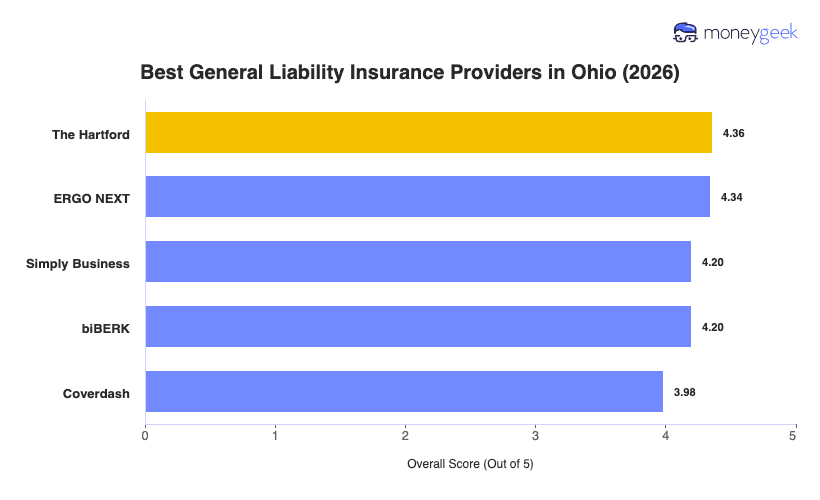
The best general liability insurance companies for Ohio small businesses balance competitive rates with dependable claims handling and flexible coverage options. These five ranked highest in MoneyGeek's analysis of 10 major insurers across 25 industries, evaluated at $1 million per occurrence/$2 million aggregate limits:

  1. The Hartford: Best Overall, Best for Service and Care Industries
  2. ERGO NEXT: Best for Customer Experience
  3. Simply Business: Best for Multiple Carriers Comparisons
  4. biBERK: Best for Service Businesses
  5. Thimble: Best for Seasonal Businesses

This group represents insurers that perform well for Ohio's diverse small business market, from seasonal operations dealing with winter weather risks to year-round service providers. What follows is a detailed look at how each stacks up and where their strengths make the biggest difference.

The Hartford
4.36
Best overall for affordability and policy management, with 27% savings for Ohio health care and education businesses plus blanket additional insured endorsements for multi-client operations
ERGO NEXT
4.34
Instant online quotes with no agent involvement, plus 24/7 certificate downloads and competitive rates for sole proprietors and Ohio micro businesses
Simply Business
4.20
Broker model aggregates quotes from at least three carriers in one application, saving Ohio businesses time comparing coverage and pricing across multiple insurers
biBerk
4.20
Competitive rates for Ohio service industries like cleaning, fitness and real estate, with instant online quotes and transparent pricing for straightforward coverage needs
Thimble
3.98
On-demand coverage by the hour, day or month with the ability to pause when not working, a good fit for seasonal or project-based Ohio businesses

For our Ohio general liability insurance ratings, we analyzed pricing, coverage options and customer experience across 408 industries within the state. Our analysis focuses on one-to-four-person businesses, which represent nearly half of Ohio's small businesses, while weighting results to ensure broader industry and location representation across Cleveland, Cincinnati, Columbus, Akron and smaller markets throughout the state.

To do this, we evaluated over 20,000 business profiles, more than 3,400 customer experience data points and performed in-depth analysis of coverage contracts and endorsements to compare how insurers serve Ohio businesses consistently across different industries and regions. We then rated each company across affordability (50%), customer experience (30%) and coverage options and terms (20%) to form an overall rating. For a detailed breakdown of the metrics, scoring methodology and pricing analysis specific to Ohio, see our full methodology.

95%

% of Small Businesses Covered

Over 20,000

Business Profiles Studied

3,478

Customer Experiences Analyzed

The Hartford
Best Overall, Best for Service and Care Industries

The Hartford

On The Hartford's site

The Hartford ranks first in MoneyGeek's analysis, saving most Ohio businesses an average of 16% ($92 monthly vs. the $110 benchmark). It's the top pick for seven industries, from health care and childcare to consulting and retail. Coverage includes a $300,000 sublimit for damage to rented premises and blanket additional insured endorsements for multi-client contracting.

The Hartford leads in policy management and claims handling, with fast endorsement processing and dedicated adjusters who respond within 24 hours. Its buying process ranks lower. Getting a quote requires agent involvement and takes one to three business days rather than offering instant online options.

Where The Hartford performs best:

  • Health care, education or childcare businesses in Ohio
  • Service businesses that need fast endorsement turnaround
  • Companies that prioritize responsive claims over quote speed
  • Businesses with one to 49 employees seeking consistent savings

Where The Hartford performs less competitively:

  • Agriculture, wholesale or real estate operations
  • Companies that need instant online quotes without agent contact
  • Businesses that require immediate buying decisions

Learn More: The Hartford Business Insurance Review

ERGO NEXT
Best for Customer Experience

ERGO NEXT

On ERGO NEXT's site

ERGO NEXT has a fast buying process; instant online quotes take under five minutes with no agent involvement. Google Reviews from Ohio businesses in Columbus and Cleveland confirm the speed: one Cincinnati contractor got a quote in three minutes and bought the same day. The digital portal offers instant downloads of insurance certificates of insurance (COIs) 24/7, with no agent approval required.

Sole proprietors save the most, at 13%, while most small businesses pay premiums 12% below Ohio's average. ERGO NEXT ranks first for nine industries, with the highest savings in hospitality (33%), manufacturing (29%) and repair services (27%). But standard sublimits are lower ($100,000 for damage to rented premises vs. $300,000 at competing carriers) and endorsement options are limited; no liquor liability or professional liability bundling. BBB complaints cite slow claims resolution, including a 75-day wait for one landscaping slip-and-fall claim, and settlement fairness concerns.

Where ERGO NEXT performs best:

  • Sole proprietors and very small Ohio businesses
  • Construction, hospitality or repair businesses prioritizing affordability
  • Companies that need instant quotes and digital-first buying

Where ERGO NEXT performs less competitively:

  • Health care or education businesses in Ohio
  • Operations that require high sublimits for rented premises
  • Businesses with frequent or complex claims

Learn More: ERGO NEXT Business Insurance Review

Simply Business
Best for Multiple Carriers Comparisons

Simply Business

Simply Business customers rank their buying experience well. It's an online broker that aggregates quotes from multiple general liability carriers into a single application. Google Reviews from Ohio businesses mention receiving three to five quotes at once; one Columbus retailer noted it saved time getting quotes from Hiscox, Chubb and others. Because Simply Business brokers policies rather than writing them directly, policy management and claims experience depend on the underlying carrier selected.

Coverage options, sublimits and endorsement availability vary by carrier in Simply Business's network, which creates less consistency than a direct carrier relationship. Simply Business ranks first for tech and IT businesses in Ohio at 22% savings, but saves only 3% on average for most small businesses, at $107 monthly.

Where Simply Business performs best:

  • Tech and IT firms in Ohio seeking competitive rates
  • Businesses that want quotes from multiple carriers in one application
  • Companies that value carrier choice over a single-carrier relationship
  • Service businesses comfortable with self-service buying process

Where Simply Business performs less competitively:

  • Construction, transportation or marketing businesses in Ohio
  • Companies that need hands-on support throughout the policy lifecycle
  • Businesses that want a direct carrier relationship for claims

Learn More: Simply Business Review

biBerk
Best for Service Businesses

biBerk

At $101 monthly, biBerk saves most Ohio businesses 9% on average, with the highest savings in hospitality (27%) and repair services (27%). It's the top general liability pick for businesses in cleaning, fitness, pet care, real estate and recreation.

Coverage ranks seventh; it lacks endorsement options like professional liability and liquor liability, and sublimits for damage to rented premises are lower than those of competing carriers. biBerk's buying experience ranks well, with instant online quotes that take three to five minutes and transparent pricing breakdowns.

Where biBERK performs best:

  • Hospitality, fitness or repair businesses in Ohio
  • Service businesses prioritizing fast online quotes
  • Companies with straightforward coverage needs
  • Businesses across all employee sizes seeking consistent savings

Where biBERK performs less competitively:

  • Construction, beauty or childcare businesses in Ohio
  • Hospitality businesses that serve alcohol and need liquor liability coverage
  • Operations that need higher sublimits for rented premises

Learn More: biBERK Review

Thimble
Best for Seasonal Businesses

Thimble

Thimble offers on-demand coverage in Ohio. Businesses can purchase GL coverage by the hour, day, month or year and pause coverage when not working. This flexibility works well for seasonal or project-based operations, especially with online quotes that only take two to three minutes. Despite that, coverage ranks last in our analysis because of lower sublimits and limited endorsement options. 
BBB reviews citing 60 to 90-day resolution times for contested claims. However, the buying process ranks strongly with instant quotes and transparent pricing. Thimble saves Ohio businesses 7% on average with an average monthly rate of $102 monthly and ranks first for businesses in wholesale and distribution, giving them 17% savings.

Where Thimble performs best:

  • Wholesale, manufacturing or construction businesses in Ohio
  • Seasonal or project-based businesses needing flexible coverage periods
  • Freelancers and gig workers who can pause coverage
  • Companies prioritizing instant quotes and digital-first buying

Where Thimble performs less competitively:

  • Hospitality, childcare or marketing businesses in Ohio
  • Businesses serving alcohol that need liquor liability endorsements
  • Operations expecting frequent or complex claims

Learn More: Thimble Review

Explore the Best General Liability Insurance in Ohio by Industry

Ohio businesses have liability exposures shaped by what they do and where they work. A Cincinnati brewery managing tasting room crowds has different risks than a Youngstown metal fabrication shop with heavy equipment, and both differ from a Columbus IT consultant working in client offices. Winter months bring slip-and-fall claims from icy walkways statewide, while older commercial buildings in Cleveland and Toledo carry property damage liability that newer construction avoids.

The industry rankings below connect you with insurers that price fairly for your operations and know the risks in your sector.

What Determines the Best General Liability Insurance for Ohio Businesses

No single factor defines the best general liability insurance in Ohio. A Defiance grain elevator needs coverage that scales with seasonal operations, while a Medina wedding planner needs fast certificate turnaround for venue requirements. The strongest insurers perform consistently across the areas that matter for your business.

    coins2 icon
    Affordability without pricing volatility

    Ohio small businesses operate on narrow margins in a competitive market. A Dayton contractor bids against larger operations, a Columbus café competes with regional chains, and an Akron event planner watches costs climb as client budgets tighten. A general liability premium that starts at $1,200 but jumps to $1,900 at renewal without a claim doesn't just strain your budget; it forces you to choose between shopping mid-policy or cutting coverage when you need to focus on running the business. Predictable pricing matters more than the lowest initial quote, especially when you're balancing payroll, rent and equipment costs, and seasonal revenue swings.

    talk icon
    Responsive service throughout your policy term

    General liability insurance isn't just the policy you buy: it's the support you get when winter ice causes a slip-and-fall at your Springfield warehouse, a Canton medical equipment supplier needs vendor certificates before delivering to hospital systems or a Dayton manufacturing client requires proof of coverage to add you to their approved supplier list. 

    Responsive service should look like:

    • Getting certificates of insurance same-day when a new client, venue or general contractor requires proof before you can start work
    • Reaching an agent during winter months when ice and snow create liability claims that need immediate attention
    • Adding coverage mid-policy when you expand from Columbus to Appalachian Ohio or into neighboring states
    • Quick claims processing when a customer injury happens during your busy season. Construction projects peak in summer, retail rushes hit in November and December.

    When service breaks down (certificates delayed past contract start dates, agents unreachable during claims emergencies or coverage questions unanswered when you're bidding on new work), you lose contracts, pay expenses out-of-pocket or miss growth opportunities.

    insurance2 icon
    Coverage options that fit common small business risks

    Ohio small businesses need general liability coverage that fits their actual operations and scales as they grow. A Sandusky boat repair shop has different liability exposures than a Warren farm supply store, and both face new risks when expanding from local customers to regional distribution or adding product lines. These coverage options address typical Ohio business risks:

    • Product liability and completed operations coverage when you manufacture, distribute or install goods. This matters for food producers, equipment suppliers and contractors working on older Ohio building stock.
    • Higher aggregate limits ($3 million to $5 million) when you serve healthcare facilities, educational institutions or participate in manufacturing supply chains with contractual requirements
    • Liquor liability or special event coverage for breweries, restaurants and entertainment venues serving Ohio's tourism and hospitality sectors
    • Broader territory coverage when you expand beyond Ohio into Pennsylvania, Kentucky, West Virginia or Indiana markets

    An Oxford software company needs different protection than a Tiffin food distribution business operating across the Midwest. Your coverage should grow with your business footprint.

    building icon
    Why consistency across all three areas matters most

    An insurer with low rates but slow service costs you contracts when Toledo hospital systems need vendor certificates by deadline. One with great service but coverage gaps leaves you exposed when winter slip-and-fall claims spike or your work on an older Steubenville commercial property creates liability months later.

    Ohio businesses evolve in ways that test all three areas. A Wilmington landscaper adds winter snow removal services, a Marion machine shop grows into automotive supply work or a Bellefontaine retailer moves into e-commerce. Insurers that work well balance affordable rates, responsive service and coverage that grows with your operations.

How to Choose the Best General Liability Insurance in Ohio

Choosing the right general liability insurer starts with knowing what your business needs and how providers differ on the factors that matter most. The steps below walk you through clarifying your priorities, narrowing options and confirming your choice with real quotes, so the decision works long-term, not just at purchase.

  1. 1
    Optimize your payment and coverage structure

    Before comparing insurers, figure out what coverage your business needs and how you'll pay for it. Ohio's winter weather creates slip-and-fall risks, older commercial buildings raise property damage liability and contracts with health care systems or manufacturers often require higher general liability limits. Ask yourself:

    • What's your annual revenue, and does it stay consistent or fluctuate seasonally?
    • Do you work on client property, in older buildings or handle products?
    • Do contracts require specific coverage limits?
    • Can you pay a higher deductible to lower your premium?
    • Does monthly or annual payment work better for your cash flow?

    Most Ohio businesses start with $1 million per occurrence/$2 million aggregate limits and monthly payment to manage cash flow. An Alliance metal fabricator may need $2 million/$4 million limits with annual payment for steady costs, while a Kelleys Island tour operator uses standard limits and monthly payment that matches summer revenue peaks. Choose coverage that fits your exposures and payment timing that fits your revenue cycle.

  2. 2
    Choose your primary priority

    Your main priority helps you narrow options when multiple insurers look similar. Ohio businesses run under different pressures. Some need to minimize costs during slow seasons, others can't afford service delays when contracts depend on quick certificate turnaround and some have exposures that standard policies don't cover well. Prioritize based on what matters most right now:

    • Affordability: Prioritize affordable general liability coverage in Ohio if you're managing seasonal cash flow like Ashtabula vineyard operations, running on slim margins in Ohio's competitive retail environment or offering low-risk professional services where basic coverage meets contractual requirements.
    • Customer experience: Prioritize service if you need same-day certificates for Mentor construction projects, fast policy changes when adding snow plowing services or immediate claims response during Ohio's November-to-March slip-and-fall season when weather liability spikes.
    • Coverage options: Prioritize policy features if you're scaling from local Middletown manufacturing into regional automotive work, managing product liability as Ohio food producers face stricter regulations or handling completed operations exposure on older commercial buildings across Youngstown and Toledo.
  3. 3
    Shortlist two to three providers

    Comparing every insurer offering general liability in Ohio wastes time. Ohio's insurance market includes national carriers, regional players and online platforms, each with different strengths. Narrow to two or three that match your priority and general liability requirements.

    Choose providers that serve Ohio businesses in your industry, work well for your size and know local realities like winter liability exposure or older building stock. If you prioritized affordability, shortlist competitive options for your business type. If service matters most, focus on carriers with responsive Ohio-based support or a strong regional presence.

  4. 4
    Double-check for dealbreakers before investing more time

    Before spending time on detailed comparisons, confirm each shortlisted provider can actually serve your business. One dealbreaker eliminates a provider immediately; better to know now than after you've switched or while filing your first claim. Check four areas:

    • Industry and property eligibility: Some insurers exclude Ohio manufacturing with metalworking, won't cover food production, restrict buildings over 50 years old common in Canton and Warren or require a minimum revenue that excludes newer businesses.
    • Certificate and vendor requirements: Verify the insurer meets Ohio health care system or manufacturing supply chain standards and provides same-day certificates for construction starts or facility access when clients need them.
    • Seasonal and service expansion flexibility: Confirm you can add November snow removal, bring on summer hospitality workers or expand coverage for seasonal events without policy restrictions or excessive fees.
    • Multi-county and cross-border coverage: Make sure the policy covers work across southeastern Ohio or extends into Michigan, Pennsylvania, Kentucky or West Virginia if you operate near state borders.
  5. 5
    Compare your finalists using the same three lenses

    Evaluate each provider across all three areas to see where they perform well and where they fall short. Comparing all three gives you the full picture, not just the dimension you prioritized:

    • Affordability: Check how rates change at renewal, how payroll audits work for businesses with seasonal Ohio employees and whether winter weather claims affect your premiums long-term.
    • Customer experience: Test certificate turnaround for commercial projects and vendor agreements, how easy it is to add winter services before November and how fast claims get processed during high-volume winter months.
    • Coverage options: Verify higher aggregate limits are available for automotive or industrial supply chains, liquor liability endorsements are offered if you operate breweries or restaurants and coverage territory extends to neighboring states if you expand regionally.
  6. 6
    Use quotes as the final confirmation step

    Once you've narrowed to one or two providers, get general liability quotes based on your actual business details. Quotes confirm pricing for your Ohio location, check coverage for seasonal operations or multi-county work and show restrictions on older buildings or specific industries. Give accurate revenue, employee count, building age and whether you add winter services or work across state lines. That step turns your research into real costs.

Best Small Business General Liability Insurance in Ohio: Bottom Line

The Hartford, NEXT Insurance and biBerk offer the best general liability insurance for Ohio small businesses, but the right match depends on your industry, business size and where you operate. The strongest insurers combine predictable pricing, responsive service for certificates and claims, and coverage that fits your risks. Don't choose on price alone; coverage gaps show up when you file a claim, not when you buy the policy.

Best General Liability Insurance for Small Business in Ohio Chart

Best General Liability Insurance for Small Businesses in Ohio: Next Steps

Validate your shortlist with real pricing. Request quotes from one or two providers based on your actual business details to see what you'll pay and confirm they cover your Ohio operations without restrictions; that's what turns research into a decision.

If cost is still your main deciding factor

Getting a realistic sense of general liability pricing for your type of business in Ohio prevents sticker shock and helps you recognize when a quote is competitive or inflated.

If you’re unsure how much coverage you need

Figuring out your coverage requirements now saves you from scrambling when a contract demands proof of insurance or realizing after a claim that your limits were too low.

  • Check general liability requirements for your Ohio industry
  • Determine appropriate limits based on contracts and exposure

If you’re ready to check quotes now

Quotes turn your research into real numbers, confirming which provider on your shortlist offers the best combination of price and coverage for your specific situation in Ohio.

  • Request quotes from your shortlisted general liability providers
  • Compare quotes using identical coverage limits and deductibles

How We Chose the Best General Liability Insurance Companies

To identify the best general liability insurance companies for Ohio small businesses, we evaluated insurers across pricing, customer experience and coverage options using a standardized, data-driven approach. Our goal was not to identify the cheapest option in every scenario, but to determine which providers deliver the most consistent overall value across common Ohio small business profiles.

Our best recommendations reflect insurers that perform well across multiple dimensions and remain competitive across industries and business sizes in Ohio.

Data and Analysis Scope

Our analysis is based on standardized estimates designed to represent the majority of Ohio small businesses:

  • Providers analyzed: 10 major insurers serving Ohio
  • Industries covered: 408 industries
  • Employee counts: Zero to 49 employees
  • Policy baseline: $1 million per occurrence/$2 million aggregate general liability policy
  • Pricing modeled: Just over 20,000 standardized estimates for Ohio businesses

Modeled average revenues and payrolls were incorporated to improve pricing accuracy for Ohio's business landscape.

Our Scoring Model

Each insurer received a composite score based on the weighted categories below.

  • Affordability (50%): Affordability reflects how competitively and consistently an insurer prices general liability coverage across all Ohio business profiles studied.
  • Customer experience (30%): Customer experience measures how well insurers support Ohio businesses throughout the policy lifecycle from purchase to claims. We also studied at each level of buying, policy management and claims sub-parts of the process that make it easier and more reliable within each as well for accuracy and comprehensive understanding.
  • Coverage options (20%): Coverage options reflect how well insurers support common Ohio small business risks and allow for flexibility as businesses grow or change.

About Connor Bolton


Connor Bolton, Senior SEO and Content Manager (Business & Pet), MoneyGeek

Connor Bolton is Senior SEO and Content Manager at MoneyGeek, where he leads the business and pet insurance editorial teams. As editorial lead for both verticals, Connor sets the research framework, data standards, and content structure that his writers execute, directly authoring in-depth guides himself and reviewing all team content for accuracy and practical value before it goes live. With over four years evaluating insurance products across personal, commercial, and specialty lines, he brings cross-vertical knowledge to every guide the team produces.

Connor architected MoneyGeek's insurance research infrastructure across all major verticals including auto, home, renters, life, health, business, and pet, building systems for pricing analysis, provider-level research, customer experience evaluation, and coverage analysis with AI support. The infrastructure includes over 6 million data points for business insurance across 408 industry areas, all 50 states, and 16 vehicle types, and over 5 million pet insurance profiles across 18 major providers and hundreds of breed and age combinations. Connor's insurance cost research and his team's work has been cited by the U.S. Chamber of Commerce, Allstate, Liberty Mutual, CBS News, Forbes and LegalZoom.

Beyond the data, Connor stays connected to how the market actually operates, drawing on direct conversations with underwriters and carrier liaisons at Ethos, The Hartford, NEXT Insurance, Nationwide, and State Farm, and monitoring business and pet owner communities including Reddit, to inform how he interprets findings and frames guidance for real buyers.

He is the direct editorial contact for methodology questions at connor@moneygeek.com and can be found on LinkedIn.