
Three factors determine which commercial auto providers earn their place on our Ohio list: what businesses in Ohio pay across different vehicle types and industries, how each provider performs when policyholders need help and whether coverage actually holds when a claim is filed. Providers were rated across affordability (50%), customer experience (30%) and coverage options (20%). Affordability carries the most weight because that's where Ohio businesses typically start, but rate alone rarely tells the full story. For a full breakdown, see our methodology.
Best Commercial Auto Insurance in Ohio
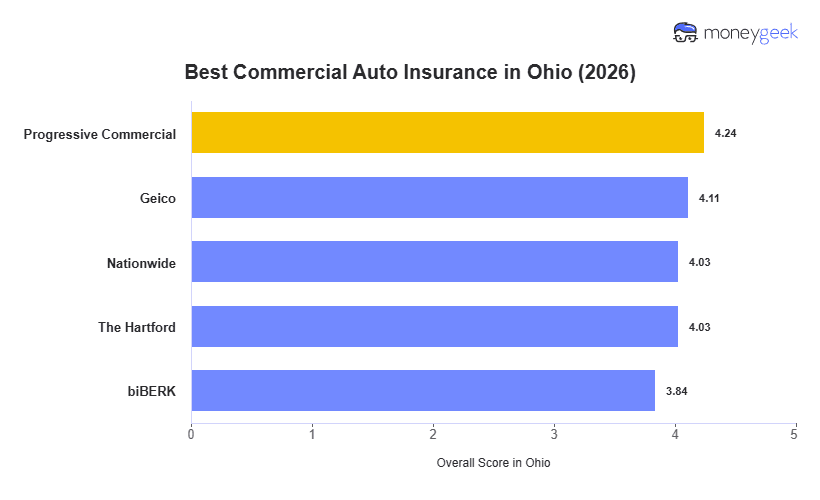
Progressive, GEICO and Nationwide offer the best commercial auto insurance providers in Ohio, combining competitive pricing with solid coverage options and customer experience across a wide range of operations.
Progressive leads Ohio's rankings overall, but the right fit for your business depends on your vehicle type, industry and specific coverage needs.
Get matched to your best commercial auto insurer and get quotes in minutes using our tool below.

Updated: May 7, 2026
Advertising & Editorial Disclosure
How We Built These Best Small Business Insurer Rankings
Pricing was collected across all five providers for Ohio's eight vehicle types, 385 industry categories and the coverage conditions specific to the state. The 24,500 Ohio business profiles studied range from solo contractors running a single van to multi-vehicle operations moving freight between Columbus, Cleveland and Cincinnati. Pricing was isolated by vehicle type, industry and Ohio-specific conditions rather than averaged across all operations, because a statewide average tells a landscaping company nothing useful about what it will actually pay.
Approximately 6,300 customer experience data points were pulled for Ohio from reviews, forum discussions and industry research. Each data point was assessed to surface what Ohio commercial policyholders consistently report across the buying process, day-to-day policy management and claims resolution. Buying tools and policy management platforms were also tested directly for each provider, because post-purchase experience matters as much as how easy it is to get a quote.
All five providers were compared across the same minimum, mid-level and high-level coverage tiers for commercial vehicles operating in Ohio. The evaluation focused on how well each provider's policy structure addresses risks common to Ohio operations, from contractor pickups and agricultural vehicles to transportation fleets running interstate routes. Holding providers to identical tiers throughout kept comparisons from being skewed by structural differences in how each carrier packages coverage.
Top Picks: Best Commercial Auto Insurance Companies in Ohio
Commercial auto rates in Ohio vary more by vehicle type and industry than most business owners expect, which means the best commercial auto insurance decision comes down to three things specific to each operation: what vehicles it runs, what a serious claim would actually cost it and how much hands-on support it needs when something goes wrong. Progressive ranks first in Ohio overall, but a Cincinnati cleaning company running three sedans and a multi-truck construction fleet out of Akron are not shopping for the same policy.
Every provider on this list earned its spot for a reason that matters more than its rank when a business has a specific vehicle mix, industry risk profile or coverage priority:
- Progressive: Best Overall, Best for Fleet Operations
- GEICO: Best for Low-Risk Business Areas
- Nationwide: Best for Agricultural and Specialty Fleets
- The Hartford: Best for Coverage Depth
- biBerk: Best for Simple Coverage Needs
The table below puts all five providers side by side for a direct comparison.
| Progressive Commercial | 4.24 | 1 | 1 | 4 |
| Geico | 4.11 | 2 | 2 | 3 |
| Nationwide | 4.03 | 3 | 5 | 2 |
| The Hartford | 4.03 | 5 | 2 | 1 |
| biBERK | 3.84 | 4 | 4 | 5 |
The summaries that follow break down who each provider fits best and who should look elsewhere, because a strong overall ranking means little if the provider doesn't match the vehicle type, industry or operational need that actually defines the business.

Best Overall, Best for Fleet Operations
Progressive
Progressive has led U.S. commercial auto insurance by written premium for more than a decade, and that standing carries into Ohio. Its pricing advantage shows most clearly with high-exposure vehicles: limousines, taxis and food trucks cost less to insure with Progressive than with most Ohio competitors. The Snapshot ProView telematics program bundles fleet management tools, driver safety scoring and GPS tracking into the policy at no extra cost. Coverage depth is the one area where Progressive falls short, ranking fourth out of five providers on this list. That gap matters for businesses needing specialty endorsements or heavily customized policy structures. Ohio companies running mixed fleets across construction, manufacturing or transportation work get the most value from Progressive's rates and broad vehicle eligibility.
Learn More: Progressive Business Insurance Review
- Ohio construction and contractor fleets: Progressive prices construction and contracting operations 23% below the Ohio average and covers pickup trucks, cargo vans and upfitted service vehicles with same-day policy activation.
- Transportation and logistics operations: Progressive rates transportation and logistics businesses 28% below the Ohio average, and its in-house commercial truck adjusters handle claims around the clock.
- Multi-vehicle fleets using telematics: Snapshot ProView requires a minimum of three enrolled vehicles to unlock the full fleet dashboard. Ohio businesses running three or more commercial vehicles get near real-time GPS tracking, geofencing alerts and monthly driver safety reports at no additional cost, with renewal discounts tied to actual driving data.
- New or non-standard businesses: Progressive accepts new businesses and drivers with prior violations that other carriers typically decline, making it a practical first option for Ohio startups or operations with mixed driver records.
- Businesses prioritizing claims experience above all else: Progressive's J.D. Power claims satisfaction score sits below the industry average, and customer reviews consistently flag slow adjuster response and low initial total loss valuations on standard commercial auto claims. The Hartford has the strongest claims reputation among the five Ohio providers.
- Beauty, wellness and financial services operations: Progressive ranks second overall in beauty and wellness, consulting and financial services industries in Ohio, where GEICO prices these operations more competitively.
- Businesses needing deep coverage customization: Progressive ranks fourth on coverage options among the five Ohio providers. Businesses needing a high level of endorsement flexibility or specialty coverage structures will find The Hartford or Nationwide better suited to those requirements.

Best for Low-Risk Business Areas
GEICO
GEICO is owned by Berkshire Hathaway and prices commercial auto through a fully digital, no-agent-required process. That makes it one of the faster options for Ohio businesses that know what coverage they need and want it activated without a phone call. Pricing is sharpest for low-risk, office-based and professional operations. Financial services businesses pay 22% below the Ohio average, and GEICO ranks first for affordability in the beauty, wellness and consulting industries. The DriveEasy Pro program adds fleet management through an OBD device, a real-time fleet dashboard and an optional road-facing dashcam. Businesses that share telematics data through its Motive partnership can save up to 10%.
GEICO loses ground with high-exposure or specialized vehicle operations. Vans and food trucks both price above the Ohio average, making it a weaker fit for fleets built primarily around those vehicle types. It works best for Ohio operations with light fleets, lower-risk profiles and no need for agent-supported guidance.
- Ohio financial services and consulting businesses: GEICO prices financial services operations 22% below the Ohio average and ranks first overall for consulting businesses in Ohio — the strongest value among the five providers for professional service firms using sedans or SUVs for client visits.
- Light fleet operators using sedans and SUVs: GEICO holds the top affordability rank for both sedans and SUVs in Ohio, pricing 15% and 12% below the Ohio average respectively. Ohio businesses running primarily light passenger vehicles get the most consistent rate advantage here.
- Businesses that want fully digital policy management: GEICO's commercial portal covers quotes, policy management, certificate of insurance generation and claims filing without requiring a call. For Ohio operations without dedicated administrative staff, that reduces friction across the policy lifecycle.
- Fleet operators interested in dashcam-based telematics: The DriveEasy Pro dashcam option pairs road-facing cameras with the fleet dashboard, giving Ohio fleet managers video evidence for claims defense alongside driver safety data — without requiring additional third-party hardware.
- Ohio businesses running vans or food trucks: GEICO prices vans 7% above the Ohio average and food trucks 3% above, ranking third on affordability for both. Progressive prices both vehicle categories more competitively for Ohio operations.
- Childcare and hospitality operations: GEICO runs 22% above the Ohio average for childcare services and ranks third overall for hospitality, travel and tourism in Ohio. Progressive posts the strongest overall scores in both of those Ohio industry categories.
- High-exposure trucking or specialty vehicle operations: GEICO's appetite for hazmat, oversized or heavily upfitted vehicles is more limited than Progressive's, and its specialty trucking depth is narrower. Ohio businesses in transportation and logistics with complex vehicle classifications will find stronger options with Progressive or The Hartford.

Best for Agricultural and Specialty Fleets
Nationwide
Nationwide was founded in Columbus, Ohio in 1926, and its commercial auto program reflects the operational depth that comes from nearly a century writing policies for Ohio's farming, trades and service businesses. Its standout feature for Ohio operators is how it handles upfitted vehicles. Rather than insuring only the base truck, Nationwide provides clearer valuation for permanently installed equipment like shelving systems, ladder racks, lift gates and service body units, which reduces coverage disputes after a total loss. Its dedicated agribusiness program bundles commercial auto, property, business income and general liability into a single policy for Ohio farming and agricultural distribution operations.
Vantage 360 Fleet adds driver behavior tracking, route management and a point-based driver rewards system redeemable for gift cards. Qualifying enrolled policies can receive up to 10% off commercial auto premiums. Nationwide falls short on customer experience, ranking last among the five providers on this list. Its purchase process also requires an agent to complete, with no fully self-service online option available. Semi-trucks and Class 8 tractor-trailers are not covered, which rules Nationwide out for Ohio long-haul trucking operations entirely.
Learn More: Nationwide Commercial Auto Insurance Review
- Ohio trade contractors with upfitted service vehicles: Electricians, HVAC technicians and plumbers operating vehicles with permanently installed equipment get clearer total-loss valuation from Nationwide than from most standard carriers — a meaningful difference when a fully equipped service van represents $30,000 or more in installed tools and equipment above the base vehicle value.
- Ohio agribusiness and farm fleet operations: Nationwide's dedicated agribusiness commercial auto program covers vehicles used in food production, processing and agricultural distribution, and can be bundled with property and business income coverage into a single policy — well suited to Ohio's active farming corridor across the northwest and central regions of the state.
- Delivery and distribution fleets using vans and food trucks: Nationwide prices food trucks 10% below the Ohio average and vans 15% below, where it ranks second overall on limousine coverage as well. Ohio delivery and direct store delivery operations get competitive rates alongside the Vantage 360 Fleet driver coaching program.
- Manufacturing operations: Nationwide prices manufacturing businesses 15% below the Ohio average and ranks second overall in that industry — a practical fit for Ohio's large manufacturing base running service and delivery vehicles between facilities.
- Ohio long-haul and heavy trucking operations: Nationwide does not cover semi-trucks or Class 8 tractor-trailers. Ohio businesses running interstate freight on tractor-trailers need Progressive, which has the broadest commercial trucking appetite and handles FMCSA filings directly.
- Tech, consulting and financial services businesses: Nationwide prices Tech/IT operations 27% above the Ohio average and ranks fifth in that industry, and underperforms on consulting and financial services as well. GEICO is the stronger value for Ohio professional service firms in these categories.
- Businesses that need a fully digital buying experience: Nationwide's quote process can be initiated online but requires an agent to complete the purchase. Ohio businesses that want same-day coverage without a phone call or agent meeting will find Progressive or GEICO better suited to that need.
Best for Coverage Depth
The Hartford
The Hartford leads all five Ohio providers on coverage depth and customization. That makes it the right call for Ohio businesses where getting coverage right matters more than getting the lowest rate. Its FleetAhead program goes beyond a standard telematics discount. Dedicated risk engineers work directly with fleet managers to build driver coaching plans and track measurable loss-reduction outcomes. The BOP option bundles commercial auto with general liability, property and business income in a single policy, cutting the administrative load for Ohio operations that currently manage those lines separately.
The pricing trade-off is real. The Hartford runs 23% above the Ohio average and ranks last on affordability among the five Ohio providers. Its purchase process also requires an agent call to finalize.
Learn More: The Hartford Business Insurance Review
- Mid-size Ohio fleets needing structured risk management: FleetAhead pairs telematics data with dedicated Hartford risk engineers who build fleet-specific loss-reduction programs, not a set-it-and-forget-it discount tool. Ohio operations running 10 or more vehicles across multiple drivers get the most value from this level of oversight.
- Ohio businesses wanting commercial auto bundled with broader coverage: The Hartford's BOP integrates commercial auto, general liability, property and business income into a single policy. Ohio operations managing separate policies for each coverage line reduce both administrative overhead and the risk of gaps between policies.
- Fleets running semi-trucks alongside light commercial vehicles: Unlike Nationwide, The Hartford covers Class 8 tractor-trailers and handles FMCSA filings for Ohio operations running interstate freight, keeping mixed fleets on a single carrier.
- Hospitality and arts operations in Ohio: The Hartford ranks second overall for hospitality, travel and tourism in Ohio, one of only two industries where it reaches the top two among the five providers.
- Ohio businesses prioritizing rate: The Hartford prices 23% above the Ohio average and ranks last on affordability among the five Ohio providers. Progressive and GEICO offer meaningfully stronger value for operations where rate drives the decision.
- Construction, manufacturing and cleaning operations: The Hartford ranks fourth overall across most of Ohio's core trade and industrial industries, well behind Progressive, which leads all of those categories with rates 23% to 26% below the Ohio average.
- Businesses that need a self-service buying experience: The purchase process requires an agent call to complete and the digital tools are the least developed of the five Ohio providers. Progressive, GEICO and biBerk all offer faster, fully online alternatives.

Best for Simple Coverage Needs
biBerk
biBerk runs on a straightforward premise: small business owners shouldn't need a broker to get covered. Backed by Berkshire Hathaway, it lets Ohio businesses buy commercial auto entirely online in minutes. For operations with standard vehicle types and simple coverage needs, that process works well. The coverage itself is another story. biBerk ranks last on depth among the five Ohio providers, and its claims process runs through a call center rather than commercial specialists, which some policyholders connect to longer resolution times. One practical detail worth checking before committing: biBerk writes commercial auto in 21 states, not all 50, unlike every other provider on this list.
Learn More: biBerk Business Insurance Review
- Ohio sole proprietors and owner-operators with one or two vehicles: biBerk's automated underwriting and fully online process is built for simple, single-vehicle or small-fleet operations. A solo contractor running one sedan or cargo van can get a policy and certificate of insurance in under 10 minutes without waiting for an agent callback.
- Low-mileage professional service businesses using sedans or SUVs: biBerk prices sedans 14% below the Ohio average and SUVs 8% below, where it holds its most competitive rate positions in the state. Ohio consultants, real estate agents and similar businesses using standard passenger vehicles for occasional client visits get solid value here.
- Businesses already using biBerk for general liability or BOP: Ohio businesses that purchase GL or a BOP through biBerk can add commercial auto to consolidate policies on a single platform, simplifying billing and certificate management without adding a new carrier relationship.
- New Ohio businesses that need coverage fast: biBerk accepts new businesses and issues coverage immediately upon purchase, with no waiting period for certificates of insurance. For an Ohio startup that needs proof of insurance before a first job, that speed is a practical advantage.
- Ohio businesses running limousines, taxis or high-exposure fleet vehicles: biBerk prices limousines and taxis 37% above the Ohio average, ranking last on both vehicle types. Progressive prices both categories 31% below the Ohio average and is the clear alternative for Ohio passenger-for-hire operations.
- Transportation, logistics and wholesale distribution operations: biBerk prices transportation and logistics businesses 28% above the Ohio average and wholesale and distribution 29% above, ranking last in both categories. Progressive leads Ohio on transportation pricing and handles FMCSA filings directly, which biBerk requires manual coordination to complete.
- Operations needing fleet telematics or complex coverage structures: biBerk offers no telematics program and its coverage customization is the most limited of the five Ohio providers. Ohio businesses with multi-vehicle fleets, upfitted vehicles or endorsement-heavy coverage requirements will find Nationwide, The Hartford or Progressive better equipped to handle those needs.
Best Ohio Commercial Auto Insurance by Vehicle Type
Progressive ranks first across all eight vehicle types in Ohio's commercial auto market, with its strongest rate advantages on high-exposure operations: limousine and taxi fleets run 31% below the Ohio average and food trucks come in 28% below. Its overall lead holds even on sedans and SUVs, though GEICO prices both vehicle types more competitively on affordability alone for Ohio businesses where rate is the primary consideration.
| Farm Tractor | Progressive Commercial | 1 | 1 | 4 |
| Food Truck | Progressive Commercial | 1 | 1 | 4 |
| Limousine | Progressive Commercial | 1 | 1 | 4 |
| Pickup Truck | Progressive Commercial | 1 | 1 | 4 |
| SUV | Progressive Commercial | 2 | 1 | 4 |
| Sedan | Progressive Commercial | 3 | 1 | 4 |
| Taxi | Progressive Commercial | 1 | 1 | 4 |
| Van | Progressive Commercial | 1 | 1 | 4 |
Most Ohio business owners underestimate how much vehicle type shifts commercial auto rates. The five providers on this list vary considerably across all eight vehicle categories:
Best Commercial Auto Insurance in Ohio by Industry
Progressive takes the top affordability ranking in 22 of 25 Ohio industries, with its strongest scores across construction and contracting, manufacturing, transportation and logistics, food and beverage, and wholesale and distribution. GEICO claims the remaining three: beauty and wellness, consulting and financial services. In those industries, GEICO's affordability score tops all five providers, and financial services businesses pay 22% below the Ohio average.
| Agriculture & Natural Resources | Progressive Commercial | 3 | 1 | 4 |
| Arts, Media & Entertainment | Progressive Commercial | 4 | 1 | 4 |
| Beauty, Body & Wellness Services | Geico | 2 | 2 | 3 |
| Childcare Services | Progressive Commercial | 1 | 1 | 4 |
| Cleaning Services | Progressive Commercial | 1 | 1 | 4 |
| Construction & Contracting | Progressive Commercial | 1 | 1 | 4 |
| Consulting Services | Geico | 2 | 2 | 3 |
| Education | Progressive Commercial | 1 | 1 | 4 |
| Financial Services | Geico | 1 | 2 | 3 |
| Fitness Services | Progressive Commercial | 4 | 1 | 4 |
| Food & Beverage | Progressive Commercial | 1 | 1 | 4 |
| Healthcare & Medical | Progressive Commercial | 1 | 1 | 4 |
| Hospitality, Travel & Tourism | Progressive Commercial | 1 | 1 | 4 |
| Manufacturing | Progressive Commercial | 1 | 1 | 4 |
| Marketing & Communications | Progressive Commercial | 4 | 1 | 4 |
| Nonprofit & Associations | Progressive Commercial | 1 | 1 | 4 |
| Other Professional Services | Progressive Commercial | 1 | 1 | 4 |
| Pet Care Services | Progressive Commercial | 1 | 1 | 4 |
| Real Estate & Property Services | Progressive Commercial | 2 | 1 | 4 |
| Recreation & Sports | Progressive Commercial | 1 | 1 | 4 |
| Repair & Maintenance | Progressive Commercial | 1 | 1 | 4 |
| Retail & Product Rental | Progressive Commercial | 1 | 1 | 4 |
| Tech/IT | Progressive Commercial | 3 | 1 | 4 |
| Transportation & Logistics | Progressive Commercial | 1 | 1 | 4 |
| Wholesale & Distribution | Progressive Commercial | 1 | 1 | 4 |
MoneyGeek breaks down commercial auto insurance options by industry to help Ohio businesses find the right fit.
What Determines the Best Commercial Auto Insurance in Ohio for You
The best commercial auto insurance in Ohio is not defined by a single factor. The right provider balances affordability, coverage depth and customer experience across the vehicle types and industries most common in Ohio. Three areas matter most when evaluating which insurer fits your business.
- Liability limits offered: Ohio's minimums are a legal floor, not a recommendation. High-exposure industries like transportation and construction should look for liability ceilings that reflect their most likely claim scenarios.
- Breadth of vehicles covered: Some providers cover farm tractors, limousines and food trucks while others restrict specialty or high-exposure vehicles. Confirm your specific vehicle types are eligible before binding.
- Standard vs. endorsement coverage: One provider may include roadside assistance and rental reimbursement as standard while another charges extra for both.
- Hired and non-owned auto coverage: Whether employee-owned or rented vehicles used for business are covered varies by carrier, which is relevant for Ohio professional services and healthcare businesses whose staff use personal vehicles for client visits.
- Cargo and equipment coverage: Ohio construction and manufacturing businesses should confirm whether tools and cargo coverage are included or require a separate inland marine policy.
- Exclusions and policy language: Driver eligibility rules, vehicle use restrictions and geographic limits differ between carriers. Ohio motor carriers crossing state lines must comply with the requirements of each state they operate in.
- Deductible flexibility: Features like diminishing deductibles or waived deductibles on a total loss are carrier-specific and can have real financial impact at claim time.
- Coverage for fleet growth: Some policies make it straightforward to add vehicles mid-term while others require policy rewrites that create temporary coverage gaps.
Commercial auto pricing in Ohio varies more by vehicle type than most other business insurance factors. High-exposure operations like taxi and limousine fleets see rate gaps of up to 68% between the most and least competitive Ohio providers, while lower-risk vehicle types like sedans show much tighter spreads. Ohio businesses in construction, manufacturing and transportation tend to see the most meaningful savings by comparing providers. The best value for your fleet depends on your specific vehicle mix and industry, not the statewide average.
Compare policy terms carefully when getting quotes in Ohio. The state requires minimum liability of $25,000 per person, $50,000 per occurrence and $25,000 for property damage for most commercial vehicles. Ohio is a standard tort state with no PIP requirement, so bodily injury liability is the primary coverage for injury claims. Motor carriers operating interstate routes are subject to FMCSA minimums that exceed Ohio's state-level requirements, and for-hire passenger carriers face higher thresholds still. Pay close attention to the following when evaluating policies:
Claims handling for commercial auto policies works differently than consumer coverage, so check provider performance specifically on commercial claims in Ohio. Look at whether the claims team is available 24/7 or only during business hours, whether your claim gets a dedicated commercial adjuster or goes through a general call center and whether your account will have a consistent agent over time. NAIC complaint ratios give an unbiased data point to compare alongside provider reviews.
How to Choose the Best Commercial Auto Insurance in OH
Choosing commercial auto coverage in Ohio comes down to matching your vehicle type, business use and compliance requirements to the provider that prices and covers those specifics most competitively. These six steps give Ohio business owners a structured way to work through that decision.
- 1Confirm What Ohio Requires for Your Operation
Ohio's base commercial auto liability minimum is $25,000 per person, $50,000 per occurrence and $25,000 for property damage. That baseline applies to most standard commercial vehicles used for local service calls, deliveries and non-carrier operations. Your actual required limits depend on how you use the vehicle:
- Private carriers hauling company-owned goods follow Ohio's base minimum only.
- For-hire intrastate carriers operating within Ohio must register with the Ohio Public Utilities Commission (PUCO) and meet FMCSA-equivalent financial responsibility requirements.
- Interstate for-hire carriers need FMCSA operating authority, a USDOT number and minimum liability of $300,000 for cargo vans and sprinters or $750,000 for trucks hauling general freight. Ohio assigns these tiers by GVWR, not actual cargo weight on a given day.
- For-hire passenger carriers need an active PUCO Certificate of Public Convenience and Necessity before accepting fares. Columbus-based operations also require separate city-level licensing through the Vehicle For Hire Board.
- Hazmat carriers face FMCSA minimums of $1,000,000 to $5,000,000 depending on the substance type and classification.
Ohio's BMV monitors insurance compliance through traffic stop checks and post-accident reporting. Coverage lapses for FMCSA-regulated carriers can trigger operating authority revocation.
- 2Identify Your Vehicle Types and Fleet Size
List every vehicle your business operates and confirm each vehicle type is eligible with any provider you are evaluating. Not all carriers cover all vehicle types in Ohio. Nationwide does not write semi-trucks or Class 8 tractor-trailers. biBerk limits specialty vehicle coverage and is available in 21 states. Progressive covers more than 30 commercial vehicle types and handles FMCSA filings directly, making it the broadest option for mixed or specialty Ohio fleets. If your vehicles have upfitted or permanently installed equipment, confirm how each carrier values that equipment at total loss, as valuation methods differ meaningfully between providers.
- 3Get Quotes Across Your Actual Vehicle Type and Industry
Statewide average rates do not reflect what your business will actually pay. An Ohio construction contractor running pickup trucks pays a different rate than a financial services firm using sedans, even with the same provider. Get quotes that specify your vehicle type, industry classification, garaging ZIP code, driver records and estimated annual mileage. Garaging location within Ohio moves premiums materially: a Columbus ZIP carries different risk than a rural ZIP in the northwest farming corridor. Request quotes from at least three of the five providers on this list and compare them at the same coverage tier.
- 4Compare Coverage Terms, Not Just Price
Once you have quotes at matching coverage tiers, compare the following before making a decision:
- Whether hired and non-owned auto coverage is included or requires a separate endorsement
- How each policy handles drivers with prior violations or limited experience
- Whether cargo, tools and permanently installed equipment require a separate inland marine policy
- Whether roadside assistance and rental reimbursement are standard or add-ons
- How mid-term vehicle additions are handled and whether they create temporary coverage gaps
- Whether the carrier handles FMCSA and PUCO filings directly or requires you to coordinate them separately
- 5Evaluate the Claims and Service Experience
Commercial auto claims are more complex than personal auto, and the difference between providers shows up most clearly after an accident. Check whether each carrier assigns a dedicated commercial adjuster or routes claims through a general call center. Confirm whether claims support is available around the clock or only during business hours, which matters for Ohio transportation and logistics operations running overnight routes. Ask whether your policy will have a consistent agent or account manager over time, and review complaint data from the Ohio Department of Insurance for each provider before binding.
- 6Confirm Filing Requirements Before Binding
Ohio for-hire and interstate motor carriers must file proof of insurance with FMCSA and separately file with Ohio PUCO through their insurer. Confirm your chosen provider handles these filings directly before you bind coverage. A lapse after obtaining FMCSA operating authority can result in authority revocation, fines and vehicle out-of-service orders. If your business has an SR-22 requirement, Ohio filings stay active for three to five years and typically increase commercial premiums by 25% to 70% during that period.
Best Commercial Auto Insurance in Ohio: Bottom Line
The commercial auto decision comes down to three questions: What vehicles does your business run? What industry are you in? What would a serious liability claim actually cost your operation? In Ohio, pricing and coverage depth shift more by vehicle type and industry than most business owners expect. Those two inputs alone will point you toward a short list of providers worth comparing.
The lowest rate on a quote isn't always the best value if the policy leaves gaps your business genuinely needs covered. Not every carrier fits every operation. It's also worth deciding upfront whether a fully digital buying experience matters to you or whether agent-supported guidance is worth paying for. That distinction separates the field in ways that rate alone doesn't. Get at least two or three quotes at the same coverage tier to confirm whether the right fit on paper holds up for your specific vehicles, location and industry.
Best Commercial Auto Insurance: Next Steps
Most Ohio businesses should start by getting quotes from Progressive and GEICO. Progressive leads Ohio's overall rankings, covers the widest range of vehicle types and handles FMCSA filings directly, making it a practical first stop for most operations. GEICO delivers the strongest value for professional service firms and light commercial vehicles, with its sharpest pricing in financial services, consulting and beauty and wellness. Ohio businesses running upfitted service vehicles, farm fleets or for-hire intrastate carrier operations should add Nationwide to their shortlist.
Recommended: If You're Ready to Get Quotes Now
By this point you should know your fleet composition, coverage requirements and which providers match your industry and vehicle type in Ohio. Request quotes from at least three providers and compare both price and policy terms before committing. If a quote comes back higher than expected, check your coverage selections and driver records first before moving on from a provider that otherwise fits your operation.
If You Want to Confirm Cost Before Deciding
Ohio commercial auto rates vary widely by vehicle type and industry, so a statewide average gives you little to work with before collecting quotes. Grounding your cost expectations in your specific vehicle type and industry first prevents over-indexing on a number that may not reflect your operation at all.
If You're Unsure What Coverage Your Fleet Needs
Start by documenting every vehicle your business operates in Ohio, how each one is used, what it carries and whether any employees use personal vehicles for business tasks. Missing a coverage type like hired and non-owned auto or cargo coverage creates a gap in financial protection that a standard commercial auto policy will not fill.
If You Operate as a For-Hire Carrier in Ohio
Ohio for-hire carriers operating within the state must register with the Ohio Public Utilities Commission before accepting fares or hauling freight for compensation. Columbus-based for-hire passenger operations also require a separate city-level Certificate of Public Convenience and Necessity on top of PUCO registration. Confirm your carrier handles PUCO Form E filings directly before binding coverage, and verify your FMCSA filings are in place if your operation crosses state lines.
How We Chose the Best Ohio Commercial Auto Insurance Companies
Our goal was to identify which providers deliver the most consistent overall value across the three dimensions that matter most to business owners: what they pay, how well they're covered and how the carrier performs when they need support. Five providers made the cut for our Ohio analysis: Progressive Commercial, GEICO, The Hartford, Nationwide and biBerk. We analyzed all five across all eight vehicle types and 25 general industry categories covering more than 400 specific industry areas.
Our Scoring Model
We scored each of the five providers across three weighted categories that combine into an overall score out of 5.
- Affordability (50% of overall score): We measured how competitively and consistently each provider prices commercial auto coverage across vehicle types, industries and states, benchmarked against national average rates.
- Customer Experience (30% of overall score): We evaluated how well each provider supports businesses across the full policy lifecycle — buying, policy management and claims handling.
- Coverage Options (20% of overall score): We assessed how well each provider addresses common commercial fleet risks and how much flexibility it allows across coverage types and endorsements.
Learn more about our methodology.
About Connor Bolton

Connor Bolton is Senior SEO and Content Manager at MoneyGeek, where he leads the business and pet insurance editorial teams. As editorial lead for both verticals, Connor sets the research framework, data standards, and content structure that his writers execute, directly authoring in-depth guides himself and reviewing all team content for accuracy and practical value before it goes live. With over four years evaluating insurance products across personal, commercial, and specialty lines, he brings cross-vertical knowledge to every guide the team produces.
Connor architected MoneyGeek's insurance research infrastructure across all major verticals including auto, home, renters, life, health, business, and pet, building systems for pricing analysis, provider-level research, customer experience evaluation, and coverage analysis with AI support. The infrastructure includes over 6 million data points for business insurance across 408 industry areas, all 50 states, and 16 vehicle types, and over 5 million pet insurance profiles across 18 major providers and hundreds of breed and age combinations. Connor's insurance cost research and his team's work has been cited by the U.S. Chamber of Commerce, Allstate, Liberty Mutual, CBS News, Forbes and LegalZoom.
Beyond the data, Connor stays connected to how the market actually operates, drawing on direct conversations with underwriters and carrier liaisons at Ethos, The Hartford, NEXT Insurance, Nationwide, and State Farm, and monitoring business and pet owner communities including Reddit, to inform how he interprets findings and frames guidance for real buyers.
He is the direct editorial contact for methodology questions at connor@moneygeek.com and can be found on LinkedIn.