




Choose where to jump to next based on your needs:
Average General Liability Insurance Cost in Georgia (2026 Report)
In Georgia, monthly general liability premiums range from $27 to $319, with your industry classification and workforce size acting as the primary cost drivers.
If you're ready for a quote, get matched to the right general liability carrier for your Georgia business with our tool below.
Select state
Updated: September 11, 2026
Advertising & Editorial Disclosure
How Much Does General Liability Insurance Cost in Georgia?
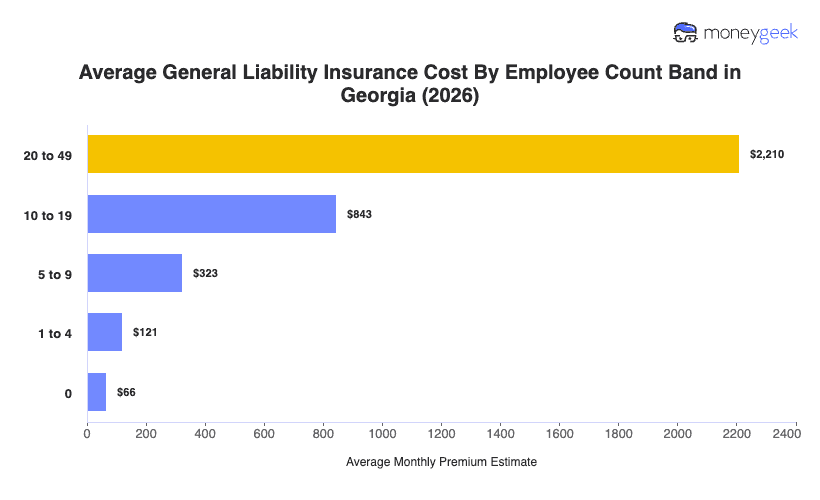
General liability costs for Georgia businesses with one to four employees average $121 monthly, or $1,452 annually, based on MoneyGeek's analysis of premium estimates from over 400 business types statewide. Georgia's rate is $2 above the national average, ranking it 27th for affordability among all states.
These figures represent aggregated estimates across industries and business sizes. An Atlanta roofing crew faces different liability exposures than a Statesboro graphic design studio, so actual premiums diverge based on industry classification, claims history and policy limits. Use the state average as a benchmark, then explore the industry and business-size breakdowns below to see where your operation falls.
To estimate average general liability insurance costs in Georgia, MoneyGeek analyzed quote data from 10 major U.S. small business insurance providers and modeled over 20,000 standardized premium estimates across 25 general industry categories and five employee count bands (zero, one to four, five to nine, 10 to 19 and 20 to 49). All estimates use a standard $1 million per occurrence/$2 million aggregate policy baseline, with modeled average revenue and payroll derived from CBP, QCEW and Economic Census/SUSB data calibrated against private compensation databases and IRS SOI totals.
The Georgia state average reflects the modeled premium for a standardized one-to-four-employee small business across all included industries. Segment averages isolate individual variables, including employee count and general industry category, so readers can compare how premiums shift across business types. These are benchmarks for comparison, not personalized quotes. Read full methodology.
What Factors Affect General Liability Insurance Costs in Georgia?
Several factors determine what Georgia businesses pay for general liability insurance. Universal drivers like business size and industry classification set the baseline, while Georgia's tort environment, litigation patterns and claim frequency trends push premiums in state-specific directions.
Georgia Agnostic General Liability Insurance Cost Factors
These factors drive general liability premiums regardless of where a business operates. Business size and industry classification shape costs most directly.
 Business size
Employee count affects general liability premiums because larger operations mean more customer contact, greater work volume and a higher likelihood of claims. In Georgia, sole proprietors pay 46% less than the state average, while operations with 20 to 49 employees pay 1,728% more. That range illustrates how sharply exposure scales with workforce size, with employee count emerging as the single largest premium variable for most businesses.
 Industry classification
Industry classification influences general liability premiums through operational risk profiles. Businesses operating primarily from office and digital environments face fewer physical hazards and customer injury scenarios than those involving jobsite work, heavy equipment or direct hands-on services, and insurers convert those differences into distinct pricing tiers.
Georgia's tech/IT sector is 78% below the state average, given minimal exposure to physical risk and limited customer interaction at commercial sites. Construction and contracting operations carry premiums 164% above that benchmark, are affected by equipment use, worksite hazards and elevated bodily injury claim potential. Verifying the classification code with the insurer ensures the business pays for the actual risk profile, not a higher-risk category.
Georgia-Specific General Liability Insurance Cost Factors
Beyond universal pricing variables, Georgia's legal environment, regional litigation patterns and claims trends create state-level cost pressures that shape premiums for all businesses operating here.

Georgia's Tort Environment and 2025 Legislative Reform
Georgia's modified comparative negligence rule (51% fault bar) established baseline liability standards, but nuclear verdicts surged between 2013 and 2024, adding $1,370 per year to small business insurance costs. Governor Kemp signed comprehensive tort reform in April 2025, eliminating phantom damages, mandating bifurcated trials and tightening negligent security standards. The Insurance Commissioner projects premium reductions of 3% to 5% as insurers factor in reduced nuclear verdict exposure.

Georgia's Regional Litigation and Cost Variation
Metro Atlanta's 6.4 million residents concentrate liability exposure in Fulton, DeKalb and Gwinnett counties, which accounted for 41% of Georgia's nuclear verdicts despite representing a fraction of state geography. Atlanta-area businesses carry premiums roughly 20% above state averages, while rural counties run 15% to 25% below. Certain DeKalb County operations in high-crime neighborhoods have seen coverage costs climb from $50 to over $1,500 per unit.

Georgia's Premises Liability Claim Patterns
General liability claim frequency in Georgia rose 24.9% between 2019 and 2023 relative to the previous five-year period, with premises liability cases representing 26% of the state's nuclear verdicts. Significant judgments include a $43 million CVS parking lot shooting verdict and multiple eight-figure negligent security awards. Georgia's litigation rate for liability cases runs nearly three times the median state level, with costs concentrated in commercial real estate and retail sectors.
Get a GA General Liability Insurance Cost Estimate
You can estimate your general liability insurance costs based on your industry and employee count using the general liability insurance calculator below. Estimates are based on a standard policy with $1 million in coverage per occurrence and a $2 million aggregate limit. You can also click Get Quotes to find insurers that may fit your business based on the information you enter.
Georgia General Liability Cost Estimate Calculator
Select your state and industry to view average business insurance premiums in your area. Rates are calculated based on a business with 5 employees and $500,000 in annual revenue.
Select General Industry
Select Employee Count
Monthly rate estimate—
Select General Industry
Monthly rate estimate—
Select Employee Count
How to Lower General Liability Insurance Costs Without Sacrificing Coverage
Reducing what you pay for general liability coverage in Georgia does not require downgrading protection. A mix of quick administrative fixes and sustained operational improvements can bring premiums down while keeping your business fully covered.
For Georgia businesses exploring their options, understanding affordable general liability coverage in Georgia is a practical starting point before applying the strategies below.
Quick General Liability Cost Lowering Methods
These six strategies can reduce general liability costs without changing operations or coverage quality. Each works within Georgia's insurance market structure and requires only administrative action.
 Provide clean, accurate underwriting information
Atlanta event planners are often misclassified as event venues, which doubles general liability premiums because insurers assume property ownership and liquor liability exposure. Coordinators who arrange vendor contracts pay $45 per month, while venues hosting events pay $110. The industry classification should be confirmed to match actual operations, as revenue, employee count and business activities determine the rating tier. Misreporting triggers mid-term recalculations that increase premiums retroactively.
 Compare multiple insurers
Proposals from four to five insurers should be pulled to identify competitive pricing across Georgia's varied risk landscape. A Savannah roofing contractor might receive quotes ranging from $180 to $340 per month for identical $1 million/$2 million coverage, with carriers pricing hurricane exposure differently based on catastrophe models.
Regional insurers familiar with Georgia-specific risks such as coastal storms, metro litigation and seasonal tourism often outperform national carriers lacking local claims data. Comparing business insurance quotes across multiple carriers remains the most reliable way to surface these differences.
 Bundle general liability into a business owner's policy (BOP)
Business owner's policies combine general liability with commercial property coverage, reducing total costs by 15% to 25% compared to separate policies. Macon retailers who review BOP costs gain dual protection for inventory damage and customer slip-and-fall claims under one premium, eliminating the need to coordinate separate liability and property policies.
 Pay annually instead of monthly
Paying the full year's premium upfront saves 5% to 10% through paid-in-full discounts and eliminates monthly billing fees that add $3 to $8 per installment. North Georgia mountain lodge and tour operators with seasonal revenue concentration can time annual payments after peak summer and fall visitor months when cash reserves are highest, securing savings without straining operational budgets.
 Increase your deductible (if you can afford it)
Premium savings should be weighed against out-of-pocket claim costs before raising deductibles from $500 to $2,500 or $5,000. Columbus manufacturers with established cash reserves can absorb higher per-claim expenses while reducing premiums 15% to 25%. Atlanta restaurants and Savannah cafés experiencing frequent minor incidents, such as kitchen accidents, customer slips and small property damage, are better served by lower deductibles even when monthly premiums are higher.
 Adjust your coverage limits
When assets and contract requirements permit flexibility, adjusting coverage limits offers savings opportunities. Augusta solo consultants with minimal assets may safely reduce from $2 million/$4 million to $1 million/$2 million, cutting premiums by 30% to 40%. Health care facilities with patient interaction and high property values require higher limits. Underinsuring creates catastrophic exposure, while overinsuring allocates premium dollars to protection the operation does not need.
Read More: How Much General Liability Insurance Do You Need?
Long-Term General Liability Cost Lowering Methods
Long-term cost reduction depends on building a favorable claims history and implementing verifiable risk controls. Savings compound as the loss profile and risk documentation improve year over year.
General Liability Insurance Cost in Georgia: Bottom Line
Georgia's general liability market sits in the Southeast's middle tier at $121 monthly for small businesses, shaped by the 2025 tort reform, metro Atlanta's litigation concentration and a 24.9% rise in claim frequency since 2019. Three questions pinpoint what drives your rate:
- Where does your industry fall in Georgia's cost spectrum? Tech/IT operations at $27 monthly and construction at $319 represent the extremes, with 60% of industries paying below average. Your industry classification alone can set your premium anywhere within that 12:1 range.
- Which Georgia-specific factors shape your baseline? Metro Atlanta's nuclear verdict concentration, county-level crime patterns and coastal storm exposure create regional rate differences before your individual business factors apply. The 2025 tort reform may produce 3% to 5% relief as insurers adjust their models.
- What can you actually control? Industry classification and location are fixed, but claims management, safety documentation, deductible selection and insurer comparison are all within your reach and produce measurable savings.
Check your rate against these figures to determine whether Georgia-specific factors or your industry's baseline risk profile is driving your premium.
About Angelique Palenzuela-Cruz

Angelique Palenzuela-Cruz is a Business Insurance Content Writer at MoneyGeek, where she specializes in general liability, workers’ compensation and professional liability insurance. Her work helps small business owners understand how these policies apply to coverage, including risks like customer injuries, employee injuries, professional mistakes, client contract terms and industry-specific coverage requirements.
She primarily covers service-based businesses where liability and employee coverage decisions are especially important, including cleaning, consulting, beauty and wellness, childcare, education, fitness, food service, pet care, repair and maintenance, and other professional services.
Before joining MoneyGeek, Angelique spent nearly 12 years at Guthrie-Jensen Consultants, one of Southeast Asia’s largest management training firms, where she advanced from Training Consultant to Managing Consultant. In that role, she worked with business clients to assess operational needs, develop training programs and present performance analyses to executive decision-makers. She also helped establish Gladwin Training Consultancy, where she served in learning solutions and client service roles.
Her background gives her practical context for writing about how businesses operate, manage client expectations, structure teams and make risk decisions. At MoneyGeek, she applies that experience to business insurance content, connecting coverage to actual business needs.
LinkedIn: linkedin.com/in/ma-angela-cruz
Email Contact: angelique.palenzuela@moneygeek.com
Sources
- American Tort Reform Foundation. "Georgia — No. 1 — Judicial Hellholes 2023-2024." Accessed September 30, 2026.
- Justia. "Georgia Code § 51-12-33 — Reduction and Apportionment of Award or Bar of Recovery According to Percentage of Fault of Parties and Nonparties." Accessed September 30, 2026.
- Small Business Administration Office of Advocacy. "2025 Small Business Profile: Georgia." Accessed September 30, 2026.