



Jump to the section that meets your needs best below:
Average Party Rental & Shop Insurance Cost (2026 Report)
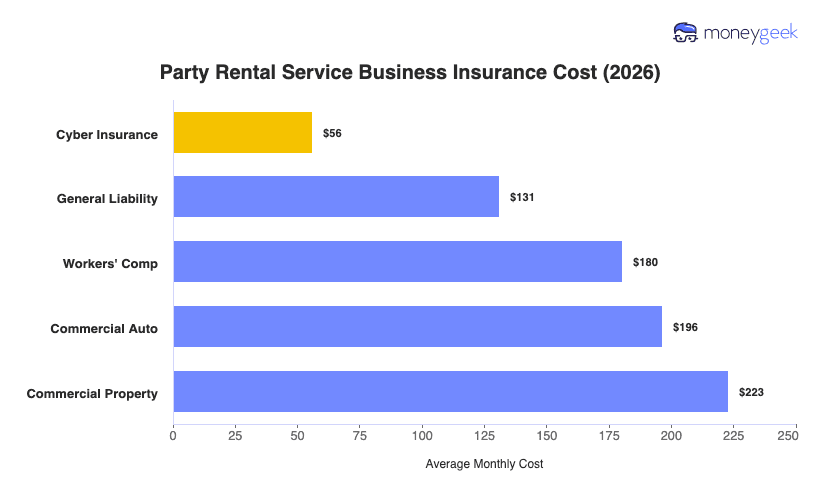
Party rental insurance costs $56 to $223 per month, shaped by your inventory, crew size, delivery vehicles and whether you rent inflatables.
If you're ready to get a quote, get connected to the best party rental business insurer for your operations with our matching tool below.
Select state
Updated: September 10, 2026
Advertising & Editorial Disclosure
How Much Does Party Rental Insurance Cost?
The average cost business insurance for party rental companies runs $157 per month, or $1,888 per year, based on MoneyGeek's analysis of quotes across 50 states and DC. That figure covers the five most common coverage types for a business profile of one to four employees at standard policy limits of $1 million per occurrence and $2 million aggregate.
Depending on your policy, your costs can fall between $56 and $223 per month. Cyber insurance is the most affordable coverage type because your primary exposures are physical, such as equipment damage, guest injuries at events and delivery vehicle accidents, not data-related. Commercial property prices highest because your tents, inflatables, generators and linens represent considerable insured value stored in a warehouse and transported to job sites throughout the season.
The coverage breakdown below shows average monthly costs by policy type, but use these figures as starting benchmarks rather than the rate you'll receive, since your actual premium reflects your specific business profile.
| Cyber Insurance | $56 | $671 | 33% | 67 |
| General Liability | $131 | $1,572 | 7% | 285 |
| Workers' Comp | $180 | $2,164 | -60% | 326 |
| Commercial Auto | $196 | $2,358 | -20% | 301 |
| Commercial Property | $223 | $2,677 | -79% | 322 |
We analyzed quote data from major U.S. commercial insurance providers and modeled standardized premium estimates across business profiles representing around 95% of the market. Results are designed to provide a consistent national benchmark showing how premiums vary by key baseline factors including business size, restaurant profession type, location and vehicle type for operations that use commercial vehicles.
Dataset Scope and Assumptions
Our cost modeling uses standardized inputs for consistent comparisons across businesses.
- Total estimates modeled: just over 6 million standardized pricing estimates
- Providers analyzed: 10 major insurance providers
- Geography: all U.S. states including Washington, D.C.
- Employee count bands: solo practitioners, one to four, five to nine, 10 to 19, and 20 to 49 employees
- Vehicle types studied: Sedans, SUVs, pickup trucks, vans, taxis, limousines, tractors, food trucks, semi-trucks (non-HAZMAT and HAZMAT), tanker trucks (non-HAZMAT and HAZMAT), buses, box trucks, dump trucks, flatbed trucks
- Policies studied: general liability, workers' comp, professional liability, commercial auto, commercial property, and cyber insurance
- General liability: $1 million per occurrence and $2 million aggregate
- Workers' comp: state required coverage
- Professional liability: $1 million per claim and $1 million aggregate
- Commercial auto: minimum coverage
- Commercial property: personal property coverage limits personalized to industry, business size and state
- Cyber insurance: $1 million per occurrence and $1 million aggregate
How We Calculated Average Party Rental Service Business Insurance Costs
Our published averages represent modeled premiums for standardized business profiles and were aggregated in two ways.
- National benchmark average: The national average cost reflects the modeled premium for a standardized one to four employee business across all and states included in our dataset for a standard policies
- Segment averages: To show how costs vary, we calculated average modeled premiums for our national base profile and isolated for variables, including:
- Employee count (business size ranges)
- Vehicle types (for commercial auto)
- States (including Washington, D.C.)
Segment averages were produced by aggregating modeled pricing trends across the full dataset so readers can compare how premiums shift across coverage types and regions.
See our full business insurance methodology.
Get Party Rental Business Insurance Cost Estimates
If you want a more personalized estimate, use our business insurance cost calculator before comparing rates.
Get Party Rental Insurance Cost Estimates
Select Coverage Type
Select State
Select Employee Count
Select Vehicle Type
Monthly Rate Estimate—
Select Coverage Type
Monthly Rate Estimate—
Select State
Select Employee Count
Select Vehicle Type
Factors Affecting Party Rental Insurance Costs
Several aspects of your party rental business insurance costs depend on more than your size. In our analysis, the factors that move premiums most connect to how much equipment you move, who handles it and what happens at the event site.
 Inventory type and value
The equipment you carry shapes your insured exposure more than almost any other variable. A fleet of commercial inflatables, large frame tents and generator sets carries a replacement cost profile that pushes premiums higher than a basic table-and-chair inventory would. Insurers price based on what it would cost to replace your stock after a covered loss, so your inventory list is one of the first things underwriters review.
 Delivery and transportation activity
If your crew loads a box truck and drives to three events every weekend, your exposure footprint is much larger than an operator who rents locally with a single vehicle. The frequency of your deliveries, the number of drivers on your policy and the distances you regularly cover all factor into how insurers assess your transportation-related risk across your entire coverage portfolio.
 Event type and guest volume
Setting up a bounce house for a private birthday party carries different liability exposure than supplying tents, staging and furniture for a 300-person corporate event or a public festival. Larger events with more guests create more opportunities for a claim, whether a tripping hazard near tent stakes, a table that folds under load or an inflatable that deflates mid-use. Insurers weigh the types of events you typically service when calculating your rate.
 Setup and labor intensity
The physical demands of party rental work introduce real injury risk for your crew. Erecting a 40-by-60-foot tent, anchoring inflatables in wind conditions or moving stacked chairs and heavy linen bundles all carry the kind of repetitive strain and acute injury exposure that underwriters weigh carefully. If your jobs regularly involve complex setup work, your labor-related premium will reflect that.
 Seasonal demand concentration
Many party rental businesses run most of their revenue through a compressed spring-to-fall window, with weekends in May, June, September and October carrying the heaviest job loads. Running more events per week during peak season compresses your exposure into a shorter period, and insurers account for that frequency when assessing your annual risk profile.
How to Lower Party Rental Insurance Costs
Party rental businesses typically carry multiple policies at once, and our analysis shows that's where the most meaningful opportunities to find affordable business insurance appear. Some adjustments can take effect at your next renewal, while others build over time as your claims record and risk profile improve. These five methods reflect the most practical levers available to your operation:
 Compare quotes using the same coverage limits
Your quotes only tell you something useful if every one of them is built on identical coverage limits and deductibles. If one insurer quotes general liability at $1 million per occurrence and another quotes $500,000, you're comparing different products. Lock down your coverage parameters before you start collecting and comparing business insurance quotes.
 Right-Size Your Coverage
Your coverage needs depend on what you actually own and operate, not a standard package. If you've recently added dance floors, staging or linen inventory to your rental catalog, your commercial property limit from two years ago may no longer reflect your actual exposure. Review your inventory value, your typical event size and your crew exposure annually so your coverage keeps pace with how your business has grown.
 Bundle policies with the same provider
If your commercial auto, property and liability policies are spread across different insurers, you're leaving multi-policy discounts on the table and managing multiple renewal cycles unnecessarily. Most party rental operators can consolidate their core coverage with one carrier without restructuring what they carry, and doing so typically brings your overall premium down without touching your limits or deductibles.
 Pay annually instead of monthly
Paying your premium in full at the start of the policy period eliminates the installment fee most insurers charge for monthly billing. For a party rental business managing cash flow across a compressed season, the timing requires some planning on your end, but the savings are straightforward and require no change to your coverage, limits or deductibles.
 Invest in risk management practices
The claims most likely to push your premiums higher, like delivery vehicle incidents, crew injuries during setup and equipment-related guest injuries at events, share a common thread: they're preventable with consistent operational discipline. Reducing the frequency and severity of those claims over time is the most durable way to lower what you pay across your entire coverage portfolio.
- Require signed client agreements that clearly define setup boundaries, guest capacity limits and prohibited uses for rented equipment at every event.
- Keep dated maintenance and repair logs for your dance floors, staging components and linen inventory to demonstrate equipment care to underwriters at renewal.
- Brief subcontractor crews on your safety standards before every large event, since their actions on your job site can directly affect your claims record.
- Store seasonal inventory in a secured, climate-controlled facility and document storage conditions to support commercial property claims if damage occurs off-site.
Party Rental Insurance Cost: Bottom Line
The $157 monthly average for party rental business insurance is a useful reference point, but it reflects a modeled profile rather than any single operation's quote. Three questions can help you put the figure you get in context:
- Where do you fall in the distribution? Start by considering your inventory value, crew size and the states where you operate. If you work primarily within one metro area, your risk profile looks very different from an operator servicing events across multiple states, and your quote should reflect where your business actually runs.
- Is your quote consistent with your risk profile? If your quote sits well above the benchmark and your operation is relatively modest, that gap is worth understanding before you accept it. Conversely, a quote that comes in far below the average may reflect lower limits than your contracts or operations actually require.
- Which cost drivers apply to your business? Not every factor on this page will apply equally to your operation. If you run 40 events across 12 peak weekends, seasonal demand concentration shapes your profile more than it would for a business that books steadily year-round. Identifying which two or three drivers actually apply to your setup gives you a more accurate frame for evaluating what you're quoted.
Knowing how far your quote sits from the average matters less than understanding why it lands there. Treat the averages as a lens for asking better questions about your quote, not as a prediction of what you'll pay.
About Angelique Palenzuela-Cruz

Angelique Palenzuela-Cruz is a Business Insurance Content Writer at MoneyGeek, where she specializes in general liability, workers’ compensation and professional liability insurance. Her work helps small business owners understand how these policies apply to coverage, including risks like customer injuries, employee injuries, professional mistakes, client contract terms and industry-specific coverage requirements.
She primarily covers service-based businesses where liability and employee coverage decisions are especially important, including cleaning, consulting, beauty and wellness, childcare, education, fitness, food service, pet care, repair and maintenance, and other professional services.
Before joining MoneyGeek, Angelique spent nearly 12 years at Guthrie-Jensen Consultants, one of Southeast Asia’s largest management training firms, where she advanced from Training Consultant to Managing Consultant. In that role, she worked with business clients to assess operational needs, develop training programs and present performance analyses to executive decision-makers. She also helped establish Gladwin Training Consultancy, where she served in learning solutions and client service roles.
Her background gives her practical context for writing about how businesses operate, manage client expectations, structure teams and make risk decisions. At MoneyGeek, she applies that experience to business insurance content, connecting coverage to actual business needs.
LinkedIn: linkedin.com/in/ma-angela-cruz
Email Contact: angelique.palenzuela@moneygeek.com