
Key Takeaways
blueCheck icon

ERGO NEXT, The Hartford and Thimble are the top three providers for your party rental business, with rates starting as low as $125 per month. (Jump to Top Providers)

blueCheck icon

The coverage your party rental business most likely needs includes general liability, inland marine for equipment at client venues, commercial auto for your delivery vehicles and workers' comp once you have crew on the road. (Jump to Types You Need)

blueCheck icon

Individual coverage costs for your party rental business range from $56 to $223 per month. (Jump to Costs)

blueCheck icon

The best insurance for party rental businesses depends on your inventory, your delivery fleet and whether your clients require proof of coverage before booking. (Jump to Get Insured)

Best Party Rental Business Insurance Companies

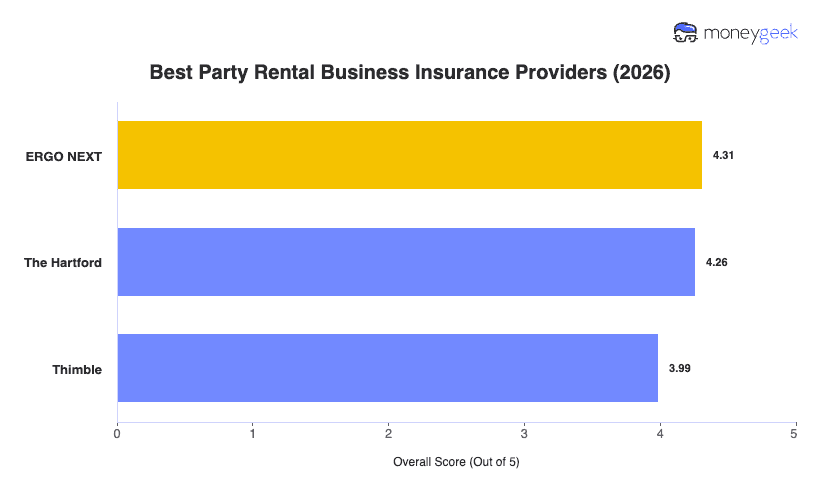
Our analysis found ERGO NEXT and The Hartford at the top providers for party rental businesses, but they earn their positions differently. ERGO NEXT leads on both affordability and customer experience, making it a practical fit if you're keeping costs manageable across a busy event season. The Hartford leads on coverage depth despite a higher price point and fits better when your venue or corporate clients require higher limits before booking.

The table below compares all seven providers across affordability, customer experience and coverage.

ERGO NEXT4.31$12513
The Hartford4.26$17261
Thimble3.99$14927
Progressive Commercial3.98$15544
biBERK3.97$16356
Nationwide3.96$15972
Hiscox3.92$16335

For our overall party rental business insurance ratings, we analyzed pricing, coverage options, and customer experience across all 50 states and Washington, D.C. Our analysis focuses on 1-to-4-person party rental businesses, while weighting results to ensure broader industry and location representation. To do this, we evaluated over six million business profiles, more than 100,000 customer experience data points and performed in-depth analysis of coverage contracts and endorsements to compare insurers consistently across industries and regions. We then rated each company across categories of affordability (50% of overall score), customer experience (30% of overall score) and coverage options and terms (20% of overall score) to form an overall rating.

See our full business insurance methodology.

Whether you run a one-person bounce house operation serving residential clients or manage a full-service company with venue and corporate contracts, your core coverage needs are similar but the provider that fits you will differ. ERGO NEXT suits you if you want efficient service and manageable monthly costs without overbuilding your coverage. The Hartford fits better when your clients are venues or corporate planners who check coverage limits and policy terms before they confirm a booking, not just whether a certificate exists.

The fit depends on your client mix, your monthly cost tolerance and whether your bookings come with certificate of insurance requirements attached.

ERGO NEXT

ERGO NEXT

Best Overall for Party Rentals
On ERGO NEXT's site

Party rental operators ranked ERGO NEXT first overall nationally. Formerly NEXT Insurance, it rebranded following its 2025 acquisition by Munich Re's ERGO Group. It leads on affordability, averaging $125 monthly and saving party rental businesses roughly $34 monthly compared to the industry average. It also ranks first for buying and policy management, built around a fully digital platform where you quote, bind and manage your entire policy without an agent.

Learn More: ERGO NEXT Business Insurance Review

The Hartford

The Hartford

Best for Party Rental Equipment Coverage
On The Hartford's site

The Hartford ranks second overall for party rental businesses, with coverage as its clearest strength across every employee band and nearly every state in the dataset. Its inland marine program is built specifically for equipment and party rental operations, with flexible replacement cost that lets you swap destroyed inventory for different equipment rather than a like-for-like replacement. It also saves party rental businesses roughly $11 monthly on average compared to the industry average. You'll pay more and wait longer to get covered compared to fully digital alternatives.

Learn More: The Hartford Business Insurance Review

What Types of Insurance Do Party Rental Businesses Need?

Party rental businesses carry multiple coverage types because your work moves in multiple directions at once. Your inventory travels public roads, gets set up by your crew at unfamiliar venues and then sits in clients' hands while guests use it. You face a distinct exposure at each stage that no single policy covers on its own. The coverage types most party rental operators need include:

  • General liability (since every event puts your equipment in guests' hands at a venue you don't control)
  • Inland marine (since your inventory travels to client venues for every job and standard property coverage only applies at your fixed location)
  • Commercial auto (since your delivery vehicles and trailers operate on public roads for every rental)
  • Workers' comp (if you have employees handling deliveries, setup and teardown at client sites)
  • Commercial property (if you store inventory and equipment at a warehouse or fixed business location)
  • Cyber liability (if you store client payment data or manage bookings and contracts digitally)

We find that coverage needs shift as your headcount grows. As a solo operator, your core decisions center on what to cover and how much to spend, but once you add crew, delivery vehicles and warehouse space, those obligations multiply and inventory exposure grows with every truck on the road. Each profile below maps to a real stage in how a party rental business grows.

How Much Does Party Rental Business Insurance Cost?

Party rental business insurance costs average $157 per month, or $1,888 per year. Commercial property runs highest, driven by the replacement value of the tents, inflatables and furniture your warehouse holds, and commercial auto and workers' comp follow closely, which reflect your vehicle-dependent delivery model and the physical demands of loading, setup and teardown your crew faces at client venues.

Commercial auto is the coverage most party rental operators add from the start, since your first delivery job requires a vehicle covered for commercial use. We find that your total cost depends heavily on which policies you carry. If you run general liability and commercial auto on their own, your total runs around $327 per month. Add workers' comp, commercial property and cyber and your monthly total runs closer to $786. 

Your individual coverage breakdown looks like this:

How did we determine business insurance rates for party rental companies?

What your party rental business pays also depends on your inventory value, your delivery fleet size and whether your bookings include venues or municipalities that require higher limits. Your cost point as an operator with a small inventory looks different from a company running a full delivery fleet with warehouse stock. A party rental business insurance calculator can give you a more personalized estimate based on how your operation actually runs.

Estimate Your Monthly Party Rental Insurance Cost

Enter your coverage type, state, number of employees and type of vehicle (if you need commercial auto coverage) to get a pricing estimate that fits your business.

We do not collect any personal information, and all rates are aggregated for all 50 states and Washington D.C. Workers' comp rate estimates are provided on a per employee basis and all coverage types assume standard industry limit recommendations for most businesses.

Select Coverage Type
Select State
Select Employee Cand
Select Vehicle Type
Average Monthly Cost—

How to Choose the Right Party Rental Business Insurance

Getting business insurance for a party rental operation works best when you treat it as a process, not a single transaction. We find that party rental operators who buy the first policy they're quoted often end up underinsured for transit and off-site equipment exposure. Working through each decision in sequence helps you build coverage that holds up in the field.

  1. 1
    Understand your risk profile and what coverage it requires

    Your party rental risk moves with your inventory from the moment it leaves your facility, through transit to the venue, through your crew's setup and into the event itself while guests are on-site. Workers' comp becomes legally required the moment you hire your first employee. Venue and corporate clients will require a certificate of insurance before you set foot on their property, regardless of your operation's size.

  2. 2
    Choose the right coverage limits

    Your coverage limits should reflect your worst-case event, not just the minimum a venue or client asks for. A tent failure at a corporate event or an inflatable injury in front of a large crowd can generate a claim that exhausts a $1 million GL limit. Set your general liability at $2 million per occurrence if you work with venues, and set your inland marine limit to cover your full deployed inventory at peak volume.

  3. 3
    Evaluate providers who understand party rental businesses

    Look for a provider that can write equipment floaters alongside your GL and commercial auto, issues certificates of insurance quickly and understands that your inventory operates away from your fixed location by design. A provider that excels on price but can't issue a COI before your crew loads the truck on Saturday morning creates a real operational problem. Balance affordability, customer experience and coverage capability when you compare your options.

  4. 4
    Get compliance-ready

    Buying insurance is the start of your compliance obligations, not the end. Most venues and corporate clients require you to name them as additional insureds on your GL policy before each event, not just show a standard COI. If you operate inflatables, some states require inspections or operator permits for amusement devices. Documenting your equipment's condition at each pickup and return is what protects you when a client files a damage claim after the event.

  5. 5
    Revisit your coverage as your party rental business grows

    Your coverage needs shift at specific growth points: when you hire your first employee, when you add a delivery vehicle, when you move inventory into a warehouse and when your client base shifts toward venues or municipalities with higher limit requirements. Review your policies at every annual renewal and before signing contracts with new client types since what covered your operation last year may not reflect what you're running today.

Get Party Rental Business Insurance Quotes

Party rental business insurance pricing varies by insurer, and the provider that fits your one-person inflatable operation isn't built the same way as one that handles fleet underwriting and enterprise COI requirements for a 20-employee company. The gap between those two businesses is wide enough that comparing options matters more than settling for the first quote you receive. Use the tool below to request business insurance quotes and get matched with a provider suited to your operation.

About Connor Bolton


Connor Bolton, Senior SEO and Content Manager (Business & Pet), MoneyGeek

Connor Bolton is Senior SEO and Content Manager at MoneyGeek, where he leads the business and pet insurance editorial teams. He sets the research framework, data standards and content structure for his team. All content goes through his accuracy review before publication. Connor also writes in-depth guides and has spent more than four years covering insurance products across personal, commercial and specialty lines.

The research infrastructure Connor built covers auto, home, renters, life, health, business and pet insurance across pricing analysis, carrier research, customer experience and coverage evaluation. It includes over 6 million data points for business insurance across 408 industry areas, all 50 states and 16 vehicle types. The pet insurance side covers over 5 million profiles across 18 major providers, 100+ breeds and ages up to 20 years. Connor’s insurance research and his team's work has been cited by the U.S. Chamber of Commerce, Allstate, Liberty Mutual, CBS News, Forbes and LegalZoom.

Connor also talks with underwriters and carrier liaisons at Ethos, The Hartford, ERGO NEXT, Nationwide and State Farm, and monitors business and pet owner communities on Reddit. Those sources shape how his team evaluates carriers, structures rate analysis and writes for human buyers rather than search engines.

For questions about MoneyGeek's business and pet insurance content, contact him at connor@moneygeek.com or on LinkedIn.