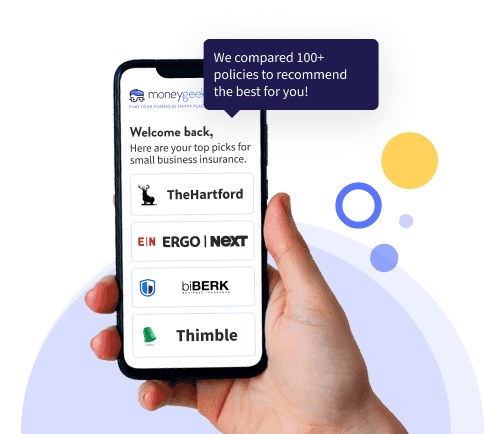




- Best Overall: ERGO Next
- Best for White Collar and Larger Businesses: The Hartford
- Best for Simple, Niche Businesses: biBERK
- Best for Gig and High-Risk Work: Thimble
- Best For Tailored Professional Liability Coverage: Hiscox
Best Small Business Insurance Companies
The top-rated small business insurance company is ERGO Next, according to MoneyGeek’s research. The right insurer for your business, however, depends on what it does and what it needs for coverage.
Select state
Updated: September 9, 2026
Advertising & Editorial Disclosure
Why You Can Trust MoneyGeek
MoneyGeek researched 12 insurance companies and compared their offerings across 25 industries and 408 sub-industries. We obtained quotes in all 50 states and Washington, D.C. to get a pricing picture for each of the carriers we looked at. Read our methodology for a more detailed explanation.
Key Takeaways
The right insurer for a business depends on multiple factors, including industry, location and more.
Not all insurers offer the same coverage, so it’s important to determine what you need before researching companies and obtaining quotes.
Best Small Business Insurance Companies
Featured Partner

The Hartford
- More than 18,000 customer reviews give The Hartford a 4.7-star claims rating.
- The Hartford ranks second overall in MoneyGeek's 2026 best business insurance study, at 4.13 out of 5, and wins Best for White Collar and Larger Businesses.
- Business owner's policies, general liability, workers' compensation, professional liability, cyber and commercial auto all sit in The Hartford's lineup.
- Small business coverage from The Hartford is available in 48 states, excluding Alaska and Hawaii.
On The Hartford's site
*MoneyGeek featured partner. Editorial rankings below are independent of this placement. Rates, rankings and savings comparisons are based on MoneyGeek's independent research and Hartford-reported data as of 2026. Figures are estimates and averages, not a guarantee of any individual quote, premium or discount.
| ERGO NEXT | 4.31 | 1 | 1 | 2 |
| The Hartford | 4.13 | 3 | 2 | 1 |
| biBERK | 4.07 | 4 | 7 | 6 |
| Thimble | 4.04 | 2 | 6 | 5 |
| Hiscox | 3.98 | 6 | 4 | 7 |

ERGO NEXT: Best For Hands-On Work Industries
pros
Ideal for small teams and online policy management
Instant COI is available after purchase
cons
Fewer options for higher limits and less common endorsements
Customer support agents are generalists, not specialists in your industry
COMPANY HIGHLIGHTS
ERGO Next is the top-rated small business insurance company, thanks to strong scores in affordability and a streamlined user experience. During testing, obtaining an online quote took less than six minutes and provided an instant certificate of insurance (COI).
No agents are needed to make simple changes to a policy; that’s great for small businesses that are less at risk of a claim. Larger businesses or those with a higher claim risk may want to look elsewhere.
Read Our Review: ERGO NEXT Business Insurance Review

The Hartford: Best For White Collar
pros
200+ years in business
Agent network provides strong customer and claim support
cons
Not the cheapest option
Doesn’t offer commercial auto insurance
COMPANY HIGHLIGHTS
The Hartford is MoneyGeek's pick for white-collar and larger businesses, thanks to its more than 200 years in business and a network of specialized insurance agents. MoneyGeek found that The Hartford offers competitive rates and tailored coverage for white-collar industries – such as accountants, tech companies and consulting firms – along with larger enterprises overall.
According to MoneyGeek's research, customers report that claim settlements from The Hartford are fair and communication is consistently strong.
Read Our Review: The Hartford Business Insurance Review

biBERK: Best For Simple, Niche Businesses
pros
Low rates for businesses with a small team
Online quotes and purchases
cons
Higher-risk companies may be declined a policy
Updating your policy requires speaking with an agent
COMPANY HIGHLIGHTS
biBERK is Berkshire Hathaway's direct-to-business insurance arm and ranks third overall in MoneyGeek's analysis of small business insurance companies. It offers competitive rates alongside high customer experience ratings, enabling policyholders to purchase coverage and receive an insurance binder online without speaking to an agent.
biBerk has the best prices for sole proprietors running simple businesses; companies that are more complex and/or have a higher claim potential may not qualify for a policy.
Read Our Review: biBerk Business Insurance Review

Thimble: Best For Gig or High-Risk Work
pros
Flexible term lengths
Instant COI available
cons
No commercial auto policies
Claims are routed through a third-party
COMPANY HIGHLIGHTS
Thimble ranks fourth overall in MoneyGeek's study and second in affordability. It provides a solid insurance option for gig workers or anyone who needs on-demand coverage and flexible policy terms, ensuring business owners only pay for coverage when needed. Thimble specializes in businesses with fewer than five employees, offering general liability, business owner's policies and workers' compensation plans.
Customer support is only reachable via email, so keep that in mind if you’re considering buying a Thimble policy. Claims are handled by a third-party administrator.
Read Our Review: Thimble Business Insurance Review

Hiscox: Best For Tailored Professional Liability Coverage
pros
Policies can be customized to fit your needs
Low prices for certain trades
cons
Online policy changes not available
Not the most affordable option for most industries
COMPANY HIGHLIGHTS
Hiscox offers customizable professional liability insurance, ensuring advice-based businesses such as consultants and agencies stay well-protected. MoneyGeek also found that Hiscox provides below-average prices for specialty trades like air duct, chimney and kitchen hood cleaning operations. Overall, Hiscox ranks sixth in terms of affordability.
Licensed insurance agents are available seven days a week to answer policy questions and process claims over the phone, unlike competitors that restrict customer support to online access.
Read Our Review: Hiscox Business Insurance Review
Best Small Business Insurance Companies by Industry
Your company’s industry is the most important piece of information when it comes to which insurance provider is the best one for you. It determines what type and the amount of coverage you need, how much that will cost and which carriers are willing to issue you a policy.
We looked at small business insurance options for more than 400 sub-industries and put together our recommendations to help business owners find a policy that’s best for their situation.






Best Small Business Insurance Companies by Coverage Type
Like the rest of the insurance industry, no single small business insurance company offers the best coverage type across the board. What matters more is a company's business profile and risk level. MoneyGeek found that ERGO Next has the best selection of coverage for four categories, including general liability and commercial property. Chubb, on the other hand, is best suited for companies needing a cyber insurance policy.
ERGO NEXT | 2 | 1 | 8 | |
ERGO NEXT | 1 | 1 | 6 | |
ERGO NEXT | 2 | 1 | 3 | |
Progressive Commercial | 1 | 1 | 4 | |
ERGO NEXT | 3 | 2 | 6 | |
Chubb | 1 | 1 | 1 |
Best Small Business Insurance Companies by State
The location of a business serves as a primary cost driver, with significant price differences occurring across states. ERGO Next stands as the top choice in much of the country – though not for all industries and businesses.


Small Business Insurance Coverage Options
Most businesses start with general liability insurance since it protects against a large proportion of operational risks and fulfills common contractual requirements. Workers' compensation becomes required when hiring employees and commercial auto coverage is needed when using vehicles for work.
General liability protects you financially when you cause or have been claimed to have caused bodily injury to a third party, damage to someone else's property and reputational harm. Legal defense costs also covered if you're sued over any of these items. | All businesses | |
Workers' comp gives reimburses you for medical costs and lost wages when an employee is injured on the job. It covers injuries from accidents, repetitive motion, and occupational illness. | Required once you have employees in most states | |
Any bodily injuries caused by you in an accident and property damage to your vehicle or another's can be covered by this policy type. | Anyone driving to jobs, clients or hauling equipment (Required by law) | |
You would be covered for financial losses a client claims to suffer because of your advice, a professional error, or a failure to deliver on contractual obligations. | Advice-based, consulting, and service businesses | |
All physical assets your business owns or leases, including equipment, inventory, furniture, and the build-out of your space is covered at a stationary physical location. It also causes loss from fire, theft, vandalism, and certain weather events, often with the inclusion of business interruption coverage. | Businesses with significant equipment or inventory | |
A bundled policy combining general liability and commercial property at a lower combined premium than buying each separately. | Any small businesses with a physical location | |
Cyber insurance reimburses you for costs from a data breach, ransomware attack, or unauthorized access to client data, including forensic investigation, regulatory notification requirements, legal defense, and settlements. | Businesses handling client data or processing payments | |
Tools & equipment | This add-on policy financially covers you for repair or replacement of your own tools and equipment lost to theft, damage, or destruction on a job site or in transit. | Trades and solo operators |
Additional liability coverage that kicks in when a claim exceeds the limits of anotherq policy. A single large claim in a high-risk trade or on a high-value commercial property can exhaust base limits before legal defense costs are factored in. | Higher-risk trades, those entering into commercial contracts, larger operations | |
How Much Does Small Business Insurance Cost?
The cost of small business insurance varies depending on industry, risk profile, location and employee headcount. Generally, most small businesses pay between $60 and $110 per month for a policy. Across the six primary coverage types (general liability, workers' compensation, professional liability, commercial auto, commercial property and cyber insurance), the national average cost of a policy is $111.
Costs rise as businesses hire additional staff. MoneyGeek's data indicates that a general liability policy for a company with up to four employees costs an average of $123 per month. Meanwhile, companies with 20 to 49 employees pay an average of $2,298 per month.
Estimate Business Insurance Costs
Select Coverage Type
Select General Industry
Select Employee Count
Select Vehicle Type (Auto Only)
Monthly Cost Estimate—
Select Coverage Type
Monthly Cost Estimate—
Select General Industry
Select Employee Count
Select Vehicle Type (Auto Only)
FAQ
Not necessarily. A contract that requires $1M per occurrence GL sets the minimum you need to work with that client, it does not account for your other clients, your other job sites, or claims that arise from work you do outside that contract. If your aggregate limit gets exhausted by one large claim, every other job you are running at the same time loses coverage. Review your full book of work, not just the contract in front of you, before setting limits.
What to check: Whether the contract also requires additional insured status on your policy. This is common in commercial work and frequently missed until a claim is already in dispute.
Yes, but two things need careful management. Written confirmation that your new policy is bound should come before you ever cancel the current one, since even a single day without coverage creates a gap that can affect future underwriting. Also check whether your current policy has a short-rate cancellation penalty, which means you may not receive a full pro-rata refund for the unused premium.
Whether switching is actually warranted is the broader question. A pattern of short policy tenures can raise questions, since carriers look at policy history when underwriting renewals. Switching makes sense if the savings are substantial and the coverage terms are truly better. The administrative cost and underwriting optics may not be worth it if you're chasing a small price difference.
A declination from one carrier is not a declination from the market, it means that carrier's underwriting appetite does not cover your risk profile at standard rates. This is more common than most business owners expect, particularly in high-risk trades and specialty industries.
Try the other carriers on my top list that have broader appetites for your trade (Hartford and Thimble both write industries that ERGO NEXT and biBERK decline), contact a commercial lines broker who specializes in your industry and has access to surplus lines markets, or consider whether your classification is accurate. Some businesses are incorrectly classified at a higher risk tier than their actual work warrants and correcting that can open up more carrier options.
The evaluation that actually matters begins once price parity is reached. Check these in order:
- Exclusions: Read the exclusions section of both policies. Care, custody and control, completed operations, professional error and pollution are among the most common coverage gaps in standard GL policies, ones some carriers remove or address through endorsements. A policy that's cheaper because it excludes something you actually need isn't a better deal.
- Claims process: How does each carrier handle a disputed claim? Third-party administrators with email-only support pose an operational risk worth weighing for businesses where a claim resolution delay could affect their ability to work.
- COI turnaround: If you regularly need to provide proof of insurance to clients or property managers, the difference between instant digital COI access and a 24-hour agent process is an operational factor that matters.
- Policy management: Can you make mid-term changes online, or does every adjustment require a phone call? For growing businesses this matters more than it seems at the start.
For most straightforward small business operations, buying directly from a carrier or through a digital platform is faster, cheaper and sufficient. The carriers on this list, ERGO NEXT, biBERK and Thimble in particular, are set up for direct purchase without a broker in the process.
A broker earns their value in specific situations, such as:
- Your industry is high-risk or specialty, and standard carriers are declining you
- Your coverage needs span multiple policy types that need to coordinate
- You're managing a commercial contract with specific and complex requirements
- You want someone to advocate for you during a disputed claim
A broker who specializes in your trade is truly worth the cost in those cases. For a solo operator buying standard GL, a broker isn't necessary in most cases.
Annual renewal is the minimum reassessment interval. Four triggers should prompt an immediate review rather than waiting:
- You hire your first employee: Immediately in most states, workers' comp requirements change your legal obligations, and that's not something to address at the next renewal.
- You take on a commercial contract: Coverage requirements your current policy may not meet are commonly specified in client contracts. Review before you sign, not after.
- Your revenue or payroll increases significantly: Some policies are rated on payroll or revenue, so substantial growth since you last bought coverage could leave you underinsured without your knowing it.
- You add a new service type or work in a new industry area: Coverage that was right for your original scope may exclude the new work entirely. A cleaning company that adds hood cleaning, a handyman who starts doing electrical work and a consultant who begins managing client funds all create new exposures your current policy may not cover.
Our Methodology
Our best small business insurance rankings are built on three things: what you'll actually pay, what happens when you need help and whether the coverage holds up when it counts. We reviewed each provider across affordability (50%), customer experience (30%), and coverage options (20%) which are weighted that way because price is where most small businesses start, but it's rarely where the decision should end.
This is what made up our analysis of popular insurers:
About Connor Bolton

Connor Bolton is Senior SEO and Content Manager at MoneyGeek, where he leads the business and pet insurance editorial teams. He sets the research framework, data standards and content structure for his team. All content goes through his accuracy review before publication. Connor also writes in-depth guides and has spent more than four years covering insurance products across personal, commercial and specialty lines.
The research infrastructure Connor built covers auto, home, renters, life, health, business and pet insurance across pricing analysis, carrier research, customer experience and coverage evaluation. It includes over 6 million data points for business insurance across 408 industry areas, all 50 states and 16 vehicle types. The pet insurance side covers over 5 million profiles across 18 major providers, 100+ breeds and ages up to 20 years. Connor’s insurance research and his team's work have been cited by the U.S. Chamber of Commerce, Allstate, Liberty Mutual, CBS News, Forbes and LegalZoom.
Connor also talks with underwriters and carrier liaisons at Ethos, The Hartford, ERGO NEXT, Nationwide and State Farm, and monitors business and pet owner communities on Reddit. Those sources shape how his team evaluates carriers, structures rate analysis and writes content for real pet owners.
Questions about MoneyGeek's business or pet insurance content? Reach him at connor@moneygeek.com or on LinkedIn.