
California Business Insurance Requirements

For most businesses, California requires workers' compensation once you have employees and commercial auto for any business-owned vehicle. General liability is required by the state only if you're an LLC contractor.

  • cashCard icon
    Workers' Compensation

    Workers' compensation pays an employee's medical bills and lost wages after a job-related injury, and California requires it the moment you make your first hire. This requirement covers part-time and seasonal staff, and going without it is a misdemeanor that can bring a stop-work order and fines starting at $10,000. 

    Sole proprietors are generally exempt from getting workers' compensation, but roofing, concrete and asbestos contractors need it with zero employees, and a new state rule extends that to every licensed contractor by Jan. 1, 2028.

  • pickupTruck icon
    Commercial Auto

    Commercial auto insurance covers liability and damage for vehicles your business owns or uses for work. California requires it on any business-owned vehicle, and the state minimum is 30/60/15: $30,000 for one person's injuries, $60,000 for everyone hurt in a crash and $15,000 for property damage. However, those minimums are low for a business, so most contracts and lenders expect a $1 million combined single limit instead.

  • insuranceCheck icon
    General Liability

    General liability covers claims that your business injured someone or damaged their property, along with your legal defense if you're sued. The state requires it for LLC-licensed contractors, who have to carry at least $1 million of coverage for any single claim to hold their CSLB license, no matter the trade. Most other businesses end up carrying it anyway, since landlords want proof of it before signing a commercial lease and clients and general contractors won't work with you without it.

What Types of Business Insurance Should California Businesses Get?

The coverage you need depends mostly on your industry, since that determines the risks you're most likely to run into. Find your business type below for the bundle most California businesses in that field start with, plus the extra coverages worth raising with your agent.

Professional services
Professional liability, general liability, cyber
These businesses are hired for their expertise, so the main risks are a client disputing the work, a contract requiring coverage, an in-person incident or exposure tied to client data.
BOP, EPLI, technology E&O, umbrella
Retail and e-commerce
General liability, commercial property, workers' comp
Sellers need a bundle that accounts for customers, inventory, employees and the space or platform used to make sales. It fits best when a business has a storefront, stocks physical goods or runs on staff day to day.
Product liability, cyber, business interruption, crime insurance
Restaurants and food businesses
General liability, commercial property, workers' comp
Food businesses combine public foot traffic with equipment, inventory, staff and lease obligations. This is a practical starting point when the business depends on a physical location, kitchen equipment and employees to operate.
Liquor liability, food spoilage, equipment breakdown, business interruption, commercial auto
Contractors and trades
General liability, workers' comp, commercial auto
Contractors need coverage that follows the business from the shop to the jobsite. It fits businesses that work on client property, run trucks or vans, employ field crews and need proof of insurance to start jobs.
Inland marine, surety bonds, umbrella, professional liability
Transportation and delivery
Commercial auto, general liability, workers' comp
These businesses carry more risk in movement than at a fixed location. The bundle matters most when vehicles, drivers, routes and delivery promises are central to the business model.
Hired and non-owned auto, motor truck cargo, inland marine, umbrella
Healthcare and personal care
General liability, professional liability (malpractice), workers' comp
These businesses carry two separate risks: a patient or client physically hurt on the premises, and harm caused by the care or service itself. General liability covers the first, malpractice the second, and most carry both because one won't stand in for the other.
Cyber, commercial property, business interruption, EPLI
Real estate
Professional liability (E&O), general liability
Agents, brokers and property managers are paid for judgment and disclosure, so the main exposure is a client claiming a missed defect, a bad disclosure or a transaction error. General liability covers in-person incidents like a client hurt at a showing, but E&O is the core policy.
Cyber, commercial auto, business interruption, umbrella

How Much Does Business Insurance Cost in California?

The average California business pays about $160 per month ($1,921 per year) for business insurance, based on my analysis of premium estimates across the state. California is the second-most-expensive state in the country to insure a business, behind only New York. What you actually pay swings widely around that average, depending on which coverages you buy and how much risk your business carries. Here's the average cost of business insurance in California for various coverage types:

Commercial Auto$209$2,503
Commercial Property$144$1,730
Cyber Insurance$98$1,177
General Liability$190$2,284
Professional Liability$63$760
Workers' Comp$256$3,069
mglogo icon
WHAT DETERMINES YOUR BUSINESS INSURANCE COST IN CALIFORNIA

What you pay for business insurance comes down to how much risk your business carries. Your industry category sets the baseline, because it tells the insurer how likely you are to file a claim and how costly that claim is likely to be. The size of your operation does most of the rest through payroll, revenue and headcount. From there, your claims history, the coverage limits you choose and your deductible push the number up or down.

California Business Insurance Checklist

I prepared a checklist that you can use when you're putting your coverage together. Each item is a decision to make or a detail to confirm before you sign, so you end up with coverage that fits your business and meets every requirement on it.

  • factChecked icon
    Confirm which coverages California requires of you

    Determine whether you have employees and whether your business owns any vehicles. Employees mean you need workers' compensation from the first hire, and owned vehicles mean you need commercial auto. If you're a licensed contractor, also confirm your $25,000 Contractors State License Board (CLSB) bond is current, since the state won't renew your license without it.

  • factChecked icon
    Pull your lease and contracts and write down what they require

    Read your commercial lease and any client or vendor agreements, and note the exact coverage types and limits each one demands. Many require general liability at a specific limit and ask to be named as an additional insured. Bring those numbers with you when you shop, because a policy that falls short of the contract can cost you the lease or the job.

  • factChecked icon
    List the risks that could actually shut you down

    Walk through what you own and what you do. Tally the value of your equipment and inventory for property coverage, decide whether you sell advice or expertise that needs professional liability, and account for any customer data that would put you on the hook in a breach. The point is to match coverage to your real exposure instead of buying a generic bundle.

  • factChecked icon
    Decide on your limits and deductibles before you compare

    Settle on the coverage limits and deductible you want ahead of time so every quote reflects the same thing. Higher limits raise the premium but protect you in a large claim, and a higher deductible lowers the premium in exchange for more out of pocket when you file. Writing these down keeps insurers from quoting you different coverage and calling it a better price.

  • factChecked icon
    Get at least three quotes with identical specs

    Request quotes from three or more carriers using the same coverages, limits and deductibles. Rates for the same business vary widely, partly because insurers specialize in different industries, so a carrier that knows your line of work often beats other providers on price. Quotes built on matching specs are the only ones worth comparing side by side.

  • factChecked icon
    Set a reminder to review coverage as the business changes

    Treat your policy as something to revisit, not set and forget. Review it at every renewal and any time you hire, move, add a service, buy a vehicle or sign a larger contract, since each of those changes your risk. A quick annual check keeps your coverage matched to the business you actually run.

Commercial Insurance in California: Bottom Line

The simplest way to work out what coverage you need beyond California's mandate is to ask yourself three questions:

  • Who could get hurt or have their property damaged because of what you do?
  • What do you own or rely on that you couldn't afford to replace if it were lost tomorrow?
  • Does anyone, whether a client, a landlord or the state, require you to carry specific coverage?

Each answer points to a coverage, and together they map where your real exposure sits. I recommend that you start with what you're legally or contractually required to carry, then add protection for the risks that would actually set you back. Choose the limits your situation calls for rather than the cheapest option on the table, and revisit the whole picture whenever your business changes in a way that matters.

California Business Insurance: Next Steps

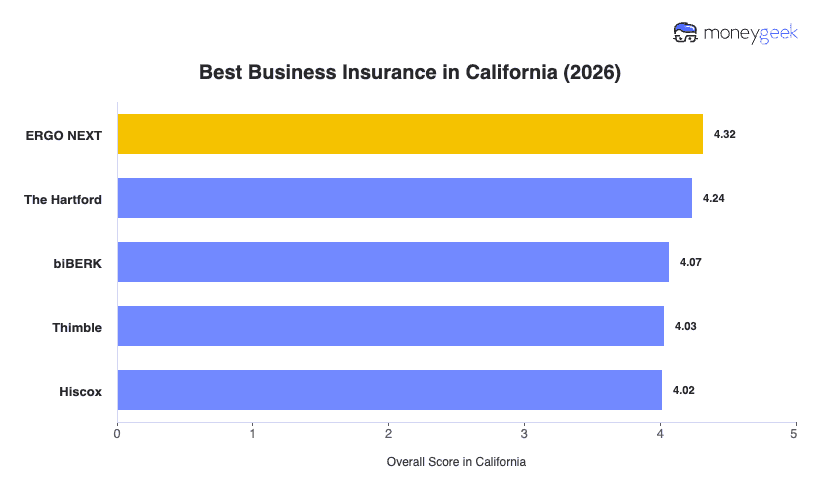
For most California businesses, the right move is to compare the top-rated insurers before anything else. In a state this expensive for business insurance, a carrier that prices fairly and actually pays claims is worth more than the lowest quote, so a vetted shortlist keeps you from shopping blind. If you're not ready to compare carriers yet, find your situation below.

Recommended: Compare Providers Before You Buy

Rates for the same coverage can vary by hundreds of dollars a year between carriers, and the cheapest one depends on your industry and size. A ranked shortlist narrows the field to carriers worth quoting so you're not shopping blind.

If You Want to Learn About Coverage Types

If You're Buying Your First Policy

If You're Working Under a Contract or Lease

If You Want to Lower Your Costs

If Your Business Is Growing or Changing

About Connor Bolton


Connor Bolton, Senior SEO and Content Manager (Business & Pet), MoneyGeek

Connor Bolton is Senior SEO and Content Manager at MoneyGeek, where he leads the business and pet insurance editorial teams. He sets the research framework, data standards and content structure for his team. All content goes through his accuracy review before publication. Connor also writes in-depth guides and has spent more than four years covering insurance products across personal, commercial and specialty lines.

The research infrastructure Connor built covers auto, home, renters, life, health, business and pet insurance across pricing analysis, carrier research, customer experience and coverage evaluation. It includes over 6 million data points for business insurance across 408 industry areas, all 50 states and 16 vehicle types. The pet insurance side covers over 5 million profiles across 18 major providers, 100+ breeds and ages up to 20 years. Connor’s insurance research and his team's work has been cited by the U.S. Chamber of Commerce, Allstate, Liberty Mutual, CBS News, Forbes and LegalZoom.

Connor also talks with underwriters and carrier liaisons at Ethos, The Hartford, ERGO NEXT, Nationwide and State Farm, and monitors business and pet owner communities on Reddit. Those sources shape how his team evaluates carriers, structures rate analysis and writes for human buyers rather than search engines.

For questions about MoneyGeek's business and pet insurance content, contact him at connor@moneygeek.com or on LinkedIn.