Key Takeaways
blueCheck icon

MoneyGeek's analysis ranks ERGO NEXT, The Hartford and Hiscox as the top three daycare insurance companies, with rates for your operation starting at $92 per month. (Jump to Top Providers)

blueCheck icon

Your daycare likely needs general liability, abuse and molestation coverage, workers' comp and professional liability to cover child injury claims, staff conduct risks and medication or care plan errors. (Jump to Types You Need)

blueCheck icon

Daycare business insurance costs range from $30 to $185 per month across the coverage types your operation may need. (Jump to Costs)

blueCheck icon

The right daycare policy starts with matching coverage to your actual risks, setting limits that reflect your enrollment and licensing obligations, and choosing a provider who can grow with your operation. (Jump to Choosing Process)

Best Daycare Business Insurance Companies

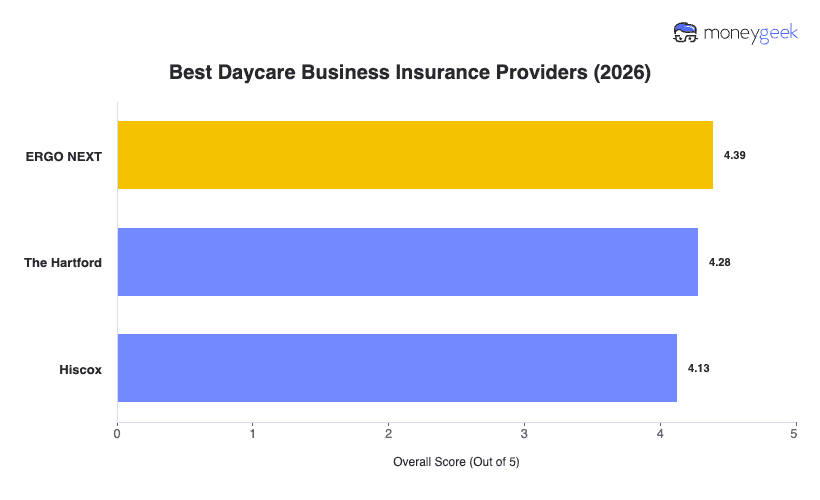
ERGO NEXT tops our rankings by leading both affordability and customer experience, which makes it the stronger fit for home-based providers and small centers where keeping costs manageable and getting claims handled quickly are the priorities. The Hartford ranks second overall but leads on coverage depth, a better match for licensed centers needing stronger abuse and molestation protection or higher general liability limits to satisfy a landlord or licensing agency.

Your best option depends on which of those pillars matters most for your operation, and the full rankings below break that down.

ERGO NEXT4.39$9213
The Hartford4.28$11331
Hiscox4.13$10126
Nationwide4.10$11862
biBERK4.01$11875
Thimble4.00$11557
Progressive Commercial3.95$11444

For our overall best daycare business insurance ratings, we analyzed pricing, coverage options, and customer experience across all 50 states and Washington, D.C. Our analysis focuses on 1-to-4-person daycare businesses, while weighting results to ensure broader industry and location representation. To do this, we evaluated over six million business profiles, more than 100,000 customer experience data points and performed in-depth analysis of coverage contracts and endorsements to compare insurers consistently across industries and regions. We then rated each company across categories of affordability (50% of overall score), customer experience (30% of overall score) and coverage options and terms (20% of overall score) to form an overall rating.

See our full business insurance methodology.

These rankings are a starting point, not a universal answer. A home-based provider caring for four children and a licensed center with 12 staff share the same core coverage needs (general liability, abuse and molestation, workers' comp and professional liability), but the right provider for each differs. For the home-based operator watching costs carefully, ERGO NEXT's combination of lower rates and top customer experience scores is the stronger fit. The Hartford's lead on coverage depth better serves the center director whose policy needs to satisfy a state licensing agency's GL minimums or a landlord's additional insured requirements.

Each provider profile below breaks down exactly which daycare operators they fit best and where their coverage or pricing falls short.

ERGO NEXT
Best Overall for Daycare Centers

ERGO NEXT

On ERGO NEXT's site

ERGO NEXT earns the top spot among daycare insurers, leading on both affordability and customer experience. Your premiums average 22% below the sub-industry rate, and that gap widens as your staff grows, with centers in the 20 to 49 employee range saving an average of $1,687 per year. The fully online process lets you quote, bind and get a certificate of insurance in under 10 minutes, and the platform covers both daycare centers and in-home providers. Bundling two or more policies saves up to 25%. Claims handling is a weaker area, and post-purchase support can be harder to reach than the buying experience suggests.

Learn More: ERGO NEXT Business Insurance Review

The Hartford
Best Coverage for Daycare Centers

The Hartford

On The Hartford's site

The Hartford ranks second overall among daycare insurers, with its coverage pillar as the clearest reason it belongs on this list. Your coverage ranks first across all 51 states and DC, the most consistent signal in the dataset. The overall savings against the industry average is just 3%, or $45 per year, so this isn't where you go to find the lowest price, but what sets The Hartford apart is the breadth of what it covers and how it handles claims when you need them most. The buying process runs through a partner marketplace rather than directly through The Hartford, which adds steps if your licensing agency or landlord needs proof of coverage on a tight timeline.

Learn More: The Hartford Business Insurance Review

What Types of Insurance Do Daycare Centers Need?

Running a daycare means carrying liability exposure across every part of the operation: the children in your care, the facility you maintain, the staff working directly with those children and every judgment call you make about a child's individual needs. No single policy covers all of it. The coverage types most daycare operators need reflect how the business actually runs, from state-mandated minimums to exposures that standard policies exclude entirely.

  • General liability (since every licensed daycare faces on-premises child injury and visitor claims, and most state licensing agencies require this coverage as a condition of licensure)
  • Abuse and molestation (since standard general liability policies exclude these claims and most state licensing agencies require separate coverage as a condition of licensure)
  • Workers' comp (since most states require it the moment you hire any paid staff, and state-mandated staff-to-child ratios mean most centers reach that threshold quickly)
  • Professional liability (since care decisions like administering medication, following a child's individualized care plan or fulfilling mandatory reporter obligations create negligence exposure that general liability doesn't cover)
  • Commercial property (since your facility holds equipment, playground infrastructure and licensed space modifications that a standard homeowners or office policy doesn't adequately cover)
  • Commercial auto (if your operation owns or leases vehicles to transport children to and from the facility or on field trips)
  • Hired and non-owned auto (if staff drive personal vehicles for work errands or you rent vehicles for occasional field trips)
  • Cyber liability (if your operation stores children's medical records, allergy documentation or custody orders in digital systems)
  • Employment practices liability (if your staff count has reached the level where wage disputes, discrimination claims or wrongful termination allegations are a realistic exposure)

We see coverage needs concentrate quickly in daycare, even at small headcounts, because state licensing creates mandatory minimums from day one and certain exposures like abuse and molestation claims exist regardless of how many children you serve. What changes as your operation grows is less about which coverage types you need and more about how much coverage you need and which gaps have become real enough to matter. Your staff count is usually what drives that shift.

How Much Does Daycare Business Insurance Cost?

Daycare business insurance costs an average of $116 per month or $1,386 per year, with commercial auto and professional liability as the highest-cost individual coverage types. Commercial auto runs high because transporting children creates passenger liability exposure for your operation, while professional liability reflects the range of professional duties you carry as a daycare operator, from administering medication to fulfilling mandatory reporting obligations. General liability is where your daycare coverage starts, because state licensing agencies require it in most states before you can legally operate. 

We see costs vary by operation type: a home-based provider carrying GL only pays $154 per month, while a licensed center adding workers' comp, professional liability and commercial property pays $399 per month. Your coverage mix determines where in that range your monthly cost lands:

How did we determine business insurance rates for daycare centers?

What your daycare pays depends on more than the coverage type alone. Your total headcount, whether you operate a home-based or licensed facility and whether you run a transportation program all shift your premium in ways the industry averages don't reflect. A daycare business insurance calculator gives you a more precise estimate built around your operation's specific profile.

Estimate Your Monthly Daycare Insurance Cost

Enter your coverage type, state, number of employees and type of vehicle (if you need commercial auto coverage) to get a pricing estimate that fits your business.

We do not collect any personal information, and all rates are aggregated for all 50 states and Washington D.C. Workers' comp rate estimates are provided on a per employee basis and all coverage types assume standard industry limit recommendations for most businesses.

Select Coverage Type
Select State
Select Employee Cand
Select Vehicle Type
Average Monthly Cost—

How to Choose the Right Daycare Business Insurance

Choosing the right insurance for your daycare is a process, not a one-time decision. We see daycare operators most exposed when they buy general liability and stop there, not realizing that abuse and molestation, professional liability and workers' comp gaps exist. Getting business insurance right for your daycare requires matching every coverage type to the specific risks your operation carries.

  1. 1
    Understand your risk profile and what coverage it requires

    Your daycare carries three layers of coverage need: legally mandated, contractually required and practically essential. Your state licensing agency requires general liability before you can operate, and your landlord or a corporate client may require higher limits or an additional insured endorsement. Abuse and molestation coverage and professional liability don't fall into either category, but your largest exposures go uninsured without them. Knowing which bucket your coverage falls into is where the process starts.

  2. 2
    Choose the right coverage limits

    Your limits should reflect the most expensive claim you could face, not the minimum your licensing agency requires. For your daycare, that worst case is usually an abuse or molestation allegation involving multiple children, where legal costs alone can exhaust a $1,000,000 primary policy before settlement. If you transport children, a van accident generates simultaneous bodily injury claims from multiple families against the per-vehicle limit. Set your limits around those scenarios, not your licensing minimum.

  3. 3
    Evaluate providers who understand daycare centers

    Not every insurer you approach will write abuse and molestation coverage, and not every provider that does understands daycare licensing requirements. As you evaluate providers, look for A&M coverage included in their daycare program, demonstrated experience with childcare licensing and strong claims handling for child-related incidents. If you choose a lower-cost provider who excludes or undervalues abuse and molestation coverage, your most catastrophic claim type ends up without a policy response.

  4. 4
    Get compliance-ready

    Buying your policy is only the beginning of the compliance picture. Your state licensing agency needs proof of your GL limits before issuing or renewing your license, and your landlord will require your GL policy to name them as an additional insured before your facility opens. If you accept government child care subsidies, the program adds its own proof-of-coverage requirement. Have all of this ready before you open or sign a contract.

  5. 5
    Revisit your coverage as your daycare center grows

    Your coverage needs change whenever your operation does. Hiring your first employee activates workers' comp obligations, and moving from a home-based setup to a licensed facility shifts your property coverage, GL limits and lease requirements simultaneously. Starting a transportation program or signing a Head Start or corporate child care contract each brings exposures your current policy may not address. Review your coverage at least annually and before any of these changes take effect.

Get Daycare Business Insurance Quotes

Daycare business insurance pricing varies by insurer, and the right provider for one operation often isn't right for yours. A home-based solo caregiver needs affordable general liability and abuse and molestation coverage from a carrier who understands your specific setup. For a licensed center with staff and a transportation program, your priorities are coverage depth, strong claims handling for child-related incidents and limits that satisfy enterprise contracts. Request business insurance quotes to compare providers matched to your specific daycare profile.

About Connor Bolton


Connor Bolton, Senior SEO and Content Manager (Business & Pet), MoneyGeek

Connor Bolton is Senior SEO and Content Manager at MoneyGeek, where he leads the business and pet insurance editorial teams. As editorial lead for both verticals, Connor sets the research framework, data standards, and content structure that his writers execute, directly authoring in-depth guides himself and reviewing all team content for accuracy and practical value before it goes live. With over four years evaluating insurance products across personal, commercial, and specialty lines, he brings cross-vertical knowledge to every guide the team produces.

Connor architected MoneyGeek's insurance research infrastructure across all major verticals including auto, home, renters, life, health, business, and pet, building systems for pricing analysis, provider-level research, customer experience evaluation, and coverage analysis with AI support. The infrastructure includes over 6 million data points for business insurance across 408 industry areas, all 50 states, and 16 vehicle types, and over 5 million pet insurance profiles across 18 major providers and hundreds of breed and age combinations. Connor's insurance cost research and his team's work has been cited by the U.S. Chamber of Commerce, Allstate, Liberty Mutual, CBS News, Forbes and LegalZoom.

Beyond the data, Connor stays connected to how the market actually operates, drawing on direct conversations with underwriters and carrier liaisons at Ethos, The Hartford, NEXT Insurance, Nationwide, and State Farm, and monitoring business and pet owner communities including Reddit, to inform how he interprets findings and frames guidance for real buyers.

He is the direct editorial contact for methodology questions at connor@moneygeek.com and can be found on LinkedIn.