


Jump to the section that meets your needs best below:
Average Daycare Center Insurance Cost (2026 Report)
Daycare centers spend an average of $487 to $1,404 per month depending on the insurance bundle that addresses your coverage needs.
If you want pricing now, MoneyGeek can match you to the insurer that meets your daycare center's coverage needs.
Select state
Updated: September 14, 2026
Advertising & Editorial Disclosure
How Much Does Daycare Center Insurance Cost?
Childcare insurance costs for daycare centers average $1,042 per month for a recommended bundle. This mix includes liability coverage, commercial property, workers’ comp and more specialized policies such as abuse and molestation liability and accident medical insurance. While this is what I'd recommend for most centers, your total will still depend on which policies you include.
This bundle covers common daycare risks, such as a child getting hurt or a parent claiming your staff failed to provide proper care. However, insurance shouldn't put too much strain on your cash flow. If the full bundle feels too expensive, you can start with the starting version, then add coverage as your business grows.
Starting Bundle | Business Owner's Policy (BOP) + professional liability + workers’ comp | $487 | Newly opened or small daycare centers operating from a commercial location |
Recommended Bundle | Starting bundle + abuse and molestation liability + accident medical insurance | $1,042 | Daycare centers that want protection for child injuries and serious care-related allegations |
Growing Bundle | Recommended bundle + cyber insurance + employment practices liability | $1,156 | Staffed daycare centers that manage enrollment and family records online |
Comprehensive Bundle | Growing bundle + commercial auto + commercial umbrella | $1,404 | Larger daycare centers that transport children and need higher liability limits |
Daycare insurance costs depend on more than the size of your business. Insurers also consider the ages of the children in your care, how your staff supervise them, whether you provide transportation, the type of facility you operate and the policies needed to protect it. We built our estimates around these common daycare needs using modeled premiums from 10 major U.S. commercial insurers.
- National benchmark average: We used daycare profiles with fewer than five employees to create monthly and annual cost benchmarks. The modeled businesses reflect common coverage needs, including general liability, professional liability, commercial property, business income and abuse and molestation coverage.
- State averages: We kept the daycare profile the same and changed only its location to show how state pricing affects costs. For specialized coverages outside our main dataset, we started with the national cost estimate and applied a state-level pricing factor. We then combined those modeled amounts with the state costs from our dataset to calculate each bundle total.
- Bundle averages: We grouped policies around common daycare setups, from a small program needing basic liability coverage to a larger center with employees, a dedicated facility, digital records and child transportation. When a bundle included a policy outside our dataset, we used outside cost estimates and added it only where that coverage fit the daycare profile.
These figures are modeled estimates, not live quotes. Use them to plan your budget and compare options, then consider how your staffing, services, location and coverage choices may change your actual cost.
See our full business insurance methodology.
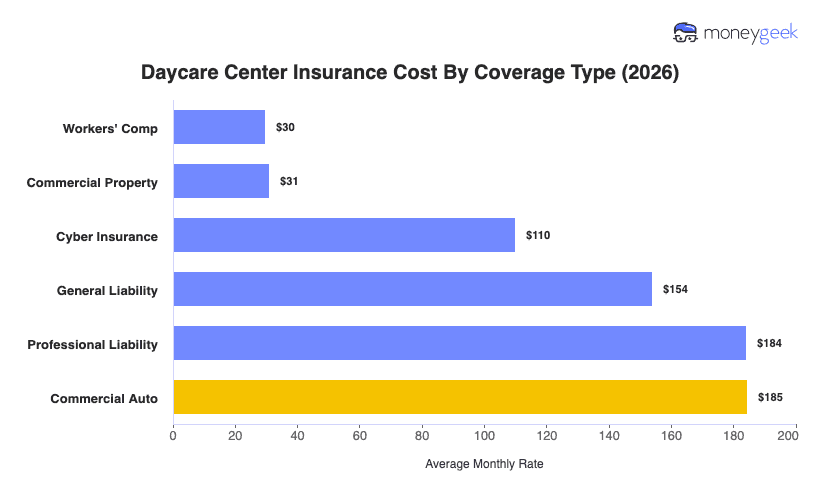
Average Daycare Insurance Costs By Coverage Type
The bundles above show how several policies work together, but each coverage type adds something different to your total cost. I've broken down what each one covers, how much it costs and when it becomes relevant to your daycare. You'll also find specialized policies outside the common coverages that are still important for risks such as child injuries, abuse allegations, employee claims and temporary closures.
Get Daycare Center Insurance Cost Estimates
If you want a more personalized estimate, use our business insurance cost calculator before comparing rates.
Get Daycare Center Insurance Cost Estimates
Select Coverage Type
Select State
Select Employee Count
Select vehicle_type
Monthly Rate Estimate—
Select Coverage Type
Monthly Rate Estimate—
Select State
Select Employee Count
Select vehicle_type
Factors Affecting Daycare Center Insurance Costs
Two daycare centers can be similar in size, location and coverage but still pay different rates because one transports children, while the other one cares for infants or gives medication. These daycare-specific factors helps you see which parts of your business are most likely to change your rate.
 Staff Duties and Supervision Practices
Insurers look at how you and your team watch children and divide responsibilities. They'll also consider how you handle busy periods such as pickup, meals and outdoor play. Strong supervision reduces the chance of injuries or a child leaving unnoticed, so adding a second staff member during playground time could help lower your rate.
 Age Groups Served
The ages you care for affect how much hands-on help and supervision children need. Infants and toddlers need more support with feeding, movement and daily routines, while school-age children are generally more independent. Your rate may increase if you add infant care to a school-age program because younger children need closer supervision and have a higher chance of injury during everyday care.
 Transportation Services
Driving children adds risks that don't exist when families handle drop-off and pickup. Insurers look at who drives, how often vehicles are used and how far children travel. Your rate may rise if you expand from occasional field trips to daily school routes because the vehicle spends more time on the road and carries children more often.
 Activities and Amenities
What children do during the day and the equipment they use can also affect your premium. Pools and large playground structures can make injuries more likely or more serious. Replacing an old climbing structure with safer, age-appropriate equipment and keeping inspection records may help lower your rate. Adding swimming activities will usually raise your rate.
 Medication and Specialized Care
Expect your rate to increase when you begin providing daily medication or managing ongoing health needs. Giving children prescription medication, using EpiPens or inhalers, or supporting conditions such as diabetes and seizure disorders can create more chances for dosing errors, missed symptoms or delayed treatment. Stronger controls reduce those risks, so insurers look at whether staff are trained and follow written procedures.
How to Lower Daycare Center Insurance Costs
Daycare center insurance costs can add up quickly, especially as your business grows. I've laid out practical strategies to get more affordable business insurance rates without leaving your center underinsured.
 Compare quotes using the same coverage limits
Ask each insurer to price the same policies, limits and deductibles. A cheaper quote could cover less or leave out coverages such as abuse and molestation liability. Giving insurers matching details lets you see which insurer really offers a better price when you compare business insurance quotes.
 Right-size your coverage
Review whether your coverage still fits your enrollment, payroll, property and transportation needs. You may be paying for more than you need or using old amounts that no longer match your operations. Make careful changes rather than removing protection tied to your main risks.
 Bundle policies with the same provider
You could get a discount by buying several policies from one insurer, such as general liability, commercial property and business income coverage. Bundling can also make payments, renewals and policy changes easier. Compare the package price with separate policies to make sure you are not giving up useful financial protection.
 Lower your risk profile
You don't have to stop offering infant care, transportation service or field trips to lower your risk. Instead, focus on how you manage them. Better staffing, driver checks, clear medication procedures and safer activity planning can lower the chance of a costly claim. In turn, that could you get better renewal options.
 Invest in risk management practices
Daycare claims often involve injuries, supervision problems, vehicle accidents and medication mistakes. Consistent safety practices prevent these incidents and show insurers that you're proactively taking steps to manage them. If you're thinking of strengthening your safety practices, I recommend starting with these:
- Add extra supervision during playground time, pickup and classroom transitions. That's when your staff's attention is most likely divided.
- Check driving records and document vehicle maintenance before employees transport children for school routes or field trips.
- Train specific staff members to give medication. When you do, record each dose to avoid missed, late or incorrect medication.
- Inspect playground equipment, gates and classroom furniture regularly, then keep records of repairs before worn items cause injuries.
Daycare Center Insurance Cost: Bottom Line
A recommended daycare insurance bundle costs an average of $1,042 per month, but your actual cost depends on the policies your center needs. A small program without employees or transportation will usually need less coverage than a center with staff, its own facility, infant care or a transport program.
Use these three questions to review your quote and put it in context:
- Does the bundle include the right policies? Check whether it covers the way your daycare runs. A lower price may leave out commercial property, accident medical, abuse and molestation coverage or another policy your center needs.
- Which policy is adding the most to the total? Look at the price of each policy instead of focusing only on the full bundle cost. This can help you see whether one policy, your location or part of your daily operations is making the quote more expensive.
- Are you comparing quotes with the same details? Make sure each insurer is pricing the same policies, limits and deductibles. One quote may look cheaper simply because it covers less or requires you to pay more after a claim.
The goal isn't to match the estimates on this page. Instead, focus on choosing or building a bundle that fits your daycare without paying for coverage you do not need.
About Angelique Palenzuela-Cruz

Angelique Palenzuela-Cruz is a Business Insurance Content Writer at MoneyGeek, where she specializes in general liability, workers’ compensation and professional liability insurance. Her work helps small business owners understand how these policies apply to coverage, including risks like customer injuries, employee injuries, professional mistakes, client contract terms and industry-specific coverage requirements.
She primarily covers service-based businesses where liability and employee coverage decisions are especially important, including cleaning, consulting, beauty and wellness, childcare, education, fitness, food service, pet care, repair and maintenance, and other professional services.
Before joining MoneyGeek, Angelique spent nearly 12 years at Guthrie-Jensen Consultants, one of Southeast Asia’s largest management training firms, where she advanced from Training Consultant to Managing Consultant. In that role, she worked with business clients to assess operational needs, develop training programs and present performance analyses to executive decision-makers. She also helped establish Gladwin Training Consultancy, where she served in learning solutions and client service roles.
Her background gives her practical context for writing about how businesses operate, manage client expectations, structure teams and make risk decisions. At MoneyGeek, she applies that experience to business insurance content, connecting coverage to actual business needs.
LinkedIn: linkedin.com/in/ma-angela-cruz
Email Contact: angelique.palenzuela@moneygeek.com
Sources
- Illinois General Assembly. ". Illinois Vehicle Code, Section 12-707.01: Liability Insurance." Accessed October 13, 2026.
- Washington State Legislature. "WAC 110-145-3160: Transportation." Accessed October 13, 2026.