Best Business Insurance Companies For Bounce House

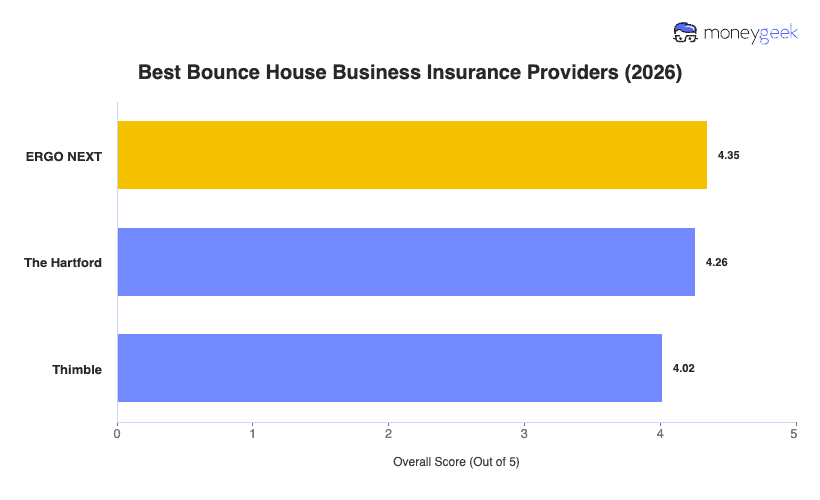
My analysis ranked these companies as the best small business insurers for bounce house rental businesses:

  • Choose if you want the lowest rates and fast COI turnaround: ERGO NEXT
  • Choose if you need broad coverage limits and inland marine protection: The Hartford
  • Choose if you run seasonal event rentals and want on-demand flexibility: Thimble

Bounce house insurance touches more risk categories than most small business coverage, since your operation combines child injury exposure, equipment transport and venue contract requirements in every single rental. I scored each provider across affordability (50%), customer experience (30%) and coverage options (20%), weighted that way because premium cost determines what a seasonal or early-stage operator can sustain, but a cheap policy that doesn't respond to an injury claim at a school event is worse than no policy at all.

This is what made up my analysis of popular insurers, which was assisted (not run) by AI:

  • Affordability: I pulled quotes isolating pricing factors across retail and product rental sub-industries, all 50 states (plus DC), employee count (5 ranges from 0 to 49), 16 vehicle types (for commercial auto) and six of the most common coverage types, extrapolating 500,000+ estimates to build a full pricing picture for inflatable rental businesses specifically.
  • Customer Experience: 300,000+ reviews, forum conversations and industry research were aggregated and manually parsed to identify the patterns that made customers enjoy and dislike service from each insurer. I also went through what an actual bounce house business owner would go through for all providers analyzed, testing their quoting experiences and policy management tools (excluding claims due to limitations).
  • Coverage Options: I read the fine print of policy terms, isolated the exclusions and hidden costs that affect inflatable rental businesses (like amusement device carve-outs, participant injury sublimits and wind event restrictions), and documented every option available for all providers to determine which has the best coverage for your operation now and as your fleet grows.
ERGO NEXT

ERGO NEXT: Best Overall for Bounce House Operators

On ERGO NEXT's site
checkmarkpros
  • Lowest average monthly cost in the dataset

  • Instant COI and additional insured generation

  • Ranks first on customer experience

closecons
  • Coverage limits fall short for larger contracts

  • Commercial auto runs through a partner carrier

  • Claims handling ranks below most competitors

COMPANY HIGHLIGHTS

I recommend ERGO NEXT for most bounce house rental operators because it pairs the lowest average cost in this study with the fastest digital tools for managing venue and school requirements. At $107 per month, it runs 23% below the sub-industry average, and that gap holds across operator sizes. Its app lets you generate certificates, add additional insureds and share updated proof of insurance at any hour, which matters when a school district calls Friday afternoon needing a COI for Monday's field day.

Where ERGO NEXT falls short is coverage depth. If your contracts require limits above $1 million per occurrence or $2 million aggregate, you will need to look elsewhere. Commercial auto also runs through a partner carrier rather than directly through ERGO NEXT, which means coordinating between two separate insurers if a delivery accident involves both vehicle damage and a third-party injury at the same time.

Read Our Review: ERGO NEXT Business Insurance Review

The Hartford

The Hartford: Best for Coverage Depth and Inland Marine

On The Hartford's site
checkmarkpros
  • Ranks first on coverage nationally for this industry

  • Dedicated inland marine for inflatables in transit

  • Strongest claims defense and loss prevention resources

closecons
  • Higher average cost at $151 per month

  • Quoting often requires a phone call

  • Digital self-service portal trails competitors

COMPANY HIGHLIGHTS

The Hartford's equipment and party rental specialty includes inland marine underwriting built around how inflatable businesses actually operate, covering your units on the trailer, at the venue and in storage rather than only at a fixed business address. That distinction matters because standard commercial property leaves your most expensive assets unprotected the moment they leave your facility, which for most bounce house operators is every working day.

The tradeoff is cost and speed. At $151 per month, The Hartford runs 9% above the sub-industry average, and getting a quote often means a phone call rather than completing the process digitally. If you manage your policy between setups on a Saturday morning, the online experience will slow you down compared to carriers that let you handle everything from an app. For operators whose priority is coverage that actually responds when a serious claim hits, that friction may be worth absorbing.

Read Our Review: The Hartford Business Insurance Review

Thimble

Thimble: Best for Flexible and On-Demand Event Coverage

checkmarkpros
  • Hourly, daily and monthly coverage options

  • Quote to bound policy in under 60 seconds

  • Instant COI generation with unlimited certificates

closecons
  • Standard policies exclude inflatable and amusement operators

  • No commercial auto offering

  • Support is email-only with no phone option

COMPANY HIGHLIGHTS

Thimble scores well in this study on affordability and customer experience because its on-demand model and digital speed outperform most carriers on those metrics across the broader retail and rental category. At $128 per month, it sits 9% below the sub-industry average, and no other provider in this dataset matches its flexible purchasing structure. You can bind coverage by the hour, the day or the month, which is a genuine advantage for operators who work seasonally or pick up one-off event gigs alongside a primary business.

The limitation that bounce house operators need to understand before purchasing is significant. Thimble's standard general liability application requires you to attest that you do not operate amusement devices, inflatables or bounce houses. If your business is primarily inflatable rentals, Thimble's GL policy will not cover that work. Operators running a mixed event rental business where inflatables are a secondary line alongside tables, chairs and tent rentals should confirm directly with Thimble whether their specific operation qualifies before binding a policy.

Read Our Review: Thimble Business Insurance Review

What Types of Insurance Do Bounce House Need?

Bounce house operations carry a risk profile that standard small business coverage wasn't designed for. Your inflatables are used by children, transported to a different location for every job, and set up on surfaces you don't control. Most standard commercial general liability policies contain explicit exclusions for amusement devices, which means the first coverage decision isn't just which policy to buy but whether the carrier will even write your business. General liability built for inflatable operations is where every operator starts. Commercial auto follows immediately, since your personal auto policy stops covering you the moment your vehicle is used for business deliveries. And inland marine fills the gap that commercial property leaves wide open: your equipment spends most of its life in transit or at event sites, not at a fixed address.

The table below summarizes the most common types of business insurance that bounce house rental businesses need to meet requirements and cover financial risks.

Third-party bodily injury and property damage claims arising from your inflatable rentals, including children injured inside a unit and damage to a client's property during setup or teardown
Every bounce house operator needs this before taking a single booking, and most venues require proof of coverage before allowing you on-site

The CPSC estimates over 18,000 inflatable-related emergency room visits annually in the U.S., and average liability claims in the commercial inflatable space range from $10,000 to over $100,000.

Liability and physical damage coverage for vehicles used to transport inflatables to events, including trucks, cargo vans and trailers
The moment you use any vehicle to deliver equipment to a rental, since personal auto policies exclude business use
Every rental puts a loaded vehicle on the road, and a single accident involving a box truck towing inflatables can generate claims that exceed personal auto limits before the first family files.
Inland marine
Covers your inflatables, blowers and generators against theft, damage and loss while in transit, at event sites and in storage
As soon as you own equipment that travels to job sites, since standard commercial property only covers items at a fixed business address
A single commercial-grade bounce house costs $3,000 to $8,000 to replace, and most operators carry several units. One theft from a trailer or one wind event at a venue can wipe out tens of thousands in inventory that commercial property will not cover.
Medical bills, lost wages and rehabilitation for employees injured on the job, including back strains from lifting inflatables and heat-related illness during summer setups
When you hire your first employee, including part-time or seasonal setup crew, as most states require it at your first hire

Setup crews lift 200- to 400-pound inflatables in summer heat at multiple events per day. A peer-reviewed study using CPSC data found roughly 160,000 inflatable-related ER visits over 20 years, and your crew faces physical exposure at every one of those setups.

Extra liability protection above your general liability and commercial auto limits when a claim exceeds your base policy
When schools, municipalities or festival organizers require limits above $1 million per occurrence in their vendor contracts
A wind event that injures multiple children at one setup can generate claims from several families against the same per-occurrence limit simultaneously. Institutional clients require $2 million to $5 million in total coverage for this exact reason.
Covers your storage facility, warehouse contents, workstations and equipment kept at a fixed location against fire, theft and other covered events
If you operate from a dedicated storage facility, warehouse or commercial space
A fire or break-in at your storage facility that destroys your fleet is a different category of loss than a single unit stolen from a trailer. At 10 or more units, your stored inventory alone can exceed $50,000 in replacement value.
Costs from data breaches, ransomware and regulatory penalties when customer booking records, payment data or signed waivers are compromised
If you store client payment information, signed liability waivers or booking records digitally
Bounce house operators collect names, addresses, payment details and signed waivers for every rental. A breach that exposes that data creates notification obligations and potential liability that your general liability policy will not address.
mglogo icon

WHY GETTING BOUNCE HOUSE INSURANCE IS IMPORTANT

The math on bounce house insurance is straightforward when you put a claim next to a premium. General liability for an inflatable rental operation averages $75 per month, or about $904 per year. A single child injury claim at a birthday party or school event routinely reaches $10,000 to $100,000 in settlement and legal defense costs. Researchers at Nationwide Children's Hospital found that more than 30 children are treated in emergency rooms for inflatable-related injuries every day in the U.S., roughly one every 45 minutes. One uninsured claim from a single weekend event can exceed what a decade of premiums would have cost.

How Much Does Bounce House Business Insurance Cost?

Bounce house insurance costs average $138 per month, or $1,662 per year, across five coverage types for a small operation with one to four employees. Commercial property is the most expensive at $204 per month because of the replacement cost of stored inflatable inventory, while cyber insurance is the least at $54 per month. What you actually pay depends on your fleet size, the mix of residential versus commercial events you book and whether you run company vehicles or tow with personal trucks.

Here's an overview of costs for common coverage types:

What Are These Costs Based On?

Our business insurance calculator below can give you a more tailored estimate based on your operation's details. It also connects you directly with a provider match when you're ready to get quotes.

Bounce House Insurance Cost Calculator
Select Coverage Type
Select Employee Count
Select Vehicle Type
Select State
Average Monthly Cost—

How To Buy The Best Bounce House Business Insurance

I've laid out the buying process below step by step. If you want something to work through while gathering quotes, download the bounce house business insurance buying worksheet to keep your coverage details organized across providers.

  1. 1

    Identify Required Coverages

    Start with the venues and clients you already serve. Schools, municipal parks and corporate event organizers each publish insurance requirements in their vendor agreements, and those requirements are where most bounce house operators first learn what coverage they need. If a venue requires additional insured status, that must be added to your policy as an endorsement through your carrier. Handing them a certificate of insurance (COI) proves your coverage exists, but it does not extend your protection to the venue. If your state classifies commercial inflatables as amusement rides, check whether your licensing board imposes separate insurance minimums or inspection requirements on top of what your clients ask for.

    Read More: Business Insurance Requirements

  2. 2

    Map Your Operation's Risks to Coverage

    Walk through a full rental cycle and test which policy would actually pay at each stage. Your crew loads a 350-pound obstacle course onto a trailer and drives 40 minutes to a school. On the way, another driver rear-ends your truck. Your personal auto policy won't touch it because the vehicle was being used for business. A commercial auto policy with a hired and non-owned endorsement would. Run that exercise for every phase of your operation, from a wind gust that lifts an improperly staked unit at a public park to a blower cord that trips a parent at a backyard party, and flag every scenario without a clear policy match.

  3. 3

    Set Limits Based on Your Worst Realistic Event

    Your limits should reflect the most expensive claim your operation could realistically face, not the minimum a venue will accept. For a bounce house business, that scenario is a wind event at a crowded school field day or festival that injures multiple children from a single unit failure. Several families filing against the same per-occurrence limit simultaneously can exhaust a $1 million policy before all claimants are settled. If your client mix includes institutional bookings, size your general liability and umbrella to reach the $2 million to $5 million total those contracts typically specify.

    Read More: How Much Business Insurance Do I Need?

  4. 4

    Vet Providers Who Actually Cover Inflatable Rentals

    Not every insurer writes coverage for bounce house operations. Many standard commercial general liability policies contain explicit exclusions for amusement devices, and some digital-first carriers require you to attest during the application that you do not operate inflatables. Before requesting quotes, confirm that each provider on your list actually covers inflatable rental businesses, writes inland marine for equipment in transit and can issue the endorsement language your venue contracts require.

  5. 5

    Get Quotes With Identical Terms

    Look up what bounce house insurance typically costs for your fleet size and event mix so you have a reference point before you start quoting. Then request quotes using the same limits, deductibles and endorsements from every provider. A policy that costs less per month but carries a higher deductible on equipment claims or excludes wind damage to inflatables at event sites is not a real savings.

  6. 6

    Verify Your Policy Before Your First Event

    Read the policy document against your venue and client requirements before you accept it. Confirm that your general liability covers participant injuries inside the inflatables specifically, not just bystander injuries, since some policies treat participants differently. Check that your inland marine limits match your current fleet's replacement value rather than what you owned when you first purchased the policy. Make sure the named insured matches your business's legal name exactly, because a mismatch on a COI can hold up a booking with a school district or park.

  7. 7

    Reassess Coverage Every Season and After Every Major Change

    Adding a water slide to your fleet shifts your inland marine limits. Hiring your first setup helper triggers workers' comp obligations in most states. Landing your first school district or county fair contract raises the general liability thresholds you need to carry. Review your coverage at the start of every rental season and any time your fleet, headcount or client base changes in a way that moves your risk profile, rather than discovering at renewal that your policy no longer matches how your business actually operates.

Bounce House Insurance: FAQ

Beyond what this guide covers, I've answered the most common remaining questions bounce house operators have before purchasing business insurance.

Best Bounce House Business Insurance: The Bottom Line

Your inflatable rental operation stacks risk in ways most small businesses never deal with. Children are the primary users of your product, your equipment travels to a different location for every job, and the venues you work at require proof of coverage before you can set foot on their property. Two policies at similar premiums can look interchangeable until you realize one excludes participant injuries inside the inflatable, caps wind damage claims or requires an amusement device attestation that disqualifies your business entirely. Those details don't surface until you file a claim or lose a contract.

The right policy covers the work you actually perform, at limits that reflect a multi-family injury scenario rather than a single incident, from a carrier that writes inflatable rental businesses without carve-outs that gut your coverage when it matters most. To help you shop around, these are my top picks overall for bounce house rental businesses.

Best Bounce House Business Insurance Chart

Get Bounce House Business Insurance Quotes

Use our matching tool below to find providers that fit your inflatable rental business. From there, you can get quotes and compare coverage directly on their site.

About Angelique Palenzuela-Cruz


Angelique Palenzuela-Cruz, Business Insurance Writer, MoneyGeek

Angelique Palenzuela-Cruz is a Business Insurance Content Writer at MoneyGeek, where she specializes in general liability, workers’ compensation and professional liability insurance. Her work helps small business owners understand how these policies apply to coverage, including risks like customer injuries, employee injuries, professional mistakes, client contract terms and industry-specific coverage requirements.
She primarily covers service-based businesses where liability and employee coverage decisions are especially important, including cleaning, consulting, beauty and wellness, childcare, education, fitness, food service, pet care, repair and maintenance, and other professional services.
Before joining MoneyGeek, Angelique spent nearly 12 years at Guthrie-Jensen Consultants, one of Southeast Asia’s largest management training firms, where she advanced from Training Consultant to Managing Consultant. In that role, she worked with business clients to assess operational needs, develop training programs and present performance analyses to executive decision-makers. She also helped establish Gladwin Training Consultancy, where she served in learning solutions and client service roles.
Her background gives her practical context for writing about how businesses operate, manage client expectations, structure teams and make risk decisions. At MoneyGeek, she applies that experience to business insurance content, connecting coverage to actual business needs.

LinkedIn: linkedin.com/in/ma-angela-cruz

Email Contact: angelique.palenzuela@moneygeek.com


Sources