



Jump to the section that meets your needs best below:
Average Auto Repair Shop Business Insurance Cost (2026 Report)
Auto repair shop business insurance typically costs $78 to $192 monthly, based on employee count, location and whether your shop tests vehicles on the road.
If you're ready to get a quote, use the tool below to get matched with the best business insurance provider for your auto repair shop.
Select state
Updated: September 11, 2026
Advertising & Editorial Disclosure
How Much Does Auto Repair Shop Business Insurance Cost?
The average cost of business insurance for auto repair shops is around $107 monthly or $1,286 annually, based on MoneyGeek's analysis of five coverage types for shops with one to four employees across all states, plus Washington, D.C.
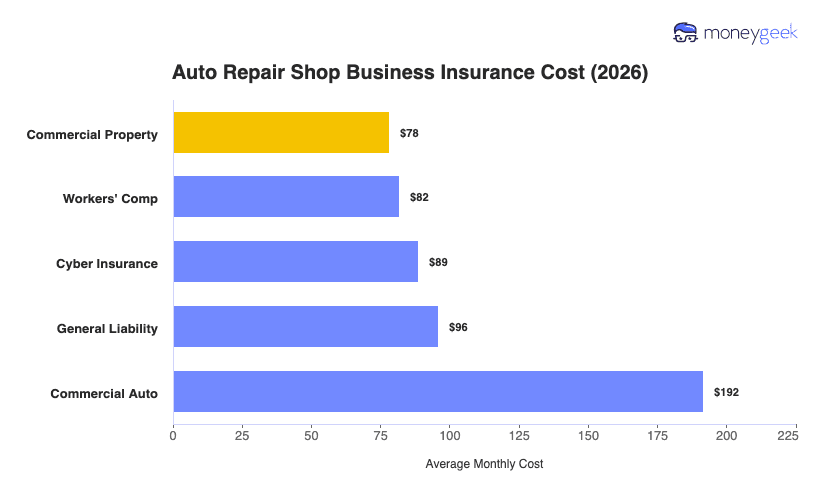
Individual coverage costs range from $78 to $192 per month. Most shops operate from a fixed location, so the building and equipment risk is straightforward to insure. Commercial Auto is the most expensive, since road testing and moving customer vehicles on public roads creates real liability, and insurers price that accordingly, whether your shop does it occasionally or every day.
The table below shows average monthly costs by coverage type. Use these as benchmarks, not quotes, since your actual premium depends on your shop's size, location and operations.
| Commercial Property | $78 | $937 | 37% | 236 |
| Workers' Comp | $82 | $982 | 27% | 241 |
| Cyber Insurance | $89 | $1,064 | -6% | 264 |
| General Liability | $96 | $1,150 | -22% | 223 |
| Commercial Auto | $192 | $2,300 | -17% | 277 |
We analyzed quote data from major U.S. commercial insurance providers and modeled standardized premium estimates across business profiles representing around 95% of the market. Results are designed to provide a consistent national benchmark showing how premiums vary by key baseline factors including business size, restaurant profession type, location and vehicle type for operations that use commercial vehicles.
Dataset Scope and Assumptions
Our cost modeling uses standardized inputs for consistent comparisons across businesses.
- Total estimates modeled: just over 6 million standardized pricing estimates
- Providers analyzed: 10 major insurance providers
- Geography: all U.S. states including Washington, D.C.
- Employee count bands: solo practitioners, one to four, five to nine, 10 to 19, and 20 to 49 employees
- Vehicle types studied: Sedans, SUVs, pickup trucks, vans, taxis, limousines, tractors, food trucks, semi-trucks (non-HAZMAT and HAZMAT), tanker trucks (non-HAZMAT and HAZMAT), buses, box trucks, dump trucks, flatbed trucks
- Policies studied: general liability, workers' comp, professional liability, commercial auto, commercial property, and cyber insurance
- General liability: $1 million per occurrence and $2 million aggregate
- Workers' comp: state required coverage
- Professional liability: $1 million per claim and $1 million aggregate
- Commercial auto: minimum coverage
- Commercial property: personal property coverage limits personalized to industry, business size and state
- Cyber insurance: $1 million per occurrence and $1 million aggregate
How We Calculated Average Auto Repair Shop Business Insurance Costs
Our published averages represent modeled premiums for standardized business profiles and were aggregated in two ways.
- National benchmark average: The national average cost reflects the modeled premium for a standardized one to four employee business across all and states included in our dataset for a standard policies
- Segment averages: To show how costs vary, we calculated average modeled premiums for our national base profile and isolated for variables, including:
- Employee count (business size ranges)
- Vehicle types (for commercial auto)
- States (including Washington, D.C.)
Segment averages were produced by aggregating modeled pricing trends across the full dataset so readers can compare how premiums shift across coverage types and regions.
See our full business insurance methodology.
Get Auto Repair Shop Business Insurance Cost Estimates
If you want a more personalized estimate, use our auto repair shop business insurance cost calculator before comparing rates.
Get Auto Repair Shop Insurance Cost Estimates
Select Coverage Type
Select State
Select Employee Count
Select Vehicle Type
Monthly Rate Estimate—
Select Coverage Type
Monthly Rate Estimate—
Select State
Select Employee Count
Select Vehicle Type
Factors Affecting Auto Repair Shop Business Insurance Costs
Your operations carry a distinct mix of physical, liability and property risks, and the factors that move premiums most tie directly to the work being done in your bays. Auto repair shop business insurance costs reflect that complexity across every coverage type.
 Services offered
The services your shop offers shape your risk profile more than most owners expect. If your shop sticks to oil changes and tire rotations, your exposure stays relatively low. Move into transmission rebuilds, brake jobs or diesel work and the risk profile shifts because more complex repairs mean more potential for damage to a customer's vehicle or injury to your technicians. Add specialty services like EV systems or performance tuning, and insurers price that additional exposure across your coverage.
 Employee count and roles
The more people you employ, the more your premiums reflect it. Payroll drives workers' comp costs directly, and a larger crew means more daily interaction with customer vehicles and the public, which adds to your general liability exposure. You and a five-person shop down the street can pay very different rates for that reason alone.
 Vehicle handling and road exposure
If your shop road tests repairs, offers pickup and delivery, or runs loaners, your commercial auto exposure goes up every time a vehicle leaves your lot. According to the Bureau of Labor Statistics, transportation incidents are among the leading causes of fatal occupational injuries across the skilled trades, and insurers factor that risk into how they price road exposure for auto repair shops.
- Chemical and hazardous material handling
Your shop likely handles used motor oil, brake fluid, refrigerants, battery acid and solvents on a daily basis. OSHA standards for automotive repair shops set specific requirements for how these substances are stored, handled and disposed of, and insurers pay attention to whether your shop meets them. Gaps in compliance or documentation can raise your premium.
 Customer vehicle value on premises
Insurers look at what's sitting in your bays, not just what you own. If you regularly work on high-value cars, classic restorations or performance builds, that increases the property exposure your policy needs to cover. If you specialize in European imports or collector vehicles, you're carrying more on-premises risk than a shop servicing everyday cars, even with the same number of bays.
How to Lower Auto Repair Shop Business Insurance Costs
Running an auto repair shop means carrying more coverage types than most small businesses, and that gives you more places to find savings. We've found that affordable business insurance for your shop usually comes from a mix of changes you can make at renewal and adjustments to how you manage risk over time.
 Compare quotes using the same coverage limits
The fastest way to find a better rate is shopping your policy, though the comparison only holds if every provider is quoting the same limits. Rates vary more than you'd expect for the same profile, since auto repair shops need coverage across multiple policy types.
Before renewing, get at least three quotes, and confirm each one reflects the same limits and deductibles so you're comparing equivalent coverage.
 Bundle policies with the same provider
Different insurers for different coverage types usually means paying more than necessary, and it creates potential gaps in how claims get handled. Multi-policy discounts are common among insurers that write auto repair shop coverage, and a single provider makes it easier to coordinate claims that touch more than one policy.
Take a customer vehicle damaged in your shop: both your general liability and commercial property coverage can come into play at the same time.
 Right-size your coverage
Your shop today may look nothing like it did when you first set your coverage limits. Changes in payroll, vehicle count or the services you offer can all mean your current limits are higher than your actual exposure requires. Compare your coverage to your current operations every year, not to what your shop looked like two or three years back.
 Increase your deductible strategically
If your shop has stable cash flow, consider a higher deductible because it lowers your premium. Predictable, manageable-out-of-pocket property claims are typical in a shop environment, since minor equipment damage or small tool losses rarely justify a low deductible. Raise your commercial property deductible and keep liability deductibles lower, and you'll cut fixed costs without taking on much additional risk.
 Invest in risk management practices
From one policy period to the next, your claims history follows your shop, and frequent claims push workers' comp and general liability premiums up at renewal. That track record works in your favor at renewal if you actively cut down on how often claims happen.
- Document lift inspection schedules and equipment maintenance logs, since insurers treat written records as evidence that your shop is managed carefully
- Train your technicians on chemical storage and disposal, so injury and contamination claims become less likely
- Set a clear test drive policy spelling out who can drive customer vehicles and when
- Log every in-shop incident in writing, even minor ones, so you can spot patterns before they become claims
Auto Repair Shop Business Insurance Cost: Bottom Line
Auto repair shop business insurance averages $107 per month, but that figure is a starting point, not a prediction. Your premium depends on the services you offer, how many people you employ and whether your shop puts vehicles on public roads.
Use the benchmarks on this page to frame your expectations, not to set them in stone. The questions below can help you put any quote you receive in context:
- Where do you fall in the distribution? Start by locating yourself relative to the benchmarks using your trade type, employee count and state. If you run a solo general repair shop in a mid-cost state, expect to sit closer to the lower end of the range, but if you have multiple technicians and an active road test policy, you'll likely land higher. Use that as a starting point when assessing whether a quote is what you should expect to pay.
- Is your quote consistent with your risk profile? If a quote sits well above or below the benchmarks for your trade and state, find out why before accepting or rejecting it. A lower-than-expected quote may reflect narrower coverage terms or higher deductibles, while a higher one may reflect your claims history, the value of vehicles you service or your road exposure.
- Which cost drivers apply to your business? Not every factor carries equal weight for every shop. Chemical handling compliance matters more for a shop that services AC systems and works with refrigerants than one focused on tires and alignments. Road exposure is a factor if you offer pickup and delivery, but not if you do strictly in-bay work. Identify which drivers apply to your operation before considering where your quote should land.
Understanding those factors matters more than knowing whether your quote is above or below the average because the same premium can represent good value for one shop and poor fit for another.
About Connor Bolton

Connor Bolton is Senior SEO and Content Manager at MoneyGeek, where he leads the business and pet insurance editorial teams. He sets the research framework, data standards and content structure for his team. All content goes through his accuracy review before publication. Connor also writes in-depth guides and has spent more than four years covering insurance products across personal, commercial and specialty lines.
The research infrastructure Connor built covers auto, home, renters, life, health, business and pet insurance across pricing analysis, carrier research, customer experience and coverage evaluation. It includes over 6 million data points for business insurance across 408 industry areas, all 50 states and 16 vehicle types. The pet insurance side covers over 5 million profiles across 18 major providers, 100+ breeds and ages up to 20 years. Connor’s insurance research and his team's work have been cited by the U.S. Chamber of Commerce, Allstate, Liberty Mutual, CBS News, Forbes and LegalZoom.
Connor also talks with underwriters and carrier liaisons at Ethos, The Hartford, ERGO NEXT, Nationwide and State Farm, and monitors business and pet owner communities on Reddit. Those sources shape how his team evaluates carriers, structures rate analysis and writes content for real pet owners.
Questions about MoneyGeek's business or pet insurance content? Reach him at connor@moneygeek.com or on LinkedIn.
Sources
- Bureau of Labor Statistics. "Census of Fatal Occupational Injuries." Accessed September 26, 2026.