



Jump to the section that meets your needs best below:
Average Excavation Business Insurance Cost (2026 Report)
Excavation business insurance costs range from $775 to $1,405 per month, varying based on the bundle you choose.
If you're ready to get a quote, use the tool below to get matched with the best business insurance provider for your excavation operations.
Select state
Updated: September 11, 2026
Advertising & Editorial Disclosure
How Much Does Excavation Business Insurance Cost?
Most excavation contractors pay about $1,001 per month for insurance. That is the cost of my recommended bundle, which includes general liability, commercial auto and commercial property, and covers the liability claims, road risks and equipment losses that come with running machines between job sites.
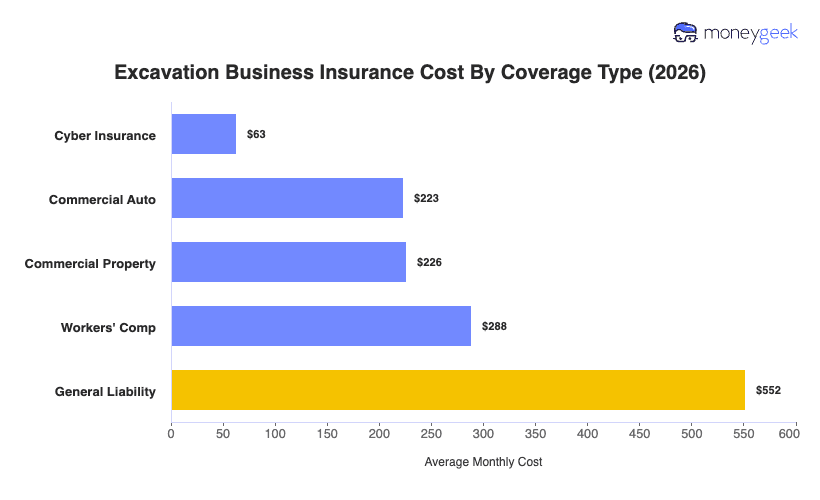
What you pay depends on which coverages you carry, so the cost of contractor insurance can start with the starting bundle to meet your basic legal and job-bidding requirements, then add crew and equipment protection as your operation grows. The table below breaks down various insurance bundles for excavation companies.
Starting | General liability + commercial auto | $775 | A solo owner-operator getting road-legal and eligible to bid basic jobs. |
Recommended | Starting + commercial property | $1,001 | An established operator with a yard and equipment worth protecting. |
Growing | Recommended + workers' comp | $1,289 | An operation that has put a crew on the payroll and needs to cover them. |
Comprehensive | Growing + cyber insurance + inland marine | $1,405 | A crewed operation that wants full protection, down to equipment in transit and digital exposure. |
We analyzed quote data from 10 major U.S. commercial insurance providers and modeled standardized premium estimates across business profiles representing around 95% of the market. Results give a consistent national benchmark showing how premiums vary by baseline factors including business size, contractor profession type, location, and vehicle type for operations that run commercial vehicles.
Our published averages represent modeled premiums for standardized business profiles and were aggregated in two ways.
- National benchmark average: The national average reflects the modeled premium for a standardized one-to-four-employee excavation business across all states in our dataset at standard policy limits.
- Segment averages: To show how costs vary, we calculated average modeled premiums for our national base profile and isolated them by employee count, vehicle type for commercial auto, and state including Washington, D.C.
We produced segment averages by aggregating modeled pricing across the full dataset so you can compare how premiums shift across coverage types and regions. Bundle totals on this page were calculated by adding the individual coverage premiums together, before any discounts, which is how the per-state bundle figures in the state table were built.
See our full business insurance methodology.
Get Excavation Contractor Business Insurance Cost Estimates
The excavation business insurance cost calculator below gives you a more personalized estimate so you can compare rates. Once you have a baseline, you can pull a quote from your top provider based on the details you enter.
Get Excavation Contractor Insurance Cost Estimates
Select Coverage Type
Select State
Select Employee Count
Select vehicle_type
Monthly Rate Estimate—
Select Coverage Type
Monthly Rate Estimate—
Select State
Select Employee Count
Select vehicle_type
Factors Affecting Excavation Business Insurance Costs
These are the things underwriters weigh differently for an excavation contractor than for other trades. They come down to your work type, your equipment, and how your crew and subcontractors are set up.
 Type of excavation work
What type of work you do is one of the strongest signals underwriters use to price your policy. Residential utility trenching, commercial site preparation, and infrastructure grading each carry different claim profiles. If your work regularly involves deep excavation near existing structures or underground systems, expect your rates to reflect that exposure.
 Equipment owned or operated
Insurers rate your equipment by class, value and whether you own or rent. Running a 50,000-pound hydraulic excavator alongside dump trucks puts you in a different risk category than a compact track loader operation on residential lots. Heavier, higher-value equipment pushes premiums across multiple coverage lines.
 Underground utility exposure
Work near gas, water, electrical or fiber infrastructure puts your operation in a distinct underwriting category. Your 811 compliance record, dig ticket frequency and history of utility-adjacent work all factor into how insurers price your exposure. If utility work is a regular part of your jobs, expect this factor to weigh heavily on your GL rate.
 Crew classification
Workers' comp rates depend less on headcount than on how your crew is classified. Equipment operators, laborers and foremen each carry different classification codes with different rates. A three-person operator crew costs more to insure than three laborers doing equivalent hours. Your classification mix matters as much as your headcount.
 Subcontractor use
When you hire subcontractors, insurers ask whether those subs carry their own coverage. If they don't, their work can fall under your general liability policy, which increases your exposure and potentially raises your premium. Collecting certificates of insurance from subs before renewal is a straightforward way to manage this factor.
How to Lower Excavation Business Insurance Costs
Excavation premiums respond to both how you operate and how you're underwritten, which gives you several levers to lower them. Some show up at your next renewal, others take a policy period or two, and finding affordable business insurance starts with knowing which ones apply to you.
 Compare quotes using the same coverage limits
As an excavation contractor, your general liability quotes can vary more across insurers than in most trades because underwriters price utility strike and ground disturbance exposure differently. Comparing quotes on identical limits, the same per-occurrence and the same aggregate, is the only way to isolate actual price differences. If your limits vary across quotes, you're comparing different products, not different prices.
 Right-size your coverage
You may be carrying coverage that made sense when you signed your last big contract but no longer reflects what your operation actually runs. If you're insuring equipment at replacement cost after significant depreciation, or holding commercial auto limits on trucks no longer active on job sites, those are candidates for adjustment. Matching coverage to your current exposure reduces premiums without reducing protection.
 Bundle policies with the same provider
If you're running an excavation operation, you're likely managing several policies at once. General liability, workers' comp, commercial auto, and inland marine are common across most contractor profiles, and carriers that write all four will often discount the package. Managing fewer insurer relationships at renewal also makes it easier to keep your coverage aligned as your operation grows or changes.
 Increase your deductible strategically
If your operation has a clean claims history and enough cash reserves to absorb a larger out-of-pocket on a minor loss, a higher deductible can greatly reduce your premium. This works best on commercial property and inland marine, where small equipment claims are common but rarely catastrophic. Review your actual claims history before adjusting so the math supports the tradeoff.
 Invest in risk management practices
Over time, the claims your operation generates shape your rate more than almost any other factor. Utility strikes, trench collapses, and operator injuries are the losses most likely to drive up what you pay, and most are preventable with documented protocols. Lower your claim frequency and you'll typically see the difference at renewal after one to two clean policy periods.
- Require your crew to complete pre-dig utility locates and submit a signed 811 confirmation before excavation begins on any new project site.
- Verify your operators hold current certification for each equipment weight class before assigning them to any heavy machinery on a job site.
- On any excavation exceeding four feet, conduct and document trench inspections at defined depth intervals and keep records per site.
- Collect active general liability and workers' comp certificates from every subcontractor before they start work on your site, and keep them on file.
Excavation Business Business Insurance Cost: Bottom Line
A recommended excavation insurance bundle averages $1,001 per month, but what you actually pay depends on which policies your operation needs. Use these three questions to read a quote once you have one.
- Does your bundle include the right coverages? The right mix depends on how you operate. A solo owner-operator may only need the Starting coverages, general liability and commercial auto, while an operation with a yard, owned equipment, and a crew works up through commercial property, workers' comp, and inland marine. Match the tier to what you actually run rather than paying for every line.
- Which coverage is driving the total? For most excavation operations, general liability is the largest line, followed by commercial auto, and then workers' comp once you have a crew. If a quote comes in high, that's usually where to look, since utility-strike exposure on general liability and crew classification on workers' comp move the most money.
- Are you comparing quotes on the same details? Give every insurer the same coverages, limits, and deductibles. A cheaper quote often just means less protection, so matching the details is the only way to see a real price difference.
The goal isn't to match the averages on this page. It's to build a bundle that fits how you operate without paying for coverage you don't need.
About Connor Bolton

Connor Bolton is Senior SEO and Content Manager at MoneyGeek, where he leads the business and pet insurance editorial teams. He sets the research framework, data standards and content structure for his team. All content goes through his accuracy review before publication. Connor also writes in-depth guides and has spent more than four years covering insurance products across personal, commercial and specialty lines.
The research infrastructure Connor built covers auto, home, renters, life, health, business and pet insurance across pricing analysis, carrier research, customer experience and coverage evaluation. It includes over 6 million data points for business insurance across 408 industry areas, all 50 states and 16 vehicle types. The pet insurance side covers over 5 million profiles across 18 major providers, 100+ breeds and ages up to 20 years. Connor’s insurance research and his team's work have been cited by the U.S. Chamber of Commerce, Allstate, Liberty Mutual, CBS News, Forbes and LegalZoom.
Connor also talks with underwriters and carrier liaisons at Ethos, The Hartford, ERGO NEXT, Nationwide and State Farm, and monitors business and pet owner communities on Reddit. Those sources shape how his team evaluates carriers, structures rate analysis and writes content for real pet owners.
Questions about MoneyGeek's business or pet insurance content? Reach him at connor@moneygeek.com or on LinkedIn.