


Jump to the section that meets your needs best below:
Average Florist Shop Insurance Cost (2026 Report)
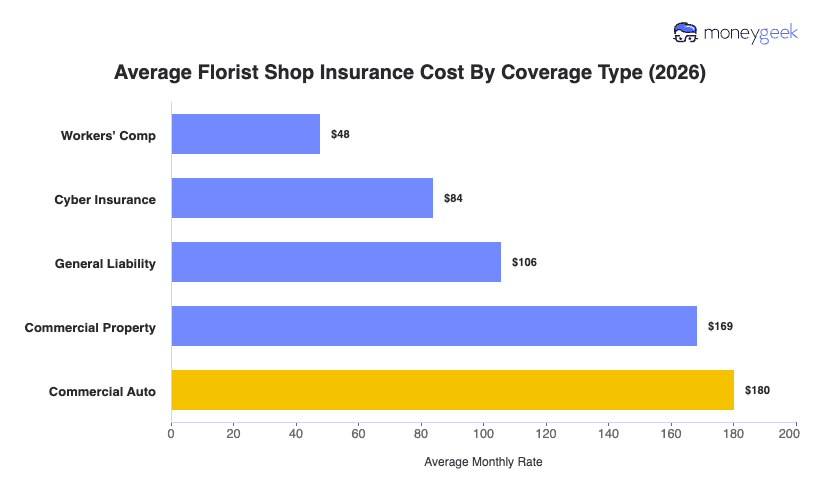
Florists with no employees running a single storefront pay about $82 per month for general liability, the base layer of a florist business's insurance cost.
If you want pricing now, MoneyGeek can match you to the insurer that meets your flower shop business's coverage needs.
Select state
Updated: September 13, 2026
Advertising & Editorial Disclosure
How Much Does Florist Shop Insurance Cost?
A basic florist insurance bundle averages $125 per month, which may be enough if you run a small storefront on your own. It can cover your shop and liability exposure, along with refrigeration that protects your flower inventory. As your business grows, retail business insurance costs can climb closer to $687 per month for the expanded bundle, especially once you add delivery vehicles or staff.
You don’t need every policy from day one. Start with coverage that matches how your shop operates now, then build on it as your needs change. Taking on larger events may call for higher liability limits, while a delivery van or your first employee can trigger entirely new coverage needs.
Starting Bundle | Business Owners Policy (BOP) + equipment breakdown endorsement | $125 | Solo florists running a single storefront |
Recommended Bundle | Starting bundle + workers' compensation + commercial auto + cyber liability | $580 | Staffed florists running deliveries and online orders |
Expanded Bundle | Recommended bundle + commercial umbrella + business income coverage | $687 | Florists with wedding and event work carrying higher liability limits |
Our estimates model standardized premiums for florist business profiles across all 50 states and Washington, D.C., built to give a consistent national benchmark rather than a personalized quote. We aggregated the results in a few ways.
- Start from how the business operates: we begin with the coverages a florist actually carries, then adjust for the variables that move the price, employee count, state, delivery vehicles and inventory exposure.
- National benchmark average: the national figure for each coverage reflects a standardized one-to-four-employee florist across all states in our dataset.
- State averages: we isolated each state to show how premiums shift by location. Where a specialty policy was not part of the main dataset, we applied state-level pricing patterns to the national estimate.
- Bundle averages: bundles are built around a recognizable operation rather than a policy count. The Starting bundle uses solo operator rates, the Recommended bundle reflects a one-to-four-employee shop that hires staff and adds a delivery van and cyber coverage, and the Expanded bundle keeps that staffed foundation and adds a commercial umbrella and business income coverage for florists taking on larger events.
These figures are planning benchmarks, not quotes. Your actual price depends on your carrier, location, coverage limits and claims history.
See our full business insurance methodology for more detail.
Get Florist Business Insurance Cost Estimates
Your monthly rate depends on how your flower shop runs. Use our business insurance cost calculator to set the coverage, state, employee count and vehicle that match your shop, then select Get Quotes to compare real prices from insurers.
Keep these details in mind:
- You do not need to enter your name, contact details or any personal information to get an estimate
- Choose the employee band that matches your shop, since staffed shops are priced differently than solo operations
- Select a vehicle only when you need commercial auto coverage for a delivery van
Get Florist Insurance Cost Estimates
Select Coverage Type
Select State
Select Employee Count
Select vehicle_type
Monthly Rate Estimate—
Select Coverage Type
Monthly Rate Estimate—
Select State
Select Employee Count
Select vehicle_type
Factors Affecting Florist Shop Insurance Costs
Your premium depends on more than the size of your flower shop. Insurers also look at how you store inventory, whether you make deliveries, how many people work for you and the type of jobs you take on. The biggest cost drivers usually come back to one question: how much could the insurer have to pay if something goes wrong?
 Value of your refrigeration and inventory
Flowers are perishable, and many shops rely on coolers to protect thousands of dollars in inventory at once. The more expensive your refrigeration setup and peak stock levels are, the more property coverage you may need. A shop carrying extra inventory for Valentine’s Day or Mother’s Day can also have a much bigger loss if equipment fails or the space is damaged.
 Whether you run delivery vehicles
Adding a delivery van changes your insurance needs because you’re putting a business-owned vehicle on the road every day. Your commercial auto premium can rise with the number of vehicles you operate and how much driving they do. A florist making a few local deliveries will usually present a different auto risk than one running several routes throughout the day.
 Number of employees
Hiring staff can raise costs in two ways. Workers’ compensation is generally priced partly around payroll and the type of work employees perform, while more people working in your shop can also increase your overall exposure to accidents. A solo florist will usually have a very different insurance profile from a shop with designers, delivery drivers and seasonal help.
 Event and wedding work
Large weddings and venue installations can push your liability needs above what a walk-in flower shop typically carries. You may be working in unfamiliar venues, handling expensive décor or signing contracts that require higher limits. If event work becomes a regular part of your business, you may need more liability coverage than a florist focused mainly on retail sales.
 How much you sell online
Online orders can add cyber exposure because you may be collecting payment details or storing customer information through your website or ordering system. The more your shop relies on digital sales, the more a data breach or system outage could disrupt your business. Cyber insurance may cost more as the amount of customer data you handle grows.
 Your location
Where your flower shop operates can affect several parts of your insurance bill. Property rates may reflect local rebuilding costs or weather risk, while workers’ comp and auto pricing can change based on state rules. That means two florist shops with similar sales and operations can still pay noticeably different premiums simply because they’re located in different states.
How to Lower Florist Shop Insurance Costs
You can lower business insurance premiums by keeping your policy aligned with how your flower shop actually operates. A shop that carries extra inventory for major holidays or adds a delivery van shouldn’t be insured the same way year-round.
 Insure your inventory at its real peak value
Your flower inventory can jump around Valentine’s Day or Mother’s Day. Make sure your property limit can handle those peak periods without leaving you overinsured during slower months. Ask whether your policy includes a seasonal increase in coverage, which can give you more room when your coolers are fullest.
 Add an equipment breakdown endorsement before you need it
A failed cooler can spoil valuable inventory even when the building itself is untouched. Review whether your policy covers equipment breakdown and the resulting loss of stock. If it doesn’t, an endorsement may be worth adding rather than assuming standard property coverage will respond.
 Right-size your delivery coverage
If you’ve stopped using a vehicle for flower deliveries, remove it from your commercial auto policy rather than paying to insure it unnecessarily. Employees who occasionally use their own cars may need a different setup, so ask whether hired and non-owned auto coverage fits better than adding another vehicle.
 Keep driver records clean
Driving records can affect what you pay for commercial auto coverage. Check motor vehicle records before assigning someone to deliveries and ask whether driver training can qualify your shop for a discount. At renewal, compare business insurance quotes using the same limits so you can see whether another carrier prices your drivers more favorably.
 Bundle and pay annually
A BOP already combines property and liability coverage, and some insurers discount additional policies when you keep them together. Paying annually may also reduce installment fees. Compare the total cost before bundling, though, since your commercial auto or workers’ comp coverage may still be cheaper with another insurer.
Florist Shop Insurance Cost: Bottom Line
The typical florist lands near the $580 recommended bundle, a staffed shop running deliveries and taking online orders. Treat that as a reference point rather than a target price, since a solo storefront sits closer to the $125 starting bundle and a shop built around weddings and events climbs toward the $687 expanded bundle.
- Does the quote match how your shop actually runs? Compare it against the bundle closest to your operation. A solo storefront should not be priced like a staffed shop with a delivery van and event contracts, and the reverse holds too.
- Is your inventory valued for your busiest week? Property and equipment are the lines florists most often underinsure. A limit set for a slow Tuesday leaves you exposed on the exact holidays when your coolers are full.
- Are you being quoted as a florist, not a generic retailer? A broad retail classification can miss perishable stock and event liability. If your agent is not asking about refrigeration, delivery or wedding work, your coverage may not be priced for what you really do.
About Mark Flores

Mark Flores is a Business Insurance Content Writer at MoneyGeek, where he focuses on commercial auto, commercial property, cyber and specialty business insurance coverage. His work simplifies coverage terms, gives business owners a strong baseline for expected costs, and narrows down policies and providers tailored to your operation, regardless of complexity.
Before joining MoneyGeek’s business insurance team, Mark worked as a Senior Content Writer at Clutch.co, where he produced structured B2B reviews and provider analyses based on client interviews, company research and service evaluation. That experience shaped his approach to business insurance content, especially when comparing insurers, explaining coverage differences and translating complex policy features into practical guidance for small business owners.
Mark also spent nearly 4 years as a digital marketing specialist serving small-business clients across industries such as home services, manufacturing and education. That background gives him practical context for how businesses evaluate vendors, manage operational needs and make purchasing decisions.
At MoneyGeek, he applies this research and evaluation experience to build guides that help transportation sectors, those with complex property-related risks (such as hotels and retail stores), and those most at risk of a cyberattack get the coverage they need at a reasonable price.
Linkedin: https://www.linkedin.com/in/mark-jason-flores-7844634a/
Contact Email: mark.flores@moneygeek.com
Sources
- U.S. Bureau of Economic Analysis. "Regional Price Parities by State and Metro Area." Accessed October 14, 2026.
- U.S. Bureau of Economic Analysis. "Real Personal Consumption Expenditures by State and Real Personal Income by State, 2024." Accessed October 14, 2026.
- Michigan Department of Insurance and Financial Services. "Auto Insurance Reform: Lower Costs." Accessed October 14, 2026.
- Oregon Department of Consumer and Business Services. "Workers' Compensation Premium Rate Comparison Across the States." Accessed October 14, 2026.
- Federal Bureau of Investigation, Internet Crime Complaint Center (IC3). "FBI Releases Annual Internet Crime Report (2024 Internet Crime Report)." Accessed October 14, 2026.