



Jump to the section that meets your needs best below:
Average Window Cleaning Insurance Cost (2026 Report)
Window cleaning insurance runs $21 to $199 a month based on crew size, building heights, equipment value and whether you operate service vehicles.
If you're ready to get a quote, use the tool below to get matched with the best business insurance provider for your window cleaning operations.
Select state
Updated: September 11, 2026
Advertising & Editorial Disclosure
How Much Does Window Cleaning Insurance Cost?
The cleaning business insurance cost for window cleaning averages around $97 a month, or roughly $1,165 a year. That figure reflects an average across five coverage types analyzed for window cleaning businesses with one to four employees, using standard policy limits of $1 million per occurrence and $2 million aggregate across all 50 states and D.C.
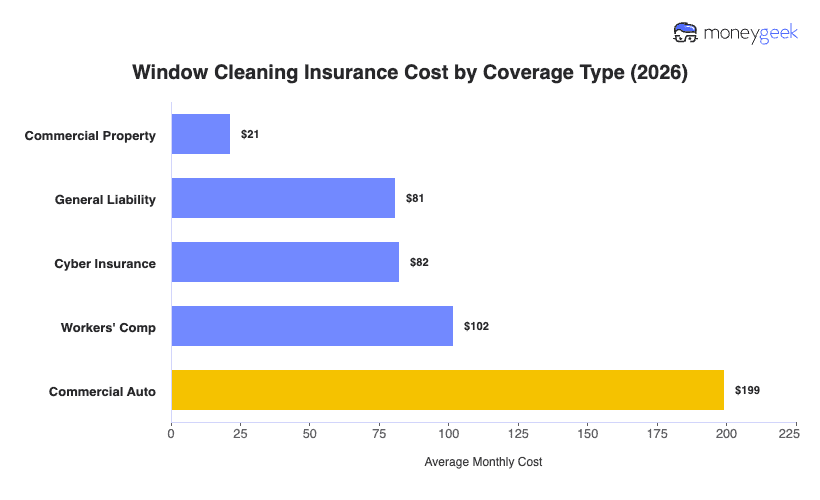
Individual policy costs run from around $21 to $199 a month depending on the coverage type. Commercial property sits at the low end because you typically work out of client locations, not owned premises, so your fixed property exposure stays minimal. Commercial auto costs the most because if you have service vehicles, they carry crews, water-fed poles and ladders, and personal auto policies don't cover that kind of use.
The figures below are benchmarks, not quotes as your actual premium varies with your crew size, vehicle count and coverage selections
| Commercial Property | $21 | $258 | 83% | 78 |
| General Liability | $81 | $969 | -34% | 182 |
| Cyber Insurance | $82 | $985 | 1% | 225 |
| Workers' Comp | $102 | $1,220 | 10% | 267 |
| Commercial Auto | $199 | $2,391 | -22% | 317 |
We analyzed quote data from major U.S. commercial insurance providers and modeled standardized premium estimates across business profiles representing around 95% of the market. Results are designed to provide a consistent national benchmark showing how premiums vary by key baseline factors including business size, restaurant profession type, location and vehicle type for operations that use commercial vehicles.
Dataset Scope and Assumptions
Our cost modeling uses standardized inputs for consistent comparisons across businesses.
- Total estimates modeled: just over 6 million standardized pricing estimates
- Providers analyzed: 10 major insurance providers
- Geography: all U.S. states including Washington, D.C.
- Employee count bands: solo practitioners, one to four, five to nine, 10 to 19, and 20 to 49 employees
- Vehicle types studied: Sedans, SUVs, pickup trucks, vans, taxis, limousines, tractors, food trucks, semi-trucks (non-HAZMAT and HAZMAT), tanker trucks (non-HAZMAT and HAZMAT), buses, box trucks, dump trucks, flatbed trucks
- Policies studied: general liability, workers' comp, professional liability, commercial auto, commercial property, and cyber insurance
- General liability: $1 million per occurrence and $2 million aggregate
- Workers' comp: state required coverage
- Professional liability: $1 million per claim and $1 million aggregate
- Commercial auto: minimum coverage
- Commercial property: personal property coverage limits personalized to industry, business size and state
- Cyber insurance: $1 million per occurrence and $1 million aggregate
How We Calculated Average Window Cleaning Service Business Insurance Costs
Our published averages represent modeled premiums for standardized business profiles and were aggregated in two ways.
- National benchmark average: The national average cost reflects the modeled premium for a standardized one to four employee business across all and states included in our dataset for a standard policies
- Segment averages: To show how costs vary, we calculated average modeled premiums for our national base profile and isolated for variables, including:
- Employee count (business size ranges)
- Vehicle types (for commercial auto)
- States (including Washington, D.C.)
Segment averages were produced by aggregating modeled pricing trends across the full dataset so readers can compare how premiums shift across coverage types and regions.
See our full business insurance methodology.
Get Window Cleaning Business Insurance Cost Estimates
If you want a more personalized estimate, use our window cleaning business insurance cost calculator before comparing rates.
Get Window Cleaning Insurance Cost Estimates
Select Coverage Type
Select State
Select Employee Count
Select Vehicle Type
Monthly Rate Estimate—
Select Coverage Type
Monthly Rate Estimate—
Select State
Select Employee Count
Select Vehicle Type
Factors Affecting Window Cleaning Insurance Costs
Several factors drive the cost of window cleaning business insurance, and in our analysis, how high you work is the most consequential. Your access method and client mix alone can place your premium well above or below a comparable operation.
 Height and access method
The elevation of your work is the single biggest pricing signal in this trade. Storefront and low-rise cleaning carries far less fall-related exposure than mid-rise or high-rise exterior work. If your operation uses rope descent systems or swing stages, expect a narrower pool of insurers and higher premiums.
 Service vehicles
Running a dedicated service vehicle changes how insurers read your risk profile. Your van loaded with a pure water system, telescopic poles and ladder racks brings vehicle, cargo and equipment exposure that drives cost across coverage types. Working solo from a personal vehicle, you don't carry that same commercial exposure.
 Crew structure
Every worker you add to a job increases the number of contact points with client property and raises the stakes for a fall-related injury claim. Running a two-person crew on high-rise accounts puts you in a meaningfully different risk category than operating solo at the same volume.
 Equipment value
Your water-fed pole systems, pure water filtration rigs and high-reach equipment represent a significant capital investment. The replacement value of your kit directly affects what you carry for equipment coverage. If you run a multi-crew operation, your specialized gear can easily total $15,000 to $30,000.
 Client type and contract requirements
Commercial accounts you take on often require higher liability limits and additional insured endorsements as a contract condition. Moving toward property management firms or office buildings means your coverage must meet the certificate of insurance standards those clients require, affecting what you carry and what you pay.
How to Lower Window Cleaning Insurance Costs
Window cleaning has one of the widest premium spreads in the cleaning industry, and in our analysis, most of that variation traces to how operations are classified and covered. Finding affordable business insurance in this trade means working on two timelines: adjustments you can make now and changes that improve how your operation is rated over time.
 Compare quotes using the same coverage limits
Your quotes will vary more in window cleaning than in most trades because no two operations are structured the same. For a true price comparison, anchor every quote to the same limits, such as general liability amount, deductible and, if you run a vehicle, commercial auto class. Quoting on different limits shows you a price difference between policies, not between providers.
 Right-Size Your Coverage
Your coverage needs shift when your operation shifts. Whether you work solo on residential storefronts or run a crew on commercial accounts, your exposure differs and your limits should reflect that. If you've moved away from high-rise contracts or scaled back your vehicle count, revisiting your limits at renewal can bring your premium in line with your current risk profile.
 Increase your deductible strategically
If you carry general liability, commercial auto and equipment coverage simultaneously, look at each deductible independently. For coverage where small claims are unlikely, raising your deductible by $500 or more can reduce your premium without considerable out-of-pocket risk. Your equipment coverage is a good place to start if your water-fed system is still under manufacturer warranty.
 Lower your risk profile
How insurers classify your operation ties directly to the elevation of your work and the access methods you use. Reducing rope-access jobs, shifting toward ladder-accessible accounts or moving from high-rise commercial to mid-rise residential changes your classification over time. Phasing out your highest-elevation contracts across two policy periods can qualify your business for a different risk tier at renewal.
 Lower your risk profile
In window cleaning, falls and water intrusion are the claim types that will move your premium most. Keeping ladder inspection logs, harness certification records and water containment procedures for interior jobs gives insurers evidence that you actively manage the losses that drive cost. Over time, that pattern strengthens your renewal position across all coverage types you carry.
- Keep signed ladder inspection and fall-arrest equipment logs for every crew member on your team who works above ground level.
- Document your water containment setup for all interior glass work where spills can reach your client's flooring, furniture or electrical fixtures.
- Schedule harness certification renewals on a fixed calendar for any crew member on your team who uses rope-access systems or elevated work platforms.
- File incident reports for all near-misses, not just submitted claims, to show insurers your operation actively manages hazards between policy periods.
Window Cleaning Insurance Cost: Bottom Line
The $97 monthly average for window cleaning insurance is a useful reference point, not a rate to expect. What your actual premium looks like depends on a much narrower set of factors specific to your operation.
Use these three questions to put any quote you get in context for your window cleaning business:
- Where do you fall in the distribution? Use your trade type, employee count and state to locate yourself relative to the benchmarks on this page. A solo residential operator in a low-cost state sits in a different part of the distribution than a multi-crew commercial operation.
- Is your quote consistent with your risk profile? If a quote sits well above or below the benchmarks for your trade and state, that gap is worth understanding before you accept or reject it.
- Which cost drivers apply to your business? Not every factor here carries the same weight for every operation. For your window cleaning operations, height and access method are the major signals for elevated commercial work, while vehicle count and equipment value matter more for multi-crew businesses running service vehicles on lower-elevation accounts.
The gap between your quote and the industry benchmark usually traces to two or three operation-specific variables. Understanding which ones apply to your business matters more than knowing where you stand relative to the average.
About Connor Bolton

Connor Bolton is Senior SEO and Content Manager at MoneyGeek, where he leads the business and pet insurance editorial teams. He sets the research framework, data standards and content structure for his team. All content goes through his accuracy review before publication. Connor also writes in-depth guides and has spent more than four years covering insurance products across personal, commercial and specialty lines.
The research infrastructure Connor built covers auto, home, renters, life, health, business and pet insurance across pricing analysis, carrier research, customer experience and coverage evaluation. It includes over 6 million data points for business insurance across 408 industry areas, all 50 states and 16 vehicle types. The pet insurance side covers over 5 million profiles across 18 major providers, 100+ breeds and ages up to 20 years. Connor’s insurance research and his team's work have been cited by the U.S. Chamber of Commerce, Allstate, Liberty Mutual, CBS News, Forbes and LegalZoom.
Connor also talks with underwriters and carrier liaisons at Ethos, The Hartford, ERGO NEXT, Nationwide and State Farm, and monitors business and pet owner communities on Reddit. Those sources shape how his team evaluates carriers, structures rate analysis and writes content for real pet owners.
Questions about MoneyGeek's business or pet insurance content? Reach him at connor@moneygeek.com or on LinkedIn.