

Jump to the section that meets your immediate needs best:
Average Beauty Salon Insurance Cost (2026 Report)
The average cost of beauty salon insurance range from $114 per month for a starting bundle to $367 per month for one that suits a staffed salon.
Depending on the services you offer, the property you own and their value, where you operate and the coverages in your policy mix, your total insurance costs could vary.
If you want pricing now, MoneyGeek can match you to the insurer that meets your beauty salon's coverage needs.

Updated: July 28, 2026
Advertising & Editorial Disclosure
How Much Does Beauty Salon Insurance Cost?
A starting insurance bundle for beauty salons costs an average of $114 per month. It combines general liability and professional liability insurance, and could be good fit if you recently opened, work on your own and provide standard beauty services from one location. This mix helps if a client slips in your salon, you damage a customer’s belongings, a treatment causes an injury or someone claims your service caused an injury, damaged their hair or skin, or required them to pay for corrective treatment.
These costs are only starting points because your services, location, payroll, coverage limits and claims history can all change what you pay. Plus, you'll probably need a broader bundle once you hire employees, buy more equipment, open another location or start using a vehicle for work. I’ve detailed each bundle below so you can see which one best matches how your salon operates.
Starting Bundle | $114 | Solo cosmetologists without a storefront | |
Recommended Bundle | Business owner’s policy (BOP) + professional liability + cyber insurance | $230 | Owner-run salons with one location |
Mobile and Event Services Bundle | Recommended bundle + tools and equipment insurance + hired and non-owned auto endorsement | $281 | Mobile stylists and event beauty teams |
Staffed Salon Bundle | Recommended bundle + workers’ compensation + employment practices liability | $367 | Staffed salons with a storefront |
Note: We gathered and analyzed quotes for beauty salons with one to four employees to determine our estimates. The rate for workers' comp assumes one employee, which commercial auto assumes a single vehicle. I did external research to determine estimates for coverages outside our datasets, such as tools and equipment insurance and hired and non-owned auto endorsement (HNOA).
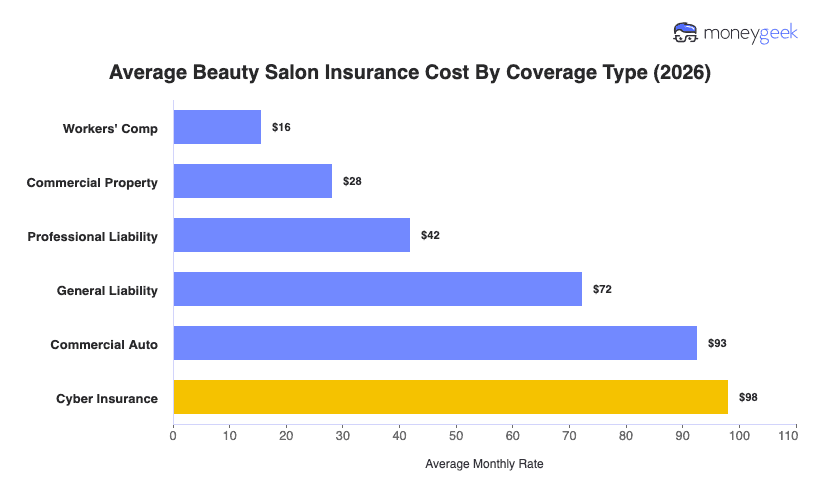
Average Beauty Salon Insurance Costs By Coverage Type
Depending on how your beauty salon operates, you'll need different combinations of these coverages to protect your services, property, employees and other business risks:
- Workers’ compensation: $16 per month per employee ($187 per year per employee)
- Hired and non-owned auto (endorsement): $17 per month ($204 per year)
- Employee dishonesty (endorsement): $24 per month ($288 per year)
- Commercial property: $28 per month ($338 per year)
- Tools and equipment insurance: $34 per month ($408 per year)
- Equipment breakdown (endorsement): $40 per month ($480 per year)
- Professional liability: $42 per month ($503 per year)
- General liability: $72 per month ($869 per year)
- Business owner’s policy: $90 per month ($1,080 per year)
- Commercial auto: $93 per month ($1,111 per year)
- Cyber insurance: $98 per month ($1,175 per year)
- Employment practices liability: $130 per month ($1,560 per year)
It's unlikely that you'll need every coverage on this list. Your mix should reflect the services you offer, the people who work for you, the property you own and how clients interact with your business. An owner-operated salon with one location and no employees has different risks from a mobile stylist who travels to weddings or events.
I’ve broken down each coverage to help you decide which ones belong in your policy mix. I’ve also analysed the costs of a BOP plus the six common coverages so you can see why premiums change from one location to another.
Professional liability insurance costs beauty salons an average of $42 per month, or $503 per year. It can help pay legal costs and covered settlements if a client claims a service burned their skin, damaged their hair or nails or caused an infection.
- What it covers: Claims that a mistake, advice you gave or a service you performed caused a client injury or other loss
- Common covered risks: Hair damaged by bleach or relaxer, a burn from wax or chemicals, an infection after a nail service or an injury linked to a lash or brow treatment
- Requirement considerations: Professional liability usually isn't part of licensing requirements for different beauty services, though a salon contract may still ask for it.
- Who needs it: Salons and self-employed beauty professionals who provide hair, nail, skin, brow, lash, makeup or other hands-on services.
Three states share the lowest rate in our dataset. Maine, North Carolina and North Dakota all have monthly averages of $36. Washington D.C., which has the highest cost, is only $13 higher at $49 per month. Prices in Washington, D.C., are higher than the national average, which makes services involved in claims handling more expensive. In turn, that pushes insurance costs up.
Data filtered by:SelectAlabama $41 $492 Alaska $38 $452 Arizona $40 $477 Arkansas $40 $477 California $47 $562 Colorado $41 $497 Connecticut $46 $547 Delaware $45 $537 Florida $45 $542 Georgia $43 $512 Hawaii $44 $522 Idaho $40 $477 Illinois $46 $552 Indiana $41 $487 Iowa $40 $477 Kansas $41 $487 Kentucky $39 $467 Louisiana $47 $567 Maine $36 $437 Maryland $40 $477 Massachusetts $44 $527 Michigan $39 $472 Minnesota $39 $472 Mississippi $42 $502 Missouri $41 $497 Montana $41 $497 Nebraska $39 $472 Nevada $48 $572 New Hampshire $41 $497 New Jersey $47 $567 New Mexico $42 $507 New York $49 $582 North Carolina $36 $437 North Dakota $36 $437 Ohio $39 $467 Oklahoma $39 $472 Oregon $39 $467 Pennsylvania $48 $577 Rhode Island $46 $552 South Carolina $43 $517 South Dakota $39 $472 Tennessee $41 $487 Texas $42 $507 Utah $40 $477 Vermont $40 $482 Virginia $38 $457 Washington $48 $572 Washington DC $49 $592 West Virginia $44 $527 Wisconsin $41 $492 Wyoming $39 $467 Beauty salons an average of $72 per month, or $869 per year for a general liability policy with standard limits of $1 million per occurrence/$2 million aggregate. It helps if a client slips on a wet floor, you accidentally damage something they brought into the salon or a product you sell causes an injury.
- What it covers: Injuries to clients and other visitors, damage to their belongings and certain claims tied to products you sell
- Common covered risks: A client slipping near a wash station, hair dye staining a customer’s clothing or a retail beauty product causing a reaction
- Requirement considerations: State law doesn't require you to carry GL coverage, but your landlord might ask for it as part of your contract when you rent a salon space
- Who needs it: Storefront, home-based and mobile beauty businesses that meet clients in person or sell beauty products.
General liability insurance for a beauty salon averages $123 per month in California, which is 2.72 times the rate in West Virginia. California has more customers moving through salons, creating more opportunities for slips, damaged belongings and other accidents. Prices in the state are also about 11% higher than the national average, which makes claims more expensive to handle. In West Virginia, you’ll pay about $45 per month, or $78 less. Its smaller customer market and lower overall prices helps keep the number of claims and the cost of handling them lower.
Data filtered by:SelectAlabama $51 $618 Alaska $98 $1,183 Arizona $75 $896 Arkansas $49 $589 California $123 $1,473 Colorado $89 $1,069 Connecticut $97 $1,155 Delaware $77 $924 District of Columbia $113 $1,347 Florida $89 $1,074 Georgia $67 $804 Hawaii $107 $1,283 Idaho $54 $640 Illinois $87 $1,040 Indiana $60 $723 Iowa $52 $630 Kansas $56 $676 Kentucky $54 $654 Louisiana $68 $815 Maine $62 $744 Maryland $95 $1,147 Massachusetts $107 $1,274 Michigan $66 $802 Minnesota $78 $931 Mississippi $46 $554 Missouri $59 $713 Montana $54 $653 Nebraska $57 $685 Nevada $86 $1,025 New Hampshire $80 $956 New Jersey $108 $1,297 New Mexico $54 $655 New York $111 $1,331 North Carolina $63 $762 North Dakota $56 $673 Ohio $63 $756 Oklahoma $53 $642 Oregon $82 $986 Pennsylvania $75 $896 Rhode Island $78 $931 South Carolina $52 $625 South Dakota $49 $593 Tennessee $61 $738 Texas $78 $932 Utah $64 $772 Vermont $71 $852 Virginia $82 $983 Washington $98 $1,182 West Virginia $45 $541 Wisconsin $63 $756 Wyoming $55 $656 A commercial property policy with a $100,000 business property coverage cap costs an average of $28 per month, or $338 per year. It helps with the cost of repairing or replacing items you use to serve clients after a covered loss. These include styling chairs, dryers, nail stations and skincare equipment.
- What it covers: The furniture, equipment, stock and other business property you keep at your salon
- Common covered risks: A fire damages your styling stations, someone steals salon equipment, a burst pipe ruins your product inventory or a storm damages your furniture
- Requirement considerations: Your landlord might ask for it if you're renting a space for your salon. A lender could also require it when you're financing equipment.
- Who needs it: Storefront salons that own furniture, equipment, retail stock or other business property kept at the location.
Hawaii has the highest commercial property rate at $33 per month, while North Dakota has the lowest at $25. Hawaii’s prices are about 10% above the national average, and many chairs, dryers, products and other supplies have to be shipped to the islands. That pushes up replacement costs after a fire, theft or other covered loss. While North Dakota salons has its own weather-related risks, replacing equipment and stock generally doesn't come with the same shipping and island supply costs.
Data filtered by:SelectAlabama $26 $317 Alaska $31 $376 Arizona $28 $340 Arkansas $26 $307 California $33 $393 Colorado $29 $353 Connecticut $31 $372 Delaware $29 $349 District of Columbia $32 $388 Florida $32 $383 Georgia $28 $337 Hawaii $33 $400 Idaho $27 $323 Illinois $29 $350 Indiana $26 $313 Iowa $25 $303 Kansas $25 $303 Kentucky $26 $314 Louisiana $29 $352 Maine $26 $317 Maryland $30 $359 Massachusetts $32 $378 Michigan $27 $324 Minnesota $28 $333 Mississippi $26 $310 Missouri $26 $310 Montana $26 $314 Nebraska $25 $301 Nevada $29 $346 New Hampshire $27 $329 New Jersey $32 $386 New Mexico $26 $316 New York $33 $398 North Carolina $28 $339 North Dakota $25 $297 Ohio $27 $323 Oklahoma $26 $311 Oregon $30 $356 Pennsylvania $29 $352 Rhode Island $30 $362 South Carolina $28 $333 South Dakota $25 $300 Tennessee $27 $324 Texas $30 $360 Utah $28 $333 Vermont $27 $319 Virginia $29 $346 Washington $31 $367 West Virginia $26 $307 Wisconsin $27 $320 Wyoming $26 $307 For about $90 per month, or $1,080 per year, a business owner’s policy can cover two major risks in your salon. These include claims from clients and damage to the property you use to run your business.
- What it covers: It protect your beauty salon against client injuries, damage to someone else’s belongings and damage to your salon’s furniture, equipment and stock
- Common covered risks: A client slips near a wash station, a fire damages your styling chairs and dryers, or a burst pipe ruins the beauty products you keep for sale
- Requirement considerations: A business owner’s policy usually isn't required by law, but your landlord might still require general liability, and you should carry property coverage if your lease makes you responsible for your salon’s contents or improvements.
- Who needs it: Owner-operated and small staffed salons with a physical location, regular client visits and business property kept on-site
BOPs cost the most in California, with an average of $140 per month, while beauty salons in West Virginia see the lowest rate of $64. Since a BOP combines general liability and commercial property coverage, California’s larger customer market and higher overall prices raise both accident-related claim costs and the cost of repairing or replacing salon property.
Alabama$70$842Alaska$117$1,403Arizona$93$1,112Arkansas$67$807California$140$1,679Colorado$111$1,336Connecticut$105$1,259Delaware$88$1,059District of Columbia$114$1,371Florida$94$1,124Georgia$89$1,069Hawaii$108$1,292Idaho$78$931Illinois$98$1,174Indiana$73$875Iowa$75$899Kansas$77$923Kentucky$72$862Louisiana$92$1,109Maine$89$1,069Maryland$101$1,214Massachusetts$109$1,311Michigan$85$1,019Minnesota$92$1,107Mississippi$68$816Missouri$79$945Montana$80$964Nebraska$76$911Nevada$95$1,136New Hampshire$91$1,088New Jersey$110$1,318New Mexico$87$1,039New York$124$1,493North Carolina$85$1,024North Dakota$73$879Ohio$78$939Oklahoma$74$893Oregon$98$1,173Pennsylvania$92$1,104Rhode Island$100$1,200South Carolina$83$996South Dakota$70$840Tennessee$80$963Texas$92$1,106Utah$84$1,008Vermont$89$1,071Virginia$99$1,196Washington$116$1,393West Virginia$64$764Wisconsin$81$968Wyoming$72$867If you use online booking, take card payments or store client details, a data breach or hacked account could interrupt appointments and expose private information. Cyber insurance costs beauty salons an average of $98 per month, or $1,175 per year and can help with the costs of responding to these incidents.
- What it covers: Costs following a data breach, hacked account or other cyberattack, such as notifying clients, restoring files and investigating what happened
- Common covered risks: Someone gets into your online booking system, client payment details are exposed, a scammer takes over your salon email or ransomware blocks access to your records
- Requirement considerations: State law or a standard salon lease usually doesn't require you to carry cyber insurance. But a franchise agreement or contract with a larger business might require it if your salon handles customer information through shared booking or payment systems.
- Who needs it: Established salons that rely heavily on digital systems to manage appointments, sales, staff schedules and customer records.
If your beauty salon's in Washington, D.C., expect to pay an average of $121 per month for cyber insurance. The FBI recorded 449 internet crime complaints per 100,000 residents there in 2025, which is the highest rate in the country. D.C. also ranked first for reported losses per 100,000 residents. By comparison, salons in Alaska, Montana, North Dakota and Wyoming pay an average of $83 per month, or 31% less.
Data filtered by:SelectAlabama $134 $1,600 Alaska $118 $1,410 Arizona $140 $1,677 Arkansas $127 $1,517 California $163 $1,955 Colorado $149 $1,789 Connecticut $158 $1,891 Delaware $153 $1,836 District of Columbia $171 $2,051 Florida $149 $1,794 Georgia $147 $1,763 Hawaii $124 $1,488 Idaho $121 $1,440 Illinois $157 $1,885 Indiana $137 $1,645 Iowa $124 $1,485 Kansas $131 $1,570 Kentucky $134 $1,600 Louisiana $134 $1,600 Maine $124 $1,490 Maryland $158 $1,888 Massachusetts $158 $1,888 Michigan $140 $1,683 Minnesota $140 $1,683 Mississippi $127 $1,517 Missouri $137 $1,648 Montana $118 $1,408 Nebraska $124 $1,490 Nevada $153 $1,840 New Hampshire $124 $1,485 New Jersey $160 $1,923 New Mexico $127 $1,517 New York $167 $2,003 North Carolina $144 $1,728 North Dakota $118 $1,410 Ohio $140 $1,683 Oklahoma $131 $1,568 Oregon $144 $1,730 Pennsylvania $144 $1,730 Rhode Island $124 $1,485 South Carolina $133 $1,597 South Dakota $121 $1,440 Tennessee $137 $1,645 Texas $149 $1,794 Utah $131 $1,570 Vermont $124 $1,485 Virginia $153 $1,840 Washington $153 $1,840 West Virginia $121 $1,442 Wisconsin $137 $1,648 Wyoming $117 $1,406 Once you hire employees, workers’ comp, which costs an average of $16 per month ($187 per year) becomes part of your salon’s insurance costs. It helps cover an employee’s medical care and part of their lost pay after a work-related injury or illness.
- What it covers: Medical bills and some lost wages when an employee gets hurt or becomes ill because of their job
- Common covered risks: A stylist cuts their hand, a nail technician develops breathing problems from repeated chemical exposure or an employee slips while cleaning the salon
- Requirement considerations: Most states require employers to carry workers’ compensation once they hire employees, but the exact rules depend on your state and workforce.
- Who needs it: Staffed salons with hairstylists, nail technicians, estheticians, receptionists or other employees
California’s workers’ compensation system has seen rising medical expenses, claim-handling costs and claims tied to injuries that develop over time, all of which can push rates higher. That partially explains why it has the highest average cost in our dataset at $29 per employee per month. In comparison, you'll pay $12 per employee per month in Texas, where you can choose to carry coverage. That makes for a different market from states that require it, contributing to the $17 gap.
Data filtered by:SelectAlabama $93 $1,112 Alaska $232 $2,783 Arizona $115 $1,379 Arkansas $81 $972 California $345 $4,145 Colorado $145 $1,741 Connecticut $267 $3,201 Delaware $177 $2,119 District of Columbia $308 $3,693 Florida $135 $1,614 Georgia $129 $1,547 Hawaii $181 $2,169 Idaho $90 $1,077 Illinois $187 $2,249 Indiana $80 $961 Iowa $86 $1,033 Kansas $93 $1,121 Kentucky $100 $1,194 Louisiana $133 $1,601 Maine $131 $1,566 Maryland $154 $1,852 Massachusetts $241 $2,887 Michigan $152 $1,822 Minnesota $148 $1,770 Mississippi $91 $1,087 Missouri $116 $1,390 Montana $123 $1,476 Nebraska $94 $1,123 Nevada $125 $1,500 New Hampshire $150 $1,795 New Jersey $255 $3,061 New Mexico $105 $1,256 New York $343 $4,120 North Carolina $112 $1,343 Oklahoma $121 $1,451 Oregon $136 $1,628 Pennsylvania $183 $2,196 Rhode Island $159 $1,904 South Carolina $132 $1,583 South Dakota $83 $996 Tennessee $103 $1,233 Texas $97 $1,169 Utah $93 $1,118 Vermont $137 $1,641 Virginia $108 $1,294 West Virginia $127 $1,528 Wisconsin $124 $1,489 Expect to pay around $93 per month, or $1,111 per year on average for commercial auto coverage. If you or an employee crashes a salon-owned vehicle while traveling to an event, moving supplies or carrying equipment between locations, this coverage helps cover your losses.
- What it covers: Injuries and property damage caused in a crash, plus damage to the salon’s vehicle if you add collision and comprehensive coverage
- Common covered risks: An employee hits another car while delivering products, your mobile salon vehicle is damaged in a crash or someone is hurt in an accident during a work trip
- Requirement considerations: State law requires you to insure any vehicle your salon owns and uses for work. Treat the required minimum as a starting point, since it might not cover the full cost of injuries or vehicle damage after a serious accident.
- Who needs it: Mobile salons and salon businesses that own vehicles used for work purposes
Expect to spend around $176 per month per vehicle if your salon's in Michigan. Its no-fault system includes medical coverage for people injured in a crash, and businesses can choose very high or unlimited medical limits. That gives insurers more potential costs to cover, pushing premiums higher. Pennsylvania also requires medical benefits, but the minimum is $5,000, so policies can start with less built-in medical coverage. That helps explain its much lower average of $46 per month per vehicle.
Data filtered by:SelectAlabama $78 $939 Alaska $154 $1,849 Arizona $85 $1,015 Arkansas $84 $1,012 California $117 $1,399 Colorado $93 $1,120 Connecticut $108 $1,299 Delaware $77 $920 Florida $132 $1,579 Georgia $89 $1,071 Hawaii $49 $592 Idaho $59 $705 Illinois $103 $1,233 Indiana $87 $1,046 Iowa $54 $652 Kansas $81 $976 Kentucky $89 $1,065 Louisiana $102 $1,225 Maine $104 $1,251 Maryland $113 $1,357 Massachusetts $113 $1,356 Michigan $176 $2,118 Minnesota $92 $1,106 Mississippi $86 $1,032 Missouri $106 $1,275 Montana $74 $893 Nebraska $77 $919 Nevada $93 $1,110 New Hampshire $66 $790 New Jersey $116 $1,395 New Mexico $73 $872 New York $122 $1,459 North Carolina $92 $1,099 North Dakota $71 $854 Ohio $89 $1,070 Oklahoma $82 $988 Oregon $89 $1,068 Pennsylvania $46 $555 Rhode Island $115 $1,380 South Carolina $92 $1,104 South Dakota $103 $1,231 Tennessee $82 $988 Texas $125 $1,502 Utah $83 $996 Vermont $51 $612 Virginia $98 $1,182 Washington $88 $1,051 Washington DC $126 $1,514 West Virginia $88 $1,056 Wisconsin $68 $812 Wyoming $79 $951 The common coverages address many of the risks your beauty salon faces, but they can still leave gaps. For example, they won't cover cash or products stolen by an employee, or the cost of repairing salon equipment that stops working because of an internal mechanical or electrical problem.
That’s where specialised policies and endorsements come in. You probably won’t need every option below, but the right additions can help cover losses your main policies leave out.
Hired and non-owned auto (endorsement)
Helps cover accident claims when you or an employee drives a personal, rented or borrowed vehicle for salon work.$17You or your employees use personal, rented or borrowed vehicles for salon work.Employee dishonesty (endorsement)
Helps replace money, products or other business property stolen by an employee.$24Staff members have access to cash, retail stock or your salon’s accounts.Helps repair or replace portable salon tools that are stolen or damaged away from your location.$34You regularly take tools valued at least $1,000 to clients, events or rented spaces.Equipment breakdown (endorsement)
Helps pay to repair or replace salon equipment after an internal electrical or mechanical problem.$40Your salon depends on dryers, HVAC systems or other powered equipment to stay open.Helps with costs if from workplace violation claims like discrimination or unfair dismissal.$130
You make decisions about hiring, schedules, pay or dismissal.
Beauty Salon Insurance Cost Estimates
Enter your state, coverage type, employee count and vehicle type to view average insurance costs for a beauty salon. You can also select Get Quotes in our business insurance cost calculator to be matched with providers in our network.
Before using the calculator:
- No personal details are collected or stored
- Workers’ compensation estimates are calculated per employee
- Commercial auto estimates depend on the vehicle type selected
Factors Affecting Beauty Salon Insurance Costs
Beauty salon insurance costs reflect how you serve clients, what you use to do the work and who works alongside you. The services, tools, staffing setup and systems that keep your salon running can all change the risks you face and the coverage you need. I've detailed how these six factors affect your premiums.

- Services Offered
The treatments you provide can change how likely a client is to make a claim and how expensive that claim could be. Haircuts and basic styling usually carry fewer risks than bleaching, chemical straightening, waxing, facials, nail services or lash work, which can lead to burns, reactions, infections or other injuries.

- Use of Chemicals and Heat Tools
Bleach, dyes, relaxers, wax heaters and other heated tools can cause more serious harm when something goes wrong. If you use these products in your salon often, an insurer might see higher possibilities of client injuries, employee exposure or damage to your space.
- Number of Employees and Booth Renters
Once other professionals work from your salon, your insurance needs grow. Employees add workers’ comp and workplace risks. Booth renters might carry their own insurance, but you still need clear agreements showing who covers their services and any claims tied to them.
- Value of Salon Equipment and Retail Stock
A salon with expensive chairs, dryers, nail stations, skincare equipment and a large product inventory costs more to rebuild after a fire, theft or water leak. As the value of what you own increases, you may need higher property limits, which can raise your premium.

- Client Traffic and Appointment Volume
A busy salon has more people moving through treatment areas, wash stations and waiting spaces each day. That gives you more chances for slips, damaged belongings and complaints about services, so insurers usually charge more when your salon handles a high number of appointments.

- Use of Booking, Payment and Client-Record Systems
Online booking, card payments and stored client notes make your salon easier to run, but they also give hackers and scammers more ways into your business. The more you depend on these systems, the more cyber protection you may need to recover files, notify clients and keep appointments moving after an attack.
How to Lower Beauty Salon Insurance Costs
These are several ways you can lower your beauty salon insurance costs without leaving gaps in your coverage. Some changes can reduce what you pay now, while others may help over time by lowering the chance of claims. I've detailed these below:

- Compare quotes using the same coverage limits
I recommend comparing several quotes with the same policies, limits and deductibles. That way, you can tell whether one insurer is really cheaper or whether another offers a lower price because it leaves out professional liability, off-site tools or another protection your salon needs.
- Right-size your coverage
Match your policy mix to how your salon presently operates. A solo cosmetologist might not need workers’ comp or employment practices liability, while a staffed salon needs both. I’d also review your equipment values, services and staffing each year so you're not paying for coverage that no longer fits.

- Bundle policies with the same provider
You could save by combining general liability and commercial property in a business owner’s policy. Some insurers also offer discounts when you keep several policies with them. I’d still check the details, since a cheaper bundle may not include a coverage you need or have lower limits.
- Lower your risk profile
Insurers typically offer better rates when your salon consistently shows that you're running your operations responsibly. Keep your licences and policies active, address past safety problems, avoid missed payments or coverage lapses and update your insurer when you add new services, staff or locations. These make your business easier to assess and helps prevent sudden price increases at renewal.

- Invest in risk management practices
I’d focus on the everyday risks most likely to lead to claims. Strong controls can protect different areas of your beauty salon's operations while improving how insurers view your business over time.
- Use consultation forms and patch tests before colour, chemical, lash or skincare services to catch allergies and treatment risks early.
- Keep walkways, wash stations and treatment areas dry and clear to reduce client and employee slips.
- Service dryers, wax heaters, nail equipment and ventilation systems regularly to prevent fires, breakdowns and harmful chemical exposure.
- Limit access to booking, payment and client records, use strong passwords and train staff to spot scam emails.
Beauty Salon Insurance Cost: Bottom Line
I’d compare your insurance cost with the bundle that most closely matches how your salon runs today. An independent cosmetologist might spend around $114 per month, while an owner-operated salon with a physical location may spend closer to $230. The extra protection raises that total.
Three questions can help you judge whether a bundle fits:
- Which bundle matches your salon today? A solo cosmetologist mainly needs coverage for client injuries and service-related claims. A multiple-service salon with a storefront might also need property and cyber coverage, while mobile and staffed salons usually have more risks.
- What has changed in your operations? Hiring employees, adding more service lines, taking equipment to events or relying more on booking and payment systems all increase your coverage needs. Your bundle should reflect how you work now, not how the business looked when you opened.
- Does your quote include the same coverages as the benchmark? A lower quote may leave out a policy included in the bundle, while a higher one may add protection for staff, equipment or vehicles. Compare what each price includes before deciding whether it's reasonable or not.
Use these bundle costs as planning points, not target rates. The closest benchmark will be the one that reflects your services, staffing, property and the way clients interact with your business.
Beauty Salon Insurance Cost: FAQ
After reading through a page that helps you gain a better understanding of your beauty salon insurance costs, you might still have questions. I've answered the most common ones below:
A recommended beauty salon insurance bundle costs about $230 per month, and suits an owner-operated salon with a physical location. You'll likely pay less if you work alone, have little business property or do not rely heavily on digital systems. Conversely, you'll spend more on coverage once you hire employees, travel to clients or carry tools off-site.
The best bundle is the one that matches how your salon runs today. If you work alone, you may mainly need general liability and professional liability. A storefront salon may also need property and cyber coverage, while mobile or staffed salons usually need added protection. I’d choose based on your services, staff, location and equipment rather than simply picking the broadest bundle.
A starting bundle for an independent cosmetologist averages $114 per month and includes general liability and professional liability insurance. Remember that this is an average and your actual rate will vary depending on the services you offer, how many clients you see, where you work and whether you use chemicals, heat tools or portable equipment
Usually, yes. The salon owner’s policy might not cover your services, tools or claims from your clients. I’d check your rental agreement and ask whether you need general liability, professional liability or both. Put the responsibility in writing so everyone knows whose policy should respond if a client is injured or a claim comes up.
It can, but only if the service is covered under your policy. Professional liability helps with claims tied to bleaching, colouring, relaxers, waxing, lash products or skincare treatments that cause burns, reactions or other injuries. I’d give the insurer your full service list and ask them to confirm which treatments are included before you buy.
How We Determined Beauty Salon Insurance Costs
To estimate beauty salon insurance costs, we built the model around how a salon’s insurance needs change as the business becomes more complex. We started with an independent cosmetologist, then added a physical salon, digital systems, mobile services and employees at the points where each change introduced a new risk. The pricing reflects quotes from 10 major U.S. commercial insurers.
- National benchmark average: Our national averages represent small beauty salons with fewer than five employees. Rather than pricing every possible policy at once, we matched coverage to the way each salon profile operates. Client-facing services drive liability needs, a permanent location adds property exposure, online booking and card payments introduce cyber risk, and hiring staff brings employee-related coverage into the mix.
- State averages: We used the same salon in every state so the comparison would reflect location rather than differences in the business. Services, payroll, equipment value, staffing and coverage details stayed fixed. Only the state changed. For specialised coverages outside our main dataset, we adjusted the national estimate using the state pricing pattern of the closest related coverage.
- Bundle averages: Each bundle represents a recognisable salon setup. The starting bundle reflects a self-employed cosmetologist focused on client and service claims. The recommended bundle fits an owner-operated salon with a location, business property and digital systems. Mobile work adds protection for portable tools and personal or rented vehicles used for business, while a staffed salon adds workers’ compensation and employment practices liability.
These figures are best used to set a realistic budget. Two salons can offer similar services and still pay different rates because of their service mix, client volume, equipment and product values, staffing setup, use of chemicals or heated tools, digital systems and location. Actual quotes also depend on the limits, deductibles and policy terms you choose.
See our full business insurance methodology.
About Angelique Palenzuela-Cruz

Angelique Palenzuela-Cruz is a Business Insurance Content Writer at MoneyGeek, where she specializes in general liability, workers’ compensation and professional liability insurance. Her work helps small business owners understand how these policies apply to coverage, including risks like customer injuries, employee injuries, professional mistakes, client contract terms and industry-specific coverage requirements.
She primarily covers service-based businesses where liability and employee coverage decisions are especially important, including cleaning, consulting, beauty and wellness, childcare, education, fitness, food service, pet care, repair and maintenance, and other professional services.
Before joining MoneyGeek, Angelique spent nearly 12 years at Guthrie-Jensen Consultants, one of Southeast Asia’s largest management training firms, where she advanced from Training Consultant to Managing Consultant. In that role, she worked with business clients to assess operational needs, develop training programs and present performance analyses to executive decision-makers. She also helped establish Gladwin Training Consultancy, where she served in learning solutions and client service roles.
Her background gives her practical context for writing about how businesses operate, manage client expectations, structure teams and make risk decisions. At MoneyGeek, she applies that experience to business insurance content, connecting coverage to actual business needs.
LinkedIn: linkedin.com/in/ma-angela-cruz
Email Contact: angelique.palenzuela@moneygeek.com
- Bureau of Economic Analysis. "Regional Price Parities by State and Metro Area." Accessed August 11, 2026.
- Federal Bureau of Investigation. "2025 IC3 Annual Report." Accessed August 11, 2026.
- Michigan Department of Insurance and Financial Services. "Purchasing Auto Insurance FAQ." Accessed August 11, 2026.
- Pennsylvania Insurance Department. "Auto Insurance." Accessed August 11, 2026.
- Texas Department of Insurance. "Employer Resources." Accessed August 11, 2026.
- U.S. Census Bureau. "U.S. Census Bureau QuickFacts: District of Columbia." Accessed August 11, 2026.
- Workers’ Compensation Insurance Rating Bureau of California. "WCIRB Releases 2025 State of the California Workers’ Compensation Insurance System Report." Accessed August 11, 2026.

