Best Business Insurance Companies For Beauty Salon

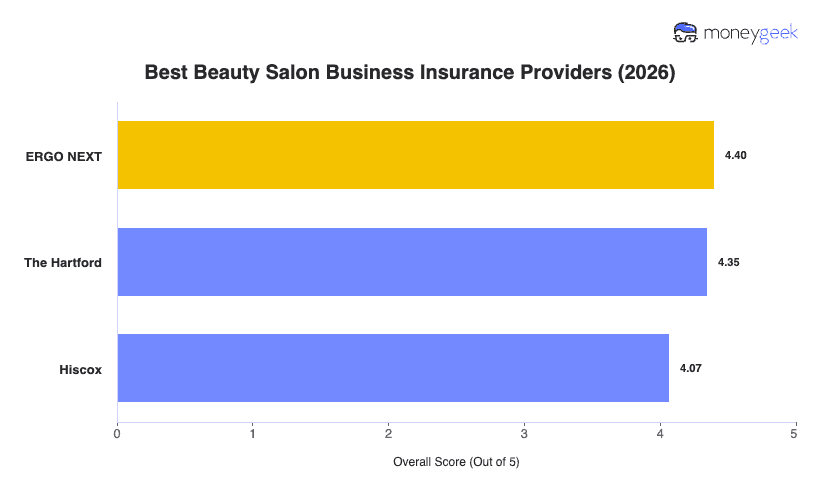
My analysis ranked these companies as the best small business insurers for beauty salons:

  • Choose if you want fast coverage and self-service policy management: ERGO NEXT
  • Choose if you need broad coverage and the lowest cost: The Hartford
  • Choose if you prioritize professional liability and do skin services: Hiscox

Beauty salon insurance looks simple until a chemical burn claim reveals that your professional liability policy excludes the treatment you performed. My rankings are built on three things: what you'll actually pay, what happens when you need help and whether the coverage holds up when it counts. I scored each provider across affordability (50%), customer experience (30%) and coverage options (20%), weighted that way because cost determines what a booth renter or small salon owner can sustain month to month, but the cheapest policy means nothing if a claim gets mishandled or a critical service isn't covered.

This is what made up my analysis of popular insurers, which was assisted (not run) by AI:

  • Affordability: I pulled quotes isolating pricing factors across beauty and personal care sub-industries, all 50 states (plus DC), employee count (5 ranges from 0 to 49), 16 vehicle types (for commercial auto) and six of the most common coverage types, extrapolating 500,000+ estimates to build a full pricing picture for beauty salons specifically.
  • Customer Experience: 300,000+ reviews, forum conversations and industry research were aggregated and manually parsed to identify the patterns that made customers enjoy and dislike service from each insurer. I also went through what an actual salon owner or booth renter would go through for all providers analyzed, testing their quoting experiences and policy management tools (excluding claims due to limitations).
  • Coverage Options: I read the fine print of policy terms, isolated the exclusions and hidden costs that affect beauty salons (like chemical service carve-outs, booth renter coverage gaps and tool/equipment sub-limits), and documented every option available for all providers to determine which has the best coverage for your salon now and as it grows.
ERGO NEXT

ERGO NEXT: Best Overall, Best for Speed and Self-Service

On ERGO NEXT's site
checkmarkpros
  • Quote to bound COI in roughly 10 minutes

  • Top-ranked customer experience for salons

  • 10% discount when stacking professional liability

closecons
  • Professional liability caps at $1M per claim

  • No salon-specific agents for support

  • Cyber coverage underwritten by Coalition, not in-house

COMPANY HIGHLIGHTS

I recommend ERGO NEXT for most beauty salon professionals because it removes the friction that slows down booth renters and small salon owners the most. Its mobile app lets you go from quote to a shareable COI in roughly 10 minutes, and every policy change happens through self-service rather than a phone call to an agent. Backed by Munich Re and insuring over 750,000 businesses, ERGO NEXT covers general liability, professional liability, BOP, workers' comp, commercial property and cyber for salons. Stacking professional liability onto an existing policy triggers a 10% discount automatically.

Where ERGO NEXT falls short is depth. Professional liability maxes out at $1M per claim and $2M aggregate, which may not satisfy a commercial lease that demands higher limits. There are no agents with beauty industry experience on staff, and cyber insurance runs through Coalition rather than ERGO NEXT's own underwriting.

Read Our Review: ERGO NEXT Business Insurance Review

The Hartford

The Hartford: Best for Broad Coverage and Low Cost

On The Hartford's site
checkmarkpros
  • Lowest average monthly cost at $44

  • BOP bundles GL and commercial property

  • In-house claims adjusters and dedicated agent

closecons
  • Policy changes require agent interaction

  • No in-house commercial auto

  • Binding takes longer than competitors

COMPANY HIGHLIGHTS

I recommend The Hartford for salon owners who need more than one or two policies working together. It runs 24% below ERGO NEXT on average monthly cost, and that gap holds whether you're insuring a single-chair studio or a multi-station operation. The business owner's policy bundles general liability with commercial property into one plan, which covers both the slip-and-fall on your salon floor and the styling chairs, shampoo bowls and color-processing equipment inside it. Workers' comp and employment practices liability insurance (EPLI) round out a coverage stack that grows with your headcount.

The tradeoff is convenience. Every policy adjustment routes through your assigned agent rather than a self-service dashboard, and quoting involves more back-and-forth than digital-first competitors. The Hartford also doesn't write commercial auto for most small beauty businesses, so mobile stylists who drive to client appointments will need a separate carrier for that line.

Read Our Review: The Hartford Business Insurance Review

Hiscox

Hiscox: Best for Professional Liability and Chemical Services

checkmarkpros
  • E&O coverage built for service-error claims

  • Dedicated claims rep on every claim

  • Zero installment fees on monthly payments

closecons
  • Narrow policy selection requires a second carrier

  • Professional liability takes 2 to 5 days to bind

  • Higher complaint volume with state regulators

COMPANY HIGHLIGHTS

Hiscox is the strongest pick for salon professionals whose biggest exposure comes from the services they perform rather than the space they work in. Its professional liability policies are structured around the kinds of claims salons actually face, including chemical burns from color and relaxer treatments, allergic reactions to products applied during a service and client injuries tied directly to technique. Coverage extends worldwide, which matters if you do destination bridal work or travel across state lines for events. Monthly payments carry no installment fees, and bundling two or more products earns a 5% discount.

The limitations show up outside of professional liability. Hiscox doesn't offer the bundled coverage that salon owners with employees and leased space typically need, so adding workers' comp, commercial property or commercial auto means managing a second carrier. The professional liability application also requires supplemental documentation about your services, which pushes binding to 2 to 5 business days instead of minutes.

Read Our Review: Hiscox Business Insurance Review

What Types of Insurance Do Beauty Salon Need?

A client slips on wet tile near your shampoo station and fractures a wrist. That same afternoon, another client's scalp blisters from a color formula left on too long. Both are real claims that happen in salons regularly, and they fall under completely different policies. The first is a general liability claim. The second is professional liability. Most beauty salon owners need both before taking on a single client, because the physical space and the hands-on services each generate their own set of exposures. 

Beyond those two, workers' comp becomes mandatory the moment you hire your first employee, and commercial property protects the buildout and equipment your lease won't cover if something goes wrong. The table below summarizes the most common types of business insurance that beauty salons need to meet requirements and cover financial risks.

Third-party bodily injury, property damage and advertising injury claims, including client slip-and-falls on wet salon floors and damage to a client's belongings from spilled product
Any salon that hosts clients in a physical space, including booth renters working inside someone else's location

Slip-and-fall incidents are the most common claim category filed by beauty and bodywork professionals, and even a straightforward injury can generate five-figure legal and medical costs.

Defense costs and settlements when a client claims your service caused them harm, including chemical burns from color or relaxer treatments, allergic reactions and infections from nail services
Every salon professional performing hands-on services, whether you're an employee, booth renter or salon owner

The average beauty and bodywork insurance claim reached $4,890 in 2025, with chemical burn and allergic reaction cases often landing well above that median.

Employee medical bills and lost wages after a work injury, including repetitive strain from years of blow-drying, standing and cutting, plus chemical exposure injuries from daily product use
When you hire your first employee, including part-time shampoo assistants and seasonal staff

More than 60% of salon workers report skin conditions such as dermatitis from chemical exposure, and OSHA has issued hazard alerts specifically about formaldehyde in salon smoothing treatments.

Damage or loss to your salon buildout, styling stations, shampoo bowls, color-processing equipment and retail inventory from fire, theft, water damage or other covered events
If you lease or own salon space with equipment and inventory inside it
Your landlord's policy covers the building structure, not the $1,500 to $5,000 per station you've invested in chairs, mirrors, equipment and product inventory.
Combines general liability with commercial property coverage at a fixed location, typically at a lower combined premium than purchasing each separately
Small salons that need both GL and property protection in a single policy
A BOP satisfies the two most common lease requirements in one policy and often reduces total premium compared to buying general liability and commercial property as separate lines.
Injuries and vehicle or property damage from work-related driving, including travel to client homes, event venues and bridal appointments
If your salon owns a vehicle or your staff regularly drive personal vehicles to client locations for mobile services
Personal auto policies typically exclude business-use claims, so an accident on the way to a bridal suite leaves a mobile stylist fully exposed for both vehicle damage and third-party injury costs.
Costs from data breaches, ransomware attacks and regulatory penalties when client payment data or personal information stored in your booking software is compromised
Any salon that processes card payments, uses online booking platforms or stores client contact and payment information digitally
A single breach notification can cost thousands in legal fees and client communication alone, and salons increasingly rely on digital booking and payment systems that store the exact data attackers target.
Extra liability protection that kicks in after your primary general liability or professional liability policy reaches its per-occurrence limit
When a lease, event contract or high-value client engagement requires limits above your base policies
A severe chemical burn claim that results in permanent scarring or hair loss can generate a lawsuit that exceeds standard $1M per-occurrence limits, especially in states with plaintiff-friendly litigation environments.
mglogo icon

WHY GETTING BEAUTY SALON INSURANCE IS IMPORTANT

Beauty salon insurance covers the cost of what happens to a client in your chair, and you're responsible for that from the moment they take a seat. The median beauty and bodywork claim settles for about $2,500, but the average is nearly $4,900, because a few severe cases pull it up. General liability for a salon costs about $72 a month, and a single uninsured slip-and-fall claim can cost more than years of those premiums.

In a 2025 national survey, 62% of consumers said they're more likely to book with a business that has liability insurance. That makes coverage more than protection against loss: it's part of why clients pick your salon over the one down the street.

How Much Does Beauty Salon Business Insurance Cost?

Beauty salon insurance costs average $58 a month across all coverage types for a small salon with 1 to 4 employees. Cyber insurance costs the most, at $98 a month, and workers' comp costs the least, at $16. Your own price depends on your service menu, whether you employ stylists or rent to booth renters, the size and location of your space and your claims history.

The costs below show costs for common coverage types:

What Are These Costs Based On?

Our business insurance calculator below can give you a more tailored estimate based on your salon's details. It also connects you directly with a provider match when you're ready to get quotes.

Beauty Salon Insurance Cost Calculator

Select your state and industry to view average business insurance premiums in your area. Rates are calculated based on a business with 5 employees and $500,000 in annual revenue.

Select Coverage Type
Select Employee Count
Select Vehicle Type
Select State
Average Monthly Cost—

How To Buy The Best Beauty Salon Business Insurance

I've outlined the buying process below step by step. If you want something to take with you while gathering quotes, download the beauty salon insurance buying worksheet to keep everything organized across providers.

  1. 1

    Identify Required Coverages

    Start with your lease. Most commercial landlords require general liability of $1M per occurrence and $2M aggregate before you take possession of the space, and many shopping center leases set higher minimums. Then check whether your state cosmetology board ties any insurance requirements to your establishment license. In Washington, a salon license requires $100,000 in combined bodily injury and property damage liability coverage. If your landlord or a venue client wants additional insured status, your carrier has to add it as an endorsement. A certificate of insurance (COI) shows that coverage exists, but it doesn't extend that coverage to the party asking for it.

    Read More: Business Insurance Requirements

  2. 2

    Map Your Beauty Salon's Risks to Coverage

    Think through the specific things that could go wrong at your salon and check which policy would pay. Say a client has a severe allergic reaction to hair dye your stylist applied without a patch test. General liability won't cover it, since no one slipped or fell. Professional liability will, as long as the policy covers the chemical services on your menu. Do this for every serious risk, from a shampoo bowl flood that damages the suite next door to an employee who develops carpal tunnel after years of blow-drying, and note any risk that no policy clearly covers.

  3. 3

    Set Limits That Reflect Your Actual Exposure

    Set your limits for what a worst-case claim could cost your salon, not only for the minimum your lease requires. A chemical burn that leaves permanent scalp damage or hair loss can lead to a lawsuit far above a basic $1M limit, more so in high-litigation states like Florida or New York. A booth renter who does cuts and blowouts has a much lower ceiling than a salon owner whose stylists do relaxers, keratin treatments and advanced color work every day.

    Read More: How Much Business Insurance Do I Need?

  4. 4

    Research Providers Specific to Your Salon

    Some insurers don't understand how beauty salon claims work. A few exclude chemical services from professional liability entirely. Others cover them but hide sub-limits that cap treatment-injury payouts far below your stated coverage. Before you ask for quotes, confirm that each insurer on your list covers your full service menu, your staffing model and the treatments you perform. An insurer with a good price for a cuts-only salon may be a poor fit for one that does color corrections and chemical straightening.

  5. 5

    Compare Identical Pricing and Quotes

    Look up what beauty salon insurance usually costs for a salon of your size and services, so you start with a baseline. Then ask every insurer to quote the same limits, deductibles and endorsements. A cheaper monthly policy that excludes chemical services from professional liability or narrows your coverage territory doesn't save you money. Check whether each quote includes products-completed operations coverage, since treatment claims can come up weeks after a client leaves.

  6. 6

    Review Your Policy Before Signing

    Before you sign, read the policy alongside your lease and state board requirements. The named insured has to match your business's legal name exactly, since even a small mismatch can cause problems when a landlord or client checks your COI. Confirm that professional liability lists every service category on your menu, not vague "beauty services" wording that could leave chemical treatments or skin services in a gray area during a claim.

  7. 7

    Reassess Coverage When Your Beauty Salon Changes

    Most states require workers' comp once you hire your first employee. When you add chemical services or skin treatments to a cuts-only menu, your professional liability risk rises. A switch from booth rental to your own leased space changes your property and premises liability needs entirely. Any of these changes can bring legal or contractual obligations your current policy doesn't cover, so review your coverage before a major change takes effect instead of waiting for renewal.

Beauty Salon Insurance: FAQ

Best Beauty Salon Business Insurance: The Bottom Line

When comparing salon insurance quotes, look beyond the price. Two policies can cost the same but cover very different risks. One may cover all the chemical services your stylists perform, while another may exclude treatments such as relaxers or keratin services. Products-completed operations coverage can also vary between policies.

Choose coverage that matches your salon’s actual services and business setup. Booth renters generally need their own general liability and professional liability coverage, while salon owners with employees may also need coverage for premises risks, service-related claims and workers' compensation. Before you compare, here are my top overall picks for beauty salons.

Best Beauty Salon Business Insurance Chart

Get Beauty Salon Business Insurance Quotes

Use our matching tool below to find providers that fit your beauty salon. From there, you can get quotes and compare coverage directly on their site.

About Angelique Palenzuela-Cruz


Angelique Palenzuela-Cruz, Business Insurance Writer, MoneyGeek

Angelique Palenzuela-Cruz is a Business Insurance Content Writer at MoneyGeek, where she specializes in general liability, workers’ compensation and professional liability insurance. Her work helps small business owners understand how these policies apply to coverage, including risks like customer injuries, employee injuries, professional mistakes, client contract terms and industry-specific coverage requirements.
She primarily covers service-based businesses where liability and employee coverage decisions are especially important, including cleaning, consulting, beauty and wellness, childcare, education, fitness, food service, pet care, repair and maintenance, and other professional services.
Before joining MoneyGeek, Angelique spent nearly 12 years at Guthrie-Jensen Consultants, one of Southeast Asia’s largest management training firms, where she advanced from Training Consultant to Managing Consultant. In that role, she worked with business clients to assess operational needs, develop training programs and present performance analyses to executive decision-makers. She also helped establish Gladwin Training Consultancy, where she served in learning solutions and client service roles.
Her background gives her practical context for writing about how businesses operate, manage client expectations, structure teams and make risk decisions. At MoneyGeek, she applies that experience to business insurance content, connecting coverage to actual business needs.

LinkedIn: linkedin.com/in/ma-angela-cruz

Email Contact: angelique.palenzuela@moneygeek.com


Sources