
What Is Software Developer Business Insurance?

Software developer business insurance is a bundle of policies that address exposure your work creates from the code you deliver, the data you handle and the people you employ.

Several risks follow directly from how software development operates:

  • A client claims your application caused a system outage or financial loss
  • A data breach exposes user credentials or personally identifiable information you stored or processed
  • A developer on your team is injured while working, even remotely
  • A client alleges the software you delivered didn't meet the agreed-upon specifications
  • A licensing dispute arises over code libraries, open-source components or intellectual property embedded in your deliverable

Tech business insurance for software developers isn't one-size-fits-all since the right coverage mix depends on how your business is structured. A solo freelancer building web apps has different exposure than a five-person shop delivering enterprise software under contracts with indemnification clauses. The policies that matter most depend on who you work for, how many people you employ and what your contracts require.

What Types of Insurance Do Software Developers Need?

Software development creates liability in several ways because your work lives inside other people's systems, is governed by contracts and depends on data you don't always control. Those conditions create the coverage needs most software developers end up carrying:

For most software developers, E&O and cyber insurance carry the most weight because those two policies address the exposures that follow you into every client engagement: professional accountability for what your code is expected to do and liability for the data your systems touch. The others depend on whether you have employees, a physical office or client-facing work arrangements. How those conditional coverages stack up depends on which of these profiles fits how you actually operate.

How Much Does Software Developer Business Insurance Cost?

Software developer business insurance costs an average of $61 per month ($735 annually), though what you'll actually pay depends on which coverage types apply to your business. For most software developers, cyber insurance and errors and omissions coverage drive the bulk of that cost. Cyber averages $168 per month because when you build systems that store, process or transmit data, you carry direct breach exposure on every engagement. Errors and omissions coverage, which insurers often list as professional liability, averages $74 per month and is typically the first policy you buy as a software developer. Professional accountability for your code exists from your first client contract, regardless of your business size. 

General liability, commercial property and workers' comp are more conditional for software developers, and all three come in under $30 per month each. Even if your business needs all three, their combined cost is less than an errors and omissions policy on its own. What each coverage type contributes to that average:

How did we determine business insurance rates for software developers?

Those averages give you a starting point, but your premium shifts based on how your software developer business runs. On-site work at client facilities carries GL exposure that remote advisory work doesn't. The industries your clients operate in influence your professional liability premium: construction and industrial clients sit at the higher end. Your annual revenue moves the number too, since professional liability for consulting work is underwritten primarily on revenue, not payroll. The software developer business insurance calculator builds an estimate around your profile.

Estimate Your Monthly Software Developer Consultant Insurance Cost

Enter your coverage type, state, number of employees and type of vehicle (if you need commercial auto coverage) to get a pricing estimate that fits your business. We do not collect any personal information, and all rates are aggregated for all 50 states and Washington D.C. Workers' comp rate estimates are provided on a per employee basis and all coverage types assume standard industry limit recommendations for most businesses.

Select Coverage Type
Select State
Select Employee Count
Select Vehicle Type
Average Monthly Cost—

Best Software Developer Business Insurance Companies

A freelance developer and a five-person agency building healthcare software may both need Tech E&O and cyber coverage, but the provider that works best for one rarely works for the other. Our analysis evaluated providers across affordability, coverage depth and the buying and service experience. Two providers led the field for software developers.

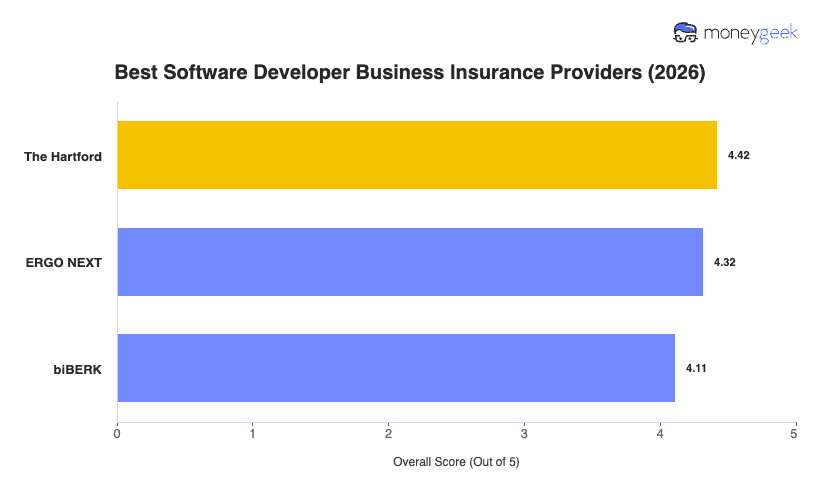
The Hartford leads our rankings with top scores for affordability and coverage breadth, and tends to work best if you want strong cyber and Tech E&O coverage without paying above the sub-industry average. ERGO NEXT's a better match if you need to get covered quickly for a contract deadline or want to manage your policies online. The table below shows how each provider performs in our study:

Progressive Commercial3.87$6876
Thimble3.88$6967
Nationwide4.04$6742
Hiscox4.06$6134
biBERK4.11$6455
ERGO NEXT4.32$6013
The Hartford4.42$2621

For our overall best software developer business insurance ratings, we analyzed pricing, coverage options, and customer experience across all 50 states and Washington, D.C. Our analysis focuses on 1-to-4-person software developer businesses, while weighting results to ensure broader industry and location representation. To do this, we evaluated over six million business profiles, more than 100,000 customer experience data points and performed in-depth analysis of coverage contracts and endorsements to compare insurers consistently across industries and regions. We then rated each company across categories of affordability (50% of overall score), customer experience (30% of overall score) and coverage options and terms (20% of overall score) to form an overall rating.

See our full business insurance methodology.

The Hartford
Best Overall for Software Developers

The Hartford

On The Hartford's site

No other provider in this analysis ranks #1 for both affordability and coverage for software developers. The Hartford saves you an average of 26% compared to what software firms typically pay, and its FailSafe Tech E&O policy covers professional liability and data privacy under one policy. If a client claims your code caused a system failure that exposed their data, you're not filing two separate claims with two separate adjusters. The one friction point is that you can't complete your purchase online.

Learn More: The Hartford Business Insurance Review

ERGO NEXT
Best Digital Experience for Software Developers

ERGO NEXT

On ERGO NEXT's site

If you want to get insured, send a client a COI and update your coverage between projects without picking up the phone, ERGO NEXT is the only provider in this analysis built to let you do all of that. It ranks first for customer experience and saves software developers an average of 8% compared to what software firms typically pay. On claims, the support behind your policy is thinner than what the other providers here offer. If client disputes are a real part of your risk profile, that difference matters.

Learn More: ERGO NEXT Business Insurance Review

biBerk
Best Direct-to-Consumer Option

biBerk

biBERK sells directly to your business with no broker in the middle, which it says can save you up to 20% compared to broker-placed policies. It ranks third overall for software developers, with its strongest performance in the buying process, where you can reach a licensed agent by phone before committing, rather than working through chat or waiting for a callback. On claims, the experience is the weakest of the three providers here, particularly when disputes escalate.

Learn More: biBerk Business Insurance Review

How to Choose the Right Software Developer Business Insurance

Getting business insurance as a software developer involves more decisions than picking a policy and moving on. Skip any of these steps and you risk ending up with a policy that looks adequate until a client dispute, a data breach or a contract requirement reveals the gap.

  1. 1
    Understand your risk profile and what coverage it requires

    As a software developer, you carry two distinct liability layers: professional accountability for your code and data exposure from the systems you build. Unlike workers' comp, which becomes legally required the moment you hire your first employee in most states, tech E&O and cyber are rarely mandated by law. But those are the two almost universally coverage types required by client contracts and essential given the nature of your work.

  2. 2
    Choose the right coverage limits

    Your limits should reflect more than the minimum your client asked for. A bug that causes a data breach can generate a professional error claim and a cyber claim at the same time, with costs running across legal defense, breach notification and regulatory response at once. Size your Tech E&O and cyber limits to cover that combined exposure, not each claim in isolation.

  3. 3
    Evaluate providers who understand software development practices

    Look for a provider with demonstrated experience writing tech E&O and cyber for technology businesses, not just general small business policies. A provider unfamiliar with software risk may offer narrower cyber definitions or exclude software-related claims. Evaluate affordability, claims handling and coverage flexibility together as a low premium with meaningful exclusions isn't a good deal.

  4. 4
    Get compliance-ready

    Most software development clients will ask for a certificate of insurance before work begins. Review what your contract requires, like minimum limits, specific coverage types, named insured status or additional insured endorsements. Don't assume a standard policy satisfies all of them. If you work with clients in regulated industries, their contracts may specify requirements beyond what a standard Tech E&O or cyber policy provides.

  5. 5
    Revisit your coverage as your software development practice grows

    Coverage that fits your business today may not fit it in 12 months. A SaaS product launch, your first hire, a regulated-industry client or a larger enterprise contract can all shift your risk profile materially. Review your coverage at least annually and before significant contract renewals.

Get Software Developer Business Insurance Quotes

What a freelance developer pays for Tech E&O and cyber coverage won't reflect what a five-person agency building fintech software is quoted. Provider pricing for software developer business insurance varies based on your revenue, the data your systems handle, your client contracts and your claims history. Requesting business insurance quotes from multiple providers is the fastest way to see what your specific profile costs and which coverage terms fit your business.

About Connor Bolton


Connor Bolton headshot

Connor Bolton is Senior SEO and Content Manager at MoneyGeek, where he leads the business and pet insurance editorial teams. As editorial lead for both verticals, Connor sets the research framework, data standards, and content structure that his writers execute, directly authoring in-depth guides himself and reviewing all team content for accuracy and practical value before it goes live. With over four years evaluating insurance products across personal, commercial, and specialty lines, he brings cross-vertical knowledge to every guide the team produces.

Connor architected MoneyGeek's insurance research infrastructure across all major verticals including auto, home, renters, life, health, business, and pet, building systems for pricing analysis, provider-level research, customer experience evaluation, and coverage analysis with AI support. The infrastructure includes over 6 million data points for business insurance across 408 industry areas, all 50 states, and 16 vehicle types, and over 5 million pet insurance profiles across 18 major providers and hundreds of breed and age combinations. Connor's insurance cost research and his team's work has been cited by the U.S. Chamber of Commerce, Allstate, Liberty Mutual, CBS News, Forbes and LegalZoom.

Beyond the data, Connor stays connected to how the market actually operates, drawing on direct conversations with underwriters and carrier liaisons at Ethos, The Hartford, NEXT Insurance, Nationwide, and State Farm, and monitoring business and pet owner communities including Reddit, to inform how he interprets findings and frames guidance for real buyers.

He is the direct editorial contact for methodology questions at connor@moneygeek.com and can be found on LinkedIn.