




Jump to the section that meets your needs best below:
Average Welding Business Insurance Cost (2026 Report)
On average, welding contractors and shops spend between $558 and $1,303 for business insurance, depending on which bundle your operations need.
If you're ready to get a quote, MoneyGeek’s matching tool connects you to the provider best addresses your welding business's coverage needs.
Select state
Safe & SecureVerified and VettedTrusted Brands
Updated: September 14, 2026
Advertising & Editorial Disclosure
How Much Does Welding Business Insurance Cost?
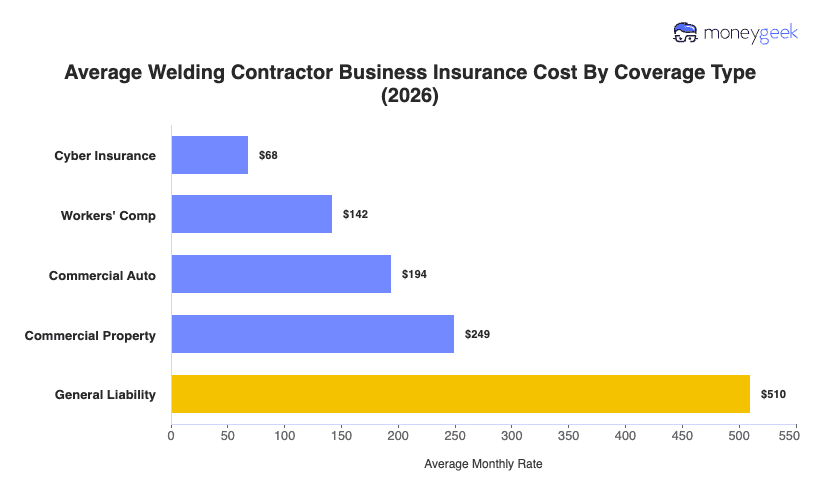
Expect to spend an average of $752 per month or $9,027 per year for a recommended bundle that combines general liability and tools coverage. It addresses risks like fires caused by sparks or hot slag, injuries from burns and fumes, damage caused by a failed weld and losses involving welding machines, gas cylinders and other specialized equipment. The cost of contractor insurance for welders will vary based on the type of welding and fabrication work you do and the environments where you weld, such as your own shop, customer sites or industrial facilities.
My recommended bundle may not be the best fit for a new or smaller welding business on a tight budget. In that case, consider a starting bundle, which covers the risks your business currently faces while keeping costs manageable. As your operations expand, you can revisit your policy and add coverages as needed.
Starting Bundle | General liability + tools and equipment | $558 | Solo or new welders taking smaller jobs with their own equipment |
Recommended Bundle | Starting bundle + commercial auto | $752 | Mobile welding businesses with company-owned vehicles |
Growing Bundle | Recommended bundle + workers’ compensation + commercial property | $1,143 | Welding businesses with employees and operating from a shop |
Comprehensive Bundle | Growing bundle + cyber insurance + commercial umbrella | $1,303 | Established welding businesses with larger contracts and digital systems |
Welding insurance costs can vary widely based on the work you perform, where you perform it and the equipment, vehicles and employees involved. To create consistent estimates, we modeled premiums from 10 major U.S. commercial insurers using profiles that reflect common welding contractors and small fabrication shops.
- National benchmark average: We used welding businesses with fewer than five employees to calculate monthly and annual cost benchmarks. The profiles reflect common insurance needs for solo welders, mobile contractors and small shop-based operations, including general liability, tools and equipment coverage, commercial auto, workers’ compensation and commercial property where applicable.
- State averages: We kept the welding business profile consistent and changed only its location to measure how state pricing affects costs. For specialized coverages outside our main dataset, we started with a national estimate and applied a state-level pricing factor before adding those amounts to the relevant state bundle.
- Bundle averages: We grouped policies around realistic operating stages, from a solo welder taking smaller jobs to a mobile contractor, a growing shop with employees and an established business handling larger contracts. Each bundle includes only the coverages that fit that profile, and outside estimates were used when a policy was not available in our internal dataset.
These figures are modeled estimates rather than live quotes. Use them as planning benchmarks, then account for your welding specialty, job locations, equipment values, vehicles, staffing, claims history and contract requirements when estimating your actual cost.
See our full business insurance methodology.
Get Welding Business Insurance Cost Estimates
Use our business insurance cost calculator below for more personalized estimates and to compare rates.
Get Welding Insurance Cost Estimates
Select Coverage Type
Select State
Select Employee Count
Select vehicle_type
Monthly Rate Estimate—
Select Coverage Type
Monthly Rate Estimate—
Select State
Select Employee Count
Select vehicle_type
Factors Affecting Welding Business Insurance Costs
These factors are the most common reasons why welders with the same business set up could pay different premiums:
 Type of welding work
A failed weld on a gate or piece of decorative metal may require a relatively contained repair. A defect in a structural beam or pressure pipe could cause serious injury or widespread property damage. Because insurers consider how severe a failure could become, higher-consequence welding work often costs more to cover.
 Work location
You have more control over fire prevention, ventilation and access when you weld in your own shop. Customer properties, active construction sites and industrial facilities introduce unfamiliar layouts, nearby workers and property you do not control, which can raise liability costs for mobile welders.
 Hot-work exposure
Sparks and hot slag become more expensive insurance risks when they can reach insulation, wood framing, fuel, coatings or stored materials. A cleared fabrication area presents less fire potential than welding or cutting inside an occupied building where nearby materials cannot be fully removed.
 Completed-work risk
Insurers look beyond what could happen while you are welding. A railing, staircase, pipe or structural connection may fail after you leave, exposing your business to a larger claim than a defect in a decorative sign or other noncritical item.
 Mobile equipment and vehicles
A shop that keeps most machinery in one location has fewer driving and transport exposures. A mobile welding business may have a service truck, trailer, gas cylinders and costly equipment on the road each day, adding both accident risk and property that could be stolen or damaged.
 Project size and contract requirements
Moving from small repair jobs to municipal or large commercial projects can increase your premium even when the welding process stays similar. Larger contracts often carry higher financial stakes and may require greater liability limits, umbrella insurance or added policy terms.
How to Lower Welding Business Insurance Costs
Because of the risks inherent to welding work, insurance can be expensive. If you're an established business, that could be easier to manage, but if you're a new player or have just begun expanding your operations, you'd be keeping a closer eye on your bottom line. Use these strategies to find more affordable business insurance without ending up underinsured.
 Compare quotes using the same coverage limits
Insurers can quote you different rates based on how they assess your work, claims history and where you operate. Compare business insurance quotes from several carriers using the same coverages, limits and deductibles so a lower price does not simply mean less protection.
 Right-size your coverage
Your policy mix should reflect the work you perform now. If you are a solo mobile welder, you'll likely need general liability, tools and equipment coverage and commercial auto. If you run a shop with employees, you may also need workers’ compensation and commercial property insurance. Carrying policies or limits that do not match your current operations can raise your costs unnecessarily. Too little coverage, however, could leave you paying for a loss yourself or prevent you from meeting a contract requirement.
 Bundle policies with the same provider
You may qualify for a discount when you buy several policies from the same insurer. For example, combining general liability and commercial property in a business owner’s policy may cost less than purchasing both separately. Bundling also make it easier to see where you have coverage gaps or duplicate protection. Compare the package price with separate policies, though, because a bundle is not automatically the cheaper option.
 Lower your risk profile
Several recent claims, missed payments or frequent policy cancellations may make your business look less stable and lead to higher rates. Strengthen your record by keeping coverage active, reporting accurate business information and addressing the causes of past claims. Insurers could review several years of history when pricing a new policy or renewal, so improvements could take time to affect your premium.
 Invest in risk management practices
Safety measures can reduce the fires, injuries, vehicle accidents and defective-work claims that drive welding insurance costs up. I suggest starting with these if you're planning to strengthen your risk-management activities:
- Remove combustible materials, use fire-resistant screens and maintain a fire watch when welding in shops, customer buildings or active job sites.
- Train your crew on ventilation, protective equipment and cylinder handling to reduce burns, eye injuries, fume exposure and compressed-gas accidents.
- Inspect completed welds and document quality checks before the customer or contractor accepts work that could injure someone or damage property if it fails.
- Secure welding machines and cylinders during transport, maintain service vehicles and review driving records for employees traveling between job sites.
Welding Business Insurance Cost: Bottom Line
A recommended welding insurance bundle costs an average of $752 per month or $9,027 per year. Use that as a budgeting reference, not a prediction of your exact rate. Your quote may be different, depending on the welding work you take on, where you work, the vehicles and equipment you use, your claims history and the limits your contracts require.
As you compare options, ask yourself:
- Does this bundle match how you work today? You may need less coverage if you handle small jobs from one location, while mobile or contract-based work can call for broader protection.
- Am I comparing the same coverage across quotes? Check the policies, limits and deductibles. A lower price may simply mean the insurer is covering less.
- Do my main cost drivers explain the price? Structural work, frequent travel, high-value equipment and greater fire exposure can push your rate above the average without making the quote unreasonable.
The goal is not to find the cheapest number on the page. It's to choose a bundle that reflects the risks you presently face and gives you room to add coverage as your business grows.
About Connor Bolton

Connor Bolton is Senior SEO and Content Manager at MoneyGeek, where he leads the business and pet insurance editorial teams. He sets the research framework, data standards and content structure for his team. All content goes through his accuracy review before publication. Connor also writes in-depth guides and has spent more than four years covering insurance products across personal, commercial and specialty lines.
The research infrastructure Connor built covers auto, home, renters, life, health, business and pet insurance across pricing analysis, carrier research, customer experience and coverage evaluation. It includes over 6 million data points for business insurance across 408 industry areas, all 50 states and 16 vehicle types. The pet insurance side covers over 5 million profiles across 18 major providers, 100+ breeds and ages up to 20 years. Connor’s insurance research and his team's work have been cited by the U.S. Chamber of Commerce, Allstate, Liberty Mutual, CBS News, Forbes and LegalZoom.
Connor also talks with underwriters and carrier liaisons at Ethos, The Hartford, ERGO NEXT, Nationwide and State Farm, and monitors business and pet owner communities on Reddit. Those sources shape how his team evaluates carriers, structures rate analysis and writes content for real pet owners.
Questions about MoneyGeek's business or pet insurance content? Reach him at connor@moneygeek.com or on LinkedIn.