




Jump to the section that meets your needs best below:
Average Catering Business Insurance Cost (2026 Report)
Catering insurance costs range from $141 per month for a starting bundle to $774 per month for a full-service operation, based on which coverages you actually carry.
If you want pricing now, MoneyGeek can match you to the insurer that meets your catering business's coverage needs.
Select state
Updated: September 9, 2026
Advertising & Editorial Disclosure
How Much Does Catering Business Insurance Cost?
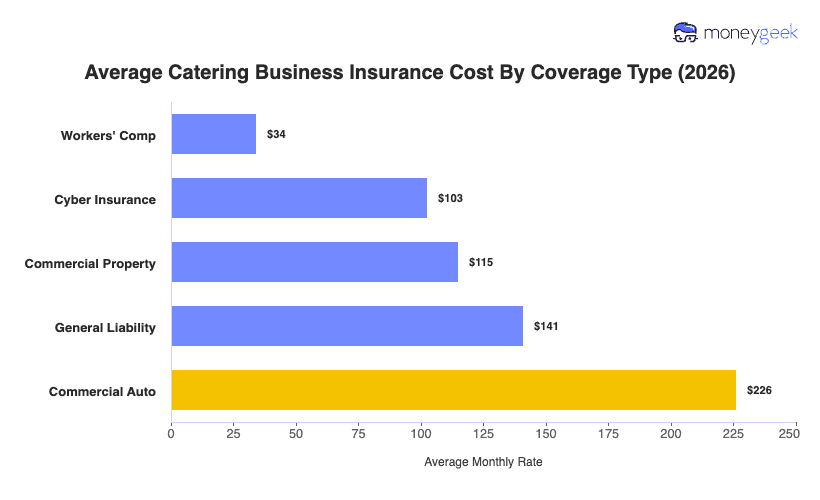
A starting catering business insurance bundle costs about $141 a month, which includes general liability on its own. That's the policy that pays out when someone gets hurt or something gets damaged while you're working a client's venue, and most venues won't let you set up without it. What you pay beyond that depends on how you run the business. You add commercial property insurance once you own or lease kitchen space, workers' comp once you bring on crew, cyber as your client list and bookings grow, and commercial auto once you're running a delivery fleet. At the top end, a full-service caterer who serves alcohol also carries specialty coverage like liquor liability.
The cost of food business insurance for caterers comes down to the coverages your operation actually needs. You don't have to buy all of it at once. Most start with the base and add on as their risks change. The table below breaks down each bundle, what it includes and who it fits.
Starting Bundle | General liability | $141 | Owner-run caterers with no staff, kitchen lease or vehicles |
Kitchen-Based Bundle | Business owner's policy (BOP) | $230 | Caterers who own or lease kitchen space |
Recommended Bundle (Staffed) | BOP + workers' comp and cyber insurance | $367 | Caterers with employees and steady client bookings |
Full-Service Bundle | BOP + workers' comp + cyber + commercial auto + liquor liability + commercial umbrella + food contamination and spoilage | $774 | Full-service caterers with staff, a kitchen, a delivery fleet and alcohol service |
We modeled catering insurance around a standard operation, then changed one variable at a time to see where costs and coverage needs rise. The estimates draw on quote data from 10 major U.S. commercial insurers and represent roughly 95% of the market, modeled across profiles ranging from an owner-run caterer to a full-service operation with staff, a kitchen, a fleet and alcohol service.
- National benchmark average: The national figures reflect a catering business with one to four employees, priced across all catering profession categories and states in the dataset. We modeled the policies tied to a caterer's everyday risks, including third-party injury at events, damaged kitchen property, workplace injuries, client-data exposure and business driving, and added specialty coverage only when a specific activity called for it.
- State averages: For the state comparison, the business itself stayed the same. We held crew size, kitchen setup, vehicles and policy details constant and changed only the location, which isolates the effect of state pricing. Where a specialty policy fell outside our main dataset, we estimated its state figures by applying each state's broader pricing pattern to the national number.
- Bundle averages: Each bundle maps to a step up in how a caterer operates. The starting bundle fits an owner-run caterer with no kitchen, staff or vehicles, and taking on a leased or owned kitchen brings in a business owner's policy. Hiring crew and building a client base add workers' comp and cyber, while running a delivery fleet and serving alcohol move the business into the full-service bundle.
These figures are a planning benchmark, not a personalized quote. What you actually pay shifts with your crew size, whether you own or lease kitchen space, whether you serve alcohol, how you get food to events and the limits and deductible you choose.
See our full business insurance methodology.
Get Catering Business Insurance Cost Estimates
Pick a coverage type and enter your state, employee count and vehicle type, and our business insurance cost calculator returns an estimate built around your catering operation. Select Get Quotes and we'll pair you with carriers from our network using those details.
Before you begin:
- The calculator collects no personal information
- Workers' comp is estimated for each employee
- Commercial auto results vary with the vehicle type you choose
Get Catering Insurance Cost Estimates
Select Coverage Type
Select State
Select Employee Count
Select vehicle_type
Monthly Rate Estimate—
Select Coverage Type
Monthly Rate Estimate—
Select State
Select Employee Count
Select vehicle_type
Factors Affecting Catering Business Insurance Costs
Several details about how you run the business push your catering insurance above or below the national averages. These are the ones insurers weigh most.
 Business Size
Most catering operations mix full-time kitchen staff with per-event crew and seasonal hires, so your payroll headcount shifts with the booking calendar instead of holding steady year-round. That swing, along with your event volume and annual revenue, shapes how insurers size up your exposure across every coverage line.
 Location
Caterers often work across counties and sometimes state lines, carrying their exposure into each place they serve rather than staying tied to one address. Insurers price on where events actually happen, so regularly serving high-liability urban venues can lift your rate no matter where the business is registered.
 Alcohol Service
Serving, pouring or managing alcohol at events changes your risk sharply compared with caterers who don't. Alcohol raises the odds of a claim at any event, and holding a liquor license or running a full bar service brings the steepest price increase.
 Event Type and Scale
Event size, venue type and guest count all shape your exposure. Running 300-person wedding receptions at private estates carries more risk per event than handling corporate lunch deliveries, and insurers price that difference across your policies.
 Vehicle Fleet
Running a fleet to move food, equipment and staff to venues adds exposure that caterers without commercial vehicles avoid. Refrigerated vans and box trucks bring cargo risk on top of vehicle liability, and insurers factor in perishable food, temperature-sensitive loads and specialized equipment when they price it.
 Kitchen and Facility Setup
Whether you own commercial kitchen space, rent a commissary or cook from a home setup shapes how much property you have at risk. An owned facility full of refrigeration units, prep equipment and storage carries an insurable footprint that a shared or rented space doesn't.
How to Lower Catering Business Insurance Costs
Some of these changes lower your catering insurance right away, while others pay off over time as you build a cleaner claims record. I'd start with what you can adjust at renewal to find cheaper business insurance now, then work on the habits that keep rates down season after season.
 Compare quotes using the same coverage limits
Give every insurer the same limits, deductibles and business details so you can fairly compare business insurance quotes. A lower quote often just means less protection, like a smaller property limit or a missing alcohol endorsement, so line the details up before you treat the cheapest option as the best one.
 Right-size your coverage
Update your policies when your services, crew size or event volume change. A caterer who dropped bar service may still be paying for alcohol coverage they no longer use, while one who added staff may be underinsured for it. Matching your limits and endorsements to how you operate now is where the real savings sit.
 Raise your deductible where it makes sense
Taking a higher deductible on commercial property or commercial auto lowers your premium, and it's a smart trade if you keep cash reserves and rarely file small claims. A caterer who almost never claims on equipment or spoilage can absorb more out of pocket in exchange for a lower annual rate.
 Bundle policies with the same provider
Buying a business owner's policy already bundles general liability and commercial property at a discount, and adding commercial auto or workers' comp with the same carrier often earns another. It also makes renewals and payments simpler. Still, compare the bundled price against buying each policy separately, since the package isn't always the cheapest route.
 Pay your premium annually
Paying upfront for the year clears the installment fees that stack up on monthly billing. Caterers often carry four or five policies, more than most businesses their size, so those fees add up faster, and dropping them lowers your total spend without touching coverage.
 Lower your risk profile
Insurers price you partly on the services you offer and how they've performed over time. Scaling a full bar back to host-liquor service, or trimming fleet exposure, can move you into a lower-cost tier at your next renewal.
 Invest in risk management
Cutting claims over time is the most direct route to lower rates, and food-borne illness, slip-and-falls at venues and alcohol-related incidents drive most catering claims. If you want to tighten things up, start here:
- Train food handlers on temperature control and cross-contamination steps to cut the risk of food-borne illness claims
- Walk each event site before guests arrive to catch trip and fall hazards at the venue
- Keep refrigerated vans and box trucks on a regular maintenance schedule
- Set alcohol cutoff procedures and require ServSafe or equivalent certification for anyone pouring at an open bar
Catering Business Insurance Cost: Bottom Line
The recommended bundle, the one that fits a kitchen operation with a small crew and client data to protect, averages $367 per month, or $4,403 per year. I'd treat that as a reference point rather than a target price, and measure it against the bundle your own operation actually needs. To see how close that is to what you'll pay, work through these:
- Which bundle matches how you operate today? The recommended bundle fits if you cook out of a kitchen with a small crew and no vehicles of your own. Once you add a delivery fleet, an open bar or steady high-end venue work, you move up toward the full-service bundle and its higher total.
- Is your quote in line with your risk profile? Check which policies, limits and deductibles sit behind the number before you judge it. A quote well above the benchmark usually traces to one driver, high commercial auto to fleet size or cargo, elevated general liability to alcohol service or event scale.
- Which cost drivers actually apply to you? Alcohol service and vehicle use carry the most weight for full-service caterers. A drop-off operation with no on-site crew or fleet may find only two or three of the factors on this page move its price at all.
About Angelique Palenzuela-Cruz

Angelique Palenzuela-Cruz is a Business Insurance Content Writer at MoneyGeek, where she specializes in general liability, workers’ compensation and professional liability insurance. Her work helps small business owners understand how these policies apply to coverage, including risks like customer injuries, employee injuries, professional mistakes, client contract terms and industry-specific coverage requirements.
She primarily covers service-based businesses where liability and employee coverage decisions are especially important, including cleaning, consulting, beauty and wellness, childcare, education, fitness, food service, pet care, repair and maintenance, and other professional services.
Before joining MoneyGeek, Angelique spent nearly 12 years at Guthrie-Jensen Consultants, one of Southeast Asia’s largest management training firms, where she advanced from Training Consultant to Managing Consultant. In that role, she worked with business clients to assess operational needs, develop training programs and present performance analyses to executive decision-makers. She also helped establish Gladwin Training Consultancy, where she served in learning solutions and client service roles.
Her background gives her practical context for writing about how businesses operate, manage client expectations, structure teams and make risk decisions. At MoneyGeek, she applies that experience to business insurance content, connecting coverage to actual business needs.
LinkedIn: linkedin.com/in/ma-angela-cruz
Email Contact: angelique.palenzuela@moneygeek.com
Sources
- National Conference of State Legislatures. "Security Breach Notification Laws." Accessed October 8, 2026.